

Discover the key differences between desktop and cabinet humidors. Learn which one fits your cigar collection and aging needs best!
TL;DR:
- Desktop humidors store 25 to 150 cigars and rely on passive humidity control suitable for short-term use. Cabinet humidors hold over 200 cigars with active electronic systems, ideal for long-term aging and larger collections. The key difference lies in size, humidity management, and long-term preservation capabilities.
The difference between desktop and cabinet humidors comes down to three factors: capacity, humidity control method, and how long you intend to age your cigars. Desktop humidors hold 25–150 cigars and rely on passive humidification, making them ideal for collectors who cycle through their stock within 6–12 months. Cabinet humidors start at 200 cigars, use active electronic systems to maintain relative humidity within ±1–2%, and are built for long-term aging measured in years. Spanish cedar lining and a quality seal are non-negotiable in both categories. The right choice depends on where your collection stands today and where it is headed.
What is the difference between desktop and cabinet humidors?
Desktop and cabinet humidors are both cigar storage instruments, but they serve fundamentally different collectors at fundamentally different stages of the hobby. A desktop humidor is a compact, lidded box designed to sit on a desk, shelf, or side table. A cabinet humidor is a freestanding furniture piece engineered for serious, long-term preservation.

The core distinction is not just size. It is the entire philosophy of humidity management. Desktop units rely on passive humidification, typically Boveda packs or simple sponge-based devices, which require you to monitor and replenish moisture manually. Cabinet humidors use electronic humidity systems with sensors and integrated humidifiers that regulate the environment automatically.
Price reflects that gap directly. Desktop humidors range from $50–$500, while cabinet humidors start around $1,000 and climb well into five figures for premium builds. That is not just a price difference. It is a signal of what each unit is engineered to do.
What are desktop humidors and who are they best suited for?
A desktop humidor is the entry point for most serious collectors. It is a lidded box, typically crafted from wood with a full Spanish cedar interior, sized to hold between 25 and 150 cigars. The cedar lining does real work: Spanish cedar’s antimicrobial properties stabilize moisture and protect flavor over time, which is why it remains the industry standard for interior lining at every price point.
Desktop humidors suit collectors who:
- Smoke regularly and cycle through their stock within 6–12 months
- Store between 25 and 100 cigars at any given time
- Prefer a portable, space-efficient storage solution
- Want a lower entry cost without sacrificing cedar quality
- Are building their collection and not yet ready for a cabinet investment
The passive humidity systems in desktop units work well within that 6–12 month window. Boveda packs, in particular, are reliable for maintaining a target relative humidity in a sealed, smaller space. The limitation appears when the collection grows or when you want to age cigars for 2–3 years or more. Passive systems struggle to hold consistent RH across seasons, especially in climates with significant temperature swings.
Pro Tip: When evaluating a desktop humidor, press the lid closed and listen for a soft “whoosh” of air. That sound confirms the seal is tight enough to maintain humidity. A loose lid is the single most common cause of dried-out cigars in desktop units.
Desktop humidors also vary widely in construction quality. A well-built unit with a tight blade fit and thick cedar lining outperforms a decorative box with thin veneer every time. Prioritize cedar interior quality and seal integrity over lacquer finish or ornamental hardware. The Dunnluxuryselections Duke desktop humidor exemplifies this standard, combining a routed-edge construction with a full cedar interior suited for collections up to 150 cigars.
What distinguishes cabinet humidors and their target users?
A cabinet humidor is a sanctuary for cigars that are meant to age. These units are built from thick solid wood, fully lined with Spanish cedar throughout, and engineered to buffer the temperature and humidity fluctuations that passive boxes cannot handle. Cabinet humidors hold 150 or more cigars and often scale into the thousands for commercial or serious collector applications.
The defining feature is active humidity control. Electronic systems combine sensors, humidifiers, and sometimes cooling units to maintain RH within ±1–2%. That precision is what makes long-term aging possible. A cigar aging for 3–5 years needs a stable environment. Passive systems simply cannot deliver that consistency across seasons.
Cabinet humidors built for serious collectors typically include:
- Thick solid wood construction for thermal mass and insulation
- Full Spanish cedar lining on shelves, walls, and drawers
- Electronic hygrometers with frequent update cycles for accurate monitoring
- Glass doors for display without compromising the internal environment
- Lockable mechanisms for security
- Slotted shelving to promote air circulation and prevent moisture pooling
That last point matters more than most collectors realize. Large passive humidors risk uneven humidity distribution, with moisture pooling near the humidification source and drying out at the far end of the cabinet. Slotted shelves and internal airflow design solve this problem in well-engineered units.
Pro Tip: Place a digital hygrometer at the far corner of your cabinet, away from the humidification source. If the reading there matches your target RH within 3–4%, your air circulation is working. A larger gap means you need to adjust shelf placement or add a secondary circulation fan.
| Feature | Entry-level cabinet | Premium cabinet |
|---|---|---|
| Capacity | 150–500 cigars | 500–5,000+ cigars |
| Humidity control | Passive or basic electronic | Active electronic with sensors |
| Temperature control | None | Integrated cooling |
| Construction | Solid wood veneer | Thick solid wood, full cedar |
| Price range | $1,000–$3,000 | $3,000–$15,000+ |
| Best for | Growing collections | Serious aging and display |
The Dunnluxuryselections Barbatus cabinet humidor represents the premium tier, with capacity for 2,000 cigars and construction built for long-term preservation. For collectors focused on electronic humidity control, integrating a dedicated humidification device into a cabinet unit raises performance to a different level entirely.
How do you choose between a desktop and a cabinet humidor?
The practical inflection point is 200 cigars. Most collectors do not need a cabinet until their collection exceeds 150–200 sticks. Below that threshold, a well-maintained desktop humidor with quality cedar and a tight seal handles storage with no compromise to cigar condition.
Work through these four questions before deciding:
- How large is your collection now, and how fast is it growing? If you currently hold 80 cigars and add 10–15 per month, you will cross the 150 mark within months. Plan for where you will be in 12 months, not where you are today.
- How long do you intend to age your cigars? Short-term cycling of 6–12 months suits a desktop unit. Aging for 2 years or more requires the RH stability that only active electronic systems provide.
- What is your available space and portability need? Desktop humidors fit on a shelf or desk and move easily. Cabinet humidors require dedicated floor space and are not portable.
- What is your maintenance commitment? Desktop units need weekly or monthly humidity checks and replenishment. Cabinet units with electronic systems largely manage themselves, requiring only periodic water refills and sensor calibration.
Budget is a real factor, but it should not be the only one. A $300 desktop humidor that is the right size for your collection outperforms a $1,500 cabinet that is half-empty. Underloaded humidors, especially passive ones, struggle to maintain stable RH because there is not enough cedar mass and cigar content to buffer moisture fluctuations.
Pro Tip: Never buy a humidor based on its maximum stated capacity. Buy for 70–80% of your actual collection size. A humidor filled to 75% of capacity maintains humidity far more consistently than one that is overpacked or nearly empty.
Common mistakes collectors make include upgrading to a cabinet too early, buying a decorative desktop box with thin cedar veneer, and ignoring seasonal climate shifts. If you live in a region with dramatic humidity swings between summer and winter, a cabinet with active climate control pays for itself in preserved cigars within a few years. Collectors who store specialty cigars, including those designed for wellness-focused smoking, benefit especially from consistent RH because the botanical compounds in those blends are sensitive to moisture variation.
Comparing desktop and cabinet humidors: capacity, maintenance, and performance
The functional differences between these two humidor categories are most visible when you compare them side by side across the criteria that matter most to collectors.
| Criterion | Desktop humidor | Cabinet humidor |
|---|---|---|
| Capacity | 25–150 cigars | 200–5,000+ cigars |
| Price range | $50–$500 | $1,000–$15,000+ |
| Humidity control | Passive (Boveda, sponge) | Active electronic |
| RH precision | Variable (±5–10%) | ±1–2% with electronic systems |
| Temperature control | None | Optional integrated cooling |
| Maintenance frequency | Weekly to monthly | Monthly (sensor calibration) |
| Portability | High | None |
| Best aging window | 6–12 months | 3–5+ years |
| Ideal collector | Regular smoker, growing collection | Serious collector, long-term aging |
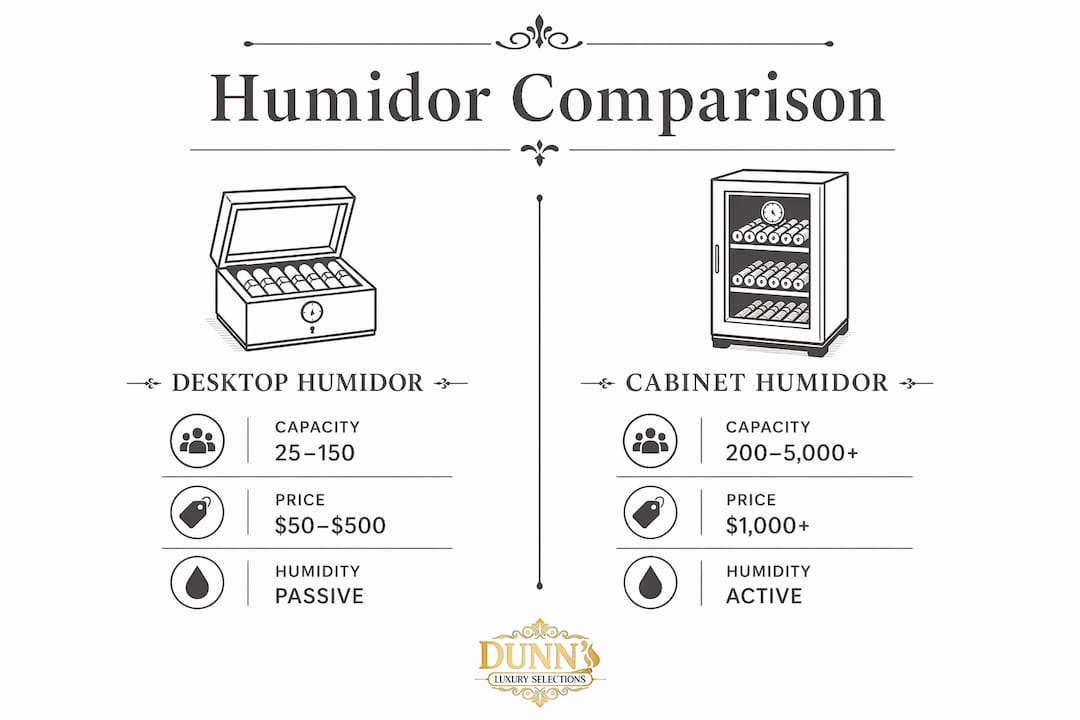
Performance in maintaining relative humidity is where the gap is most consequential. A digital hygrometer with frequent updates improves monitoring accuracy in larger units, and electronic cabinet systems use that data to trigger humidification automatically. Desktop units depend entirely on the collector’s attention.
Long-term value also shifts the calculus. A premium cabinet humidor is an investment in the cigars it holds. A collection of aged Cubans or rare limited releases stored at consistent RH for 5 years gains complexity and value. The same cigars stored in a passive desktop box through seasonal humidity swings may lose that potential entirely.
Aesthetics matter too, but they should follow function. A cabinet humidor with glass doors and furniture-grade finish serves as a display piece and a preservation instrument simultaneously. A desktop humidor with a lacquered exterior but poor cedar lining is decoration, not storage. Function always precedes form in any humidor worth owning.
Key Takeaways
The single most important decision in cigar storage is matching your humidor type to your collection size and aging timeline, not your budget or aesthetic preference.
| Point | Details |
|---|---|
| Capacity is the first filter | Desktop humidors hold 25–150 cigars; cabinet humidors start at 200 and scale to thousands. |
| Humidity control defines aging potential | Active electronic systems maintain ±1–2% RH, which passive desktop units cannot match over years. |
| The 200-cigar threshold is the upgrade signal | Most collectors do not need a cabinet until their collection exceeds 150–200 cigars. |
| Spanish cedar lining is non-negotiable | Full cedar interiors stabilize moisture and protect flavor in both desktop and cabinet formats. |
| Buy for 75% capacity, not maximum | A humidor filled to 75% of its capacity maintains humidity more consistently than one that is overpacked or nearly empty. |
What I have learned after years of watching collectors choose the wrong humidor
By Belle Dunn
The most common mistake I see is not buying too small. It is buying too large, too soon. Collectors get excited about a cabinet humidor, invest $2,000 or more, and then fill it with 60 cigars. An underloaded cabinet with passive humidification is actually harder to manage than a well-sealed desktop box. The cedar has nothing to work with. The moisture dissipates into empty space.
My honest observation is that build quality matters more than category. A $400 desktop humidor with thick cedar, a tight seal, and a reliable Boveda system will outperform a $1,200 cabinet with thin veneer and a leaky door every single time. The specs on the box mean nothing if the construction is poor.
The collectors I have seen preserve their cigars best are the ones who treat the upgrade decision as a milestone, not an aspiration. They hit 150 cigars, they assess their aging goals, and then they invest in a cabinet that fits where their collection is actually going. They do not buy the cabinet to motivate the collection. The collection motivates the cabinet.
One more thing: seasonal climate shifts are underestimated. If you live somewhere with cold, dry winters and humid summers, a passive desktop humidor will fight you every year. An electronic cabinet with integrated climate control removes that variable entirely. That consistency, compounded over 3–5 years, is what separates a good cigar from a great one.
— Belle Dunn
Dunnluxuryselections: precision storage for every stage of your collection
Whether your collection sits at 50 cigars or 5,000, Dunnluxuryselections builds humidors that match the ambition of what you are preserving. Every unit in the collection is lined with Spanish cedar, tested for seal integrity, and crafted to maintain the conditions your cigars deserve.

For collectors ready to move into serious cabinet storage, the Humidor Supreme 9200 Series delivers double-door electronic climate control built for large collections and long-term aging. Collectors who want a refined desktop option will find the Duke desktop humidor a worthy sanctuary for up to 150 cigars. For those seeking a premium cabinet with commanding presence, the Barbatus 2000 and the Reagan Electronic Cabinet represent the standard for serious collectors. White-glove delivery and expert consultation are included with every purchase.
FAQ
What is the main difference between desktop and cabinet humidors?
Desktop humidors hold 25–150 cigars and use passive humidity control, while cabinet humidors hold 200 or more cigars and use active electronic systems to maintain RH within ±1–2%.
When should a collector upgrade from a desktop to a cabinet humidor?
The practical upgrade point is when your collection exceeds 150–200 cigars or when you plan to age cigars for more than 12 months, since passive systems cannot maintain consistent RH over longer periods.
Do cabinet humidors require more maintenance than desktop units?
Cabinet humidors with electronic systems actually require less frequent manual attention. They self-regulate humidity and need only periodic water refills and sensor calibration, compared to weekly or monthly replenishment for passive desktop units.
Is Spanish cedar lining necessary in both humidor types?
Spanish cedar lining is the industry standard for both desktop and cabinet humidors. Its natural properties stabilize moisture, resist mold, and protect cigar flavor during storage and aging.
Can a desktop humidor be used for long-term cigar aging?
A desktop humidor can age cigars for 6–12 months reliably, but passive humidity systems struggle to maintain consistent RH across seasonal changes, making them unsuitable for aging cigars over 2–3 years.
Recommended
You May Also Enjoy
Cigar Collection Insurance: How to Protect Your Humidor
Home policies often cap or exclude cigars. Learn how floaters, agreed value, appraisals and inventories protect a serious...
Read Article
Cigar Locker Dimensions: Sizing Guide for Collectors and Lounges
Cigar locker dimensions explained: compartment sizes, cabinet footprints, capacity math and clearances, so you size a locker bank...
Read Article
Sealing a Walk-In Humidor: Envelope, Door and Penetrations
How to seal a walk-in humidor properly: vapor barrier placement, door gasket, penetrations and the controlled airflow a...
Read Article