

Discover the art of aging with our guide on explaining cigar aging rooms. Learn design tips, ideal conditions, and why stability is key.
TL;DR:
- A cigar aging room is a climate-controlled space lined with Spanish Cedar that maintains environmental stability for long-term tobacco aging. Proper conditions, such as consistent humidity and temperature, are critical to allow biochemical changes that enhance flavor harmony and reduce harshness. For high-value collections, a custom walk-in humidor offers optimal control, security, and capacity, with professional installation ensuring precise climate management.
A cigar aging room is a climate-controlled space, lined with Spanish Cedar, where rolled cigars rest under precise temperature and humidity conditions so the wrapper, binder, and filler tobaccos harmonize into a single, unified smoke. The single most important design priority is environmental stability, not any particular number on a hygrometer.
Quick reference for collectors:
- Target RH for long-term aging: low-to-mid 60s percent RH for daily storage and low-to-mid 60s RH at 60–64°F for long-haul aging
- Why stability matters: swings in relative humidity cause wrappers to crack, promote mold, and accelerate tobacco beetle activity
- When to commission a bespoke room: once you plan to hold high-value boxes for multi-year aging and require environmental precision, security, and capacity beyond what a cabinet can offer
One critical terminology note: “Aging Room” is also the name of a boutique cigar brand. When researching aging techniques, distinguish the factory process from the brand name to avoid confusion.
Table of Contents
- How cigars actually age: chemistry, marrying, and mellowing
- Core environmental specs and construction principles
- Which scale is right for your collection?
- How to build or commission a collector-grade aging room
- Monitoring and maintenance protocols for long-term stability
- Realistic aging timelines and what to expect
- Common mistakes that ruin aging attempts
- When to commission a custom walk-in, and how Dunnluxuryselections helps
- Key Takeaways
- What collectors consistently underestimate about aging rooms
- Useful sources for further research
- FAQ
How cigars actually age: chemistry, marrying, and mellowing
Aging does not simply make a cigar softer. The process is a controlled biochemical conversation between three distinct tobacco components. As Habanos emphasizes, correct storage conditions are the active agent that produces rounder, more balanced aromas — time alone, without the right environment, yields disappointment or worse.
The key changes during aging:
- Ammonia outgassing: fermentation byproducts, particularly ammonia, continue to dissipate after rolling, reducing harshness
- Moisture redistribution: wrapper, binder, and filler arrive from different growing regions with different moisture levels; aging equalizes them
- Volatile-compound mellowing: sharp, angular flavor notes soften as volatile compounds stabilize over months
Master blender Manuel Inoa of La Aurora frames the purpose precisely:
“The aging room allows the different humidity levels in the wrapper, binder, and filler to equalize, so the tobaccos become one — a single, harmonized blend rather than three separate leaves.”
— Manuel Inoa, La Aurora master blender, via La Aurora Cigars
Daily storage prioritizes smokability and access. Long-term aging pursues refinement and integration. The distinction matters when you are designing a space, because the two goals call for different environmental targets and different cedar exposure strategies.
Core environmental specs and construction principles
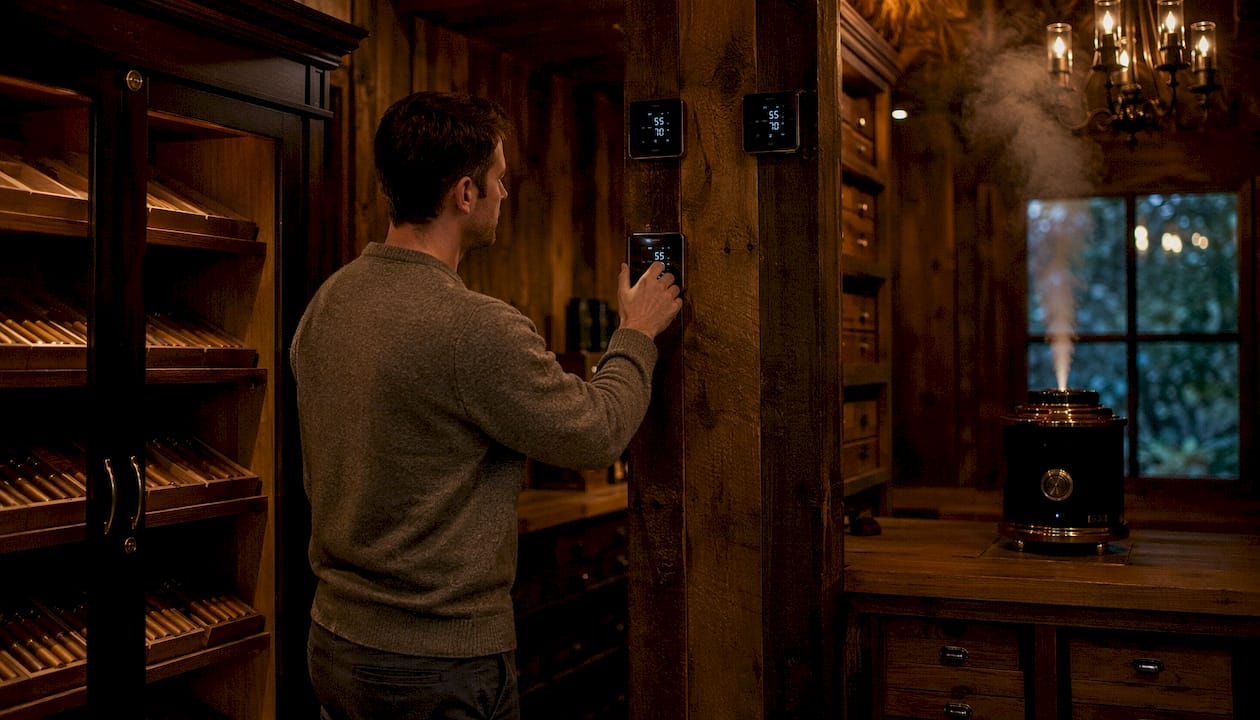
The environmental specification a collector-grade aging room must hold is low-to-mid 60s percent RH and mid-60s to low 70s Fahrenheit for active storage, or low-to-mid 60s RH at 60–64°F for long-haul aging, with stability within a narrow tolerance at all times.
| Specification | Active Storage | Long-Term Aging |
|---|---|---|
| Relative Humidity | mid-60s % RH | Low-to-mid 60s % RH |
| Temperature | mid-60s to low 70s °F | 60–64°F |
| Stability tolerance | ±1–2% RH | ±1% RH or tighter |
| Ventilation | Passive cedar airflow | Controlled, low-exchange |
| Beetle prevention | Freeze new stock; monitor | Cooler temps keep beetles dormant |
Construction essentials:
- Spanish Cedar lining on walls, shelving, and box trays — cedar regulates moisture, imparts subtle wood notes, and helps deter insects
- Vapor barrier behind cedar panels to prevent moisture migration through exterior walls
- Airtight door seals with compression gaskets
- Dedicated HVAC or split-system AC for temperature control, independent of the humidification circuit
Pro Tip: Balance cedar exposure deliberately. Delicate Connecticut or Ecuadorian wrapper cigars can absorb cedar aroma aggressively if stored directly against bare cedar planks for years. Use cedar-lined cases or cedar sheets as a buffer layer, and consult Dunnluxuryselections’s cedar storage guide for precise placement guidance.
Which scale is right for your collection?
Commercial harmonization, private long-term aging, and daily access are three distinct goals that call for three distinct scales of storage.
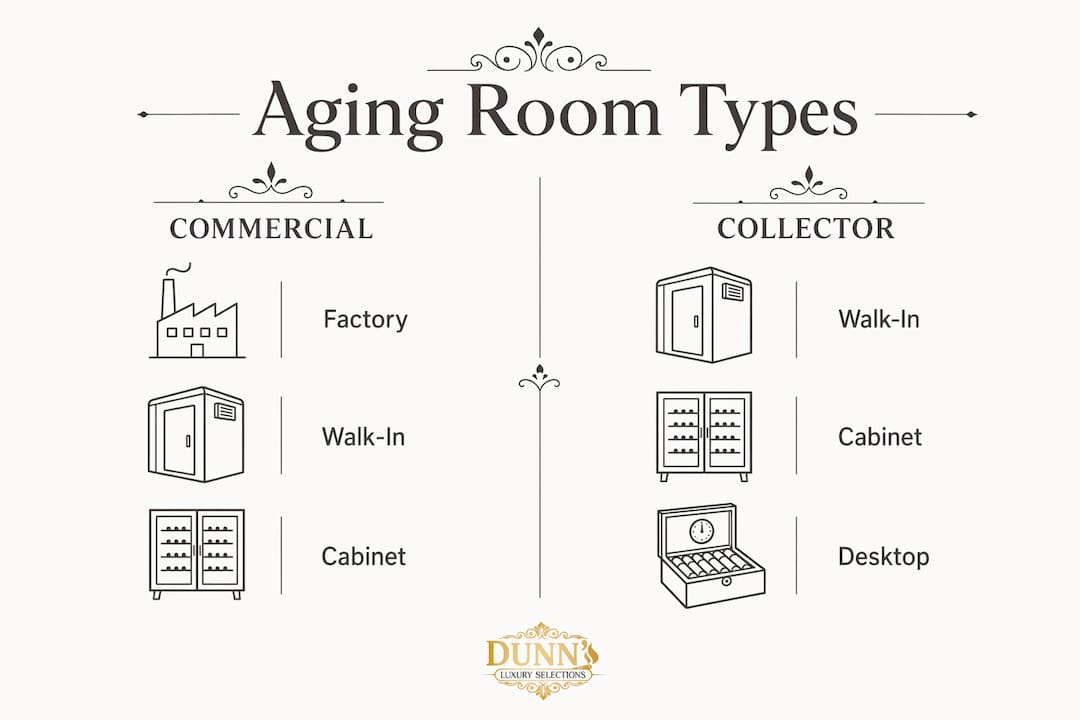
| Dimension | Factory Aging Room | Custom Walk-In Humidor | Cabinet Humidor | Desktop Unit |
|---|---|---|---|---|
| Purpose | Blend harmonization at production scale | Multi-year collector aging, security | Mid-collection aging and display | Daily access, small collections |
| Target RH | 65–70% | Low-to-mid 60s% | 65–70% | 65–70% |
| Temperature | mid-60s to low 70s °F | 60–64°F | 65–70°F | Ambient |
| Footprint | Warehouse room | Dedicated room or large closet | 4–8 sq ft floor space | Desktop |
| Materials | Spanish Cedar, industrial HVAC | Spanish Cedar, vapor barrier, dedicated AC | Spanish Cedar, electronic humidification | Cedar tray, passive humidifier |
| Monitoring complexity | Automated with human oversight | Remote telemetry, dual sensors | Digital hygrometer, app-connected | Manual hygrometer |
| Typical cost | N/A (factory) | — | — | — |
Collectors holding 500 or more cigars for multi-year aging, or those with significant investment-grade boxes, should consider a custom walk-in. A cabinet humidor collection suits collectors who want precision control and display aesthetics without a dedicated room. Desktop units serve daily rotation, not long-term aging.
How to build or commission a collector-grade aging room
Three non-negotiables before any build begins: confirm the site can hold stable temperature year-round, establish your climate control strategy (active HVAC vs. passive), and plan your monitoring and backup systems before walls go up.
Step-by-step commissioning checklist:
- Site selection: choose an interior wall location away from exterior temperature fluctuations, direct sunlight, and HVAC vents
- Structural preparation: insulate walls and ceiling to R-19 or better; install a continuous vapor barrier on the warm side of insulation
- Climate control: install a dedicated mini-split or through-wall AC unit sized for the room’s volume; never rely on a home’s central HVAC
- Humidification: select a precision ultrasonic or evaporative humidifier with a reservoir sized for the room; add an independent dehumidifier for summer months
- Drainage: route condensate lines to a drain or collection reservoir; never allow standing water near cedar
- Electrical: dedicate a 20-amp circuit; install a UPS (uninterruptible power supply) for monitoring equipment
- Cedar lining: install tongue-and-groove Spanish Cedar panels; allow panels to acclimate for 72 hours before sealing the room
- Odor control: avoid paints, adhesives, or finishes with VOCs inside the room; use only food-safe or cedar-compatible sealants
- Commissioning burn-in: run the room empty at target conditions for 14 days before introducing cigars; log RH and temperature every 6 hours
Equipment list: precision ultrasonic humidifier, independent dehumidifier, dual calibrated digital hygrometers (primary + secondary), remote telemetry logger with SMS or app alerts, backup UPS, and a calibrated reference hygrometer for annual verification.
Monitoring and maintenance protocols for long-term stability
Monitor continuously, verify weekly, and act on any excursion immediately. That single rule prevents the vast majority of aging failures.
Monitoring setup:
- Place a primary hygrometer at mid-shelf height, away from the humidifier output
- Place a secondary calibrated sensor near the door to catch infiltration events
- Set remote alerts for any reading outside your target band by more than 2% RH or 3°F
- Calibrate both sensors against a salt-test reference every six months
Monthly maintenance checklist:
- Inspect humidifier reservoir and clean with distilled water; replace wicks or ultrasonic discs annually
- Check AC coils and filters; clean or replace per manufacturer schedule
- Inspect cedar panels for mold, warping, or unusual odor
- Rotate box positions to equalize cedar exposure
- Check door seals for compression integrity
- Review remote logs for slow drift patterns
Warning signs requiring immediate action:
- RH spike above 75% (mold risk within 48 hours)
- RH drop below 58% (wrapper cracking, rapid desiccation)
- Visible powder or webbing on cigars (tobacco beetle activity)
- Uneven box swelling or wrapper separation
Automation handles steady-state control, but human oversight catches the slow drift that sensors alone miss. Review your logs as a narrative, not just a snapshot.
“The blender’s role is to preserve blend consistency across years and changing leaf characteristics — automation is the instrument, but judgment is the craft.”
— La Aurora, What is the aging room?
Realistic aging timelines and what to expect
Aging improves integration and mellowness; it does not create new flavors or increase strength. The changes are subtle and best judged by side-by-side comparison with a control cigar from the same box.
- Resting: cigars recover from travel and shipping stress; draw resistance normalizes; flavor changes are minimal at this stage
- Marrying: over several months, the wrapper, binder, and filler begin to equalize; harshness softens; the blend starts to read as unified
- Aging: over time, most blends show their best integration; ammonia notes dissipate; complexity and balance peak for many cigars
- Long-haul: extended aging can further refine some full-bodied blends; lighter, delicate blends may risk flattening or losing vibrancy
Sensory testing protocol:
- Smoke one cigar from the aging room alongside one from a sealed, unaged reference box of the same blend
- Note differences in draw resistance, aroma at cold, first third flavor, and finish length
- Document results with date, RH, and temperature at time of testing
- Repeat every six months; a cigar that has peaked will show diminishing returns between tests
Blends that benefit most from aging: high-ligero Nicaraguan and Dominican full-bodied cigars, maduro wrappers, and complex multi-region blends. Blends that can flatten: mild Connecticut shade cigars and light-bodied Dominican puros beyond the 3-year mark.
Common mistakes that ruin aging attempts
The three most damaging errors are an unstable environment, confusing resting with aging, and poor material or ventilation choices. Each is avoidable with the right setup.
- Chasing exact numbers instead of stability: a room that holds 63% RH with ±0.5% variance outperforms one that averages 65% but swings ±5% weekly
- Storing flavored or infused cigars alongside prized natural-leaf boxes: aromatic compounds migrate through cedar and contaminate neighboring cigars
- Inadequate monitoring: a hygrometer checked monthly cannot catch a failed humidifier that drained dry in week two
- Placing the aging room near a heat source: a furnace room, exterior south-facing wall, or water heater closet introduces thermal cycling that no humidifier can compensate for
- Skipping the freeze protocol for new stock: introducing uninspected cigars directly into an aging room risks introducing tobacco beetle eggs that will hatch and devastate an entire collection
“Time without correct environment yields disappointment. Proper conditions are the active agent that magnifies quality — without them, aging produces ‘sick’ cigars that taste bloated or sour.”
— Habanos, S.A.
Consult Dunnluxuryselections’s care guides for a complete maintenance and contingency checklist before your first cigars enter an aging room.
When to commission a custom walk-in, and how Dunnluxuryselections helps
The right moment to commission a bespoke walk-in humidor is when you plan to hold high-value boxes for multi-year aging and require environmental precision, security, and capacity that no off-the-shelf cabinet can deliver.
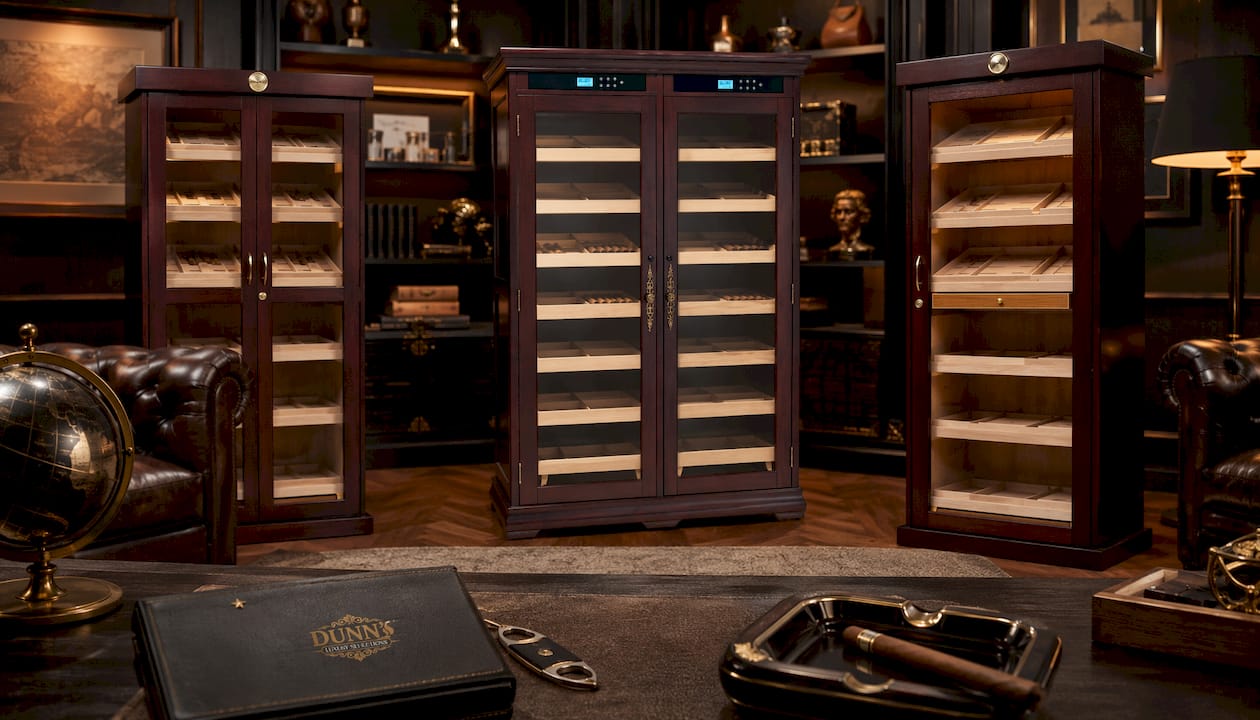
Dunnluxuryselections designs, delivers, and installs bespoke walk-in humidors and premium cabinet solutions for collectors, lounges, and private clubs across the United States. Every project begins with a consultation to establish your collection size, target aging timeline, location constraints, and aesthetic vision. From there, the team specifies climate control, cedar lining, telemetry, and security, then handles white-glove delivery and on-site installation. For collectors who want precision climate control in a cabinet form factor before committing to a full walk-in, three cabinet options worth exploring:
- The Bermuda Cabinet Humidor is a large-capacity cabinet built for serious collections that demand both display elegance and aging-grade humidity control.
- The Reagan Electronic Cabinet delivers precise electronic climate management in a refined cabinet form, ideal for collectors who want set-and-monitor convenience.
- The Barbatus 2000 Cabinet Humidor offers high-capacity storage with the construction quality collectors require for multi-year aging programs.
To begin your consultation, visit dunnluxuryselections.com and request a custom project brief.
Key Takeaways
A collector-grade aging room succeeds or fails on environmental stability, not the precision of any single reading.
| Point | Details |
|---|---|
| Stability over precision | Hold RH within ±1–2% of your target; swings cause more damage than a slightly off average. |
| Long-term aging targets | Aim for low-to-mid 60s % RH and 60–64°F to slow chemistry and keep beetles dormant. |
| Commission when scale demands it | A bespoke walk-in is warranted once you hold high-value boxes for multi-year aging and need security and precision beyond cabinet capacity. |
| Monitor continuously | Use dual calibrated sensors, remote telemetry, and monthly maintenance checks; never rely on a single hygrometer. |
| Dunnluxuryselections | Offers bespoke walk-in humidors, cabinet solutions (Bermuda, Reagan, Barbatus), white-glove installation, and expert consultation across the United States. |
What collectors consistently underestimate about aging rooms
Most collectors who contact us have the humidity question answered before they call. What they underestimate, almost universally, is temperature. A room that holds 65% RH but swings between 62°F and 78°F across seasons is not an aging room. It is a slow-motion disaster. Temperature drives the rate of every chemical reaction in tobacco, and it is the variable that residential HVAC systems handle least reliably.
The second thing collectors underestimate is the commissioning phase. An aging room is not ready the day the cedar goes up. It needs a 14-day empty burn-in, during which you log conditions every six hours and verify that your climate control system can hold target ranges through a full day-night cycle. Skipping that step and loading $50,000 worth of cigars on day one is a risk no collection should absorb.
What reliably works: a dedicated mini-split for temperature, a precision ultrasonic humidifier for RH, dual remote sensors with SMS alerts, and Spanish Cedar panels allowed to acclimate before the room is sealed. That combination, installed correctly, will hold a collection safely for decades. The Dunnluxuryselections journal documents the installation and acceptance-testing process in detail for collectors who want to understand what a professional commissioning looks like before they commit.
Useful sources for further research
These sources informed this guide and offer deeper technical reading for collectors who want to verify specifications or study the science of cigar aging directly.
- Habanos, S.A. — Ageing Finished Cigars: the industry’s most authoritative public statement on aging conditions, stability requirements, and vintage character development
- La Aurora Cigars — What Is the Aging Room?: master blender Manuel Inoa explains harmonization and cedar’s role from a production perspective
- La Aurora Blog — What Is the Aging Room?: factory practice data on aging durations for premium and super-premium cigars
- Cigarista — Cigar Aging: Process, Timeline, Humidity & Temperature: practical collector-focused guide covering timelines, target conditions, and sensory testing methodology
- Cigar Smoker Club — Aging Room Explanation: clarifies the dual meaning of “Aging Room” as both a factory process and a boutique brand name
- Frontiers in Bioengineering and Biotechnology — Sensory Attributes of Cigars Aged with Different Media: peer-reviewed research on how aging media affect chemical composition and sensory quality
- Cigar Aficionado Glossary — Aging Room: concise industry definition confirming Spanish Cedar lining and harmonization as the standard purpose
FAQ
What is a cigar aging room?
A cigar aging room is a climate-controlled, Spanish Cedar-lined space where rolled cigars rest at stable temperature and humidity so the wrapper, binder, and filler tobaccos harmonize into a unified blend.
What are the ideal humidity and temperature for aging cigars?
For long-term collector aging, target low-to-mid 60s percent RH and 60–64°F; for active storage, low-to-mid 60s percent RH at 65–70°F is standard, with stability within ±1–2% RH throughout.
How long does cigar aging take?
Most blends show their best integration in the 1–3 year window; noticeable smoothing begins at 3–6 months, and long-haul aging beyond 3–5 years is speculative and blend-dependent.
What is the difference between resting and aging a cigar?
Resting (2–8 weeks) allows a cigar to recover from shipping stress; aging (months to years) is the deliberate, environment-controlled process that harmonizes tobaccos and mellows volatile compounds.
When should a collector commission a bespoke walk-in humidor?
Commission a custom walk-in when your collection requires multi-year aging, investment-grade security, and environmental precision beyond what a cabinet can provide. Dunnluxuryselections offers consultation, design, and white-glove installation for exactly that transition.
Recommended
You May Also Enjoy
Cigar Collection Insurance: How to Protect Your Humidor
Home policies often cap or exclude cigars. Learn how floaters, agreed value, appraisals and inventories protect a serious...
Read Article
Cigar Locker Dimensions: Sizing Guide for Collectors and Lounges
Cigar locker dimensions explained: compartment sizes, cabinet footprints, capacity math and clearances, so you size a locker bank...
Read Article
Sealing a Walk-In Humidor: Envelope, Door and Penetrations
How to seal a walk-in humidor properly: vapor barrier placement, door gasket, penetrations and the controlled airflow a...
Read Article