

Master your humidor with our complete guide to cigar box arrangement, ensuring every cigar is perfectly stored and ready to enjoy.
The best arrangement system for any humidor uses three functional zones (everyday, resting, and aging/backstock); FIFO rotation, Spanish cedar dividers between strength groups, and humidification units placed to minimize microclimate drift. Get those four elements right, and every cigar you pull will be exactly where you expect it, in exactly the condition you intended.
Start here — your day-one checklist:
- Season the humidor with distilled water and verify RH with a calibrated hygrometer before placing a single cigar
- Create three zones: front/top for daily smokes, middle for new arrivals resting, back/bottom for long-term aging
- Place humidification units at opposite ends of each shelf for even distribution
- Label every row or tray by wrapper type, strength, or occasion
- Rotate FIFO: new stock enters at the bottom or back; ready cigars surface to the top or front
For walk-in humidors serving retail or club members, walk-in aisle width should be at least 36 inches so customers can browse comfortably without disturbing displayed stock.
Key Takeaways
Proper cigar box arrangement requires seasoned cedar, defined zones, consistent FIFO rotation, and calibrated humidity monitoring to protect aging potential and present your collection with confidence.
| Point | Details |
|---|---|
| Season before arranging | Wipe cedar with distilled water, let settle 24+ hours, confirm mid-to-upper 60s %RH before placing cigars. |
| Use three functional zones | Top/front for everyday smokes, middle for resting arrivals, bottom/back for long-term aging. |
| Fill to 70–80% capacity | Keeping humidors below full capacity allows airflow and prevents humidity dead zones. |
| Rotate FIFO consistently | New cigars enter at the bottom; ready cigars surface upward — never dig through aging stock. |
| Dunnluxuryselections for upgrades | Custom cabinets with Spanish cedar interiors, multi-zone controls, and white-glove installation for collectors and retailers. |
Table of Contents
- How to prepare your humidor before arranging cigars
- How to map microclimates and zone your humidor
- How to arrange cigars inside boxes, trays, and drawers
- What humidification system should you use?
- Should you keep cellophane on or take it off?
- Retail and lounge merchandising that actually drives sales
- Managing small humidors and overflow without losing control
- Routine maintenance and troubleshooting common problems
- When is it time to upgrade to a custom humidor?
- Dunnluxuryselections: custom storage built for serious collectors
- Sources
How to prepare your humidor before arranging cigars
Always season before you arrange. A new Spanish cedar interior is thirsty — it will pull moisture from your cigars before it stabilizes, which means the first batch you place in an unseasoned humidor will arrive at your lips drier than intended.
The seasoning procedure is straightforward: lightly dampen a clean sponge with distilled water, wipe all interior cedar surfaces without saturating them, place your humidification unit inside, close the lid, and let the humidor sit undisturbed for at least 24 hours. Then check with a calibrated hygrometer. Target the mid-to-upper 60s %RH as your starting point — that range gives the cedar time to stabilize before you introduce cigars.
Pro Tip: Never use tap water for seasoning or refilling humidifiers. Tap water minerals leave a white film on cedar and can introduce off-odors that migrate into your tobacco. Distilled water only.
Placing your hygrometer at the center of the humidor during seasoning gives you the most representative reading. Once cigars are inside, move a second sensor to the corner farthest from the humidification unit — that corner tells you where your weakest humidity point is.
How to map microclimates and zone your humidor
Multiple hygrometers reveal microclimate variation that a single sensor will never show. Place sensors at the top shelf, middle, and bottom before you commit to a zone layout. In most cabinet humidors, the top runs slightly warmer and drier; the bottom stays cooler and more humid. That gradient is your map.
Assign zones based on what you find:
- Top/front zone: everyday smoking stock — cigars you reach for this week, fully acclimated, easy to grab without disturbing anything else
- Middle zone: new arrivals resting and acclimating, grouped by wrapper or strength using cedar dividers
- Bottom/back zone: long-term aging boxes, whole original cedar boxes preferred, undisturbed for months at a time
For retail and club layouts, organize by wrapper, age, ring gauge, and occasion and use left-to-right grouping within each zone so bands face the same direction. Customers read a humidor the way they read a shelf — left to right, top to bottom. Put your most compelling stock at eye level.
Pro Tip: In a walk-in, place rare or allocated cigars at the center visual plane, not the edges. The eye lands in the middle first. Reserve lower flat shelves for bulk backstock.
How to arrange cigars inside boxes, trays, and drawers
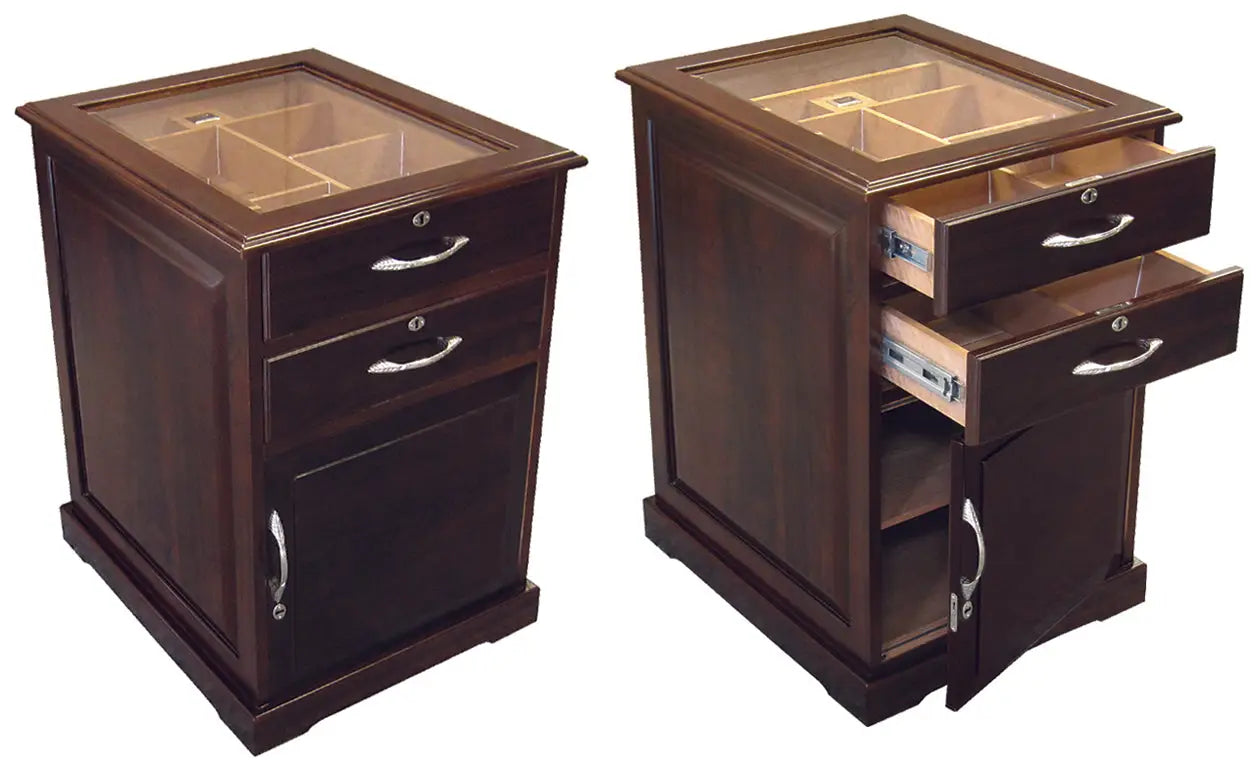
Arrange by a single dominant axis first, then subdivide. Strength is the most practical primary axis for mixed collections: mild wrappers on one side, full-bodied on the other, with a cedar divider between them. Spanish cedar dividers improve airflow separation and reduce aroma migration between groups — a Maduro and a Connecticut sharing a tray without separation will influence each other over time.
Packing rules that protect your investment:
- Keep stacking depth to two layers maximum in open trays; three layers only in original cedar boxes with lids
- Leave cigars in their original cedar boxes when aging — the box itself buffers humidity and contains the microclimate
- Separate cellophane-wrapped cigars from naked ones within the same tray (more on cello below)
- Never pack a tray so tightly that you have to dig to retrieve a cigar; every retrieval disturbs neighbors
Pro Tip: Use a simple label template on each tray: brand, vitola, vintage year if known, and zone designation (E = everyday, R = resting, A = aging). A printed card tucked at the front of each row takes 30 seconds and saves minutes of searching.
The goal of arrangement is not just aesthetics — it is protecting aging potential by reducing disruptive handling. Every time you dig through a tray looking for a specific stick, you risk cracking wrappers and disturbing the rest of the collection.
For FIFO rotation, the tray method is the most practical daily system: the top tray holds your working stock, the bottom tray holds resting and aging cigars. New purchases go to the bottom; cigars move upward only after they have acclimated or reached their target age.
What humidification system should you use?
Choose the system that fits your maintenance rhythm, then place units strategically to reduce drift between zones.
Boveda-style two-way packs are the low-touch standard for most collectors. They absorb excess moisture when RH climbs and release it when RH drops, requiring no adjustment. Refillable units give you more control over the target RH but demand regular attention and distilled water refills. For precise humidity control in large cabinets or walk-ins, electronic humidification systems with sensors offer the tightest tolerance.
Placement grid:
- Single tray or box: one pack centered beneath the cigars or tucked at one end
- Two-tray desktop: one pack per tray, placed at opposite ends to cross-distribute
- Cabinet or walk-in: one unit per shelf, alternating left and right placement across shelves
Check hygrometers weekly. Log readings in a notebook or a cigar inventory app so you can spot drift before it damages a box.
Should you keep cellophane on or take it off?
Keep cellophane on for retail display and travel; remove it for long-term aging when you want the cigar to breathe and acclimate fully to your humidor’s microclimate.
Cellophane is not airtight — it does allow some moisture exchange — but it slows the process. For a cigar you plan to smoke within six months, cello provides meaningful protection against handling scuffs and wrapper cracking during retrieval. For a cigar you are aging for two or more years, removing cello lets the tobacco interact directly with the cedar environment and your humidification system.
Practical scenarios:
- Retail display: keep cello on — customers handle cigars, and the wrapper needs protection
- Travel locker or short-term storage: keep cello on for physical protection
- Long-term aging (12+ months): remove cello, place in cedar-lined tray or original box
Pro Tip: When you remove cellophane for aging, write the date on a small label and tuck it with the cigar or its tray card. You will not remember when you unwrapped it six months from now.
Retail and lounge merchandising that actually drives sales
Consistent, clean presentation with clear price tags and highlighted premium items builds customer confidence and supports sales. A messy humidor signals neglect — and in a retail or club environment, perceived neglect translates directly to lost revenue.
The mechanics of effective display:
- Angle shelves at 15–20 degrees so bands face the customer naturally; flat shelves require customers to lean in and disturb stock
- Left-justify all bands within a row so the visual line is clean and consistent
- Place rare or allocated cigars at the center visual plane, framed as a focal piece
- Keep bulk backstock on lower flat shelves, accessible to staff but below the primary sight line
- Attach clear, legible price tags to every row — ambiguity about price is one of the most common reasons customers do not ask for a cigar they are interested in
For walk-in humidors, aisles should be at least 36 inches wide and shelves cleaned with water only — no scented cleaners that could transfer chemical notes to tobacco. Run a display rotation schedule every two weeks: pull forward any cigars that have been sitting at the back of a row, refresh price tags, and replace any sticks with visible wrapper damage.
Managing small humidors and overflow without losing control
Don’t overfill. Keeping a humidor around 70–80% full allows air to circulate between cigars and around humidification units. A packed-to-capacity humidor creates dead zones where humidity stagnates or drops, and those zones are almost always where your best aging stock sits.
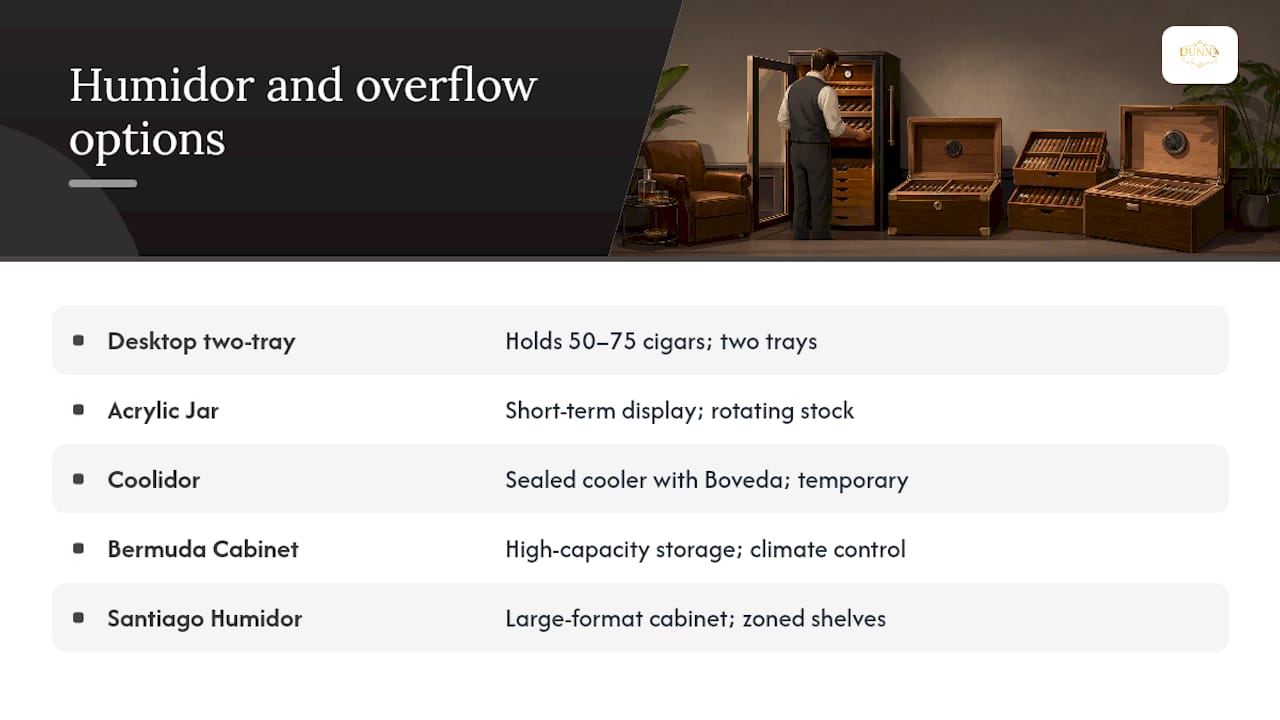
For a two-tray desktop holding 50–75 cigars, the practical layout is one tray for everyday smokes and one for resting arrivals, with a cedar divider separating mild from full-bodied on each tray. The Acrylic Jar works well for short-term retail display or a curated selection on a lounge counter — it keeps a small rotating stock visible and accessible without committing your main humidor to display duty.
When your desktop humidor is consistently at 80% capacity or above, that is not an organization problem — it is a capacity problem. A secondary coolidor (a sealed cooler with Boveda packs) buys time, but it is not a long-term solution for serious aging.
For overflow beyond what a coolidor handles, the Bermuda Cabinet offers high-capacity storage with the climate control a serious collection demands. The Santiago Cigar Humidor suits retailers and collectors who need a large-format cabinet with room for zoned organization across multiple shelves.
Pro Tip: Label your overflow humidor or coolidor with the date you opened it and the target smoking window for the cigars inside. Overflow storage has a way of becoming forgotten storage.
Routine maintenance and troubleshooting common problems
A simple monthly protocol prevents most problems before they require intervention.
- Weekly: Read and log all hygrometers; check humidification unit levels; inspect the top tray for any cigars with visible wrapper issues
- Monthly: Rotate FIFO — move resting cigars upward; inspect all trays for mold (white or blue-green spots on the foot or wrapper); wipe shelves with a cloth dampened in distilled water only
- Quarterly: Calibrate hygrometers against a salt test or a reference sensor; assess whether your humidification system needs replacement packs or a refill unit upgrade; review your inventory log
Troubleshooting quick reference:
- Over-humidity: remove one humidification pack, check the lid seal, and prop the humidor open for 30 minutes in a climate-controlled room
- Under-humidity: add a fresh pack or refill your unit; inspect the seal gasket for gaps; check that cedar dividers are not blocking airflow to the sensor
- Off-odors: isolate the offending cigars immediately; wipe the affected tray with distilled water; allow the humidor to air for several hours before reintroducing stock
- Cracked wrappers: usually a sign of RH dropping below 62% for an extended period; check your care guides for recovery steps
Pro Tip: Never use scented cleaners, alcohol wipes, or any chemical product inside a humidor. Cedar absorbs everything, and those scents will migrate into your tobacco.
When is it time to upgrade to a custom humidor?
Upgrade when your current humidor can no longer reliably deliver what your collection requires.
Collectors who have reached that threshold often describe the same moment: they open the humidor, and instead of a sanctuary, they see a problem to manage. That is the upgrade signal.
“The difference between a well-organized humidor and a custom-built one is the difference between managing a collection and trusting it.” Precision humidity control within ±1–2% RH, Spanish cedar interiors, and multi-zone climate management are not luxuries at a certain collection size — they are the minimum standard for protecting what you have invested.
What a custom solution from Dunnluxuryselections delivers: a site assessment, a humidity specification matched to your collection’s needs, bespoke cedar divider configurations, multi-zone electronic controls, and white-glove installation. The craftsmanship behind each unit is designed to hold RH within the tolerances that serious aging demands.
Pro Tip: Before your consultation, document your current collection size, your RH log from the past 90 days, and the zones you are trying to maintain. That data makes the design conversation specific and productive.
A consultant’s perspective on what actually matters
Most collectors focus on the wrong variable first. They obsess over which humidification brand to use when the real question is whether their cedar is seasoned, their zones are defined, and their rotation is consistent. A Boveda pack in an unseasoned humidor with no zoning will underperform a simple refillable unit in a well-organized, properly seasoned cabinet every time.
Presentation matters — but protection comes first. The collectors whose cigars age the most gracefully are the ones who treat their humidor as a precision instrument, not a display case. White-glove installation and Spanish cedar craftsmanship are not about aesthetics alone; they are about building an environment where the tobacco can do what it was made to do, undisturbed, for years.
Dunnluxuryselections: custom storage built for serious collectors
For collectors and retailers whose collections have outgrown standard storage, Dunnluxuryselections offers a direct path from the zoning and humidification principles in this guide to a purpose-built environment that holds them reliably.
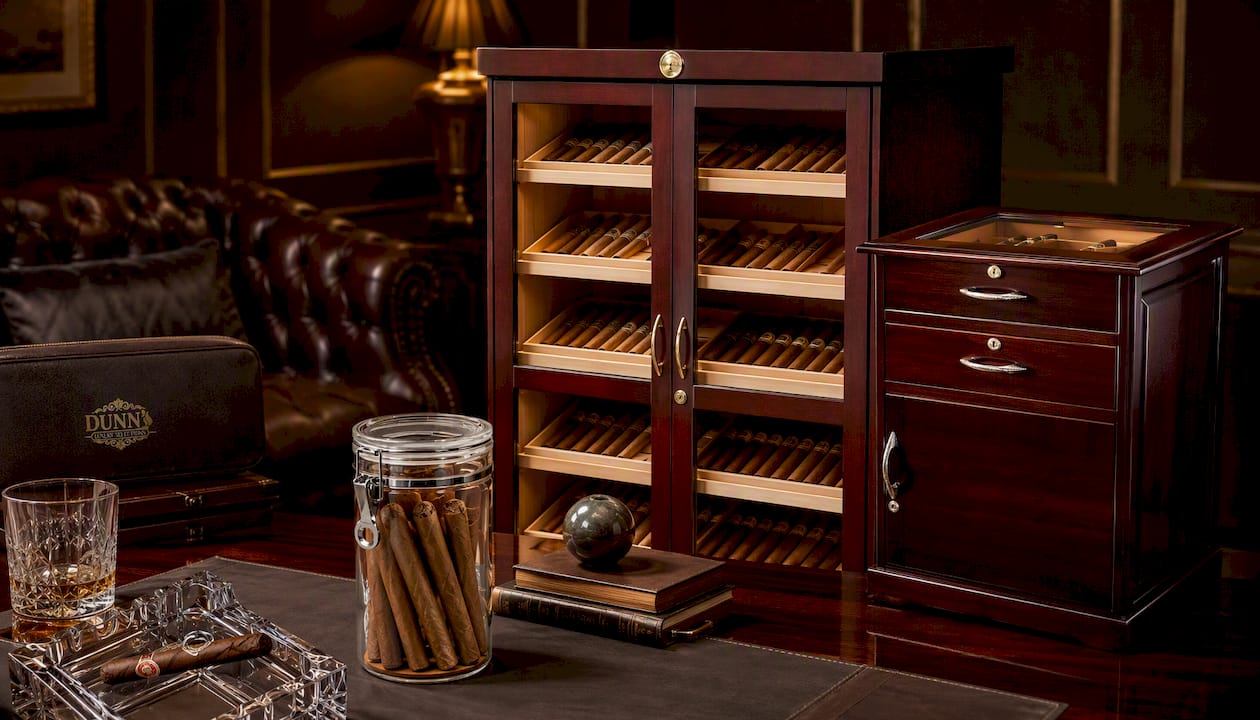
Every engagement begins with a consultation: a site assessment, a humidity specification matched to your collection’s profile, and a design proposal that accounts for your zones, your traffic patterns, and your presentation goals. Spanish cedar interiors, multi-zone electronic controls, and white-glove delivery are standard. The Santiago Cigar Humidor and the Bermuda Cabinet represent the range from serious collector to full retail installation. Visit Dunnluxuryselections to begin your consultation and receive a custom proposal for your collection.
Sources
The following sources informed the practical recommendations throughout this guide:
- Your Walk-in Humidor
- How to Organise a Humidor (The Concierge 's System) Cigarro
- Why Organization Inside Your Humidor Matters More Than Most Smokers Realize
FAQ
How full should a humidor be for proper airflow?
That fill level allows air to circulate between cigars and around humidification units, preventing humidity dead zones.
How often should you check hygrometers in a humidor?
Read and log hygrometer readings weekly. Quarterly calibration against a salt test or reference sensor keeps your readings accurate over time.
Should cigars be stored with or without cellophane?
Keep cellophane on for retail display and short-term storage; remove it for long-term aging of 12 months or more so the tobacco can interact fully with the cedar environment.
What is FIFO rotation and why does it matter for cigar storage?
FIFO (first in, first out) means new cigars enter at the bottom or back of a tray and move upward as they acclimate. It prevents older stock from being buried and ensures your most-ready cigars are always at the top.
When should a collector upgrade to a custom humidor?
Dunnluxuryselections offers custom cabinets with multi-zone controls and white-glove installation for collections that have reached that threshold.
Recommended
You May Also Enjoy
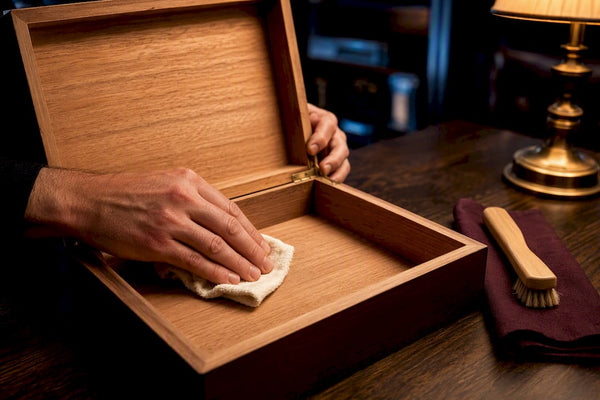
Save Flavor in 14 Days: Cleaning a Humidor for Collectors
For collectors: clean mold or plume without tainting cedar. Keep or toss decision rules, 14 days reseasoning, hygrometer...
Read Article
6 to 26 Weeks: Custom Humidor Timeline for Collectors & Gift Buyers
Plan a bespoke humidor with a realistic production calendar. See stage-by-stage timings, what typically adds weeks, and how...
Read Article
50/50 Propylene Glycol Ratio + 90/10 Flush for Collectors & Installers
Use a 50/50 propylene glycol ratio to hold passive humidors near 70% RH. Installer tested: occasional 90/10 water...
Read Article