

Learn how to accurately size humidification capacity for any humidor. From small boxes to commercial units, ensure your cigars stay perfectly preserved.
The rule is simple even when the math looks intimidating: measure your humidor’s interior air volume, apply an exchange multiplier for door openings and cedar absorption, then match that number to a device class. A sealed desktop box under 100 cigars runs on Boveda packs or beads. A cabinet holding 100 to 1,500 cigars needs an electronic humidifier rated in milliliters per hour or pints per day. A walk-in built for 1,500 cigars or more needs a commercial ultrasonic system with a backup unit standing by.
Here’s the fast version, before we get into the calculation:
- Under 100 cigars: 1 to 4 Boveda packs (Size 60 or 320) based on box volume, per Boveda’s pack chart.
- 100 to 1,500 cigars: an electronic cabinet humidifier delivering a moderate humidification output, depending on cabinet size and cedar surface area.
- 1,500+ cigars: a commercial ultrasonic or fog system, sized to room volume, with a second unit for redundancy.
Three variables push you off these baselines fast: how often the door opens during business hours, how much raw Spanish cedar is inside soaking up moisture, and how dry your worst winter day gets. Get those three right, and the rest of this guide is just arithmetic.
Key Takeaways
Humidification capacity sizing works by matching interior air volume, adjusted for traffic and cedar absorption, to a device class rated in mL/hr, PPD, or pack count.
| Point | Details |
|---|---|
| Measure before buying | Calculate interior cubic feet, not exterior cabinet dimensions, as your baseline. |
| Apply an exchange multiplier | Add 1.3 to 1.5x for high traffic or unsealed cedar shelving. |
| Electronic beats passive at scale | Electronic units hold ±1-2% RH versus ±5-10% for packs in cabinets. |
| Redundancy protects walk-ins | Run two units, or a primary and backup, for commercial installations. |
| Dunn’s maps sizing to product | Consultation-based sizing pairs your load calculation with the right Dunn’s cabinet or electronic unit. |
Table of Contents
- Measuring Your Humidor and Calculating the Humidification Load
- Matching Sizing to Equipment: Desktop, Cabinet, and Walk-In
- What mL/hr, PPD, and ±1-2% RH Actually Mean
- Installing for Real-World Performance
- Maintenance and Calibration That Keep Sizing Accurate
- Dunn’s Approach to Sizing and Product Selection
- What Collectors Get Wrong About Sizing
- Get a Sizing Consultation Built Around Your Actual Collection
- Sources
- FAQ
Measuring Your Humidor and Calculating the Humidification Load
Before you can size a humidifier, you need a number: cubic feet of interior air. Skip this step and you’re guessing, which is exactly how collectors end up with mold on one shelf and cracked wrappers on another.
Step 1. Measure the interior length, width, and height in inches, not the exterior cabinet dimensions. Round down for shelving and drawers that reduce usable air space.
Step 2. Multiply length × width × height, then divide by 1,728 to convert cubic inches to cubic feet.
Step 3. Assign an exchange multiplier based on how the humidor gets used. A rarely opened personal cabinet gets a multiplier near 1.0. A retail case opened dozens of times a day, or one lined with unsealed cedar shelving, gets 1.3 to 1.5, because both traffic and cedar pull moisture out of the air faster than a sealed box does.
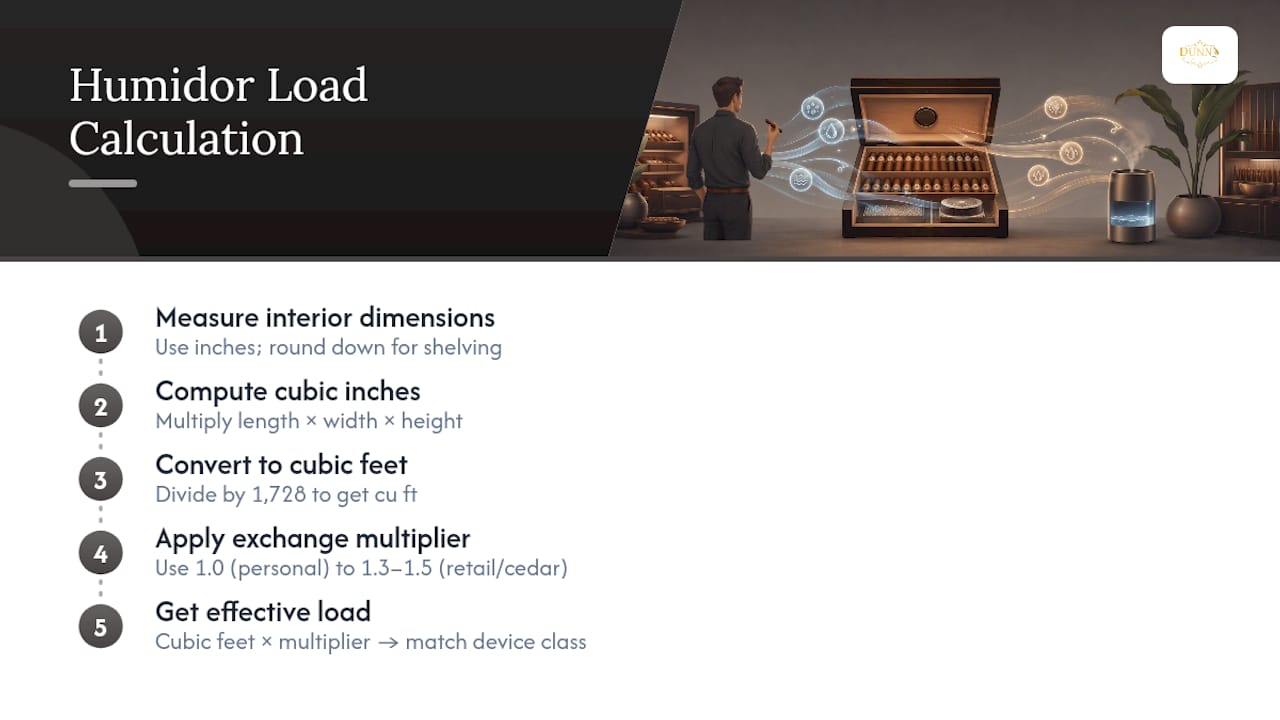
Step 4. Multiply cubic feet by the exchange multiplier to get your effective load, then match that figure against the device classes in the next section.
This mirrors how engineers actually approach whole-room humidity design. According to UltraPure Systems’ design guide, a proper load calculation weighs volume, ventilation, infiltration, and absorption by contents before landing on a required moisture-output rate. Collectors don’t need HVAC software to get a workable answer.
Worked example: a 4 ft × 3 ft × 6 ft cabinet is 72 cubic feet. With moderate foot traffic and cedar shelving, apply a 1.3 multiplier for an effective load of about 94 cubic feet. That points to an electronic unit rated in the 100 to 150 mL/hr range, the sweet spot for a mid-size retail cabinet rather than a passive pack system.
Matching Sizing to Equipment: Desktop, Cabinet, and Walk-In
Once you know your cubic footage, the device class mostly picks itself.
Desktop and small humidors (under 100 cigars). Boveda packs or humidity beads handle these boxes without a second thought. Boveda’s own pack-count chart recommends one Size 60 pack for a 25-cigar box, scaling up to four Size 320 packs (or sixteen Size 60s) for 400 cigars. These two-way packs release or absorb moisture automatically, which means they can’t push a sealed box past their rated humidity, a genuine safety advantage for collectors who travel or forget maintenance for weeks at a time.
Cabinets (100 to 1,500 cigars). This is where passive systems start to strain. Research comparing passive versus electronic humidification for cigar cabinets found that passive setups typically swing ±5 to 10% RH at this scale, while electronic units hold ±1 to 2%. For a cabinet holding a five-figure collection, that gap is the difference between stable aging and a slow, expensive mistake. Electronic units with appropriate output for cabinet size become worth the added cost when inventory value justifies the investment.
Walk-ins (1,500+ cigars). Retail and commercial guidance consistently points toward wall or ceiling mounted commercial units for this scale, per MDC Wholesale Cigars. The House of Hydro recommends cool-fog ultrasonic systems on a humidistat, targeting a stable relative humidity in the typical range, with auto-fill reservoirs to maintain operation. Redundancy matters here in a way it never does for a desktop box: run two mid-size units instead of one large one, or pair a primary unit with a backup that kicks in automatically. If one unit fails on a Friday and nobody notices until Monday, a single-unit walk-in can drift dangerously dry across an entire weekend of retail traffic.
The trade-off across all three scales is the same: passive systems ask nothing of you until they fail quietly, while electronic and ultrasonic systems ask for occasional maintenance in exchange for tight, verifiable control. For a $200 desktop box, that trade favors passive. For a walk-in stocked with six-figure inventory, it doesn’t.
What mL/hr, PPD, and ±1-2% RH Actually Mean
Specs sheets throw numbers at you without context, so here’s what they mean in practice.
- mL/hr (milliliters per hour): how much water vapor a unit adds to the air hourly. A small cabinet unit might run 50 to 100 mL/hr; a commercial walk-in system can exceed 500.
- PPD (pints per day): the same measurement expressed as daily output, common on larger commercial units. One pint per day equals roughly 20 mL/hr of continuous output.
- ±1-2% RH control: the tolerance an electronic humidistat holds around your target, compared to the ±5-10% swings typical of passive packs at cabinet scale.
On technology choice: passive packs and beads suit small, sealed, low-traffic boxes. Evaporative cartridge units offer a step up in cabinets without the complexity of ultrasonic hardware. Ultrasonic cool-fog systems dominate walk-ins because they add moisture without heat, staying quiet and scalable by adding discs or units as room size grows, a point The House of Hydro makes directly. Electronic evaporative and steam units sit in between, trading some of the ultrasonic’s fine control for lower upfront cost.
Closed-loop control, meaning a humidistat that reads actual RH and adjusts output accordingly, matters more than raw output capacity. A unit with impressive mL/hr numbers but no feedback loop will overshoot and undershoot. When buying, ask for the humidistat’s accuracy rating and whether it’s calibrated at the factory or requires setup on-site.
Installing for Real-World Performance
Sizing on paper means nothing if placement undermines it. Follow these steps once equipment arrives.
- Position the humidifier output away from direct cigar contact. Fog or mist aimed straight at wrappers causes localized over-humidification and can encourage spotting.
- Place hygrometers at opposite ends of larger spaces. For humidors over 500 cigars, MDC Wholesale Cigars recommends at least two sensors, since a single reading near the door won’t reflect conditions at the back wall.
- Add gentle circulation. A slow-moving fan equalizes RH across shelves without creating turbulence that dries out exposed wrapper leaves.
- Build in redundancy for retail and walk-in installations. Two smaller units, or one primary paired with a backup, protect against the failure-over-a-weekend scenario that ruins inventory.
Pro Tip: Always fill humidifiers with distilled or reverse-osmosis water, never tap. Mineral deposits from tap water clog ultrasonic discs and evaporative cartridges within weeks, quietly cutting your rated output long before the unit shows any obvious sign of failure.
Maintenance and Calibration That Keep Sizing Accurate
Correct sizing degrades without upkeep. Passive packs need replacement every two to six months depending on ambient conditions. Electronic reservoirs need refilling on a schedule matched to their run-time rating. Ultrasonic discs need cleaning monthly, more often in hard-water regions, to maintain rated mist output.
Calibrate hygrometers with the salt-test method every six months, or quarterly for busy retail displays where traffic accelerates sensor drift. If RH drops fast after refilling or stays stubbornly high despite a working humidifier, check door seals and cedar saturation before assuming the unit itself has failed. Rapid inventory growth or a jump in foot traffic is itself a signal: re-run the load calculation rather than assuming last year’s sizing still holds.
Dunn’s Approach to Sizing and Product Selection
Belle Dunn and the team at Dunnluxuryselections built their reputation on treating humidification sizing as engineering, not guesswork, applying the same load-calculation logic to every bespoke walk-in project. Each installation includes white-glove delivery and a consultation that walks through your actual cubic footage, traffic pattern, and cedar coverage before recommending equipment.
That mapping looks like this across Dunn’s catalog:
- Desktop and small collections: the ONYX, Modena, and Duke humidors pair naturally with humidity beads for low-maintenance stability.
- Cabinet-scale collections: the Barbatus and Bermuda cabinets pair with the HYDRA SM electronic humidifier for tight RH control.
- Retail and display: the Humidor Supreme® 9200 Series and Milano display suit high-traffic settings alongside the HYDRA Turbo commercial unit.
For collections with real investment value, a custom consultation catches load variables a generic chart never will.
| Point | Details |
|---|---|
| Sizing starts with volume | Measure interior cubic feet before choosing any humidifier. |
| Device class follows scale | Packs suit under 100 cigars, electronic units suit cabinets, ultrasonic suits walk-ins. |
| Custom sizing reduces risk | A Dunn’s consultation accounts for traffic and cedar load a chart can’t. |
What Collectors Get Wrong About Sizing
Most sizing mistakes I see aren’t equipment failures. They’re assumption failures. Collectors buy a humidifier rated for their cabinet’s total volume and never account for how often the door opens, then wonder why RH crashes every time a customer browses the case for ten minutes with the door propped open.
The conventional advice, buy a unit rated for your cubic footage and call it done, ignores the variable that actually determines real-world performance: behavior. A sealed personal cabinet opened twice a week behaves nothing like an identical cabinet in a retail lounge opened 40 times a day. Sizing charts that don’t ask about traffic are giving you half an answer.
The other overlooked factor is cedar itself. Raw, unsealed Spanish cedar is hygroscopic. It pulls moisture from the air to protect your cigars, which is exactly why collectors love it, but that same property means a cabinet lined floor to ceiling in raw cedar needs meaningfully more humidification capacity than a comparable cabinet with painted or sealed interior surfaces. Few buyers factor that into their calculation, and it’s often the reason a “properly sized” unit still struggles to hold target RH.
If you take one thing from this guide, let it be this: size for how you actually use the humidor, not for the empty box sitting in a showroom.
Get a Sizing Consultation Built Around Your Actual Collection
Generic sizing charts get you close. They don’t account for your specific traffic pattern, your cedar coverage, or the six-figure inventory riding on the outcome. Dunnluxuryselections builds every bespoke walk-in and cabinet project around the load calculation this guide walks through, refined through real consultations with collectors, lounges, and retailers who couldn’t afford to guess.

Whether you need a desktop humidor sized for a personal collection, a cabinet solution built for retail traffic, or a fully custom walk-in with commercial-grade redundancy, Dunn’s consultation process starts with your actual dimensions and usage pattern, not a generic chart. White-glove delivery and installation guidance come standard on every custom project. If your current setup drifts outside target RH or you’re planning a new installation, start a consultation and get a sizing recommendation matched to your real numbers.
Sources
- How many Boveda do I need? — Boveda Inc.
- How to Humidify a Walk-In Humidor — The House of Hydro
- Engineering the Perfect Smoke: A Design Guide to Humidity Control in Cigar Rooms — UltraPure Systems
FAQ
How many Boveda packs do I need for a 100-cigar humidor?
Boveda’s chart recommends roughly two Size 60 packs or one Size 320 pack for a humidor in the 100-cigar range, though cedar-heavy boxes may need one more.
When should I upgrade from packs to an electronic humidifier?
How often should I calibrate my hygrometer?
Every six months for personal collections, and quarterly for busy retail displays where handling and door traffic accelerate sensor drift.
What RH level prevents both mold and tobacco beetle activity?
Should I use tap water in my humidifier?
No. Use distilled or reverse-osmosis water only. Tap water minerals clog ultrasonic discs and evaporative cartridges, cutting output well before any visible failure.
Do walk-in humidors need a backup humidification unit?
Yes, for any commercial or high-value installation. Running two units, or a primary paired with a backup, protects inventory if one unit fails unnoticed over a weekend.
Recommended
You May Also Enjoy
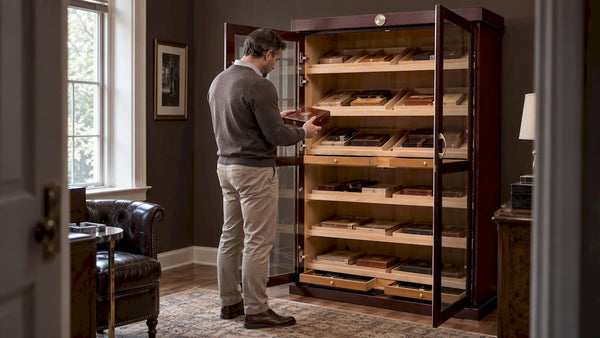
Cigar Collection Insurance: How to Protect Your Humidor
Home policies often cap or exclude cigars. Learn how floaters, agreed value, appraisals and inventories protect a serious...
Read Article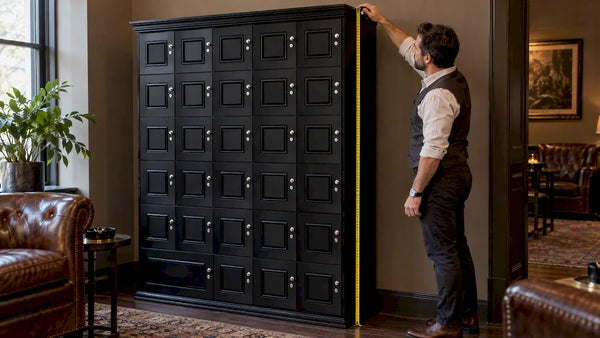
Cigar Locker Dimensions: Sizing Guide for Collectors and Lounges
Cigar locker dimensions explained: compartment sizes, cabinet footprints, capacity math and clearances, so you size a locker bank...
Read Article
Sealing a Walk-In Humidor: Envelope, Door and Penetrations
How to seal a walk-in humidor properly: vapor barrier placement, door gasket, penetrations and the controlled airflow a...
Read Article