

Discover what a humidor divider is and how it optimizes cigar storage. Control humidity effectively and protect your prized collection today!
You’ve invested in a quality humidor, chosen premium cigars, and sourced the finest humidity packs available — yet subtle inconsistencies in moisture still find a way to threaten your collection. Some cigars dry out along the edges. Others absorb too much moisture near the humidification source. The culprit is rarely the humidor itself; it’s the absence of proper internal climate control at the zone level. Professional standards call for no greater than ±3% RH drift across the interior, a benchmark that’s difficult to achieve without thoughtful use of humidor dividers.
Table of Contents
- What is a humidor divider?
- How dividers affect humidity balance
- Organizing your cigars with dividers
- Selecting and maintaining the best divider for your humidor
- Why most cigar owners underestimate the impact of dividers
- Unlock precision storage with premium humidor dividers
- Frequently asked questions
Key Takeaways
| Point | Details |
|---|---|
| Precision humidity control | Humidor dividers help limit humidity fluctuations, ensuring all your cigars age evenly and remain fresh. |
| Organized cigar storage | Dividers allow you to sort and separate cigars by type, age, or brand for easier access and inventory checks. |
| Protects flavor and value | Using dividers minimizes cross-contamination of tastes and preserves the distinct character of premium cigars. |
| Easy upgrade | Adding a divider is a simple change with major benefits—most collectors will notice improved quality and organization quickly. |
What is a humidor divider?
Now that we’ve set the stage for why humidity control matters, let’s clearly define what a humidor divider actually is and what sets it apart from ordinary separators.
A humidor divider is a structured panel, shelf, or partition installed inside your humidor to create distinct zones within the storage environment. Unlike a generic tray or shelf that simply holds cigars in place, a properly designed divider actively participates in regulating airflow and humidity distribution throughout the cabinet’s interior. It is, in essence, a precision instrument within your sanctuary of fine tobacco.
Materials used in quality dividers include:
- Spanish Cedar: The gold standard. Spanish Cedar (Cedrela odorata) is porous enough to absorb and release moisture, naturally supporting relative humidity regulation. It also carries aromatic compounds that repel the tobacco beetle, one of the most insidious threats to a collection.
- Acrylic: A modern alternative that provides visual clarity and is easy to clean. Acrylic dividers do not contribute to humidity regulation but offer excellent structural rigidity, making them ideal as secondary separators.
- Kiln-dried hardwood: Some artisan dividers use kiln-dried maple or mahogany, offering a balance between aesthetic beauty and moderate humidity interaction.
- Plastic composites: Budget-friendly and moisture-neutral, plastic dividers serve primarily organizational purposes without offering any climate contributions.
Dividers are typically slotted vertically or horizontally into the humidor’s interior framework, fitting snugly against cedar-lined walls. In cabinet humidor designs, dividers may occupy multiple shelves across a towering enclosure, segmenting a collection of hundreds into precise categories without disrupting the ambient climate.
“A divider is not a wall. It is a guide — directing moisture, organizing legacy, and ensuring that each cigar receives the exact environment it was meant to age within.”
The physical placement of a divider shapes how air circulates inside your humidor, channeling humidity more evenly toward every corner rather than allowing moisture gradients to form near the humidification device. Even a single well-placed panel can transform an uneven microclimate into a coherent, stable ecosystem.
How dividers affect humidity balance
With a clear understanding of what a humidor divider is, it’s crucial to see how it actually influences your humidor’s internal environment.
The interior of any humidor is subject to natural humidity gradients. Moisture-rich air rises and concentrates near the humidification source, while areas farther from that source receive progressively less humidity. Without intervention, humidity zone variance can exceed 5% relative humidity from one corner to another, a range wide enough to compromise the aging process of the cigars stored there.
Dividers disrupt this uneven distribution by breaking the interior into smaller, more manageable microzones. Each compartment develops its own localized equilibrium, reducing the magnitude of humidity swings that any single cigar must endure. The result is a more predictable, uniform environment across the full depth of your collection.
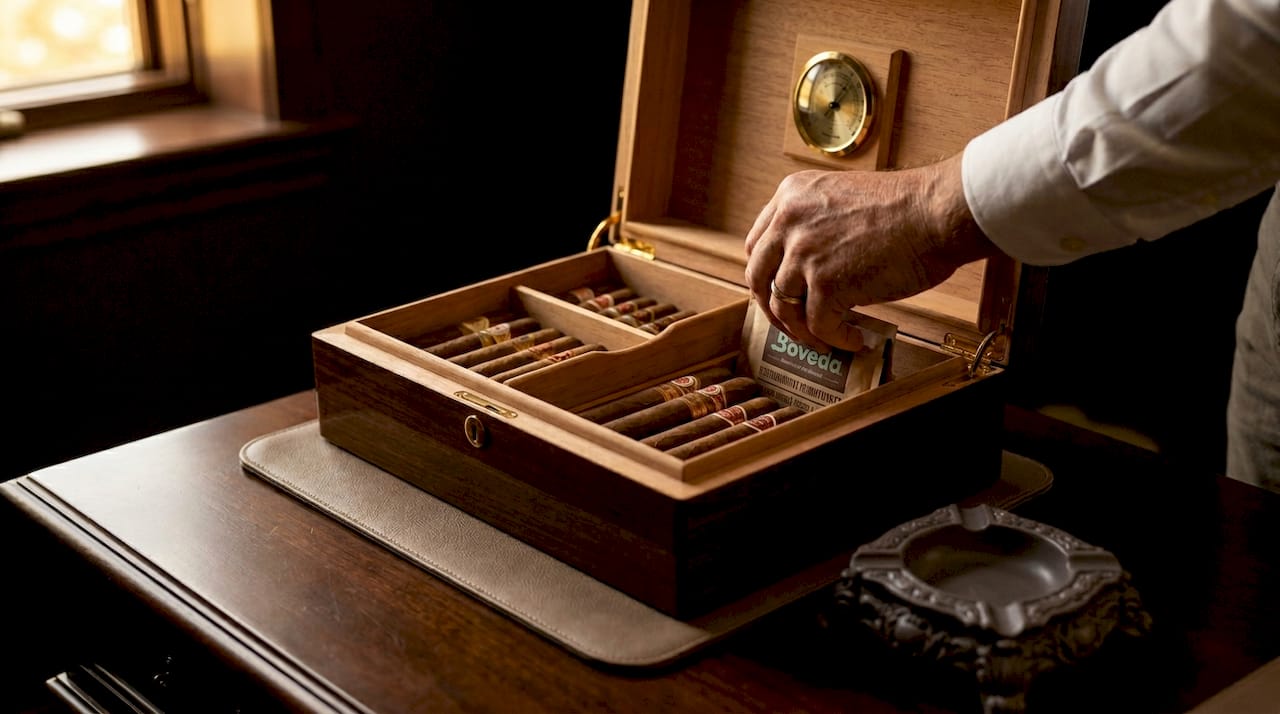
Humidity performance benchmarks:
| Condition | Without dividers | With proper dividers |
|---|---|---|
| RH drift (daily) | ±5% to ±8% | ±1% to ±3% |
| Zone variance | 6% to 10% | Less than 5% |
| Temperature gradient | Moderate | Minimal |
| Moisture near source | Oversaturated | Regulated |
| Moisture at far corners | Under-humidified | Balanced |
Pro Tip: If you’re using Boveda packs, dividers amplify their effectiveness significantly. Boveda packs stabilize ambient relative humidity within a sealed space. Dividers reduce the size of the effective “space” that each pack must manage, enabling more precise calibration with less variance.
One of the most persistent misconceptions in cigar storage is that dividers block humidity flow, effectively starving sections of the humidor from moisture. This is incorrect. Well-designed dividers, particularly those crafted from Spanish Cedar, are permeable enough to allow slow, regulated humidity exchange while buffering against sudden spikes and drops. They do not create sealed vaults; they create controlled passages.
Consider a desktop humidor setup holding 50 cigars. Without a central divider, the cigars on the left side of the tray, directly beneath the humidification panel, might hover at 72% relative humidity while those at the far right rest at 66%. Over weeks and months, this differential silently separates the cigars into two very different states of readiness. A single cedar divider placed at center can close that gap to within 2%, protecting the entire tray with one elegant intervention.
For collectors who consult detailed humidor care guides, zonal climate control is identified as one of the most meaningful refinements a serious aficionado can make, second only to selecting the humidor itself.
Organizing your cigars with dividers
Once humidity is managed, maximizing the organizational potential of dividers can further elevate your cigar collecting experience.
Beyond climate control, dividers are one of the most powerful organizational tools available to the serious collector. The ability to sort, categorize, and protect cigars at a granular level transforms a humidor from simple storage into a curated library of moments. Each compartment becomes a chapter in your collection’s story.
Step-by-step arrangement for optimal preservation:
- Define your sorting criteria. Decide whether you’ll organize by brand, size (robusto, toro, churchill), country of origin, or aging batch. Mixed criteria systems work well in larger cabinets with multiple rows of dividers.
- Assign zones by humidity preference. Certain wrappers, particularly Connecticut and Ecuadorian varieties, perform best at 65% to 68% RH. Full-bodied Nicaraguan blends often thrive closer to 70%. Place humidity-sensitive cigars in zones closest to the humidification source.
- Install dividers with appropriate spacing. Ring gauge matters. A 60-ring gauge cigar needs more vertical space per row than a slender lancero. Adjust divider placement to avoid compression, which can damage the wrapper leaf.
- Label each zone. A small cedar placard or removable label at the front of each divider section brings immediate clarity when reaching for a specific blend.
- Rotate stock by aging date. Position newer acquisitions at the rear of each zone and older cigars at the front, maintaining a first-in, first-out inventory discipline.
Comparing divider strategies by collection type:
| Collection type | Recommended divider setup | Key benefit |
|---|---|---|
| Single brand collector | 2 to 3 size-based zones | Simplicity and easy access |
| Multi-brand aficionado | 4 to 6 brand-based zones | Clean separation, no flavor transfer |
| Aging cellar | Batch-dated compartments | Timeline precision for long-term aging |
| Mixed RH needs | Humidity-graduated zones | Tailored environment per wrapper |
Rare cigars warrant particular care. A single Dominican Fuente Fuente OpusX or a vintage Cohiba Behike represents not just significant monetary value but irreplaceable flavor heritage. Cross-contamination, where a heavily flavored infused cigar shares airspace with an aged natural, is a real and often underestimated risk. Walk-in humidor divider options allow for complete physical separation of such collections, creating a truly bespoke preservation system worthy of the cigars it houses.
Pro Tip: When storing infused or flavored cigars alongside naturals, always place infused cigars in a separate, sealed tray within their own divider zone. Even with cedar dividers, aromatic compounds from infused cigars are volatile enough to migrate and subtly alter the character of neighboring naturals over time.
The organizational discipline reinforced by dividers also supports inventory awareness. Aficionados who curate with intention are far less likely to over-purchase, forget aging cigars, or inadvertently smoke a cigar before it reaches its peak. Structure, in this sense, is a form of respect for the craft.
Selecting and maintaining the best divider for your humidor
To fully benefit from dividers, it’s worth considering which type best suits your setup and how to keep them performing at their peak.
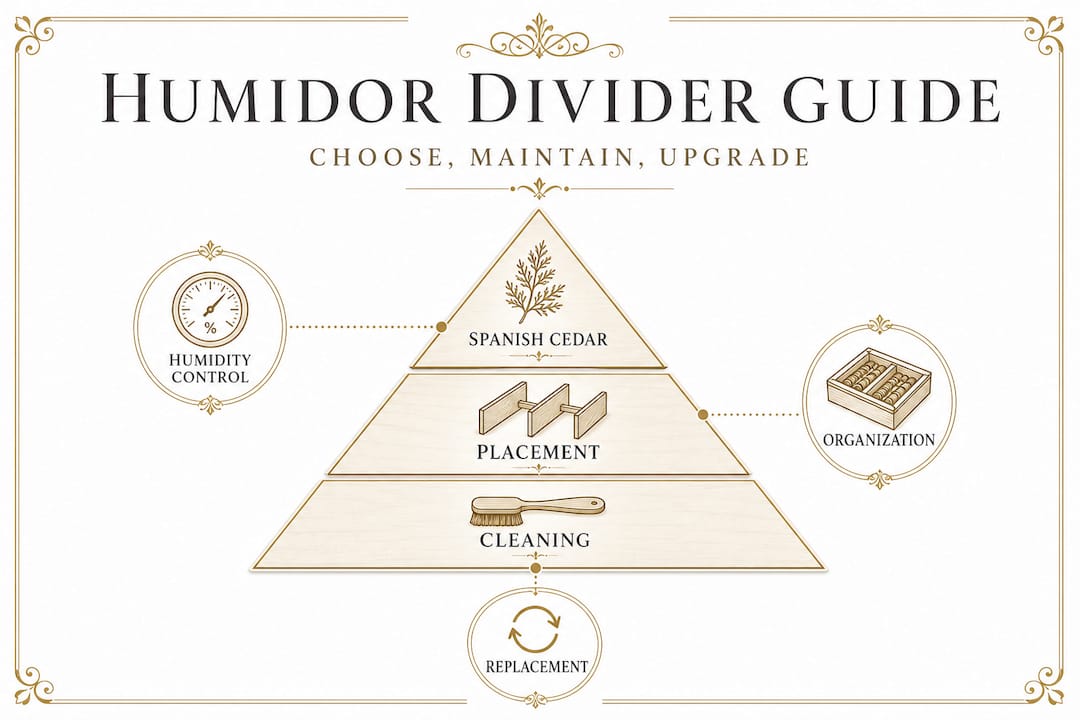
Selecting the right divider is a decision informed by three variables: the size of your humidor, your humidity management system, and your organizational preferences. Not every divider serves every collection equally, and choosing incorrectly can introduce new problems rather than solve existing ones.
Key considerations when selecting a humidor divider:
- Match material to humidity system. If you rely on passive humidity packs like Boveda or Heartfelt, Spanish Cedar dividers are strongly preferable, as they actively buffer moisture changes. If you use an active electronic humidification system, acrylic dividers work well alongside the device’s precision output.
- Size the divider to your humidor’s interior. A loose-fitting divider that doesn’t contact the floor and walls of the humidor creates humidity bypass channels, defeating the purpose of zonal control. Precision-cut panels that fit snugly are essential.
- Consider adjustable divider systems. Many premium humidors feature slotted rail systems that allow dividers to be repositioned as your collection evolves. This flexibility is invaluable for serious collectors who acquire new sizes and formats regularly.
- Avoid treated or varnished wood. Chemical finishes on wooden dividers off-gas into the humidor’s environment and can impart unwanted odors to your cigars. Always use unfinished, untreated wood or food-grade acrylic.
- Inspect dividers seasonally. Seasonal shifts in ambient temperature and humidity outside the humidor create internal stress on wood dividers, causing subtle warping over time. Inspect panels every three to four months.
Maintenance is equally important. A neglected divider can become a liability. Accumulated dust or residue diminishes the cedar’s natural porosity, reducing its ability to contribute to humidity regulation. Divider maintenance tips recommend wiping Spanish Cedar panels monthly with a dry, lint-free cloth. Avoid any moisture-based cleaning agents, as excess water introduction can spike internal humidity and create conditions favorable to mold.
If you notice a white powdery film on a cedar divider, investigate immediately. This can indicate the early stages of mold growth triggered by excessive moisture. Remove the affected panel, allow it to air out in a cool, dry location away from direct sunlight, and recalibrate your humidity source before reinstalling.
Replacement is straightforward. Cedar divider panels are modular by design, and replacing a warped or compromised panel is far less costly than addressing widespread mold damage throughout your collection. Maintaining consistent zone-level humidity standards of less than 5% zone variance remains the governing principle behind every divider decision you make.
Why most cigar owners underestimate the impact of dividers
Bringing all of this together, it’s clear that the humble divider deserves a louder spot in the cigar community’s conversations.
We see it repeatedly: aficionados invest thousands in a statement humidor, source Boveda packs by the case, and acquire electronic hygrometers with laboratory precision, yet leave the interior of their cabinet as one undifferentiated open space. The assumption seems to be that the humidor’s quality alone is sufficient to protect everything inside it. That assumption is quietly, persistently wrong.
The truth is that a premium humidor without internal organization is like a wine cellar without a racking system. The environment may be ideal at the macro level, but without structure, individual bottles — or in your case, individual cigars — are subject to the room’s variations rather than the precision you’ve carefully engineered.
We have observed collections where a single cedar divider, costing a fraction of the humidor itself, resolved humidity instability that had persisted for months. The RH drift dropped from ±6% to ±2% overnight. The aficionado had been blaming his Boveda pack size, then his humidor seal, then his hygrometer’s placement. The issue was simply an absence of internal structure directing moisture where it needed to go.
Dividers are not accessories. They are infrastructure. They are the circulatory system of your humidor’s climate. Without them, even the finest instrument cannot perform at its full potential. Every serious collection, regardless of size, deserves the quiet, elegant precision that a properly placed divider provides. We believe that investing in this often-overlooked element is one of the highest-value decisions a collector can make.
Unlock precision storage with premium humidor dividers
If you’re ready to upgrade your cigar storage with proven tools, take the next step toward a truly refined collection.
At Dunn Luxury Selections, we understand that every cigar in your collection carries a story worth preserving. Our curated range of premium humidor accessories includes precision-engineered dividers, tray systems, and humidity management tools designed to work in harmony with the finest humidors available. Whether you’re optimizing a personal desktop setup or commissioning a full walk-in environment, the right internal architecture begins with quality components.

Explore our full collection of desktop humidors and divider-ready storage systems, each built to the standards that serious aficionados demand. Precision, prestige, and presence — that’s the promise we deliver with every product in our catalog. Your collection deserves nothing less.
Frequently asked questions
Do I need a divider for a small desktop humidor?
A divider is genuinely helpful even in compact desktop setups, keeping cigars organized while minimizing humidity differences that naturally develop between the zone nearest the humidification source and the far corners of the tray.
What’s the best material for a humidor divider?
Spanish Cedar remains the premier choice because its natural porosity supports relative humidity regulation and its aromatic oils repel tobacco beetles, though acrylic dividers offer a clean, moisture-neutral alternative for collectors using active electronic humidification systems.
How often should I clean or replace my humidor divider?
Wipe Spanish Cedar dividers with a dry cloth monthly to maintain their porosity, and replace any panel showing signs of mold, significant warping, or noticeable odor transfer to protect the integrity of your collection.
Can dividers prevent flavor mixing between cigars?
Properly placed dividers create physical separation that significantly reduces aromatic cross-contamination, helping each cigar retain its distinct flavor profile and aging character over time, particularly when separating infused cigars from natural blends.
Recommended
You May Also Enjoy
Cigar Locker Dimensions: Sizing Guide for Collectors and Lounges
Cigar locker dimensions explained: compartment sizes, cabinet footprints, capacity math and clearances, so you size a locker bank...
Read Article
Sealing a Walk-In Humidor: Envelope, Door and Penetrations
How to seal a walk-in humidor properly: vapor barrier placement, door gasket, penetrations and the controlled airflow a...
Read Article
Retail Humidor ROI: How to Measure What a Display Earns
What does a retail or lounge humidor really return? A practical framework for cigar shops, lounges and clubs:...
Read Article