

Discover iconic cigar moments that shaped culture, from JFK’s last-minute stockpile to Churchill’s lifelong ritual. Dive in!
The most culturally significant iconic cigar moments include the Tampa “Cigar of Liberty” that sparked the 1895 Cuban uprising, Cohiba’s origin as Fidel Castro’s personal smoke, Winston Churchill’s lifelong Havana ritual, JFK’s last-minute Cuban cigar stockpile before signing the embargo, Red Auerbach’s Boston Celtics victory cigar, the Revolutionary-era Connecticut seed story, and the indelible cigar images of Bogart, Twain, and Bond. Each of these moments shaped how collectors, historians, and aficionados understand the cigar as an object of power, identity, and legacy.
- The “Cigar of Liberty,” rolled at Tampa’s O’Halloran factory, concealed the message that launched a revolution
- Cohiba began as Castro’s private smoke in 1966 before becoming a diplomatic icon
- Churchill’s Havana habit started in 1895 and never stopped, even at altitude
- JFK ordered hundreds of Cuban cigars hours before signing the U.S. embargo
- Red Auerbach’s victory cigar provoked the Cincinnati Royals to distribute 5,000 cigars to fans
- Israel Putnam’s alleged Cuban seed import seeded the Connecticut wrapper tradition
- Bogart, Twain, Freud, and Bond fixed the cigar’s image in popular imagination for generations
For collectors, these stories carry weight beyond nostalgia. Provenance, archival artifacts, and the preservation of related memorabilia demand the same precision as the cigars themselves, which is where museum-grade humidor storage becomes part of the legacy.
Key Takeaways
The most enduring iconic cigar moments share one quality: each is anchored by a documented artifact, a named place, or a recorded act that collectors can trace, visit, and preserve.
| Point | Details |
|---|---|
| Provenance defines value | Cigars tied to documented historical moments carry cultural weight that demands archival-grade storage. |
| Tampa / Ybor City is the epicenter | The O’Halloran factory and USF archives make Tampa the most important American site for cigar history. |
| Political rituals shaped the market | JFK’s pre-embargo stockpile and the Cuban nationalization permanently transformed U.S. cigar culture. |
| Pop culture fixed the cigar’s image | Bogart, Twain, Freud, and Bond normalized cigar prestige across the 20th century. |
| Dunnluxuryselections preserves the legacy | The Bermuda Cabinet, Milano Display, and Santiago Humidor offer collectors the precision storage these artifacts deserve. |
Table of Contents
- Iconic cigar moments that changed history
- What cigars have symbolized across cultures
- How cigars function as ritual objects
- How these moments reshaped American cigar culture
- How these moments were selected
- A collector’s perspective on preserving what matters
- Preserve the legacy with Dunnluxuryselections
- Sources
- FAQ
Iconic cigar moments that changed history
The stories below are arranged roughly in chronological order, each grounded in primary sources and archival evidence.
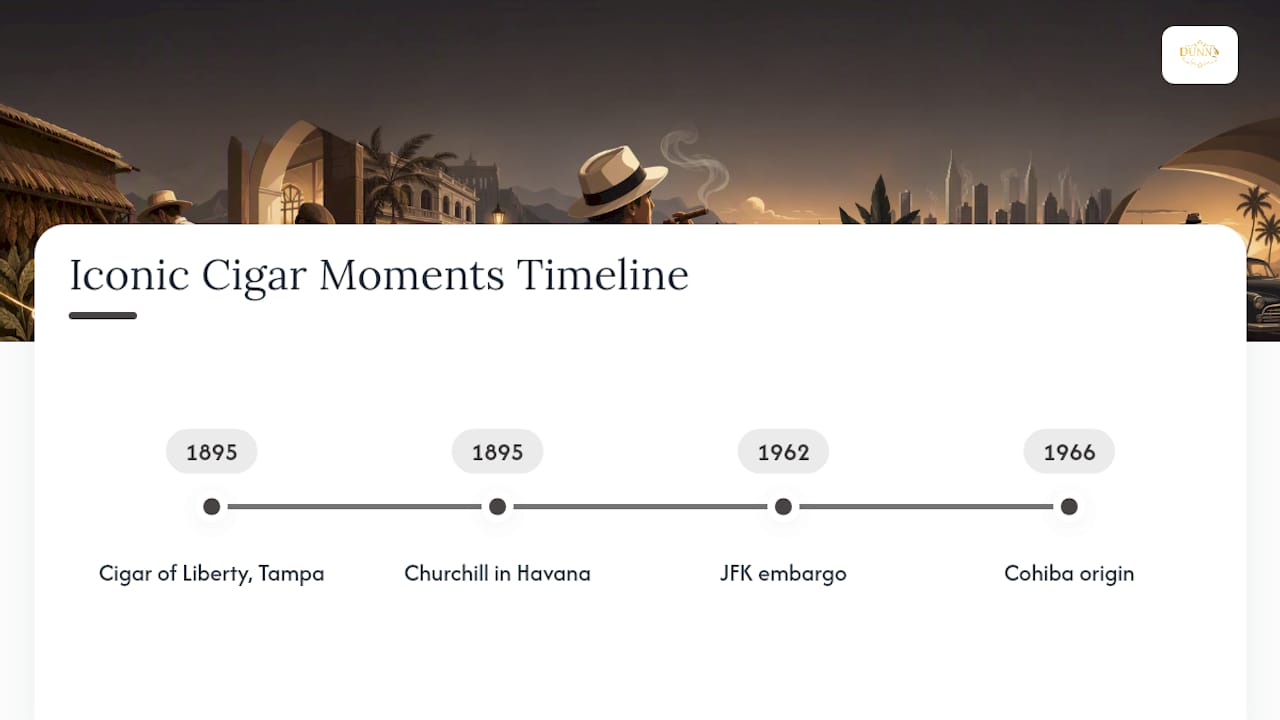
The Cigar of Liberty, Tampa, 1895. The most consequential cigar in American history was never smoked. Rolled at the O’Halloran factory in Tampa’s Ybor City, it concealed the “Message to Gómez,” a communiqué that helped ignite the Cuban War of Independence. University of South Florida archives document the episode, including factory records and sketches of the historic cigar. For collectors, this is the definitive proof that a cigar’s provenance can carry the weight of a nation’s history.
The Revolutionary-era Connecticut seed story. According to a persistent origin myth documented in American cigar history reporting, General Israel Putnam returned from Cuba with seeds that eventually gave rise to the Connecticut wrapper tradition. Whether strictly factual or partly legend, this story anchors American cigar identity to the Revolutionary era and explains why Connecticut-grown leaf commands reverence among collectors today.
Winston Churchill in Havana, 1895 onward. Churchill’s affinity for Cuban cigars began during a visit to Havana in 1895 and never wavered. Biographers and Cigar Aficionado’s profile recount that he had a special oxygen mask modified to allow smoking at altitude during wartime flights. That single detail says everything about ritual preservation: Churchill treated his cigar not as an indulgence but as a non-negotiable instrument of his public identity.
Cohiba’s origin, 1966. Cohiba did not begin as a commercial brand. According to Cigar Aficionado’s 50-year retrospective, it started as Fidel Castro’s personal smoke, produced by a single roller whose work caught Castro’s attention. It later became a vehicle for Cuban diplomacy, gifted to heads of state and foreign dignitaries. Brand origin stories of this kind function as living provenance, and Cohiba’s anniversary editions still command premium prices at auction.
Red Auerbach’s victory cigar. Boston Celtics coach Red Auerbach made a habit of lighting a cigar in the closing minutes of games he knew his team had won. The gesture infuriated opponents. According to Cigar Aficionado’s Top 100 Cigar Smokers, the Cincinnati Royals once distributed 5,000 cigars to fans before a game against Boston as a pointed counter-statement. No other cigar ritual in American sports history generated that kind of organized response.
JFK and the Cuban embargo, 1962. The night before President Kennedy signed the executive order banning Cuban imports, he sent press secretary Pierre Salinger to secure a large supply of Petit Upmann cigars. Cigar Aficionado’s account places the order at over 1,000 cigars. Kennedy signed the embargo the following morning. The episode crystallized how political acts and personal cigar rituals could intersect at the highest levels of power, and it permanently elevated the mystique of Cuban cigars in the American market.
Tampa / Ybor City and the Cuban exodus. When Cuba nationalized its cigar factories in 1960, master rollers and tobacco families emigrated, many to Tampa’s Ybor City, others to Honduras, Nicaragua, and the Dominican Republic. Cigar Aficionado’s “The Exodus” documents how that diaspora seeded the global premium cigar industry outside Cuba, transforming what had been a Cuban monopoly into a multinational craft tradition.
Film, literature, and the popular imagination. Humphrey Bogart, Mark Twain, Sigmund Freud, and the James Bond franchise each fixed a distinct cigar archetype in the public mind: the world-weary detective, the irreverent wit, the intellectual provocateur, the suave operative. Cigar Aficionado’s cultural survey traces how these recurring images normalized and romanticized cigar consumption across the 20th century, making the cigar a shorthand for a certain kind of authority and ease.
What cigars have symbolized across cultures
Scholar Fernando Ortiz framed tobacco and sugar as counterpoint commodities in Cuban history, arguing that Havana tobacco became a symbol of bourgeois triumph and a central element of Cuban national identity. His analysis, cited in El Habano: The Global Luxury Smoke, positions the cigar as something more than a consumer product: it was a cultural argument about civilization, refinement, and independence.
Historians studying tobacco use and social identity in Britain and North America argue that smoking functioned as a social display across centuries, signaling status, belonging, and elite affiliation. The cigar, specifically, carried connotations of deliberate leisure and financial ease that the cigarette never quite achieved.
Across cultures, the cigar has served as:
- A national symbol (Cuba’s independence movement, Tampa’s émigré identity)
- A masculine signifier (from Revolutionary-era American unity to 20th-century celebrity culture)
- A diplomatic instrument (Cohiba gifted to foreign dignitaries by Castro)
- A political prop (Castro photographed with Khrushchev, Churchill in wartime)
- A pop-culture shorthand for authority, wit, and worldliness (Bogart, Twain, Freud, Bond)
How cigars function as ritual objects
The victory cigar works precisely because it is public and deliberate. Auerbach did not light up in private; he did it on the bench, in view of opponents and fans, as a statement of certainty. The Cincinnati Royals’ 5,000-cigar counter-gesture confirms that the ritual had real psychological force.
Diplomatic cigars operate differently. A gifted box of Cohiba carries the weight of the brand’s origin story, its association with Cuban sovereignty, and the personal authority of the giver. Cohiba’s trajectory from Castro’s private smoke to a global luxury brand is inseparable from that gifting tradition.
The Cigar of Liberty represents a third ritual category: concealment. A physical cigar became a courier, its hollow core carrying a message that no envelope could safely deliver. The USF archival record of the O’Halloran factory sketches makes this one of the few cigar stories with genuine documentary evidence.
- Victory rituals: public display, psychological dominance, opponent provocation
- Diplomatic gifts: brand provenance, political symbolism, ceremonial weight
- Concealment: the cigar as courier, physical object as covert instrument
- Personal ritual: Churchill’s altitude modification, Kennedy’s pre-embargo stockpile
Pro Tip: When acquiring cigars with documented historical provenance, photograph the band, box, and any accompanying paperwork before storing. That documentation is as valuable as the cigar itself.
How these moments reshaped American cigar culture
The 1960 Cuban factory nationalization and the subsequent émigré exodus transformed the American cigar market permanently. Master rollers who settled in Tampa’s Ybor City, along with those who moved to Honduras, Nicaragua, and the Dominican Republic, carried their seed stocks, blending knowledge, and rolling techniques with them. The result was a genuinely global premium cigar industry built on Cuban craft traditions but no longer dependent on Cuban soil.
The Connecticut wrapper myth, traced to Israel Putnam’s alleged seed import, gave American-grown leaf a founding narrative that collectors and manufacturers have cultivated ever since. Whether or not Putnam actually brought Cuban seeds back from the Caribbean, the story functions as a provenance claim that adds cultural weight to Connecticut shade-grown tobacco.
Places and events where you can experience these stories:
- Ybor City Historic District, Tampa, FL: Walking the streets where the O’Halloran factory stood and where the Cigar of Liberty was rolled
- University of South Florida Digital Commons: Archival access to the Sunland Tribune’s 1980 documentation of the Cigar of Liberty episode
- Habanos Festival, Havana: Annual celebration of Cuban cigar culture, including Cohiba anniversary releases
- Ybor City Museum State Park: Exhibits on the Tampa cigar industry and the Cuban émigré community
For collectors who acquire cigars with historical significance, archive-grade storage is not optional. The Santiago 700-cigar humidor offers the capacity and climate precision that serious archival collections require.
How these moments were selected
Each moment in this article was chosen against four criteria: documented historical significance, surviving primary artifacts or archival records, cultural resonance across multiple contexts, and coverage by credible scholarly or industry sources. Moments supported only by anecdote without documentary backing were excluded or clearly labeled as origin myths.
Sources used include:
- University of South Florida Digital Commons (primary archival documentation)
- Cigar Aficionado industry reporting (Top 100 Cigar Smokers, Cohiba 50th anniversary, Kennedy/Cuba, The Exodus)
- Cambridge University Press / The Historical Journal (scholarly tobacco and identity research)
- DOI-linked academic work on Fernando Ortiz and Cuban tobacco symbolism
- Smoke Signals Weekly (Connecticut seed origin narrative)
Dunnluxuryselections brings the same standard of evidence to its humidor craft: every cabinet, display, and humidor is built to specifications that protect the artifacts collectors entrust to them.
A collector’s perspective on preserving what matters
The emotional pull of these stories is real, and it changes how serious collectors think about storage. A cigar associated with a historic moment, a band from a pre-embargo Cuban box, a factory label from Ybor City — these are not decorative details. They are provenance, and provenance requires the same controlled environment as the tobacco itself.
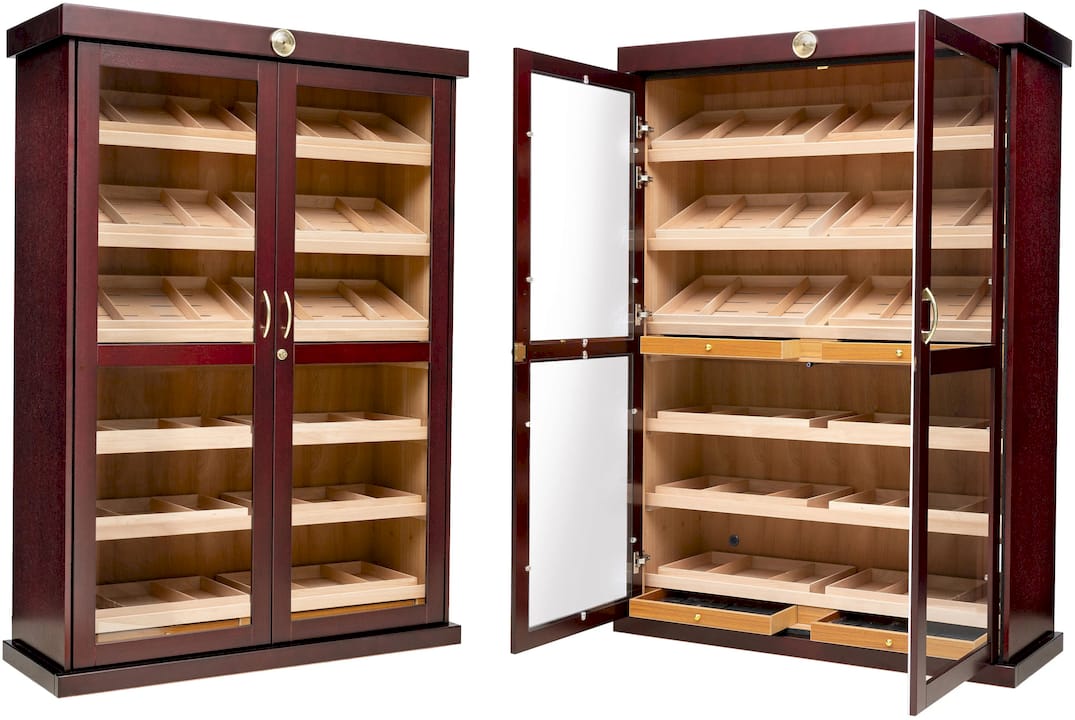
The Bermuda Cabinet humidor suits large archival collections; the Milano cigar display presents single prized cigars or memorabilia with museum-grade visibility; the Santiago humidor handles 700-cigar capacity for collectors building a serious archive.*
Preserve the legacy with Dunnluxuryselections
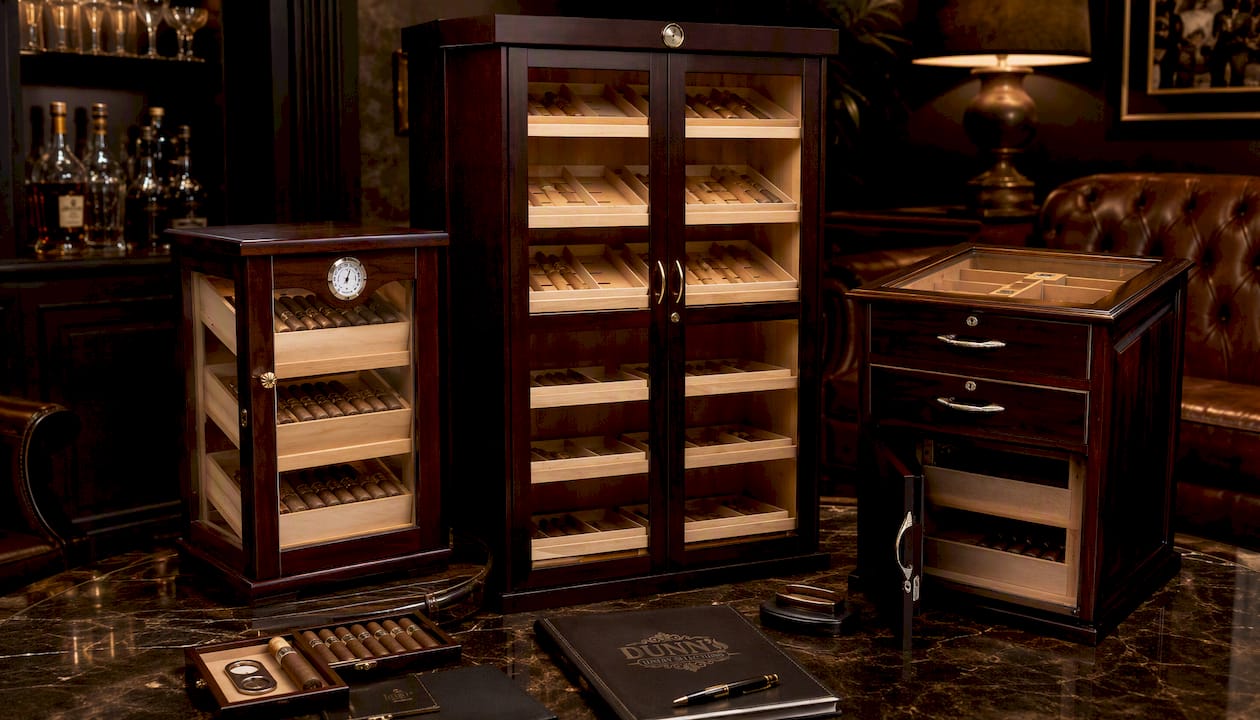
Every story in this article ends with an artifact worth protecting. The Cigar of Liberty’s factory sketches, a pre-embargo Cuban band, a Cohiba from a diplomatic occasion — these objects lose their meaning the moment humidity control fails. Dunnluxuryselections builds the sanctuaries that serious collectors trust: the Bermuda Cabinet for large archival holdings, the Milano Display for single prized pieces, and the Santiago for collectors scaling toward a 700-cigar archive. Explore the full cabinet humidor collection or contact Dunnluxuryselections directly for a bespoke consultation.
Sources
- Digital Commons @ University of South Florida: Cigar of Liberty (Sunland Tribune, 1980)
- 50 Years Of Cohiba | Cigar Aficionado
- Tobacco-taking and identity-making in early modern Britain and North America | Historical Journal
FAQ
What is the “Cigar of Liberty” and why does it matter?
The Cigar of Liberty was rolled at Tampa’s O’Halloran factory in 1895 to conceal the “Message to Gómez,” a communiqué that helped spark the Cuban War of Independence. University of South Florida archives preserve the factory records and sketches documenting the episode.
Why did JFK stockpile Cuban cigars before the embargo?
The night before signing the Cuban import ban in 1962, President Kennedy sent press secretary Pierre Salinger to secure over 1,000 Petit Upmann cigars. Cigar Aficionado’s reporting on the episode remains the primary published account.
How did Cohiba become a diplomatic symbol?
Cohiba originated in 1966 as Fidel Castro’s personal smoke, produced by a single roller whose blends caught Castro’s attention. It was later gifted to foreign dignitaries, transforming a private ritual into a vehicle for Cuban state diplomacy.
What humidity level should collectors maintain for archival cigars?
The Dunnluxuryselections Bermuda Cabinet and Santiago Humidor are engineered to that standard.
Where can you experience American cigar history in person?
Ybor City Historic District in Tampa, Florida, and the Ybor City Museum State Park offer the most direct connection to the émigré cigar tradition and the site of the O’Halloran factory. The University of South Florida Digital Commons provides online archival access to primary documents.
Recommended
You May Also Enjoy
Cigar Collection Insurance: How to Protect Your Humidor
Home policies often cap or exclude cigars. Learn how floaters, agreed value, appraisals and inventories protect a serious...
Read Article
Cigar Locker Dimensions: Sizing Guide for Collectors and Lounges
Cigar locker dimensions explained: compartment sizes, cabinet footprints, capacity math and clearances, so you size a locker bank...
Read Article
Sealing a Walk-In Humidor: Envelope, Door and Penetrations
How to seal a walk-in humidor properly: vapor barrier placement, door gasket, penetrations and the controlled airflow a...
Read Article