

Discover the most popular cigar shapes and how each vitola impacts your smoking experience. Elevate your enjoyment today!
Parejos dominate premium cigar production, and within that family, a handful of vitolas account for the vast majority of what collectors and enthusiasts actually smoke: the Robusto, Toro, Churchill, Corona, Lancero, Panetela, Belicoso, Torpedo, Perfecto, and Double Corona. According to Cigar Aficionado, parejos are the most common premium cigar shape precisely because their straight-sided construction makes them efficient to produce and consistent to smoke. Shape is not cosmetic. It determines how long you smoke, how much heat concentrates at the draw, and whether the wrapper or filler dominates your palate from the first third to the last.
The most popular vitolas at a glance:
- Robusto — ~5 in., 50 ring gauge (rg), ~60 minutes
- Toro — ~6 in., 50–54 rg, ~75–90 minutes
- Churchill — ~7 in., 47–50 rg, ~90–120 minutes
- Corona — ~5.5 in., 42–44 rg, ~45–60 minutes
- Corona Gorda — ~5.5–6 in., 46–50 rg, ~60–75 minutes
- Lancero — ~7–7.5 in., ~38 rg, ~90 minutes
- Panetela — ~6–7 in., 34–38 rg, ~60–75 minutes
- Belicoso — ~5–5.5 in., 50–52 rg, ~60 minutes
- Torpedo / Pyramid — ~6–7 in., 52–56 rg, ~75–90 minutes
- Perfecto — varies, 48–60 rg at widest, ~60–90 minutes
- Double Corona — ~7.5–8.5 in., 49–52 rg, ~120+ minutes
The vitola cheat sheet below gives you the precise dimensions and occasion guidance to match any of these shapes to your time, palate, and pairing.
Key Takeaways
The Robusto is the most practical entry point for any blend, but the vitola you choose ultimately determines how long you smoke, how intense the draw feels, and whether wrapper or filler leads the flavor.
| Point | Details |
|---|---|
| Parejos dominate production | Straight-sided vitolas (Robusto, Toro, Churchill) account for the majority of premium cigars due to rolling efficiency. |
| Ring gauge drives intensity | Gauges below 44 concentrate wrapper flavor; gauges of 50 and above broaden and soften the smoke. |
| Figurados shift the flavor arc | Tapered shapes like the Pyramid and Perfecto change combustion zones, making wrapper influence rise toward the final third. |
| Blenders reformulate by vitola | Filler composition often changes across vitolas in the same line to preserve balance, so the same blend can taste distinctly different in a Lancero vs. a Robusto. |
| Storage preserves the comparison | Keeping multiple vitolas in a dedicated humidor, such as the Dunnluxuryselections Duke desktop or Milano display, ensures identical conditions for accurate tasting. |
Table of Contents
- What Are the Most Popular Cigar Shapes? A Vitola Cheat Sheet
- Parejos vs. Figurados: Understanding the Two Primary Categories
- How Does Cigar Shape Change Flavor, Burn, and Draw?
- How to Choose a Cigar Shape by Time, Strength, and Occasion
- Vitola Terminology and Ring Gauge Measurements Explained
- How Blenders and Master Rollers Compensate for Vitola Differences
- Preserve and Present Your Collection with Dunnluxuryselections
- Sources
- FAQ
What Are the Most Popular Cigar Shapes? A Vitola Cheat Sheet
The term “vitola” is the industry’s precise word for a cigar’s size and shape specification. Every vitola carries a standard length, ring gauge, and characteristic smoking behavior. Boveda’s cigar shape guide documents the standard ranges collectors rely on when selecting a smoke for a specific occasion.
How ring gauge and length interact
Ring gauge and length do not operate independently. A thick ring gauge (54+) draws more air through a wider combustion column, which cools the smoke and dilutes intensity. A narrow ring gauge (38 or below, as in the Lancero) concentrates heat and forces smoke through a tighter column, amplifying wrapper character. Length adds time and allows flavors to develop through distinct thirds, each cooler than the last as the smoke travels farther from the foot.
The Robusto sits at the intersection of these forces: roughly 5 inches and a 50 ring gauge, it delivers a full hour of balanced smoke where neither wrapper nor filler overwhelms. Cigarro’s vitola dictionary notes that the Robusto has become the modern American reference format, the vitola blenders most often use when launching a new line, because it reveals a blend’s character without the extremes of a Lancero’s concentration or a Double Corona’s length.
Pro Tip: Choose by time budget first, then ring gauge. If you have 45 minutes, a Petit Corona or Corona will finish cleanly. If you have 90 minutes and want to taste a blend’s full arc, a Churchill or Lancero rewards the patience.
Parejos vs. Figurados: Understanding the Two Primary Categories
Every cigar ever rolled falls into one of two structural families. Knowing which family a cigar belongs to tells you something immediate about how it was made, how it will draw, and what it will cost.
Parejos are straight-sided cylinders with a consistent ring gauge from foot to head. They are cut at the cap before smoking. The Corona, Robusto, Toro, Churchill, Lancero, Panetela, and Double Corona are all parejos. Their uniformity makes them the dominant form in premium production because a skilled torcedor can roll them with reliable consistency, and the draw is predictable.
Figurados are any cigar with a non-uniform shape. The category includes:
- Torpedo — tapered head, open foot, widest point near the middle
- Pyramid (Piramide) — wide foot tapering to a pointed head
- Perfecto — tapered at both ends with a bulge in the middle
- Belicoso — short, rounded taper at the head, similar to a torpedo but more compact
- Culebra — three panetelas braided together, a rarity even in specialist shops
Tobacconist University explains that figurados require more advanced rolling techniques and are typically entrusted only to the most experienced torcedores. That skill premium translates directly into price: a figurado from the same brand and blend as a parejo counterpart will almost always carry a higher per-stick cost.
Box-pressed and fancy cap variations
Beyond the two primary families, parejos can be pressed into a square profile during aging. SigCulture’s cigar 101 guide notes that box-pressing changes how a cigar sits in a humidor or display and can subtly tighten the draw by compressing the filler. Fancy cap finishes, including the pigtail cap, triple cap, and fantail, are finishing details on the head that signal handcraft quality and affect how cleanly the cap cuts.
The anatomy every collector should know
- Foot — the open end you light
- Shoulder — where the body transitions toward the head
- Head — the closed end you draw from
- Cap — the small piece of wrapper leaf applied to seal the head
- Ring gauge — measured in 64ths of an inch at the widest point of the body
Parejos dominate production for a straightforward reason: efficiency and consistency. A factory can train a torcedor to roll Robustos at volume. Rolling a flawless Perfecto, tapered at both ends with a precise bulge, demands years of additional mastery. This rarity is part of what makes figurados prized by collectors who appreciate the artisanal craftsmanship behind each stick.
How Does Cigar Shape Change Flavor, Burn, and Draw?
Shape meaningfully alters heat, draw resistance, and the sequence in which wrapper, binder, and filler contribute to flavor. This is not a subtle effect. Smoke the same blend in a Lancero and a Robusto back-to-back, and you will encounter what feels like two different cigars.
The mechanism is airflow and combustion surface area. A wider ring gauge draws more air through a larger cross-section of filler, which cools the smoke and creates a richer, fuller delivery. A narrow ring gauge forces the same volume of draw through a smaller column, concentrating heat and pushing wrapper character to the foreground. Cigarro’s vitola dictionary describes this precisely: long, thin cigars tend to be wrapper-forward and slower burning, while short, thick cigars deliver strength faster and with more filler influence.
The Lancero vs. Robusto comparison
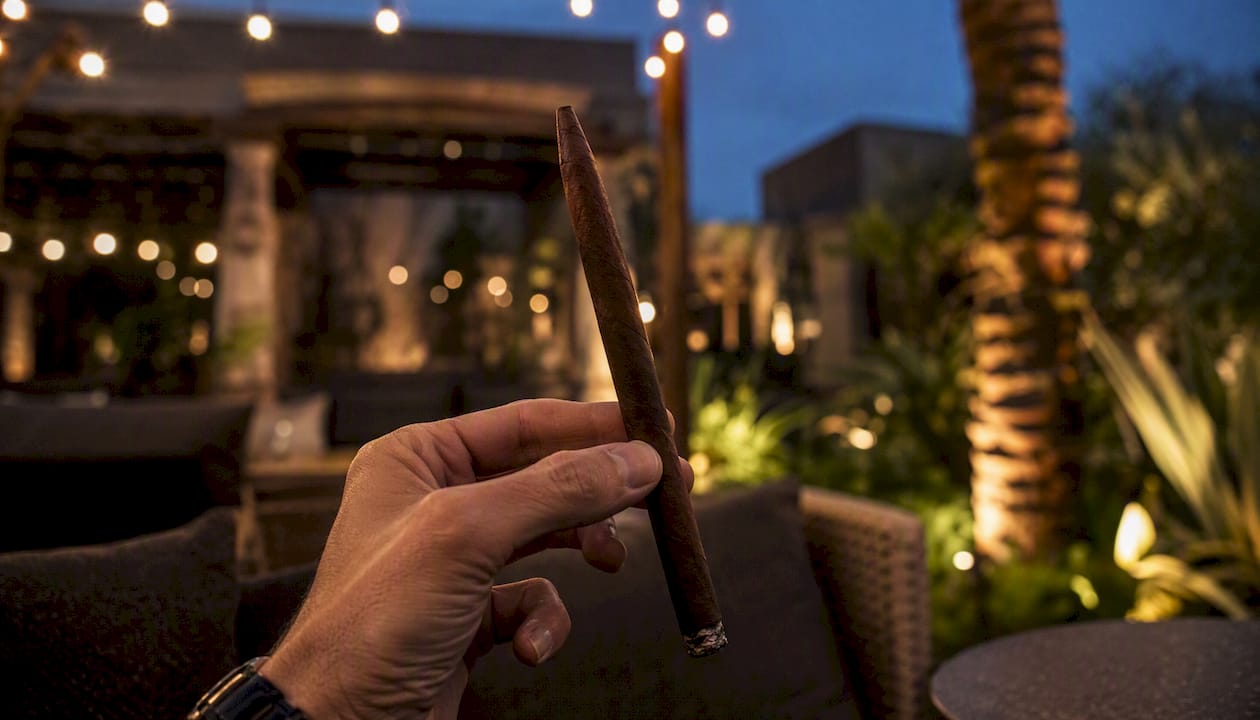
Take a Honduran puro released in both Lancero and Robusto. In the Robusto, the filler’s earthy, cedar-driven character comes through from the first draw, balanced by the wrapper’s natural oils. In the Lancero, that same filler recedes. The wrapper, stretched thin across a 38-ring-gauge column, dominates every third of the smoke. Connoisseurs prize the Lancero as a precision tasting format for exactly this reason: it isolates wrapper character in a way no parejo with a wider gauge can replicate.
How figurados shift the flavor arc
Cigar Aficionado documents how tapering in figurados changes the combustion zone at different stages of the smoke. A Pyramid’s wide foot lights easily and delivers a full, filler-rich opening third. As the smoke progresses toward the tapered head, the combustion zone narrows, wrapper influence increases, and the final third concentrates flavor in a way a straight-sided parejo cannot replicate. A Perfecto, tapered at both ends, creates an inverse arc: the narrow foot opens with concentrated wrapper character, the middle bulge broadens the smoke, and the tapered head closes it again.
Blender adjustments across vitolas
Habanos, S.A. notes that experienced blenders compensate for these physical differences by adjusting filler composition across vitolas within the same line. A blend formulated for a Robusto may use a slightly different filler leaf ratio in its Lancero expression to prevent the wrapper from overpowering the palate. This is why two vitolas from the same brand can taste genuinely different without either being “wrong.” The blender intended the difference.
How to Choose a Cigar Shape by Time, Strength, and Occasion
The fastest path to the right vitola is a three-step filter: how much time do you have, how strong do you want the smoke, and what are you pairing it with?
-
Set your time budget first. This is the single most practical filter. A cigar smoked past its natural finish turns harsh and acrid. Match the vitola to the window you actually have.
- 30–45 minutes: Petit Corona or short Panetela
- 45–60 minutes: Corona, Robusto, or Belicoso
- 60–90 minutes: Toro, Corona Gorda, or Torpedo
- 90–120 minutes: Churchill, Lancero, or Perfecto
- 120+ minutes: Double Corona
-
Choose ring gauge by desired intensity. A ring gauge below 44 concentrates flavor and delivers a sharper, more wrapper-driven experience. A ring gauge of 50 or above broadens the smoke, softens intensity, and lets filler character come through. Beginners generally find the 48–52 range most approachable.
-
Match the occasion and pairing. A Robusto or Toro pairs well with almost anything, from a single malt Scotch to an espresso, because the balanced ring gauge neither overwhelms a delicate spirit nor disappears next to a bold one. A Churchill or Double Corona suits a long dinner or a milestone celebration where the smoke is the centerpiece. A Lancero is a connoisseur’s choice for a quiet evening when you want to study a blend without distraction.
-
Consider your experience level. The Robusto is the near-universal recommendation for collectors new to a brand or blend, and Cigarro confirms it is the format most blenders use to introduce a new line. The Lancero and Perfecto reward smokers who already know a blend well and want to explore how vitola changes its character.
-
Buy the same blend in two vitolas. Purchasing a Robusto and a Lancero from the same line and smoking them on consecutive evenings is the most instructive tasting exercise available to a collector. Store both in a portable option like the 6 Cigar Leather Humidor to keep conditions identical between sessions.
-
Consider presentation for daily rotation. If you keep three or four vitolas in regular rotation, a desktop humidor designed for display, such as the Duke desktop humidor, lets you see your selection at a glance and pull the right shape for the moment without disturbing the rest of the collection.
Vitola Terminology and Ring Gauge Measurements Explained
A vitola is the formal specification of a cigar’s size and shape. The word comes from Spanish and is used universally across the premium cigar industry. When you read a box label or a retailer’s description, the vitola name tells you the shape family, the approximate length, and the ring gauge range.
Ring gauge is measured in 64ths of an inch. A ring gauge of 64 equals exactly one inch in diameter. A Robusto at 50 ring gauge measures 50/64 of an inch, or roughly 0.78 inches, across its widest point.
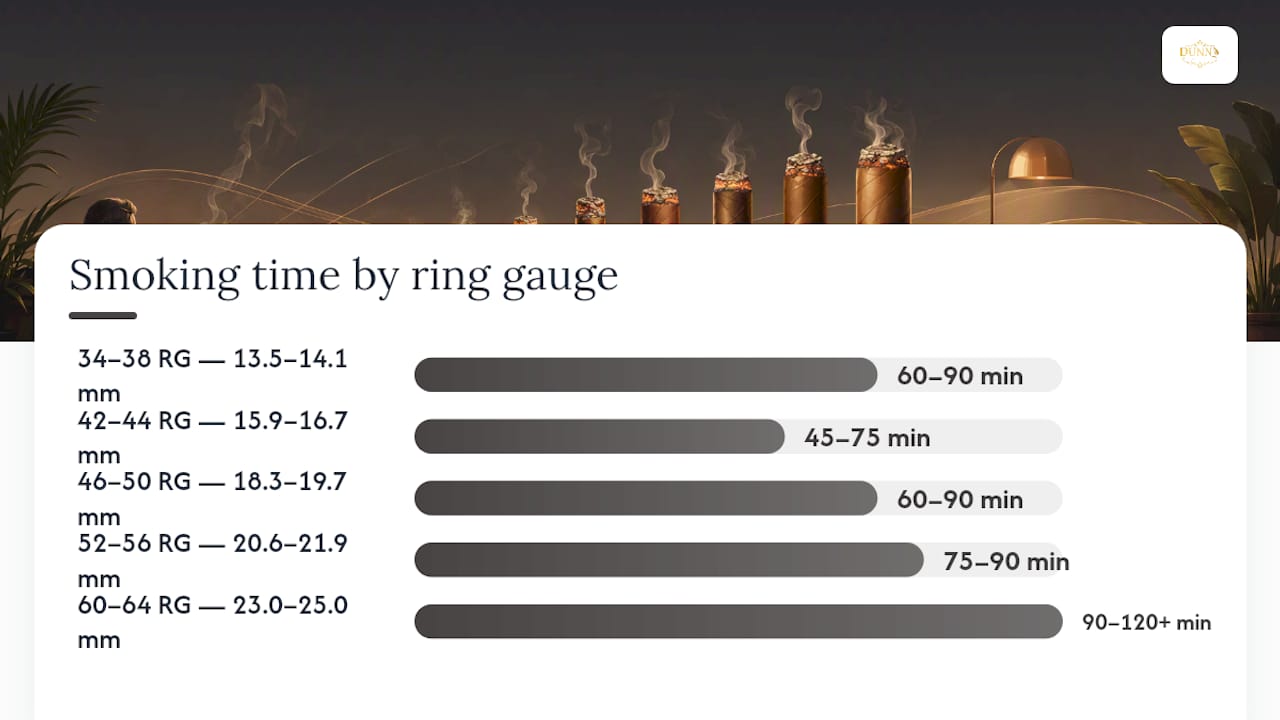
| Ring Gauge | Diameter (in.) | Diameter (mm) | Typical Smoking Time |
|---|---|---|---|
| 34–38 | 0.56–0.58 | 13.5–14.1 | 60–90 min |
| 42–44 | 0.63–0.66 | 15.9–16.7 | 45–75 min |
| 46–50 | 0.75–0.78 | 18.3–19.7 | 60–90 min |
| 52–56 | 0.81–0.86 | 20.6–21.9 | 75–90 minutes |
| 60–64 | 0.91–0.98 | 23.0–25.0 | 90–120+ min |
Factory name vs. market name
Habanos, S.A. draws a distinction that experienced collectors find indispensable: the vitola de galera (factory name) versus the vitola de salida (market name). The factory name describes the precise rolling specification used on the production floor. The market name is what appears on the box and in retailer catalogs. The same factory vitola can carry different market names across brands, which is why a “Toro” from one manufacturer and a “Gordo” from another may share nearly identical dimensions. Relying on the actual length and ring gauge rather than the market name alone is the more reliable way to compare cigars across brands.
How Blenders and Master Rollers Compensate for Vitola Differences
Yes, blenders intentionally reformulate or adjust filler weight and leaf selection by vitola to maintain balance across a line. This is not a minor tweak. It is a deliberate act of craft that separates a thoughtfully produced cigar line from one that simply rolls the same blend into different sizes.
Habanos, S.A. documents that larger formats deliver a richer, cooler smoke while thinner formats concentrate flavors and feel sharper on the palate. A blender who ignores this and uses identical filler proportions across a Robusto and a Lancero will produce a Lancero that tastes unbalanced, wrapper-heavy to the point of bitterness. To prevent this, the filler leaf ratio shifts: the Lancero expression typically uses a lighter or differently proportioned filler to let the wrapper contribute without dominating.
Tobacconist University reinforces why this matters from the rolling side: figurados require vastly different techniques, and only the most skilled torcedores are assigned to roll them. The physical challenge of tapering a Perfecto or a Pyramid consistently means that even within a single factory, figurado production is limited to a small team. That constraint is part of why figurados from respected houses carry a premium and why their filler compositions are often more carefully calibrated than their parejo counterparts.
For collectors, the practical implication is straightforward: do not assume you know a blend from its Robusto alone. The same line in a Lancero or a Torpedo will reveal different facets of the blender’s intent. Request samples, or purchase one of each and store them under identical conditions. A display solution like the Milano Cigar Display lets you present both vitolas side by side, making the comparison a ritual rather than an afterthought.
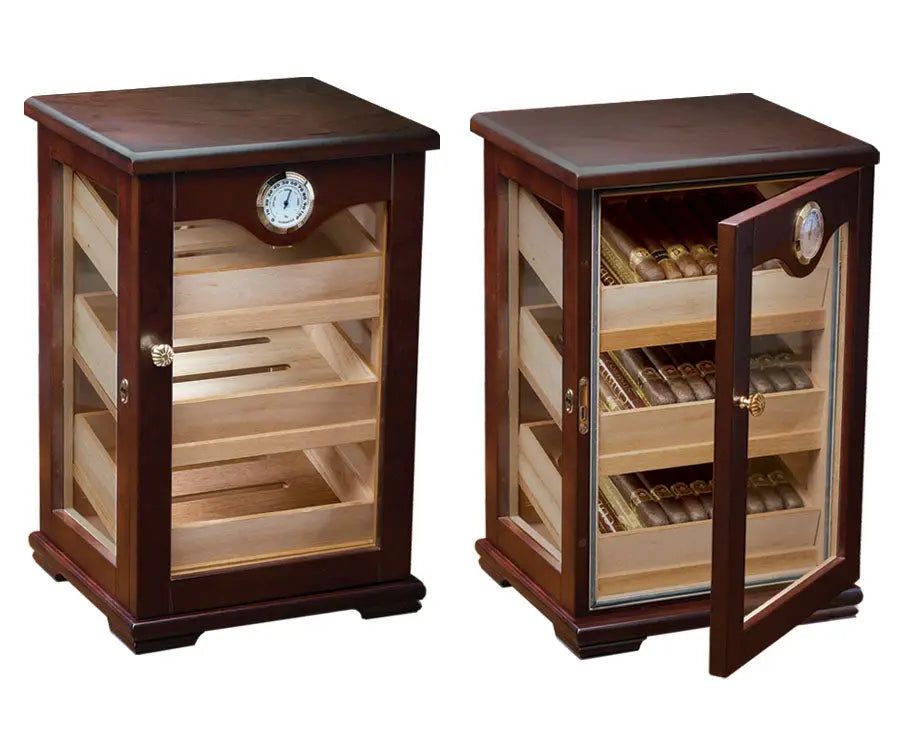
Pro Tip: When visiting a retailer, ask to see the same blend in two vitolas placed in a display case. The visual difference in taper, cap style, and wrapper sheen often tells you something about the rolling quality before you ever light either one. A well-rolled figurado will show a seamless taper with no visible seams or soft spots.
A collector’s perspective on tasting across vitolas
The most instructive thing you can do with a blend you admire is smoke it in two vitolas on consecutive evenings under the same conditions. My standing recommendation is to start with the Robusto, which gives you the blend’s balanced center of gravity, then move to the Lancero, which isolates the wrapper’s contribution with a precision nothing else matches. The difference is rarely subtle. What reads as “earthy cedar” in the Robusto often resolves into something sharper and more floral in the Lancero, because the wrapper is doing more of the work.
Keep both sticks in a compact desktop humidor, the Duke is well-suited for this, so temperature and humidity stay identical between sessions. Any variation in storage conditions introduces a variable that obscures what the vitola itself is doing. Record your impressions after each smoke. Over time, those notes become a personal vitola map of every blend you collect.
Preserve and Present Your Collection with Dunnluxuryselections
Selecting the right vitola is only half the equation. Dunnluxuryselections was built for collectors who take both halves seriously.
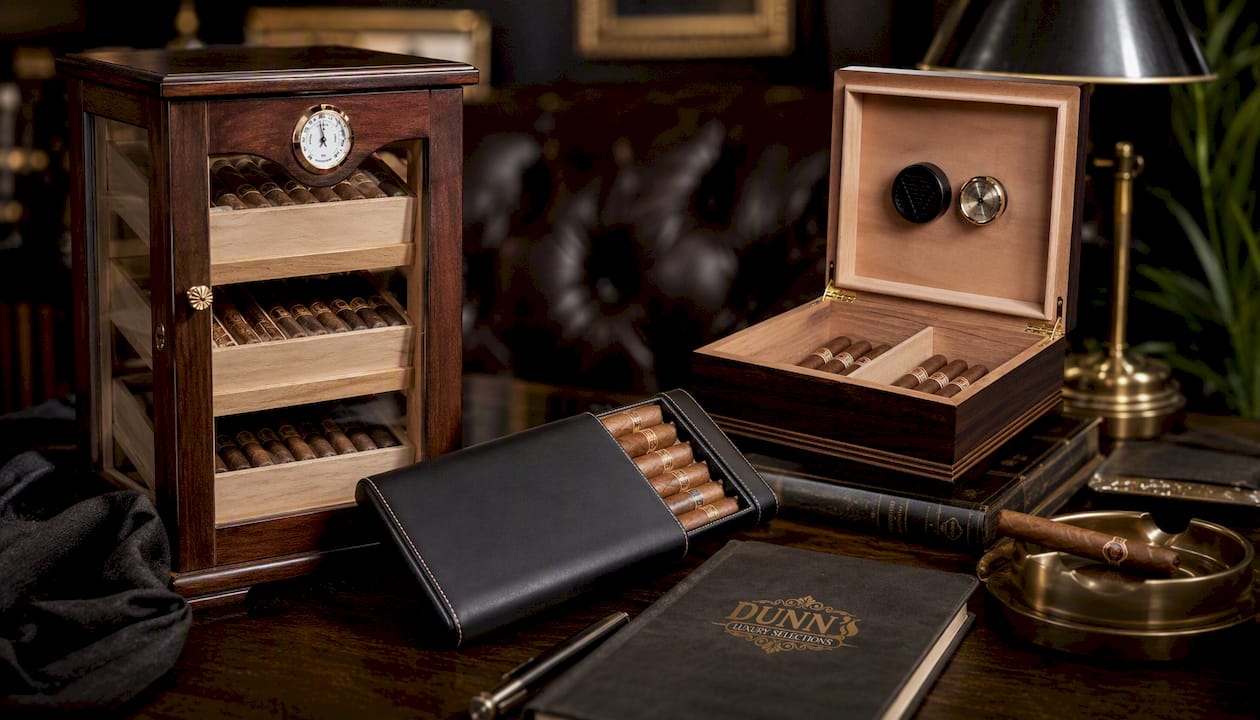
The Milano Cigar Display gives you a 360-degree view of your selected vitolas, making it the natural home for a curated rotation of Robustos, Torpedoes, and Lanceros you want to compare or present to guests. For collectors who travel with their selection or want to run a same-blend, two-vitola tasting, the 6 Cigar Leather Humidor keeps up to six sticks at ideal conditions in a form that moves with you. And for daily rotation at your desk or lounge, the Duke desktop humidor holds your most-smoked vitolas in a climate-controlled sanctuary, ready when the moment calls for them. Browse the full collection at Dunnluxuryselections and find the storage solution that matches the precision of the cigars you collect.
Sources
- Cigar Shapes, Sizes And Colors | Cigar Aficionado
- Cigar Shapes and Sizes: A Comprehensive Guide | Boveda
- Tobacconist University | Tobacco College | Cigar Shapes & Sizes
- The Cigar Vitola Dictionary: Every Shape Explained | Cigarro
- Principal shapes & sizes | Habanos, S.A.
- Cigar 101: Types of cigars explained | SigCulture
FAQ
Which cigar shape is the most popular?
The Robusto is the most widely smoked vitola in the premium market, measuring approximately 5 inches at a 50 ring gauge and delivering roughly 60 minutes of balanced smoke. Blenders most often launch new lines in this format because it reveals a blend’s character without extremes.
What are the two main types of cigar shapes?
All cigars fall into one of two categories: parejos (straight-sided, consistent ring gauge from foot to head) and figurados (tapered or irregular shapes, including torpedoes, pyramids, and perfectos). Parejos account for the majority of premium production.
How does ring gauge affect the smoking experience?
A lower ring gauge (below 44) concentrates heat and amplifies wrapper character, producing a sharper, more focused smoke. A higher ring gauge (50 and above) draws more air through a wider filler column, cooling the smoke and broadening flavor delivery.
What is a vitola?
A vitola is the formal specification of a cigar’s size and shape, defined by its length in inches and its ring gauge in 64ths of an inch. The same factory specification (vitola de galera) can carry different market names (vitola de salida) across brands, which is why comparing actual dimensions is more reliable than relying on brand-specific names alone.
What cigar shape is best for a beginner?
The Robusto or Toro is the standard recommendation for collectors new to a blend or brand. Both offer a ring gauge in the 50–54 range, which delivers an approachable, balanced smoke without the intensity concentration of a narrow Lancero or the extended commitment of a Double Corona.
Recommended
You May Also Enjoy
Cigar Collection Insurance: How to Protect Your Humidor
Home policies often cap or exclude cigars. Learn how floaters, agreed value, appraisals and inventories protect a serious...
Read Article
Cigar Locker Dimensions: Sizing Guide for Collectors and Lounges
Cigar locker dimensions explained: compartment sizes, cabinet footprints, capacity math and clearances, so you size a locker bank...
Read Article
Sealing a Walk-In Humidor: Envelope, Door and Penetrations
How to seal a walk-in humidor properly: vapor barrier placement, door gasket, penetrations and the controlled airflow a...
Read Article