

Discover the role of cedar sheets in storage for cigars. Learn how these panels enhance moisture control and protect your collection.
TL;DR:
- Spanish cedar sheets are thin panels used inside humidors to regulate moisture, repel pests, and enhance cigar aging. Proper seasoning with distilled water is essential before use to maintain stable humidity levels and prevent cigar damage. They are versatile, effective in various storage solutions, and often underestimated for their crucial role in preserving cigar quality.
Spanish cedar sheets are defined as thin, hygroscopic wood panels placed inside humidors and cigar boxes to regulate moisture and protect cigars from environmental damage. The role of cedar sheets in storage goes far beyond aesthetics. These panels act as a living buffer, absorbing excess humidity when conditions spike and releasing moisture when the air turns dry. Spanish cedar, the industry standard for premium cigar storage, also repels tobacco beetles naturally and contributes a subtle aromatic quality that enhances the aging process. Whether you manage a personal collection or operate a commercial lounge, understanding how cedar sheets function is the foundation of preserving every cigar you own.
How do cedar sheets regulate humidity in cigar storage?
Spanish cedar is highly hygroscopic, meaning it absorbs and releases moisture in direct response to the surrounding environment. This property makes it the most effective natural humidity buffer available for cigar storage. No synthetic material replicates this behavior with the same consistency or longevity.

The target humidity range for premium cigar storage is 65–72% relative humidity (RH). Staying within this range prevents cigars from drying out, which causes cracking and flavor loss, and from over-humidification, which leads to mold and uneven burns. Cedar sheets act as a secondary humidity reservoir, smoothing out the fluctuations that even the best electronic humidifiers cannot fully prevent.
When ambient humidity rises above the target range, the cedar absorbs the excess moisture into its wood fibers. When conditions drop below the threshold, the wood releases that stored moisture back into the air. This cycle repeats continuously, creating what experienced collectors call a “perfectly balanced ecosystem” inside the humidor.
| Characteristic | Spanish Cedar | MDF or Composite Wood | Untreated Wood |
|---|---|---|---|
| Hygroscopic behavior | Strong absorption and release | Minimal moisture regulation | Inconsistent and unpredictable |
| Aroma contribution | Subtle, enhances aging | None | Variable, often undesirable |
| Pest resistance | Natural repellent | None | None |
| Long-term durability | High with proper care | Degrades over time | Moderate |
| Industry standard | Yes | No | No |
Pro Tip: Place cedar sheets between cigar rows, not just along the walls. This positions the wood closest to where moisture imbalances first appear, giving you faster and more localized humidity correction.
What are the benefits of using cedar sheets beyond humidity control?
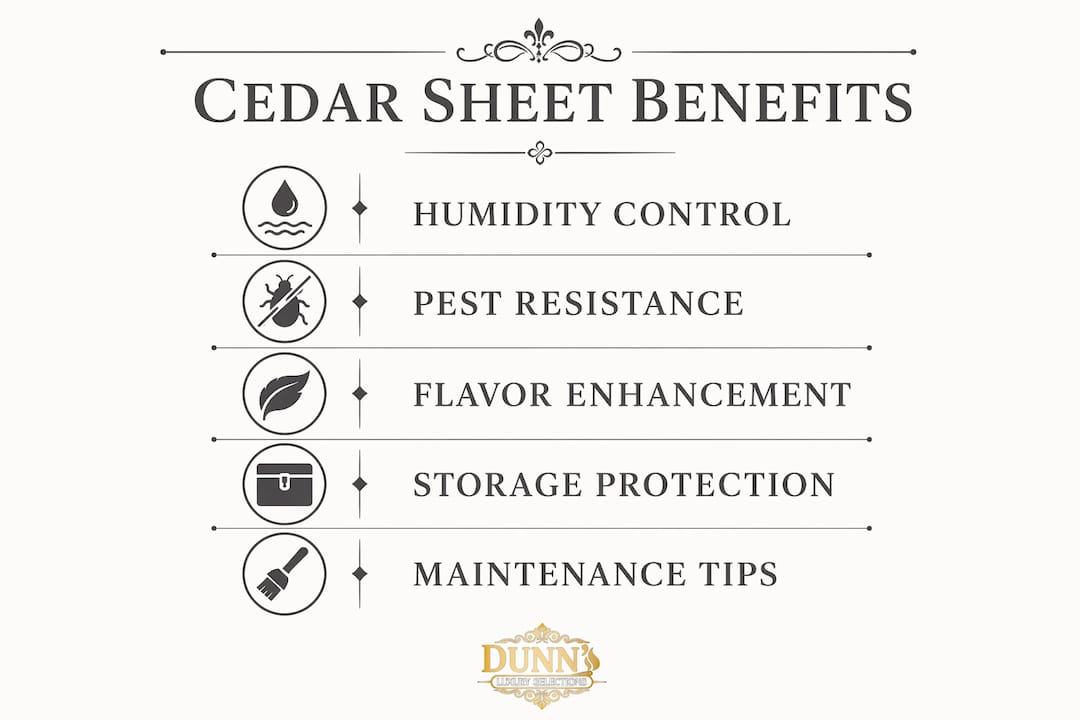
Cedar sheets for preservation deliver three functional advantages that no other storage material matches: pest resistance, aroma contribution, and structural protection during transport.
Natural pest resistance
Spanish cedar oils repel tobacco beetles naturally, reducing infestation risk in stored cigars. Tobacco beetles are the most destructive pest a collector faces. They bore through wrappers and fillers, destroying entire collections in weeks. Cedar’s natural oils create an environment these insects avoid, making it the preferred material over all alternatives.
Aroma and flavor enhancement
Cedar sheets contribute a subtle, woody aroma that integrates with the aging process of premium cigars. This is not a masking effect. The cedar note becomes part of the cigar’s flavor profile over time, adding complexity that aficionados actively seek. The key word is “subtle.” Cedar that is too green or improperly seasoned can overpower a cigar’s natural character, which is why preparation matters.
Transport and long-term storage protection
Cedar sheets maintain a stable microclimate inside cigar boxes during storage, aging, and transport. Wrapping individual cigars or bundles in cedar sheets before placing them in a travel humidor provides an additional layer of moisture stability. This practice is especially valuable for collectors who ship cigars or carry them across climates. You can also explore cannabis storage parallels to understand how hygroscopic materials protect aromatic botanicals in transit.
The full list of cedar storage benefits includes:
- Continuous passive humidity buffering between humidifier cycles
- Natural tobacco beetle and moth deterrence through cedar oil compounds
- Subtle aromatic contribution that supports long-term flavor development
- Physical protection for cigars during transport and repositioning
- Presentation enhancement when wrapping individual sticks or gift bundles
Pro Tip: Cedar sheets used for wrapping individual cigars during transport should be lightly moistened with distilled water before use. This prevents the dry wood from drawing moisture out of the cigar wrapper during transit.
How should cedar sheets be prepared and maintained?
Seasoning cedar is a foundational practice. Skipping it often leads to humidity imbalances and cigar spoilage. An unseasoned cedar sheet or lining aggressively pulls moisture from everything around it, including your cigars, before it reaches equilibrium. The preparation process is straightforward but non-negotiable.
Step-by-step seasoning process
- Wipe all cedar surfaces with distilled water. Use a clean, lint-free cloth dampened with distilled water. Cover every interior surface, including cedar sheets, trays, and dividers. Never use tap water at this stage.
- Place a small dish of distilled water inside the humidor. Set it on a cedar tray or directly on the floor of the humidor. This creates a humid microenvironment that drives moisture into the wood fibers.
- Close the humidor and wait 24–48 hours. Proper seasoning typically takes 2 to 4 days, depending on the size of the humidor and the dryness of the cedar. Larger humidors with more cedar volume require the full four days.
- Repeat the wipe-down once. After the first 24 hours, open the humidor, wipe the surfaces again with distilled water, and replace the dish. This second pass saturates any fibers that absorbed the first application.
- Verify humidity before adding cigars. Place a calibrated hygrometer inside and confirm the reading holds steady within the 65–72% RH range for at least 12 hours before introducing your collection.
Why tap water destroys cedar
Minerals in tap water create deposits that clog wood pores and negatively affect cigars. This is not a minor inconvenience. Mineral buildup permanently reduces cedar’s hygroscopic capacity, meaning the wood loses its ability to regulate humidity over time. Distilled water contains no minerals and leaves no residue. This single rule separates collectors who maintain their cedar for decades from those who replace it every few years.
Ongoing maintenance
Cedar sheets do not require constant attention, but they benefit from periodic care. Every three to six months, remove the sheets and inspect them for mineral deposits, mold spots, or structural warping. A light wipe with distilled water refreshes the surface without over-saturating the wood. For detailed care routines, Dunnluxuryselections provides guidance specific to each humidor type in its collection.
How do cedar sheets integrate with different humidor designs?
Cedar sheets serve different functions depending on the humidor type they inhabit. Understanding this distinction helps you choose the right storage solution for your collection size and environment.
A premium humidor with solid Spanish cedar lining ensures long-term humidity stability and proper cigar aging. Lower-cost options use MDF or veneer, which do not regulate humidity or aroma properly. Thin cedar veneer glued onto composite wood peels off and loses its moisture-regulating ability over time. Solid cedar lining must be thick enough to prevent flex and maintain structural integrity across years of use.
| Storage Type | Cedar Sheet Role | Best For | Key Consideration |
|---|---|---|---|
| Desktop humidor | Primary humidity buffer and aroma source | Personal collectors, 25–150 cigars | Solid cedar lining is non-negotiable |
| Cabinet humidor | Supplemental sheets between trays | Mid-size collections, 150–500 cigars | Sheets extend humidifier range across zones |
| Walk-in humidor | Cedar panels plus loose sheets for wrapping | Commercial lounges, large collections | Full cedar wall lining preferred |
| Tupperdor (alternative) | Cedar sheets replace built-in lining | Budget-conscious or travel storage | Sheets must be seasoned before first use |
| Travel humidor | Wrapping sheets for individual cigars | Transport across climates | Lightly moistened sheets prevent moisture loss |
For collectors who use tupperdors or non-cedar storage containers, cedar sheets become the entire humidity management system. Two or three properly seasoned sheets placed inside an airtight container with a calibrated Boveda pack create a functional microclimate that rivals entry-level desktop humidors. This approach works well for short-term storage but lacks the precision of a cedar-lined desktop humidor built for long-term aging.
Commercial operations face a different challenge. A lounge storing hundreds of cigars across multiple display cases needs cedar sheets between every tray layer, not just along the walls. This zonal approach ensures that cigars in the center of a large cabinet receive the same humidity stability as those closest to the humidifier. Dunnluxuryselections’ cabinet humidor collections are designed with this layered cedar philosophy built in.
Key Takeaways
Spanish cedar sheets are the single most effective passive humidity management tool in cigar storage, and their performance depends entirely on proper seasoning with distilled water before first use.
| Point | Details |
|---|---|
| Hygroscopic regulation | Spanish cedar absorbs and releases moisture to hold cigars at 65–72% RH. |
| Pest and aroma benefits | Cedar oils repel tobacco beetles and contribute subtle flavor complexity during aging. |
| Seasoning is mandatory | Unseasoned cedar pulls moisture from cigars; season for 2–4 days using distilled water only. |
| Solid cedar outperforms veneer | Thin veneer on composite wood peels and loses humidity function; solid lining lasts decades. |
| Sheets work in any storage type | Cedar sheets extend humidity control to tupperdors, travel cases, and multi-zone cabinets. |
Why cedar sheets are the most underestimated tool in your humidor
By Belle Dunn
After years of working with collectors ranging from first-time buyers to operators managing walk-in humidors with thousands of sticks, I keep encountering the same blind spot. Collectors spend thousands on a beautiful humidor, invest in a precision electronic humidifier, and then overlook the cedar entirely. They buy a humidor with veneer lining, skip the seasoning, or never think to add cedar sheets between their tray layers. Then they wonder why their cigars taste flat after six months.
Cedar is not decorative wood. It is the shock absorber between your cigars and every climate fluctuation your humidor experiences. A well-seasoned cedar interior can compensate for a humidifier that cycles off for a day. A poorly prepared or thin cedar lining cannot compensate for anything. The wood either works or it does not, and the difference shows up in your cigars before it shows up anywhere else.
The seasoning discipline is where I see the most damage done. Collectors who skip it often blame the humidifier or the hygrometer when their humidity readings swing wildly. The real culprit is dry cedar pulling moisture aggressively from every source it can find, including the cigars themselves. Two to four days of proper seasoning with distilled water costs nothing and protects everything.
My honest recommendation: prioritize the quality of the cedar before you prioritize the brand name on the lid. A humidor with solid Spanish cedar lining and properly maintained sheets will outperform a visually impressive case with composite wood and veneer every single time. Buy the cedar first. The craftsmanship follows.
— Belle Dunn
Premium humidors with expert-crafted cedar interiors
Every principle covered in this guide, from hygroscopic regulation to seasoning discipline, depends on one foundational choice: the quality of the cedar in your humidor.

Dunnluxuryselections curates a collection of humidors built with solid Spanish cedar lining, verified for thickness and moisture performance before they reach your collection. The Duke desktop humidor delivers precision cedar storage for personal collections, while the Humidor Supreme 9200 Series serves collectors and commercial operators who require electronic humidity control paired with full cedar interiors. For collectors who travel, the Manhattan Travel Humidor integrates cedar sheet protection in a format built for transit. Every product in the Dunnluxuryselections catalog is selected with cedar quality as a non-negotiable standard.
FAQ
What are cedar sheets in cigar storage?
Cedar sheets are thin panels of Spanish cedar placed inside humidors and cigar boxes to regulate humidity, repel pests, and contribute aroma. They act as a passive moisture buffer between the humidifier and your cigars.
What humidity range do cedar sheets help maintain?
Spanish cedar sheets help maintain the industry-standard range of 65–72% relative humidity by absorbing excess moisture and releasing it when levels drop.
Why must cedar sheets be seasoned before use?
An unseasoned cedar sheet aggressively pulls moisture from cigars and humidifiers before it reaches equilibrium. Seasoning with distilled water for 2–4 days saturates the wood and stabilizes humidity from the first day cigars are stored.
Can cedar sheets work in non-humidor storage containers?
Yes. Properly seasoned cedar sheets placed inside an airtight container with a calibrated humidity pack create a functional microclimate suitable for short-term storage. This setup works for tupperdors and travel cases.
How often should cedar sheets be replaced or refreshed?
Cedar sheets do not require frequent replacement. Inspect them every three to six months and wipe with distilled water to refresh the surface. Replace sheets only if they show structural warping, mold, or significant mineral buildup from tap water exposure.
Recommended
You May Also Enjoy
Cigar Collection Insurance: How to Protect Your Humidor
Home policies often cap or exclude cigars. Learn how floaters, agreed value, appraisals and inventories protect a serious...
Read Article
Cigar Locker Dimensions: Sizing Guide for Collectors and Lounges
Cigar locker dimensions explained: compartment sizes, cabinet footprints, capacity math and clearances, so you size a locker bank...
Read Article
Sealing a Walk-In Humidor: Envelope, Door and Penetrations
How to seal a walk-in humidor properly: vapor barrier placement, door gasket, penetrations and the controlled airflow a...
Read Article