

Discover why precise humidity control is crucial for cigar collectors. It protects flavors, prevents beetles, and enhances aging. Keep your cigars pristine!
TL;DR:
- Maintaining a humidity variation of only ±1-2% with stable temperature is crucial for preserving fine cigars. Precise control safeguards oils, prevents beetle hatching and mold, and promotes desirable aging. A ±1% system at 68% RH ensures a consistent environment, unlike less precise systems that risk damage and flavor loss.
Maintaining a narrow relative humidity band of ±1–2% with consistent temperature stability is the single most consequential factor in preserving a fine cigar collection. Precise humidity control protects essential tobacco oils, prevents tobacco beetle hatching and mold, and produces predictable aging outcomes that passive or retail-grade systems simply cannot deliver.
The short version:
- Tobacco is hygroscopic; it responds to every RH shift by expanding, contracting, and releasing or absorbing oils
- Tobacco beetles hatch when RH exceeds 72% and temperature exceeds 72°F — staying below both thresholds is non-negotiable
- Humidity swings, not just a wrong mean, crack wrappers and flatten flavor
- The retail 70/70 rule is a warehouse safety buffer, not an aging target
- A ±1% system set to 68% RH stays 67–69%; a ±5% system can swing into beetle territory at 73%
Table of Contents
- Why precise humidity control defines what your cigar becomes
- How temperature and RH interact — and why you must control both
- What target ranges should collectors actually use?
- How ±1–2% RH precision changes aging trajectory and flavor
- What are the signs that your humidity control is failing?
- How luxury custom-built humidors maintain ±1–2% RH
- Which humidification system fits your collection?
- Routine maintenance and emergency recovery
- When does a custom walk-in humidor justify the investment?
- Key Takeaways
- The detail most collectors overlook when specifying a humidor
- Dunnluxuryselections builds the precision your collection deserves
- Useful sources
- FAQ
Why precise humidity control defines what your cigar becomes
Tobacco leaf is alive in a meaningful sense long after it is rolled. Its cells are hygroscopic, meaning they absorb and surrender moisture continuously in response to the surrounding air. At the right RH, essential oils remain suspended within the leaf structure, fermentation chemistry proceeds at a controlled pace, and the wrapper stays supple enough to burn evenly. Tip the balance even a few percentage points and the consequences compound over weeks and months.
Humidity swings are more destructive than a wrong steady-state RH. A humidor that averages 68% but oscillates between 62% and 74% subjects every leaf to repeated expansion and contraction cycles. The wrapper, the most delicate component, cracks along its veins. Binder stress alters the draw channel. Volatile aromatics — the compounds responsible for a cigar’s top notes — evaporate during the dry phases and never fully return.
Pro Tip: If your hygrometer log shows swings wider than ±3% over a 48-hour period, the humidification system is the problem, not the ambient environment. Upgrade before the cigars pay the price.
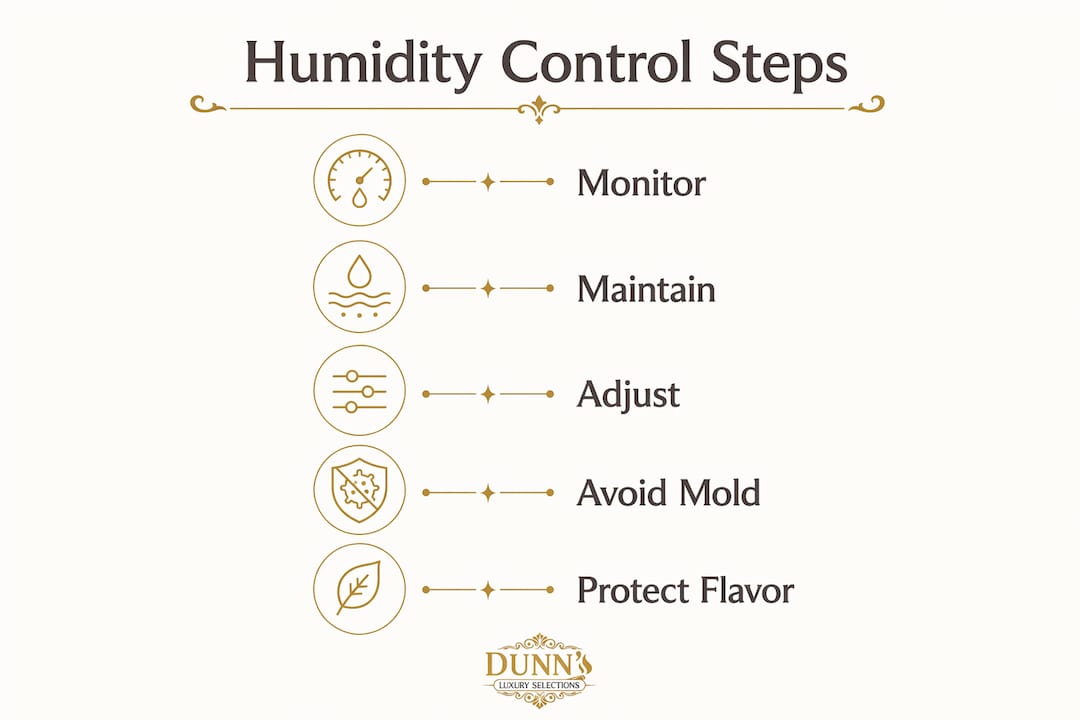
Over-humidification carries its own penalties. Above 75% RH, mold conditions become favorable. Cigars stored too moist develop a tight draw, burn unevenly, and produce heavy, muddy smoke that obscures the blender’s intent. The oils that should migrate slowly through the leaf instead become diluted by excess moisture, muting complexity.
How temperature and RH interact — and why you must control both
Relative humidity is a ratio: the percentage of moisture in the air relative to the maximum that air can hold at a given temperature. That ceiling rises with temperature, which means the same RH reading at 75°F contains significantly more water mass than the same reading at 65°F. A humidor holding steady at 68% RH will deliver a wetter environment on a warm summer afternoon than on a cool winter morning, even if the hygrometer never moves.
Temperature spikes undo RH control in two ways. First, warmer air holds more moisture, so the tobacco absorbs more water even at a “stable” RH. Second, rapid temperature drops cause condensation inside the humidor, creating localized wet spots that invite mold. Seasonal ambient changes — dry winter heating systems, humid summer air — will affect even a well-sealed humidor unless active thermal management is in place.
- Thermal mass: Thick solid-wood construction absorbs temperature fluctuations before they reach the cigars
- Insulation: Closed-cell foam or double-wall construction slows heat transfer from room to interior
- Active temperature control: Semiconductor (Peltier) or refrigeration-based systems maintain a set-point regardless of room conditions
Pro Tip: Place a secondary thermometer at the bottom of your humidor, not just at the top. Temperature stratification of 3–5°F is common in tall cabinets and creates micro-zones with meaningfully different effective humidity.
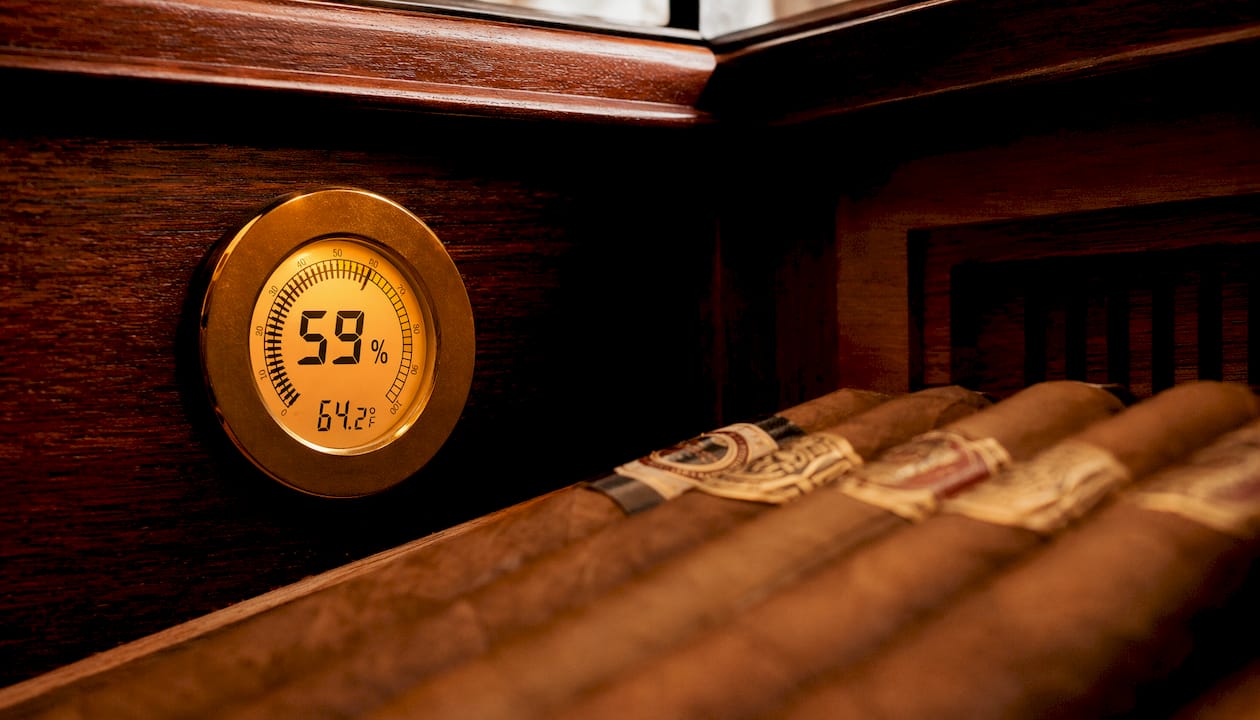
What target ranges should collectors actually use?
The 70/70 rule originated as a retail and warehouse guideline, designed to protect inventory moving in and out of humidors frequently. Serious collectors prefer cooler, drier conditions to preserve essential oils and avoid beetle risk.
| Purpose | RH Target | Temperature | Notes |
|---|---|---|---|
| Ready-to-smoke rotation | ~65–68% RH | ~65–68°F | Slightly more moisture for immediate enjoyment |
| Everyday storage | ~65–68% RH | ~65–68°F | Balanced preservation and draw quality |
| Long-term aging | 62–65% RH | 62–65°F | Slows fermentation, protects oils |
| Beetle/mold safety margin | Below 72% | Below 72°F | Hard ceiling; never exceed both simultaneously |
Wrapper and terroir matter, too. Nicaraguan puros often benefit from lower RH to emphasize spice and keep the draw open, while delicate Connecticut wrappers require higher humidity to prevent brittleness. Applying a uniform 70% setting to a mixed collection ignores these distinctions entirely.
How ±1–2% RH precision changes aging trajectory and flavor
Precision is not an abstraction. It is the difference between a cigar that develops as its blender intended and one that arrives at year five tasting flat.
- Years 0–1 (stabilization): Newly acquired cigars need to equilibrate to their storage environment. A ±1% system brings them to target without the oil-stripping spikes that refillable humidifiers cause when water is added.
- Years 1–5 (maturation): Controlled oil migration softens harshness, integrates the filler and binder chemistry, and builds complexity. Swings interrupt this process; each spike or dip resets the tobacco’s moisture equilibrium and disrupts the progression.
- Years 5+ (aging): Long-term aging at 62–65% RH and cooler temperatures slows secondary fermentation to a pace that deepens flavor rather than degrading it.
Preventing a single tobacco beetle infestation — which can destroy an entire cabinet in weeks — more than pays for a precision electronic humidification system. The ROI calculation is not subtle.
A ±5% system set to 68% can reach 73% at its upper swing, crossing the beetle hatching threshold and exposing every cigar in the cabinet to infestation risk. A ±1% system at the same set-point never does.
What are the signs that your humidity control is failing?
Catching a problem early preserves the collection. Here are the risks and their visible signals:
- Tobacco beetles: Tiny pinholes in the wrapper, fine tobacco dust on the humidor floor, larvae visible under magnification
- Mold: White or gray surface bloom, musty odor, soft spots on the wrapper
- Cracked wrappers: Longitudinal splits along the leaf vein, often appearing after a rapid RH drop
- Over-humidification: Spongy feel when rolled between fingers, tight draw, tunneling burn
- Flavor degradation: Flat, muted, or muddy profile; loss of top-note complexity
Early troubleshooting steps:
- Log hygrometer readings over 72 hours to identify swing patterns
- Inspect every cigar for pinholes or bloom before returning it to the humidor
- Quarantine any cigar showing beetle damage immediately — infestation spreads fast
- If RH exceeds 75%, open the humidor for 10–15 minutes daily until levels drop; never use a heat source to accelerate drying
- For dry-outs below 62%, place cigars at 62–65% RH and allow gradual rehydration over several weeks; sudden exposure to high-humidity packs cracks wrappers
How luxury custom-built humidors maintain ±1–2% RH
The engineering behind a precision humidor is what separates a sanctuary for your collection from an expensive box. Several design elements work in concert:
- Solid thick Spanish cedar lining: Cedar’s hygroscopic properties buffer minor RH fluctuations and naturally deter pests; its role in cigar storage extends well beyond aesthetics
- Gasketed seals: Compression seals on doors and lids prevent ambient air infiltration that passive humidors cannot stop
- Compartmentalization: Separate climate zones allow different RH targets for Nicaraguan puros versus Connecticut-wrapped blends within one cabinet
- Multi-sensor arrays: Sensors at multiple heights and zones catch stratification before it damages cigars
- Active humidification and dehumidification: Systems like the HYDRA SM electronic humidifier add and remove moisture on demand, rather than waiting for passive evaporation
Seasonal ambient changes — winter dry air, summer humidity — will overwhelm passive systems. Active semiconductor or refrigeration-based control eliminates those swings entirely.
Pro Tip: When commissioning a custom humidor, specify the precision tolerance in writing: “±1% RH at set-point across all sensor locations.” A builder who cannot commit to that specification in writing cannot deliver it in practice.
Which humidification system fits your collection?
| System Type | Precision | Best For | Limitation |
|---|---|---|---|
| Passive two-way packs (e.g., Boveda) | ±3–5% RH | Small collections | Cannot dehumidify in high-ambient conditions |
| Humidity beads/gel | ±3–5% RH | Small to mid collections | Requires manual monitoring and refilling |
| Entry electronic units | ±2–3% RH | Medium collections | Limited sensor coverage |
| Precision electronic/walk-in | ±1% RH | Large collections | Higher upfront investment |
Two-way packs are recommended for small cigar collections; active electronic regulation becomes necessary for larger collections. Refillable devices cause immediate RH spikes when water is added, stripping oils from tobacco — a risk no serious collector should accept.
Calibration and monitoring steps:
- Use a calibrated digital hygrometer as your primary reference; verify accuracy with a salt-test calibration every 90 days
- Place sensors at the top, middle, and bottom of any cabinet larger than 200 cigars
- Enable remote alerts so temperature or RH excursions notify you before damage occurs
- Cross-check two independent sensors; if they diverge by more than 2%, recalibrate both
Pro Tip: Never rely on a single hygrometer. A second independent sensor costs very little and catches calibration drift before it becomes a collection-wide problem.
Routine maintenance and emergency recovery
Routine checklist (quarterly):
- Recalibrate all hygrometers using the salt-test method
- Inspect door and lid seals for compression loss or cracking
- Wipe cedar surfaces with a lightly dampened cloth (distilled water only); never use cleaning agents
- Check humidification reservoirs and replace or recharge as needed
- Review 90-day hygrometer logs for drift or seasonal swing patterns; consult the care guides for seasonal adjustment protocols
Emergency recovery:
- Dry-out (below 62% RH): Move cigars to a stable 62–65% environment and allow slow rehydration over several weeks. Never place dried cigars directly against a high-output humidity source.
- Over-humidification (above 75% RH): Open the humidor briefly each day, remove the most affected cigars to a dry box, and reduce the humidification source output. Gradual reduction over days, not hours.
Avoid these common errors:
- Quick-dunk rehydration (causes immediate wrapper cracking)
- Adding uncalibrated humidity boosters to a system already running high
- Using tap water in any humidification device (mineral deposits and mold risk)
When does a custom walk-in humidor justify the investment?
A walk-in is not simply a larger humidor. It is a climate-controlled room engineered to maintain zonal precision across hundreds or thousands of cigars simultaneously.
Decision checklist:
- Collection exceeds 500 boxes or 5,000 cigars
- You store multiple wrapper/terroir types requiring different RH zones
- Display and security are priorities alongside preservation
- Long-term aging (5+ years) is the primary goal
- Seasonal ambient swings in your home or office regularly challenge cabinet-level systems
| Investment Level | Approximate Range | What It Delivers |
|---|---|---|
| Entry custom cabinet | $2,000 or less | ±2% RH precision, Spanish cedar, active humidification |
| Mid-tier precision cabinet | $2,000 to $5,000 | ±1% RH precision, multi-sensor, refrigeration control |
| Ultra-luxury / walk-in | Over $5,000 | Zonal climate control, bespoke design, HVAC integration |
Beyond the financial case, a walk-in reduces overall preservation risk by eliminating the micro-environment variability that even the best cabinet systems cannot fully suppress. For a collection representing significant financial and personal investment, that risk reduction is the real return.
Key Takeaways
Precise humidity control, maintained at ±1–2% RH with active temperature stability, is the foundation of every preservation and aging outcome a serious collector cares about.
| Point | Details |
|---|---|
| Hold the ±1–2% RH band | A ±5% RH system can swing past the 72% beetle hatching threshold; ±1% keeps you safely below it. |
| Target 62–65% RH for aging | The retail 70/70 rule is a warehouse buffer; long-term aging favors cooler, drier conditions. |
| Control temperature alongside RH | The same RH at higher temperatures delivers more water mass to the leaf; thermal stability is non-negotiable. |
| Calibrate every 90 days | Hygrometer drift is silent; a quarterly salt-test calibration catches it before cigars suffer. |
| Dunnluxuryselections for custom precision | Dunnluxuryselections designs bespoke walk-in and cabinet humidors engineered to ±1% RH with white-glove delivery and expert consultation. |
The detail most collectors overlook when specifying a humidor
Most collectors focus on capacity and aesthetics when commissioning a humidor. Both matter. But the specification that actually determines whether a $20,000 cabinet performs like a precision instrument or an expensive display case is the tolerance written into the climate control system.
A humidor that holds 1,000 cigars at a mean of 67% RH but swings ±4% is delivering the same mechanical stress to your collection as a cheap desktop unit. The wrapper cracks are smaller, the flavor loss is slower, but the trajectory is identical. What separates a genuinely precision instrument is the combination of active humidification and dehumidification, multi-point sensing, thermal mass, and a builder who will commit to a specific tolerance in writing.
The collectors who protect their investment most effectively are not necessarily those with the largest budgets. They are the ones who ask the right questions before the first cedar plank is cut.
Dunnluxuryselections builds the precision your collection deserves
For collectors who have moved past passive packs and entry-level cabinets, Dunnluxuryselections offers something the mass market cannot: a bespoke humidor engineered to your collection’s exact requirements, delivered with white-glove installation and ongoing expert consultation.
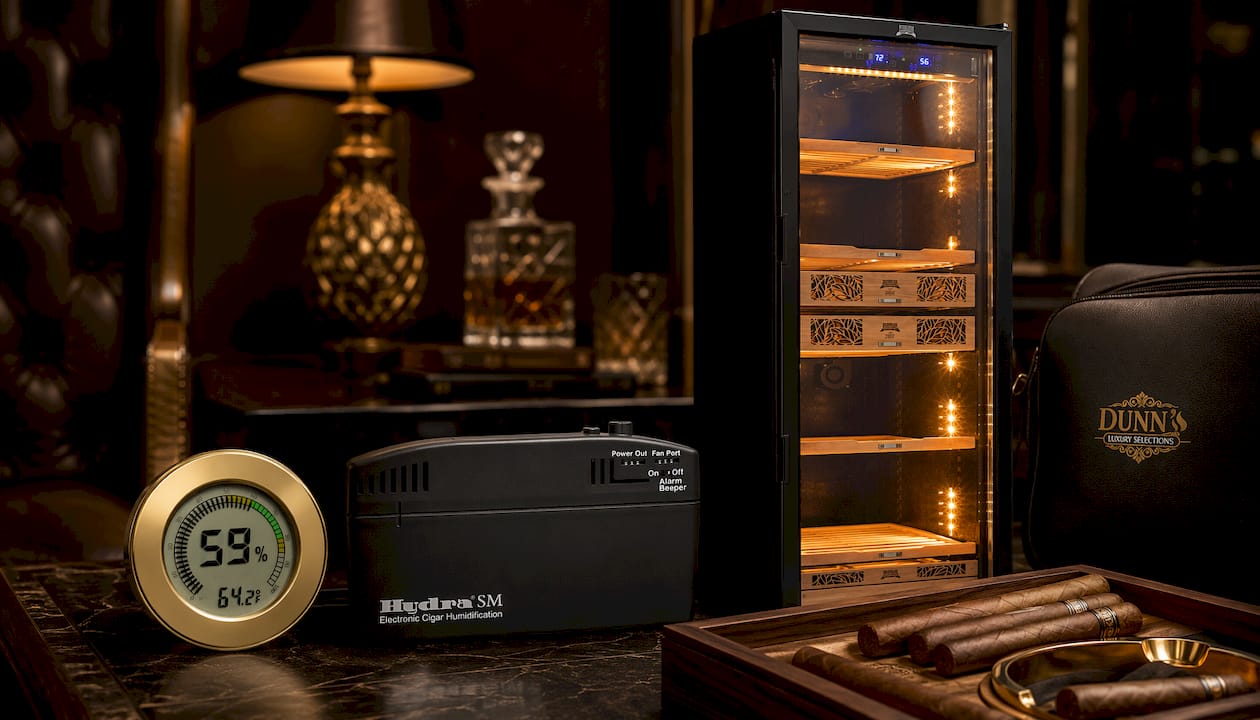
The HYDRA SM electronic humidifier provides active moisture management for cabinet and custom installations, while the Humidor Supreme® 9000 Series delivers a turnkey precision environment for collectors who want performance without compromise. Pair either with the Digital Hygrometer with Calibration (Gold) for a monitoring setup that matches the quality of the collection it protects.
Every Dunnluxuryselections humidor begins with a consultation. Contact the team at dunnluxuryselections.com to discuss your collection’s scale, aging goals, and the precision specification your cigars have earned.
Useful sources
- Best Humidity Range for Aging Cigars — Luxury Wine Appliances
- How Accurate Does a Humidor Need to Be? — Luxury Wine Appliances
- Fix Just 1 Thing & Get Amazing Flavor From Your Cigars — Boveda
- Cigar Humidor Humidity: Why the 70/70 Rule Is a Myth — Atelier Atypique
- What Humidity Should Cigars Be Stored At? — After Action Cigars
- How Humidity Affects Cigars — La Aurora
- Why Humidity Control Matters for Cigars — Bullz-Eye
FAQ
What RH level should collectors target for long-term aging?
Most experienced collectors prefer 62–65% RH at 62–65°F for long-term aging, well below the retail 70/70 guideline, to preserve essential oils and stay clear of the beetle hatching threshold.
Why does humidity precision matter more than the average RH?
A system that averages 68% but swings 62–74% causes repeated expansion and contraction that cracks wrappers and disrupts aging chemistry, even though the mean looks acceptable.
At what point do tobacco beetles become a risk?
Tobacco beetles hatch when humidity exceeds 72% RH and temperature exceeds 72°F simultaneously; a ±1% precision system set to 68% never crosses that threshold.
How often should a digital hygrometer be calibrated?
Recalibrate every 90 days using the salt-test method, and always run two independent sensors so drift in one is caught before it affects the collection.
What does Dunnluxuryselections offer for precision cigar storage?
Dunnluxuryselections designs bespoke walk-in and cabinet humidors engineered to ±1% RH, featuring active humidification systems, calibrated monitoring, and white-glove delivery with expert consultation.
Recommended
You May Also Enjoy
Cigar Collection Insurance: How to Protect Your Humidor
Home policies often cap or exclude cigars. Learn how floaters, agreed value, appraisals and inventories protect a serious...
Read Article
Cigar Locker Dimensions: Sizing Guide for Collectors and Lounges
Cigar locker dimensions explained: compartment sizes, cabinet footprints, capacity math and clearances, so you size a locker bank...
Read Article
Sealing a Walk-In Humidor: Envelope, Door and Penetrations
How to seal a walk-in humidor properly: vapor barrier placement, door gasket, penetrations and the controlled airflow a...
Read Article