

Discover the artistry of artisanal cigar makers in this comprehensive guide. Learn to distinguish premium hand-rolled cigars from imitations.
TL;DR:
- Artisanal cigar makers are master craftsmen who hand-roll premium cigars following strict legal and quality standards. Their work requires years of training, tactile skill, and careful leaf selection, which automated processes cannot replicate. Proper storage with a quality humidor preserves the integrity of these handcrafted cigars for collectors and enthusiasts.
Artisanal cigar makers are specialized craftsmen who hand-roll premium cigars using traditional methods, meeting strict criteria including whole leaf wrappers, at least 50% long-filler tobacco, and no characterizing flavors. In 2026, a US federal court formally defined what qualifies as a premium cigar, giving collectors a legal benchmark to distinguish true handcrafted cigars from machine-assisted imitations. The industry term for these craftsmen is “master rollers,” and their work represents a living tradition that no automated process has replicated. This guide profiles the defining qualities of the world’s finest luxury cigar makers and explains exactly what separates their work from the mass-produced alternative.
What makes artisanal cigar makers truly premium?
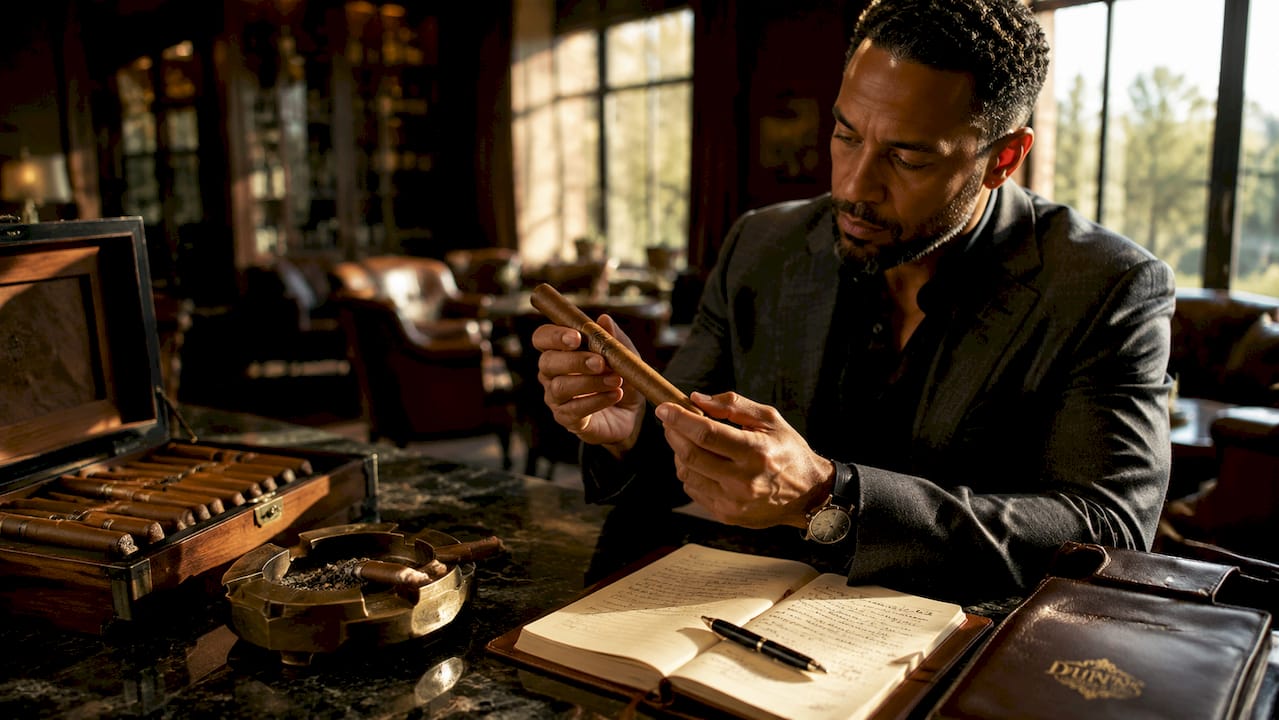
True premium craftsmanship begins with a strict set of construction standards. According to the 2026 federal court ruling, a premium cigar must be hand-rolled by a person with no automated machinery, contain at least 50% long-filler tobacco, use a 100% leaf binder, be wrapped in whole tobacco leaf, and contain no flavoring other than tobacco. These are not marketing claims. They are legal criteria.
Beyond the legal threshold, the hallmarks of genuine artisan production include:
- Leaf selection: Wrappers are graded by color, texture, and vein structure before rolling begins.
- Despalillado: The precise removal of the central tobacco vein. Poor despalillado causes uneven burn and tunneling, two of the most common quality failures in cigars.
- Manual bunching: The roller hand-packs the filler to achieve consistent density and draw resistance throughout the cigar.
- Wrapper application: The final leaf is applied under controlled tension, with no tears, seams, or air pockets.
One widespread misconception is that “boutique” equals premium. The term “boutique” refers to production size or marketing positioning, not craftsmanship quality. A small-batch cigar rolled with a Lieberman bunching machine is not a handmade cigar by any rigorous standard.
Pro Tip: When evaluating a cigar’s authenticity, ask the retailer whether the filler was hand-bunched or machine-bunched. That single question separates true artisan production from the majority of the market.
10 artisanal cigar makers excelling in craftsmanship and tradition
1. Plasencia Cigars
Plasencia is one of the oldest family-owned tobacco operations in Central America, with roots stretching back five generations. The family grows its own tobacco across Nicaragua and Honduras, controlling every stage from seed to finished cigar. Their rollers train under a strict apprenticeship model, and the factory maintains separate rolling rooms by vitola to preserve specialization.
2. Oliva Cigar Co.
Oliva built its reputation on Nicaraguan tobacco grown in the Jalapa and Estelí valleys, two of the most prized growing regions in the world. Every cigar in their Serie V and Master Blends lines is hand-rolled and hand-bunched, with no machine assistance in the filler stage. The family has maintained direct control over its leaf supply for decades, which gives their rollers consistent raw material to work with.
3. Padron Cigars
Padron is the benchmark for consistency in the handcrafted cigar category. The Padron 1964 Anniversary Series uses tobaccos aged a minimum of four years before rolling, and the cigars are produced entirely by hand in Nicaragua. Collectors prize Padron for the fact that a box purchased today will smoke identically to one purchased five years ago. That level of repeatability is the product of disciplined roller training and strict leaf grading.
4. My Father Cigars
Founded by José “Pepin” Garcia and his son Jaime, My Father Cigars operates out of Estelí, Nicaragua. Pepin Garcia is widely regarded as one of the most skilled master rollers alive, and his factory trains rollers to his personal standard. The cigars are notable for their complex Nicaraguan puro construction, meaning every component, wrapper, binder, and filler, comes from a single country’s tobacco.
5. Davidoff of Geneva
Davidoff represents the Swiss precision end of the handcrafted cigar spectrum. Their cigars are produced in the Dominican Republic under some of the tightest quality control protocols in the industry. Every cigar passes through a quality inspection team before packaging, and rollers who do not meet consistency benchmarks are retrained rather than reassigned. The brand’s commitment to the cigar tasting room experience extends from production floor to retail environment.
6. Arturo Fuente
Arturo Fuente is the most recognized name in Dominican handcrafted cigars, and the Fuente family has operated continuously since 1912. Their Opus X line, introduced in 1995, was the first Dominican puro to achieve critical acclaim, proving that the island could grow wrapper-quality tobacco. The factory employs rollers who have worked there for decades, and institutional knowledge passes from senior to junior rollers through direct mentorship.
7. Liga Privada by Drew Estate
Liga Privada represents the American craft movement applied to cigar production. Drew Estate sources Connecticut Broadleaf wrappers and Nicaraguan and Honduran fillers, then has them rolled in small batches in Estelí. The Liga No. 9 and T52 lines are produced in limited quantities specifically because the factory will not compromise roller-to-cigar ratios to increase output. That production discipline is what keeps the quality consistent.
8. Cohiba (Cuba)
Cuban Cohiba remains the global reference point for what a hand-rolled cigar can achieve at the highest level. Produced at El Laguito factory in Havana, Cohiba rollers are selected from Cuba’s national roller training program and must demonstrate mastery across multiple vitolas before working on the brand’s flagship lines. The tobacco undergoes a third fermentation unique to Cohiba, adding complexity that no machine process can introduce.
9. Alec Bradley Cigars
Alec Bradley sources from Honduras and Nicaragua and works with master roller Henke Kelner’s former apprentices in the Danlí region of Honduras. Their Prensado line, rolled in a box-pressed format, requires additional skill from the roller because maintaining even density in a squared profile demands more tactile control than a round vitola. The brand’s small-batch approach means each roller handles fewer cigars per day, which preserves attention to construction detail.
10. Rocky Patel Premium Cigars
Rocky Patel’s factory in Honduras trains rollers through a structured progression system. Entry-level rollers begin with shorter, simpler vitolas and advance to longer, more technically demanding formats over several years. The brand’s Vintage series uses aged tobacco and requires rollers with enough experience to handle leaf that has become more fragile with time. Rocky Patel has published detailed accounts of roller mastery timelines, making them one of the most transparent producers on the subject of artisan training.
Pro Tip: When attending a cigar tasting event, ask which vitola the roller specializes in. A master who trained on lanceros has a fundamentally different skill set than one who trained on robustos. That context changes how you evaluate the cigar in your hand.
How artisan training and mastery elevate cigar quality
Becoming a master roller is not a short process. Mastering premium cigar rolling typically requires five to seven years of professional factory experience to achieve consistent quality across a full production day. That timeline reflects the complexity of the skill, not a lack of available instruction.
The most structured training program in the industry today is the PROCIGAR-INFOTEP School of Tobacco Artisans, which opened in february 2026 in the Dominican Republic. The school offers 135 hours of hands-on training covering every stage of cigar production, from leaf preparation through final quality inspection. Its inaugural groups included 88 participants, establishing a formal pipeline for the next generation of skilled rollers.
The core technical skills developed through this kind of training include:
- Vitola specialization: Master rollers specialize by vitola, meaning the skills for rolling a lancero differ fundamentally from those needed for a robusto. Lancero rolling demands more precise tension management across a longer, thinner format.
- Tension calibration: The roller adjusts hand pressure continuously during bunching to achieve consistent draw resistance without creating hard spots.
- Stem removal (despalillado): Removing the central vein cleanly without tearing the leaf is a foundational skill. A torn leaf cannot hold tension evenly.
- Wrapper application: The final leaf must be applied in a single, uninterrupted spiral with consistent overlap and no visible seams.
“Cigar construction is the quiet architecture that determines performance. Mastery involves tactile adjustments during rolling that machines cannot replicate. The human hand remains the most essential tool in premium cigar quality.”
That insight captures why even the most advanced bunching equipment falls short. Machines apply uniform pressure. A master roller reads the leaf in real time and adjusts. That difference shows up in the draw, the burn line, and the flavor delivery of every cigar.
What sets small-batch handcrafted cigars apart from mass-produced options?
The construction difference between a fully handmade cigar and a machine-assisted one is measurable. Many cigars marketed as handmade use Lieberman machines for bunching, which mechanically compress filler and binder. This reduces the skill required from the roller and affects how evenly the cigar burns.
| Feature | Fully handmade | Machine-assisted |
|---|---|---|
| Filler bunching | Hand-packed by roller | Mechanically compressed |
| Tension control | Tactile, real-time adjustment | Fixed machine pressure |
| Despalillado | Manual, leaf-by-leaf | Partially automated |
| Wrapper application | Hand-rolled, single spiral | Hand-applied over machine bunch |
| Construction consistency | Roller-dependent, high skill | More uniform, less nuanced |
The table above shows why two cigars can both carry a “handmade” label while delivering very different experiences. The FDA’s premium cigar criteria, formalized in 2026, specifically require hand rolling with no automated machinery. That standard exists precisely because the distinction matters to quality.
Aficionados who smoke small-batch handcrafted cigars often describe subtle variations between individual cigars in a box. Those variations are not defects. They are the signature of human craftsmanship, and experienced collectors learn to appreciate them as part of the character of a truly artisan product.
Pro Tip: Prioritize long-filler, aged tobacco, and confirmed hand-bunching over boutique branding when selecting a cigar. The term “boutique” carries no quality guarantee. Construction indicators do.
Key Takeaways
True artisanal cigar quality is defined by legal construction standards, master roller training spanning five to seven years, and the irreplaceable tactile skill of hand-bunching and wrapper application that no machine process has matched.
| Point | Details |
|---|---|
| Legal premium cigar standards | Hand rolling, 100% leaf binder, 50% long-filler, whole leaf wrapper, and no flavoring are required by 2026 federal criteria. |
| Mastery takes years | Consistent master roller quality requires five to seven years of professional factory experience. |
| Vitola specialization matters | Rollers train for specific cigar sizes; a lancero specialist has different skills than a robusto roller. |
| “Boutique” is not a quality marker | Small production size does not guarantee hand-bunching or premium construction standards. |
| Storage preserves the craft | Artisanal cigars require precise humidity control to maintain the integrity of their handcrafted construction. |
Why the human hand is still the gold standard in cigar making
I have spent years handling cigars from factories across Nicaragua, Honduras, the Dominican Republic, and Cuba. The single most reliable predictor of a great smoke is not the brand name on the band. It is whether a skilled human being bunched that filler by hand.
What strikes me most about the PROCIGAR-INFOTEP school opening in 2026 is that the industry recognized it needed a formal institution to preserve this knowledge. Legacy factories pass skills through mentorship, and that works when the senior rollers stay. But when a master retires without a trained successor, the knowledge walks out with them. Formal training programs are how the craft survives generational change.
My advice to collectors is direct: stop letting marketing language do your evaluation for you. Ask your retailer whether the cigar was hand-bunched. Ask which factory produced it and whether that factory trains rollers through a structured program. Visit a cigar tasting event where rollers demonstrate their craft in person. The difference between watching a master roller work and reading a brand’s website is the difference between knowledge and advertising.
Small-batch handcrafted cigars are cultural artifacts as much as they are luxury goods. They carry the fingerprints, literally, of the person who made them. That is worth protecting, worth paying for, and worth storing properly.
— Belle Dunn
Protecting your artisanal cigars with the right humidor
Artisanal cigars represent a significant investment of craft and cost. Storing them correctly is the final act of respect for the maker’s work.

Dunnluxuryselections offers a curated collection of premium humidors built to maintain the precise humidity and temperature conditions that handcrafted cigars demand. From the Duke desktop humidor for collectors building their first serious collection, to the Barbatus cabinet humidor for aficionados housing thousands of cigars, every product in the Dunnluxuryselections catalog is verified for quality before it reaches your home. Bespoke walk-in humidor consultations are available for collectors whose collections have grown into something that deserves its own sanctuary. The cigars you select deserve storage that honors the craft behind them.
FAQ
What is the legal definition of a premium cigar?
A 2026 US federal court ruling defines a premium cigar as hand-rolled with no automated machinery, containing at least 50% long-filler tobacco, a 100% leaf binder, a whole tobacco leaf wrapper, and no characterizing flavors.
How long does it take to become a master cigar roller?
Mastering premium cigar rolling typically requires five to seven years of professional factory experience to achieve consistent quality across a full production day.
What is despalillado and why does it matter?
Despalillado is the manual removal of the central tobacco vein from each leaf. Poor despalillado causes uneven combustion and tunneling, two of the most common quality failures in finished cigars.
Is a boutique cigar the same as an artisanal cigar?
No. “Boutique” refers to production size or brand positioning, not construction quality. A boutique label does not guarantee hand-bunching, long-filler tobacco, or any other premium craftsmanship standard.
How should I store artisanal cigars at home?
Artisanal cigars require stable relative humidity, typically in the 65%–70% range, and consistent temperature to preserve their handcrafted construction. A quality humidor with a calibrated hygrometer is the minimum standard for serious collectors.
Recommended
You May Also Enjoy
Cigar Locker Dimensions: Sizing Guide for Collectors and Lounges
Cigar locker dimensions explained: compartment sizes, cabinet footprints, capacity math and clearances, so you size a locker bank...
Read Article
Sealing a Walk-In Humidor: Envelope, Door and Penetrations
How to seal a walk-in humidor properly: vapor barrier placement, door gasket, penetrations and the controlled airflow a...
Read Article
Retail Humidor ROI: How to Measure What a Display Earns
What does a retail or lounge humidor really return? A practical framework for cigar shops, lounges and clubs:...
Read Article