

Discover the role of lighting in humidors to protect your cigar collection. Learn about LED options that maintain humidity and temperature stability.
TL;DR:
- Lighting in humidors ensures clear visibility while preventing heat that could damage cigars. Modern LED systems produce no heat, helping maintain stable humidity levels and extend cigar freshness. External light sources, especially UV rays, pose a greater threat to wrapper quality than internal lighting.
Lighting in humidors is defined as the internal illumination system that allows collectors to view and monitor cigars without opening the door or disrupting the sealed microclimate. The role of lighting in humidors goes far beyond aesthetics. The wrong light source raises internal temperature, destabilizes relative humidity, and accelerates the very degradation you built your collection to prevent. Premium cigars require a stable environment of 65–72% RH, and any heat source inside that sanctuary works directly against that target. Modern humidor design has resolved this conflict through cool, low-voltage LED arrays that deliver full visibility with zero thermal impact.
How does lighting affect humidity and temperature inside humidors?
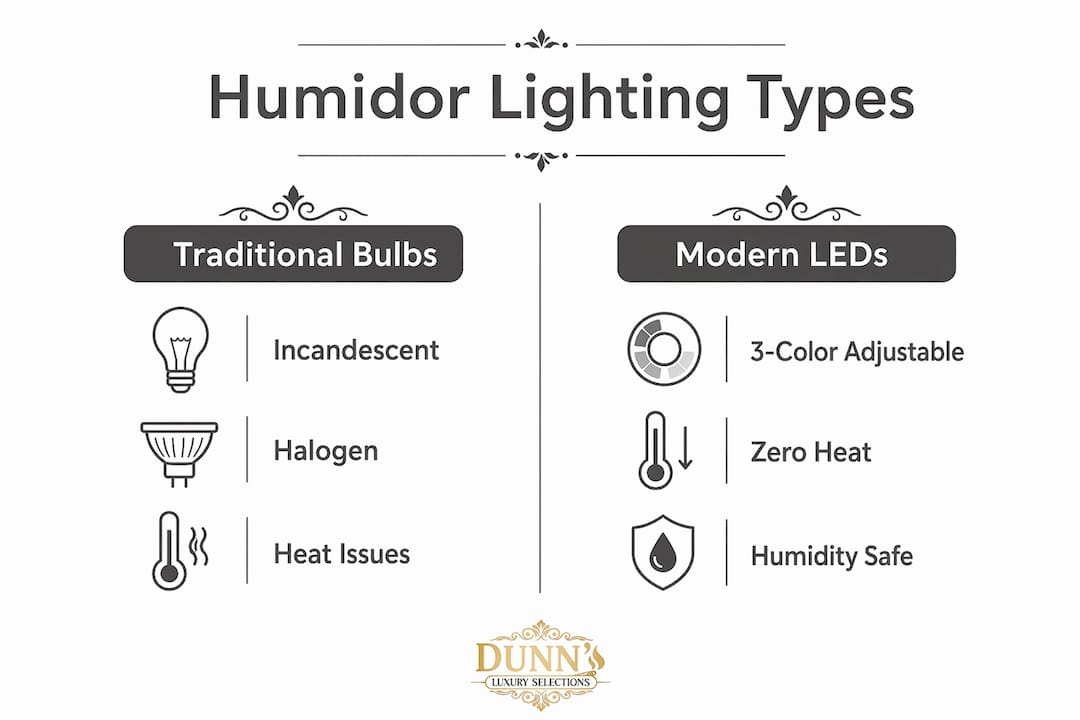
Heat is the primary enemy of humidity stability inside a humidor. Halogen and incandescent bulbs generate significant radiant heat, which raises the internal temperature and forces moisture out of the air and the cigars themselves. A cigar that dries below 65% RH loses its essential oils, tightens its draw, and burns unevenly. The damage is often irreversible.
Modern high-end electronic humidors exclusively use cool, low-voltage LED arrays that produce zero heat, preserving humidity between 65–72% RH. This is the 2026 industry standard for any serious humidor, from compact desktop units to full cabinet installations. The contrast with older bulb technology is not subtle. A single halogen bulb inside a sealed cabinet can raise the internal temperature by several degrees, which directly collapses the relative humidity reading.
The consequences of heat-driven humidity loss include:
- Wrapper cracking caused by rapid moisture loss in the outer leaf
- Draw tightening as the filler compresses when dried
- Flavor degradation from the loss of volatile aromatic compounds
- Accelerated aging that bypasses the slow, controlled maturation collectors prize
Humidity levels of 65–72% RH are optimal for premium cigars, with 68–70% RH often targeted as the sweet spot. Lighting must avoid heat generation entirely to hold that balance. This is why the shift from incandescent to LED is not a cosmetic upgrade. It is a preservation decision.
Pro Tip: If your humidor uses any bulb that feels warm to the touch after 10 minutes of operation, replace it immediately. Heat-emitting bulbs have no place in a precision storage environment.
What are the best lighting options for humidors in 2026?
The current standard for premium humidor lighting is the 3-color adjustable LED system. These systems offer cool, neutral, and warm light settings, giving collectors control over both the visual character of the display and the practical clarity needed for inventory checks. 3-color adjustable LED systems with electrodeless dimming are now common in humidors ranging from desktop units storing 80 cigars to large cabinet models holding 550 or more.
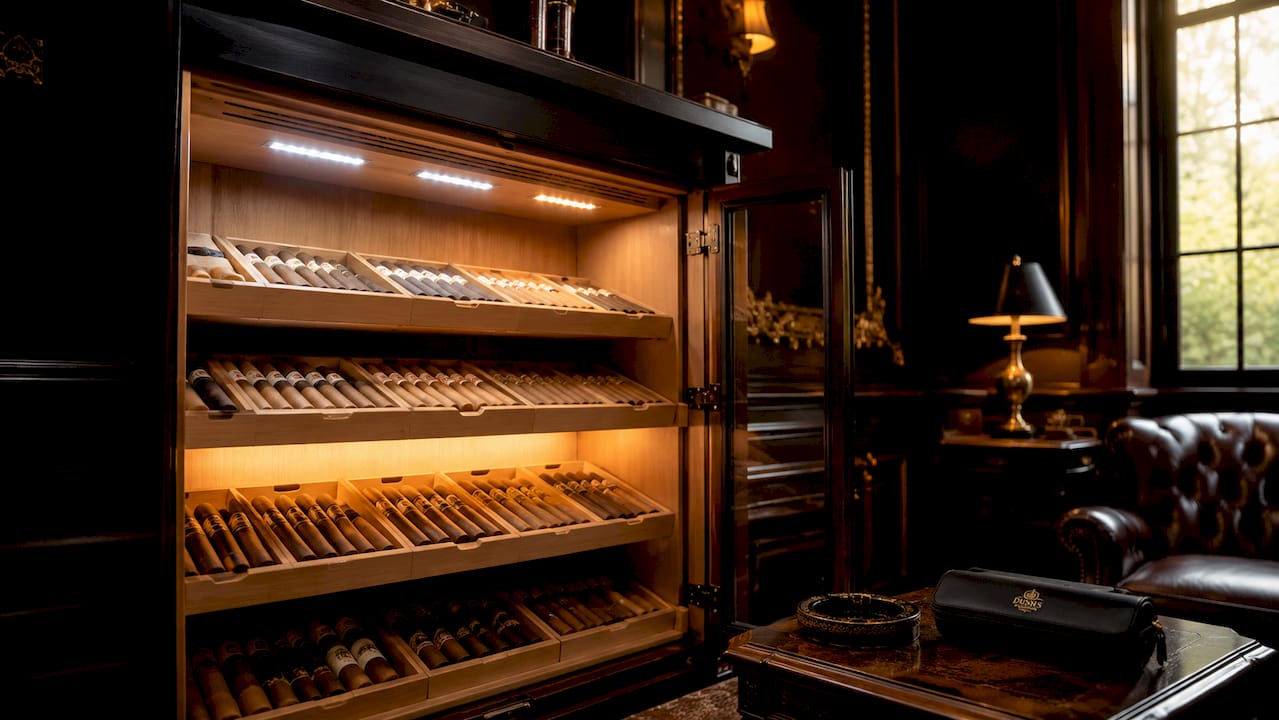
Electrodeless dimming is worth understanding. Traditional dimmer switches create a flickering effect at low brightness by rapidly cycling power. Electrodeless dimming adjusts voltage smoothly, producing a consistent, flicker-free glow at any brightness level. This matters for display quality and for the long-term stability of the LED driver, which generates less heat when not cycling on and off.
The table below compares the three primary lighting types used in humidors today:
| Lighting Type | Heat Output | Humidity Impact | Best Application |
|---|---|---|---|
| Incandescent / halogen | High | Significant drying effect | Not recommended |
| Standard LED (fixed) | None | No impact | Entry-level humidors |
| 3-color adjustable LED | None | No impact | Premium and cabinet humidors |
Triple-sided LED lighting systems deliver diffused illumination that eliminates shadows across all shelves. Some models include touch controls for brightness and color temperature, which lets you shift from a warm amber display tone for evening viewing to a cooler, cleaner light for detailed inspection. This level of control reflects the broader principle that the best lighting for humidors serves both the cigars and the collector’s experience.
Pro Tip: For walk-in humidors and large cabinet installations, position LED strips along three interior walls rather than just the top panel. This eliminates the shadow zones where cigars at the back of lower shelves become difficult to inspect without opening the door.
How does humidor lighting influence cigar aging and wrapper preservation?
Internal lighting protects cigars indirectly by reducing how often you need to open the humidor door. Integrated lighting’s primary role is functional visibility that lets you monitor inventory without disrupting the microclimate. Every time the door opens, conditioned air escapes and ambient air enters. In a room with lower humidity, that exchange pulls moisture from your cigars. Lighting that lets you see clearly through the glass panel eliminates most of those unnecessary openings.
The external light threat is equally serious and often underestimated. UV light and direct sunlight cause heat spikes and degrade wrapper quality, affecting both flavor and texture. The wrapper leaf is the most delicate and most exposed component of any cigar. UV radiation breaks down the chlorophyll and oils in the leaf, producing a bleached, brittle surface that burns poorly and tastes flat.
Key risks from external light and UV exposure include:
- Wrapper discoloration from UV-driven chlorophyll breakdown
- Oil loss that strips the wrapper of its natural sheen and aroma
- Heat spikes near windows that create localized humidity drops inside the humidor
- Uneven aging when one side of a cigar faces a light source consistently
Placement away from direct sunlight is more important than lighting technology alone. A perfectly lit humidor positioned in front of a south-facing window will still suffer UV damage to its contents. The ideal placement is an interior wall, away from windows, in a room with stable ambient temperature. Internal LED lighting then handles visibility without adding any thermal or UV risk.
The role of technology in humidors has expanded to include UV-filtering glass panels on premium cabinet models, which block harmful wavelengths while still allowing a clear view of the collection. This combination of UV glass and internal LED lighting represents the most complete solution for wrapper preservation currently available.
How to install and maintain humidor lighting for optimal cigar preservation
Installing LED lighting inside a humidor requires attention to the humidity seal above all else. Any penetration of the cabinet wall for wiring creates a potential gap in the vapor barrier. Follow these steps to protect the microclimate during installation:
- Use pre-wired LED strip kits designed for humidors. These route the power cable through the hinge channel or a sealed grommet, avoiding any new holes in the cabinet walls.
- Seal all cable entry points with food-grade silicone. This maintains the vapor barrier and prevents ambient air from entering around the wiring.
- Mount LED strips on the interior walls, not the ceiling panel. Ceiling-mounted strips concentrate light downward and create hot spots directly above the top shelf.
- Test the internal temperature after 24 hours of continuous operation. Use a calibrated hygrometer to confirm that humidity has not shifted. Calibrating your hygrometer before and after installation gives you a reliable baseline reading.
- Inspect wiring connections every six months. Loose connections generate micro-heat at the junction point, which accumulates over time in a sealed environment.
Maintaining the humidity seal and avoiding wiring issues are the two most critical factors when adding internal lighting to any humidor. The seal is the foundation of the entire microclimate. Compromise it and no amount of precision humidification will compensate.
Integrated LED lighting helps with inventory monitoring by illuminating the interior without requiring the door to open. This reduces fluctuations in humidity and temperature caused by frequent access. For collectors with large cabinet humidors holding hundreds of cigars, this functional benefit alone justifies the investment in a quality lighting system.
Key Takeaways
The most effective humidor lighting is a zero-heat, 3-color adjustable LED system that maintains 65–72% RH stability while eliminating the need to open the door for inventory checks.
| Point | Details |
|---|---|
| LED lighting is the only safe choice | Halogen and incandescent bulbs generate heat that destabilizes humidity and dries cigars. |
| Target humidity requires zero heat input | Premium cigars need 65–72% RH; any internal heat source works against that range. |
| Lighting reduces door openings | Clear interior illumination lets you monitor inventory without releasing conditioned air. |
| UV and sunlight are external threats | Place humidors away from windows; UV exposure degrades wrapper quality regardless of internal lighting. |
| Seal integrity governs installation | Route LED wiring through sealed grommets to preserve the vapor barrier during and after installation. |
Lighting is the detail most collectors overlook until it costs them
By Belle Dunn
I have consulted on hundreds of humidor setups over the years, and the lighting conversation almost always comes last. Collectors spend weeks selecting the right Spanish Cedar lining, the right hygrometer, the right humidification system, and then they drop a warm-toned halogen puck inside because it “looks better.” It does not look better when your Nicaraguan Robusto has dried to a crisp.
The insight that changed how I think about this: lighting in humidors is designed primarily for display and ease of access, not preservation. But it significantly supports preservation by reducing door openings. That reframing matters. When you stop thinking of the light as decoration and start thinking of it as a tool that keeps the door closed, you make better decisions about which system to install.
The mistake I see most often is placing a beautiful humidor on a sideboard directly below a skylight or beside a west-facing window. The internal LED lighting is perfect. The UV exposure from outside is destroying the wrappers anyway. External light placement is the variable that most collectors underestimate, and it is the one that cannot be fixed with a better bulb.
My honest recommendation: choose a 3-color adjustable LED system, position your humidor on an interior wall, and compare passive and active humidor options before committing to a lighting configuration. The lighting system should be the last decision you make, after placement and humidity control are already solved.
— Belle Dunn
Precision lighting, built into every Dunnluxuryselections humidor
Dunnluxuryselections designs each humidor with integrated lighting that serves the collection, not just the room. Every model in the cabinet and electronic range features zero-heat LED illumination calibrated to maintain the 65–72% RH environment your cigars require.

The Duke desktop humidor and the Bermuda large cabinet both feature integrated LED systems with touch-controlled brightness, UV-filtering glass panels, and sealed wiring channels that preserve the vapor barrier. For collectors building a serious display, the full cabinet humidor collection at Dunnluxuryselections offers bespoke configurations with climate-controlled systems and multi-zone LED lighting. White-glove delivery and expert consultation are included with every order.
FAQ
What is the role of lighting in humidors?
Lighting in humidors provides visibility for monitoring cigars without opening the door, which preserves humidity stability. The primary preservation benefit is indirect: fewer door openings mean fewer humidity fluctuations.
Does LED lighting affect humidity inside a humidor?
Modern cool, low-voltage LED arrays produce zero heat and have no measurable impact on internal humidity or temperature. Halogen and incandescent bulbs do affect humidity by generating radiant heat.
What humidity level should a humidor maintain?
Premium cigars require 65–72% RH, with 68–70% RH as the most commonly targeted range. Any internal heat source, including warm bulbs, works against maintaining that balance.
How does UV light damage cigars?
UV exposure breaks down the oils and chlorophyll in the wrapper leaf, causing discoloration, brittleness, and flavor loss. Placing the humidor away from direct sunlight is the most effective protection.
What is the best lighting for a cabinet humidor?
A 3-color adjustable LED system with electrodeless dimming is the current standard for premium cabinet humidors. Triple-sided LED strip placement eliminates shadows and allows full inventory inspection without opening the door.
Recommended
You May Also Enjoy
Cigar Locker Dimensions: Sizing Guide for Collectors and Lounges
Cigar locker dimensions explained: compartment sizes, cabinet footprints, capacity math and clearances, so you size a locker bank...
Read Article
Sealing a Walk-In Humidor: Envelope, Door and Penetrations
How to seal a walk-in humidor properly: vapor barrier placement, door gasket, penetrations and the controlled airflow a...
Read Article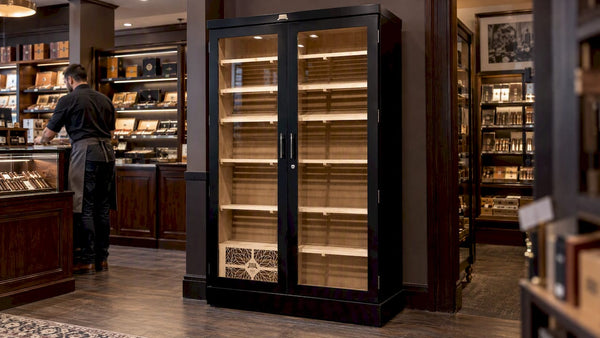
Retail Humidor ROI: How to Measure What a Display Earns
What does a retail or lounge humidor really return? A practical framework for cigar shops, lounges and clubs:...
Read Article