

Discover the pivotal role of technology in humidors for precise cigar preservation. Elevate your collection and ensure perfect aging in 2026!
The role of technology in humidors is to automate precise humidity and temperature regulation so your cigars age gracefully without constant manual intervention. Where a traditional cedar box relies on passive evaporation and your own vigilance, a modern electronic or smart humidor operates as a self-correcting ecosystem. Sensors read conditions in real time, actuators respond within minutes, and your smartphone receives the data before you even open the lid. For serious collectors, that shift from reactive maintenance to proactive preservation is not a convenience. It is the difference between a cigar that peaks and one that quietly deteriorates.
What is the role of technology in humidors?
Technology in humidors is defined by one governing principle: remove the human error that passive systems invite. Digital hygrometers, active humidification circuits, temperature cooling units, and wireless connectivity each address a specific failure point that wooden humidors cannot solve on their own.
Digital hygrometers are the foundation. Analog gauges drift by as much as 5 to 10 percentage points over time and require salt-test calibration every few months. A quality digital sensor holds accuracy within ±1% relative humidity (RH) and delivers readings you can actually trust when making storage decisions.
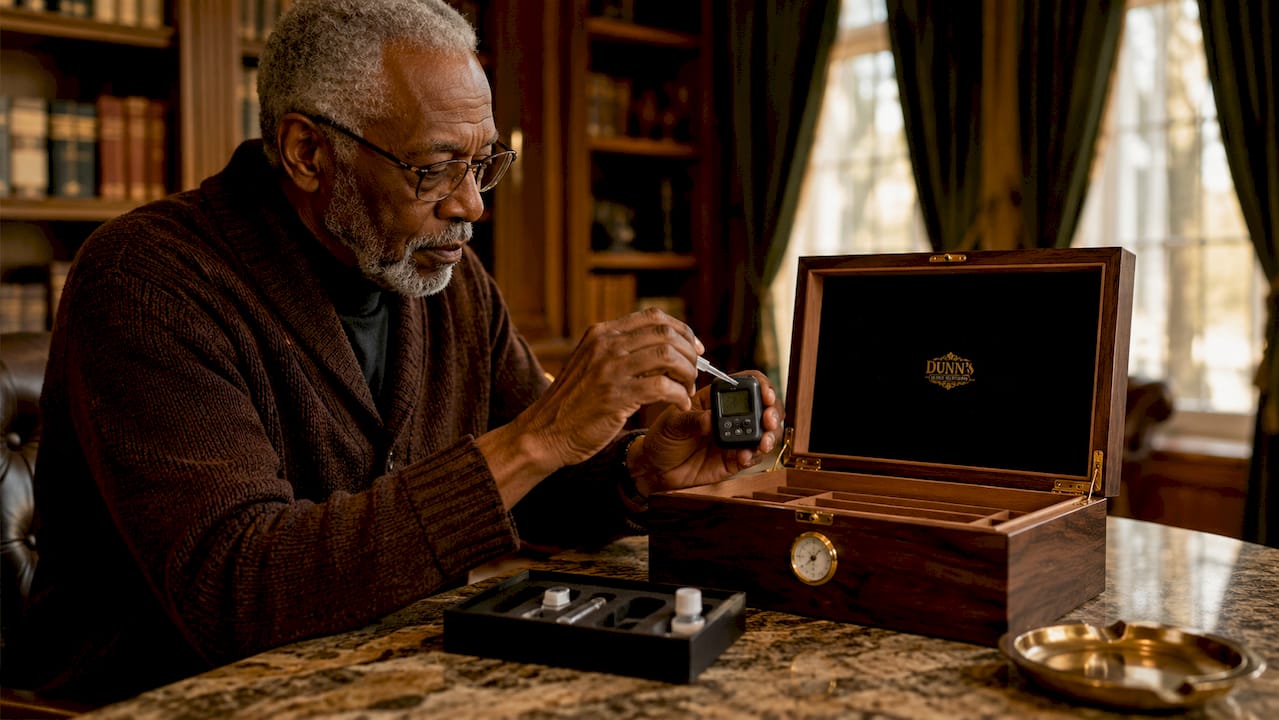
Active humidification systems go further. Rather than relying on a passive sponge or Boveda pack to release moisture by diffusion alone, active systems use water circulation and fine-mist distribution to respond to humidity drops in real time. Humidity control systems operate as continuous feedback loops, measuring RH then automatically adding or removing moisture. That feedback architecture is what separates a smart humidor from a well-stocked wooden box.
Temperature control is the feature most collectors underestimate. Tobacco beetle larvae activate above 72°F, and a single infestation can devastate an entire collection. Units like the NEEDONE 48L intelligent humidor maintain temperature between 61 and 72°F with 360° air circulation, holding RH between 65 and 75%. That combination of thermal and humidity control creates conditions where aging proceeds on your terms, not the environment’s.
Smart connectivity completes the picture. Systems like the Klaro Valet BLE Bridge push real-time temperature and humidity data to your smartphone, send automated alerts for low water levels, and log historical condition data. That log is more valuable than most collectors realize. It gives you a verified record of every aging environment your cigars have experienced.
- Digital hygrometers with ±1% RH accuracy replace unreliable analog gauges
- Active water circulation prevents stagnant air pockets that create uneven conditions
- Thermoelectric or compressor cooling holds temperature below the beetle-activation threshold
- App connectivity delivers remote monitoring and automated maintenance alerts
- Inventory tracking features log your collection, aging schedules, and rotation habits
Pro Tip: Calibrate your digital hygrometer against a known reference, such as a Boveda calibration kit, every six months. Even the best sensors drift slightly over time, and a 3% RH error compounds into real flavor damage across a multi-year aging cycle.
How does technology improve humidors compared to traditional systems?
The most direct answer: technology compresses the recovery window after every door opening. When you retrieve a cigar from a passive humidor, the RH inside can drop by 5 to 10 points and take hours to stabilize. The FreshBox MaxFlow™ system recalibrates humidity up to 4 times faster than traditional humidors and sustains consistent freshness for up to 12 months. Faster recovery means less cumulative stress on your wrappers across hundreds of openings over a year.
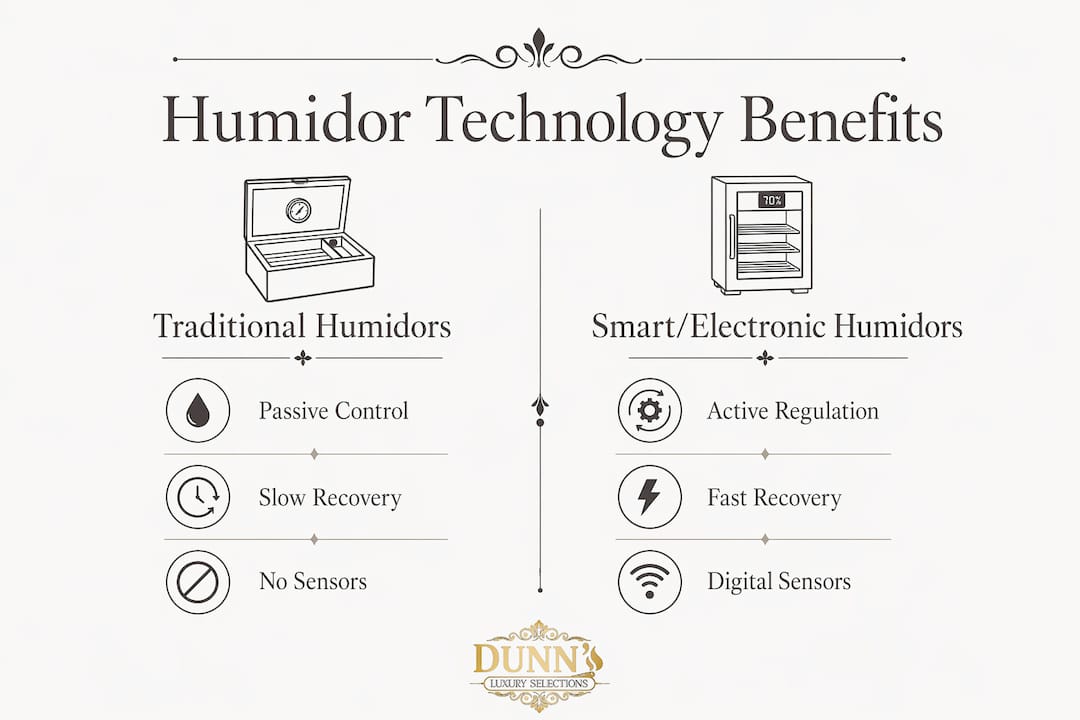
The table below captures the practical differences a collector experiences daily:
| Feature | Traditional humidor | Electronic/smart humidor |
|---|---|---|
| Humidity recovery after opening | Slow, hours to stabilize | Up to 4x faster recovery |
| Temperature control | None, ambient only | Active cooling/heating, 61–72°F |
| Monitoring method | Manual hygrometer checks | Real-time app alerts and logging |
| Maintenance frequency | Weekly refills and calibration | Automated alerts, reduced manual checks |
| Aging consistency | Variable, environment-dependent | Stable baseline for experimentation |
| Inventory management | Manual notes or memory | Digital tracking and rotation reminders |
Electronic humidors control moisture and airflow actively with sensors and circulation systems to prevent microclimates. That uniformity directly reduces wrapper cracking, uneven burn, and the flavor defects that come from inconsistent hydration. A cigar stored in fluctuating conditions develops off-notes that no amount of rest will fully correct.
The organizational dimension deserves its own mention. Technology integration allows for inventory management and categorization, facilitating aging schedules and better rotation habits. Collectors who track their cigars digitally smoke them at the right moment rather than letting rare sticks become forgotten relics at the back of the box.
Pro Tip: When aging cigars at different humidity setpoints, use the app’s condition log to correlate RH levels with tasting notes over time. That data turns subjective preference into a repeatable, personalized aging protocol.
What types of electronic and smart humidors suit different collectors?
The category has matured enough that there is now a purpose-built format for every stage of a collector’s journey.
Desktop smart humidors serve the enthusiast who maintains a rotating stock of 25 to 100 cigars. Units in this category typically integrate a digital hygrometer, a Boveda-compatible or active humidification chamber, and Bluetooth connectivity for app monitoring. They fit on a desk or shelf and require minimal infrastructure. Dunnluxuryselections curates a selection of desktop humidors that combine these monitoring features with the Spanish Cedar interiors that serious collectors demand.
Cabinet humidors with climate control are the sanctuary of the dedicated collector. These units hold 500 to several thousand cigars and incorporate thermoelectric or compressor-based cooling alongside active humidification. The controlled temperature environment makes them the only responsible choice for long-term aging of premium cigars, particularly those with delicate Connecticut Shade or Ecuadorian Habano wrappers that react visibly to thermal swings.
Travel humidors with active controls represent the newest frontier. Portable units now incorporate small-scale humidity regulation that maintains stable RH during transit, protecting your selections whether you are traveling by car or crossing time zones by air. These are not passive cases with a foam insert. They are miniature climate systems.
Choosing between these formats comes down to three variables: collection size, aging ambition, and how much environmental control your storage location already provides. A climate-controlled home office changes the calculus differently than a garage or a vacation property in a humid coastal climate.
How to set up and maintain a tech-enabled humidor for best results
Setup and calibration determine whether your investment in technology actually delivers. Follow this sequence to get it right from day one.
- Season the interior before loading cigars. Even electronic humidors with Spanish Cedar shelves benefit from a 48 to 72-hour seasoning period. Wipe the cedar lightly with distilled water, place an open container of distilled water inside, and allow the wood to absorb moisture before introducing any cigars.
- Calibrate the digital hygrometer against a reference standard. Use a Boveda 75% RH calibration kit or a precision reference hygrometer. Record the offset and apply it to your readings. A sensor reading 73% when the true RH is 70% will cause you to under-humidify your collection.
- Fill the reservoir with distilled water only. Tap water introduces minerals that clog humidification membranes and promote bacterial growth. Distilled water keeps the system clean and extends the service life of your humidification components.
- Position cigars to allow airflow between rows. Active circulation systems work best when air can move freely. Overcrowding creates the very microclimates the technology is designed to eliminate. Leave at least a finger’s width between bundles.
- Configure app alerts before you close the lid. Set low-humidity alerts at 63% RH and high-humidity alerts at 76% RH. Set temperature alerts at 73°F. These thresholds give you a response window before conditions reach damaging levels.
- Schedule a monthly maintenance check. Inspect the reservoir, wipe sensor surfaces with a dry cloth, and review the condition log for any anomalies. Monitoring cigar freshness consistently is what separates collectors who age successfully from those who discover problems too late.
Pro Tip: Minimize door openings during the first 30 days after loading a new batch of cigars. That initial period is when the wood and tobacco are equilibrating to the target RH. Every unnecessary opening extends that process and adds cumulative stress to the wrappers.
Key takeaways
Smart and electronic humidors outperform passive systems by automating humidity recovery, eliminating microclimates, controlling temperature, and providing real-time monitoring that protects your collection around the clock.
| Point | Details |
|---|---|
| Technology defines precision | Digital sensors and active humidification hold RH within ±1%, far beyond analog capability. |
| Faster recovery protects wrappers | Active systems restore target humidity up to 4x faster after door openings, reducing cumulative stress. |
| Temperature control prevents infestation | Maintaining storage below 72°F eliminates the beetle-activation threshold that destroys collections. |
| App connectivity enables aging strategy | Condition logs and inventory tracking turn passive storage into an active, data-informed aging program. |
| Calibration determines accuracy | Even the best sensors require periodic calibration against a reference standard to remain trustworthy. |
Why technology has changed what it means to collect cigars
I have spent years observing how collectors relate to their humidors, and the most significant shift is not technical. It is psychological. Before smart humidors, the anxiety of collection management was constant. You checked the hygrometer, refilled the humidifier, worried about the summer heat spike, and hoped for the best. That vigilance consumed mental energy that should have been directed toward the pleasure of the cigars themselves.
What electronic humidors actually give you is permission to stop worrying. When a system like the FreshBox MaxFlow™ is maintaining conditions automatically and alerting you only when intervention is needed, your relationship with your collection changes. You start thinking about aging trajectories rather than daily maintenance. You experiment with humidity setpoints for different wrapper types because you have a stable baseline to return to. Electronic humidors reduce environment oscillations that harm quality, and that stability is what makes genuine aging experimentation possible.
My one caution: technology does not replace knowledge. A collector who does not understand why 65% RH produces a different smoke than 70% RH will not benefit from the precision a smart humidor provides. The technology amplifies your expertise. It does not substitute for it. Learn the fundamentals of cigar aging first, then let the instruments execute your vision with the consistency that human hands cannot match. The future of this craft belongs to collectors who hold both.
— Brian
Discover precision humidors at Dunnluxuryselections

Dunnluxuryselections is America’s premier destination for luxury cigar humidors, and every unit in our collection reflects the same standard: precision engineering in service of your cigars’ full potential. Whether you are building a desktop sanctuary for your daily rotation or commissioning a cabinet humidor capable of aging a thousand-cigar legacy collection, we carry the formats, the technology, and the expertise to match your ambition. Our electronic humidor collection brings together active humidity control, thermoelectric temperature regulation, and app-based monitoring in designs worthy of the cigars they protect. Explore the collection and let us help you build a storage environment your cigars deserve.
FAQ
What is the ideal humidity range for cigar storage?
The standard target for cigar storage is 65 to 72% relative humidity. Units like the NEEDONE 48L maintain this range actively, preventing the wrapper cracking and flavor defects that occur outside these boundaries.
How do smart humidors monitor conditions remotely?
Smart humidors use Bluetooth or Wi-Fi sensors to transmit real-time temperature and humidity data to a smartphone app. Systems like the Klaro Valet BLE Bridge send automated alerts when conditions drift outside your set parameters.
Can technology in humidors prevent tobacco beetles?
Yes. Maintaining storage temperature below 72°F deactivates tobacco beetle larvae, which is the primary biological threat to cigar collections. Electronic humidors with thermoelectric cooling provide this protection passively and continuously.
How often should I calibrate a digital hygrometer?
Calibrate your digital hygrometer every six months using a Boveda calibration kit or a precision reference instrument. Even accurate sensors drift over time, and an uncorrected 3% RH error compounds into measurable quality loss across a multi-year aging cycle.
Do electronic humidors work for long-term cigar aging?
Electronic humidors are the preferred format for long-term aging because they maintain the stable, consistent conditions that allow cigars to develop complexity over years. The ability to set and hold precise humidity and temperature setpoints, combined with condition logging, makes them far more reliable than passive wooden humidors for aging collections of significant value.
Recommended
You May Also Enjoy
Save Flavor in 14 Days: Cleaning a Humidor for Collectors
For collectors: clean mold or plume without tainting cedar. Keep or toss decision rules, 14 days reseasoning, hygrometer...
Read Article
6 to 26 Weeks: Custom Humidor Timeline for Collectors & Gift Buyers
Plan a bespoke humidor with a realistic production calendar. See stage-by-stage timings, what typically adds weeks, and how...
Read Article
50/50 Propylene Glycol Ratio + 90/10 Flush for Collectors & Installers
Use a 50/50 propylene glycol ratio to hold passive humidors near 70% RH. Installer tested: occasional 90/10 water...
Read Article