

Plan an engineered home cigar room: size exhaust to 15–25 ACH, ensure negative pressure and makeup air, add HEPA+carbon purification, and match humidors...
A home cigar room works when it’s isolated from your central HVAC and built around a dedicated exhaust fan paired with an in-room purifier, not when it merely looks the part. Before choosing a single finish or club chair, measure your room’s cubic footage and calculate the airflow you’ll need. Everything else, the design and the humidors, follows from that number.
TL;DR:
- Proper ventilation requires sizing exhaust fans for at least 15 air changes per hour, with premium setups reaching 21 to 25 ACH, and using continuous-duty inline centrifugal fans rated for static pressure.
- Isolation from central HVAC and rooms with exterior walls or detached structures significantly reduce smoke migration and containment costs.
- Hard flooring, leather or performance fabric seating, and layered dimmable LED lighting best withstand smoke exposure and preserve room aesthetics over time.
- Humidors should be placed at least three feet from exhaust vents, with electronic humidifiers and calibrated hygrometers ensuring stable humidity around 70/70, minimizing fluctuations.
- Costs vary from $3,000 to over $30,000 depending on ventilation complexity, finishes, and humidor sizes, with installation taking four to ten weeks on average.
Table of Contents
- What Makes the Best Home Cigar Rooms Work?
- How Do You Engineer Ventilation for a Cigar Room?
- Design and Furnishings That Stay Sharp Under Smoke
- Choosing and Placing Humidors Inside Your Cigar Room
- What Does a Home Cigar Room Cost and How Long Does It Take?
- How Do You Maintain a Cigar Room Long Term?
- Why Dunn’s Luxury Selections Understands This Better Than Most
- Recommended Humidity and Temperature Devices Beyond Basic Monitors
- How Do You Keep Smoke From Spreading to the Rest of the House?
- What Lighting Works Best Without Harming Cigar Preservation?
- A Note From Belle Dunn
- Ready to Outfit Your Cigar Room?
- Sources
- FAQ
What Makes the Best Home Cigar Rooms Work?
Not every room in your house is a candidate. The right choice comes down to isolation, access, and how far the smoke has to travel before it hits fresh air.
Basements are the most popular pick, and for good reason: they’re naturally separated from living spaces, often have exterior walls for venting, and the concrete structure resists odor absorption better than framed interior rooms. The tradeoff is duct routing. You’ll likely need to core-drill or route ductwork up and out, which adds labor cost.
Spare bedrooms offer easy exterior-wall access and existing electrical, but they usually sit close to other bedrooms or shared HVAC returns. That adjacency is a problem. Smoke migration into a central return duct means the whole house smells like your hobby, not just your favorite room.
Garages and detached structures (a converted shed, a pool house) are the cleanest solution from a containment standpoint since they’re already outside the home’s air envelope. Attics work in theory but rarely in practice: insulation, headroom, and duct runs make them the most expensive retrofit.
Before you commit, run through this checklist:
- Does the room have an exterior wall for direct exhaust termination?
- Is there existing electrical capacity for fans, purifiers, and lighting?
- Is the room isolated from central HVAC supply and return vents?
- Is there clearance above the ceiling or behind a wall for duct routing?
- Is the room away from bedrooms, nurseries, or shared air paths?
A room that checks four or five of these boxes will cost you far less to retrofit than one that checks only two.
How Do You Engineer Ventilation for a Cigar Room?
Ventilation is the single element separating a cigar room that works from one that just smells like an ashtray with nice furniture. Four pillars make it functional: isolation from the house’s HVAC, dedicated exhaust, makeup air, and in-room purification.
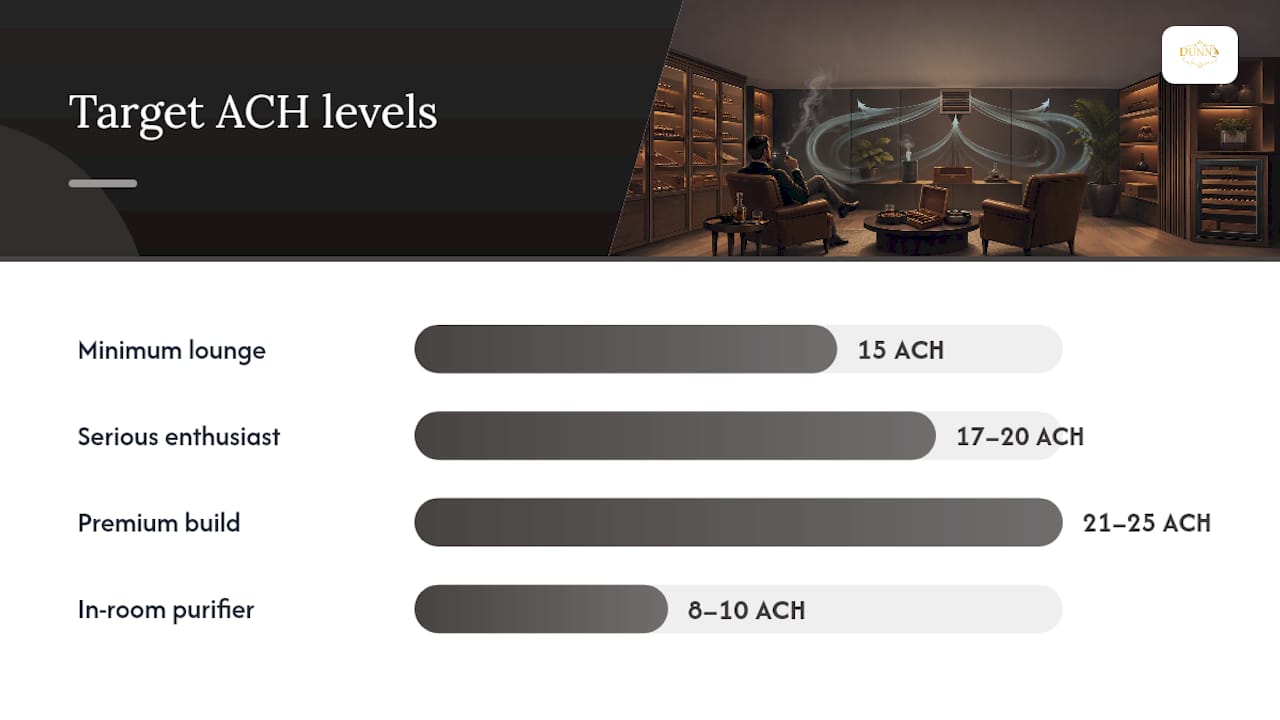
Start with the math, not the fan. Industry guidance recommends a minimum of 15 air changes per hour (ACH) for a competent home lounge, with serious enthusiasts pushing to 17 to 20 ACH and premium builds landing at 21 to 25 ACH. To convert ACH into the CFM (cubic feet per minute) your exhaust fan needs to move, use this formula:
- Calculate room volume: length × width × ceiling height.
- Multiply volume by your target ACH.
- Divide by 60 to get CFM.
Sizing example: A 200-square-foot room with an 8-foot ceiling is 1,600 cubic feet. At 15 ACH, that’s (1,600 × 15) ÷ 60 = 400 CFM of required exhaust.
Pro Tip: Never spec a bathroom exhaust fan for this job. Contractors who work on smoking rooms consistently warn against household-grade fans and instead recommend continuous-duty inline centrifugal fans rated for the static pressure your duct run actually creates.
For in-room polishing, aim your purifier at 8 to 10 ACH using a unit that combines True HEPA filtration with a heavy activated carbon bed. HEPA catches particulates; carbon adsorbs the gaseous odor compounds HEPA can’t touch. Skip energy-recovery ventilators here: experts caution against ERVs for cigar rooms because they recirculate air and can spread smoke contaminants elsewhere in the ductwork.
Makeup air matters as much as exhaust. A simple undercut beneath the door often supplies enough passive makeup air for smaller systems, but once your exhaust CFM climbs, you may trip local code requirements for active, tempered makeup air. Check with your municipality before finalizing duct size. When you’re vetting contractor bids, ask for guaranteed CFM at a stated external static pressure, a post-install airflow test report, and a target sound level under 50 dBA at seating height.
Design and Furnishings That Stay Sharp Under Smoke
Style in a cigar room has to survive years of particulate exposure, which rules out a lot of otherwise beautiful choices.
Layout comes first. Position seating so the primary airflow path runs from the makeup-air source, across the seating area, toward the exhaust intake, rather than blowing smoke back into someone’s face. A horseshoe or L-shaped arrangement around a central humidor or bar tends to work better than facing chairs directly into each other.
Materials matter more here than in almost any other room in the house:
- Hard flooring (tile, stone, sealed hardwood) resists staining far better than carpet, which traps particulate and holds odor indefinitely.
- Leather or tightly woven performance fabric on seating outperforms heavy drapery and upholstered fabric, both of which act like odor sponges.
- Sealed or lacquered wood paneling holds up better than raw or oil-finished wood.
- Skip heavy curtains altogether; wood blinds or shutters look sharp and don’t absorb smoke the way fabric does.
Lighting should run on dimmable layers, a warm ambient wash plus focused task lighting near the humidor and pour station, and never anything that generates enough heat to disturb the room’s temperature stability. Wire dedicated outlets for your purifier and beverage station during the rough-in phase; retrofitting outlets after drywall goes up costs far more.
Pro Tip: A solid-core door with a compression seal (the kind used on soundproofed home offices) does double duty. It keeps smoke contained and cuts down noise transfer, which matters if the room sits anywhere near a shared wall.
Choosing and Placing Humidors Inside Your Cigar Room
Your ventilation system protects the room. Your humidor protects the cigars, and the right choice depends entirely on how much you’re storing and how you use the space.
A desktop humidor like the Duke or the Modena suits a rotating everyday stash, the two to three boxes you’re actively smoking through. A cabinet humidor, such as the Bermuda, the 17-Locker Dark Cherry cabinet, or the Barbatus, makes sense once your collection outgrows a single tray, and a standing locker, like the Mahogany Cigar Locker, works well for collectors housing thousands of sticks or running a private club-style setup.
Hold to the 70/70 baseline (70°F, 70% relative humidity) as your starting point, but understand that stability matters more than hitting an exact number. The 135 rule reframes storage around minimizing fluctuation rather than chasing a single fixed target, which is exactly why a quality electronic humidifier with digital monitoring earns its cost over passive foam solutions.
- Keep humidors at least three feet from any exhaust vent or door undercut to avoid drying drafts.
- Stock spare hygrometers, cedar dividers, and replacement humidification media before you need them.
- Calibrate your hygrometer against a salt-test at least twice a year.
What Does a Home Cigar Room Cost and How Long Does It Take?
Budgets vary widely depending on how far you push the ventilation and finishes.
- Minimal setup ($3,000 to $8,000): basic inline exhaust fan, passive makeup air, entry-level HEPA/carbon purifier, and a cabinet humidor.
- Mid-range engineered room ($10,000 to $25,000): properly sized inline fan hitting 15 to 20 ACH, active makeup air, premium purifier, sound insulation, and custom cabinetry.
- High-end lounge ($30,000 and up): 21 to 25 ACH systems, tempered makeup air, architectural millwork, and a walk-in or locker-style humidor built into the room.
Ventilation labor and ducting typically eat the largest share of the budget, followed by cabinetry and permitting fees where local code triggers a mechanical permit. Plan on four to ten weeks from final design to commissioning, longer if your municipality requires inspection for the makeup-air system. Stage the project if needed: get exhaust and purification right first, then upgrade finishes and cabinetry once the bones are solid.
How Do You Maintain a Cigar Room Long Term?
Neglect is what turns a well-built room into a stale one within a year.
- Replace HEPA and carbon filter cartridges on the manufacturer’s schedule, typically every three to six months depending on usage, and inspect inline fan bearings annually.
- Wipe down leather and sealed wood surfaces weekly; run a deeper upholstery and finish clean quarterly.
- Check hygrometer calibration and top off humidification media seasonally, and treat any sudden RH swing as a signal your exhaust or makeup-air balance needs a professional look.
Why Dunn’s Luxury Selections Understands This Better Than Most
We don’t just sell humidors. We consult on where they live. When a client is planning a ventilated cigar room, we work alongside their HVAC contractor to place humidors away from vent paths and door drafts, matching the piece to the room’s actual airflow, not just its square footage.
Our catalog spans the full range a serious room demands:
- Entry and everyday: the Duke, Modena, and ONYX desktop humidors.
- Display and centerpiece: the Milano and Santiago.
- Growing collections: the Bermuda, 17-Locker Dark Cherry, and Barbatus cabinets.
- Serious volume: the Mahogany Cigar Locker and full walk-in aging room builds.
| Collection Size | Recommended Category | Example |
|---|---|---|
| Under 50 cigars | Desktop humidor | Duke, ONYX |
| 50 to 500 cigars | Cabinet humidor | Bermuda, Barbatus |
| thousands of cigars | Locker or walk-in | Mahogany Locker |
Recommended Humidity and Temperature Devices Beyond Basic Monitors
A wall-mounted hygrometer tells you the current reading. It won’t fix a drift, and by the time you notice one manually, your cigars may have already sat in overly dry or damp air for days. That gap is why serious rooms layer in active control hardware rather than relying on passive monitoring alone.
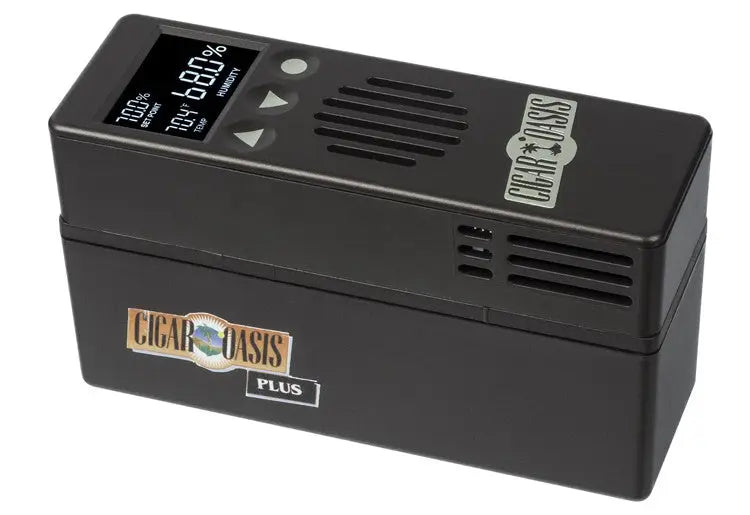
Electronic cabinet humidifiers, like the Cigar Oasis Plus, pull moisture readings and adjust output automatically, holding RH within a tighter band than a foam puck or gel jar ever could. For the room itself rather than the humidor, a standalone dehumidifier earns its keep in humid climates or basement installations where ambient moisture swings with the seasons. Pair it with a small in-room fan to keep air circulating gently across your storage units; stagnant pockets of air are where localized mold risk creeps in even when your overall room reading looks fine.
Temperature stability deserves equal attention. A mini-split or a dedicated zone thermostat holding the room within two or three degrees does more for long-term aging than any single humidity gadget, since temperature swings drive the humidity fluctuations the 135 rule warns against in the first place. If your cigar room shares a wall with an exterior surface, insulate that wall properly. It’s a cheap fix that prevents your climate equipment from fighting outdoor conditions all day.
How Do You Keep Smoke From Spreading to the Rest of the House?
Containment starts at the door, not the exhaust fan. A solid-core door with a compression seal or an automatic door bottom closes the gap that lets smoke drift into hallways every time someone walks in or out.
Sealing is the unglamorous half of the job. Foam gaskets around any penetration, an outlet, a light switch, a duct penetration, stop smoke from migrating through wall cavities into adjacent rooms. This matters more than most first-time builders expect, because smoke doesn’t need an open door to travel; it finds every unsealed gap in the envelope.
The single biggest containment failure is a shared HVAC connection. If your cigar room’s supply or return vent ties into the same ductwork serving the rest of the house, you are actively piping smoke into every other room every time the system cycles. Isolating the room from central HVAC entirely is the single highest-leverage decision in the entire build, and it should happen before you pick a single fan or filter.
Negative pressure inside the room, achieved by exhausting slightly more air than your makeup air supplies, ensures smoke gets pulled toward your exhaust duct rather than pushed out through door gaps into the hallway. It’s a subtle balance, and it’s exactly why a professional airflow test after installation matters: you want measured proof the room is pulling air inward, not guesswork.
What Lighting Works Best Without Harming Cigar Preservation?
Lighting sets the mood in a cigar room more than almost any other design choice, but it can quietly undermine the very cigars you’re protecting if you get it wrong.
Heat is the enemy here, not brightness. Incandescent and halogen fixtures throw off real heat, and mounted too close to a humidor or storage cabinet, they can create localized temperature spikes that dry out wrappers in that specific zone even while your room-wide hygrometer reads normal. LED fixtures solve this cleanly: they run cool, last far longer, and now come in warm color temperatures (2700K to 3000K) that mimic the amber glow collectors associate with a proper lounge.
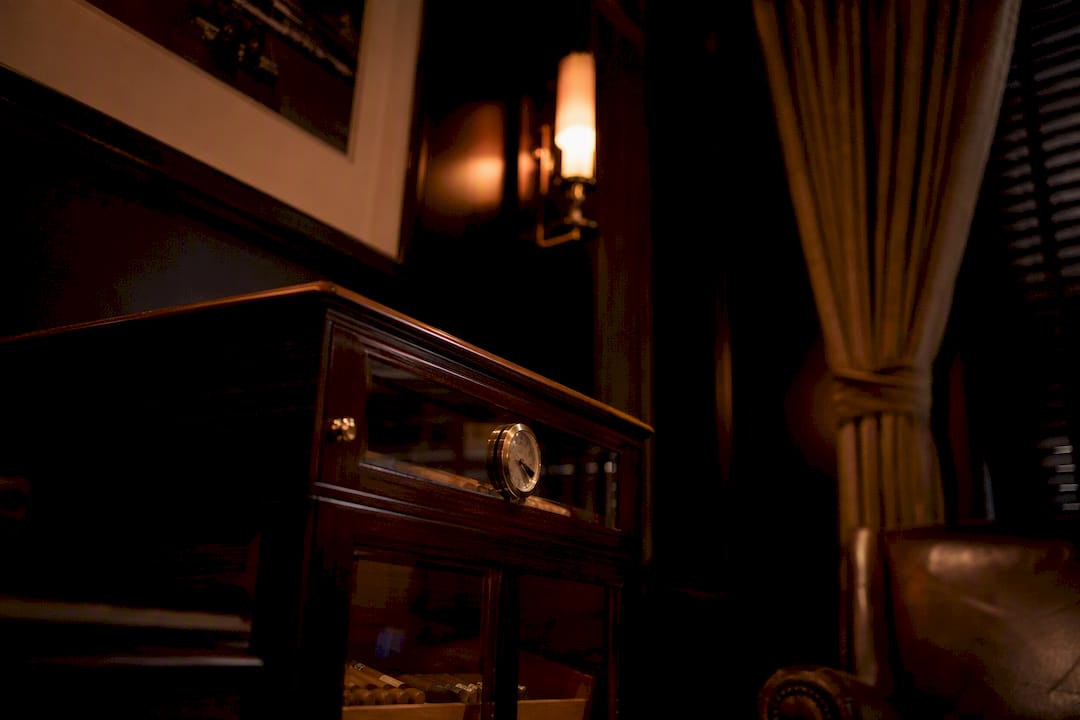
Layer your lighting rather than relying on one overhead fixture. A dimmable ambient layer sets overall mood, wall sconces or picture lights add warmth without glare, and a focused accent light over the humidor or pour station does practical work without washing out the room. Keep any light source at least a foot away from humidor glass or wood surfaces, and never point a fixture directly at cedar-lined storage for extended periods.
Avoid UV-heavy bulbs near any display humidor with a glass front. Ultraviolet exposure fades cigar bands and can degrade wrapper leaf over time, the same reason wine cellars avoid direct sunlight on bottles. A simple UV-filtering glass panel on a display case, paired with LED lighting, lets you show off a collection like the Milano’s 360-degree case without any of that risk.
A Note From Belle Dunn
Preservation and ventilation are the same problem viewed from two directions: one keeps smoke out of your home, the other keeps humidity locked around your cigars. We built our catalog around that overlap. If you’re planning a room and want a second set of eyes on placement or humidor selection, we’re glad to talk it through.
— Belle Dunn
Ready to Outfit Your Cigar Room?
Once the ventilation engineering is settled, the humidor you choose determines how well your collection actually ages inside that room. Dunn’s Luxury Selections built its catalog around that exact handoff, matching cabinet, locker, and desktop pieces to the airflow and layout decisions you’ve already made rather than selling storage as an afterthought.

Whether you need a desktop humidor for daily rotation, a cabinet for a growing collection, or you’re ready to discuss a full walk-in humidor build integrated into your room’s climate system, browse our current collections or reach out directly for a consultation on placement and specification. The room’s engineering protects the space. The right humidor protects the cigars inside it, and that’s the piece we’re best positioned to help you get right.
Sources
- Complete Cigar Lounge and Smoking Room Planning — LakeAir
- The blueprint: how to build a professionally ventilated home cigar room — Commercial Air Purifiers
- Cigar room smoke ventilation: Codes, sizing & hiring guidance — Man Cave Insider
- What is the 135 Rule for Cigars? | Custom Cigars
FAQ
What Is the 135 Rule for Cigars?
The 135 rule is a storage guideline that shifts focus from hitting an exact humidity number to minimizing fluctuation and keeping temperature and humidity stable over time.
What Is the Best Ventilation System for a Home Cigar Room?
A dedicated inline centrifugal exhaust fan vented outdoors, combined with a HEPA and heavy-carbon in-room purifier, sized to hit at least 15 ACH for exhaust and 8 to 10 ACH for purification, performs best for home installations.
What Are the Must-Haves for a Cigar Room?
The essentials are HVAC isolation, dedicated exhaust ducted outdoors, a HEPA and carbon purifier, makeup air, a sealed door, and stable humidor storage rated for your collection size.
What Are Some Ideas for a Cigar Room in My House?
Basements, converted garages, and detached structures make the strongest candidates because they isolate easily from central HVAC; pair the space with hard flooring, leather seating, and layered warm LED lighting for a room that looks sharp and resists odor buildup.
How Many Air Changes Per Hour Does a Cigar Room Need?
Most professionals recommend a minimum of 15 ACH for exhaust in a home lounge, with 17 to 25 ACH common in premium builds, alongside 8 to 10 ACH from an in-room purifier.
Can I Use a Regular Bathroom Fan for a Cigar Room?
No. Contractors specifically warn against household bathroom fans because they lack the static pressure rating and continuous-duty design a cigar room’s exhaust load requires.
Should I Choose a Cabinet Humidor or a Walk-In for My Room?
A cabinet humidor like the Bermuda or Barbatus suits collections up to a few hundred cigars, while a locker or full walk-in makes more sense once you’re storing well into the thousands or building a private club-style space.
Recommended
You May Also Enjoy
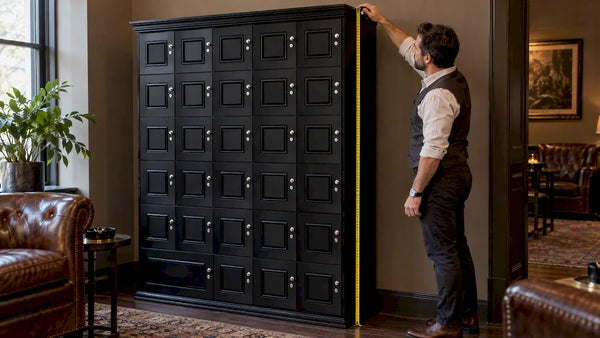
Cigar Locker Dimensions: Sizing Guide for Collectors and Lounges
Cigar locker dimensions explained: compartment sizes, cabinet footprints, capacity math and clearances, so you size a locker bank...
Read Article
Sealing a Walk-In Humidor: Envelope, Door and Penetrations
How to seal a walk-in humidor properly: vapor barrier placement, door gasket, penetrations and the controlled airflow a...
Read Article
Retail Humidor ROI: How to Measure What a Display Earns
What does a retail or lounge humidor really return? A practical framework for cigar shops, lounges and clubs:...
Read Article