

Engineering first home cigar room ideas: hit 15–20 ACH and 65–70% RH, use HEPA plus carbon filtration, and pair ventilation with bespoke humidified storage.
The room works only when three systems function together: engineered exhaust with makeup air, an airtight seal that isolates smoke from the rest of the house, and dedicated humidified storage that holds cigars at the correct relative humidity. Get those three right, and everything else in this guide is refinement, not repair.
TL;DR:
- Achieving proper airflow requires exhaust systems capable of 15 to 20 air changes per hour, with a minimum of 18 ACH recommended for a home cigar lounge.
- Ventilation must be paired with airtight sealing and dedicated humidified storage that maintains 65 to 70% relative humidity to prevent odor buildup and cigar deterioration.
- Using HEPA filters combined with activated carbon is essential for effective smoke and odor removal, while electrostatic filters offer cost savings but require frequent cleaning.
- Proper room size, exterior wall access for ducting, and HVAC isolation are critical factors that influence installation ease and long-term performance.
- Smoke extraction should incorporate a dedicated exhaust fan with airflow verified through testing, and a heat detector is preferred over smoke alarms to prevent nuisance false triggers.
Table of Contents
- What Room Should You Turn Into a Home Cigar Room?
- How Many ACH and CFM Does a Cigar Room Need?
- Which Filtration Setup Actually Clears Cigar Smoke?
- What Humidity Level Keeps Cigars Fresh in a Lounge?
- What Finishes and Furniture Keep a Cigar Lounge Smelling Clean?
- What Maintenance Keeps a Cigar Room Fresh Long-Term?
- Where Bespoke Storage Fits Into an Engineered Room
- How Do You Manage Sound in a Home Cigar Lounge?
- What Fire Safety Steps Does a Cigar Room Need?
- How Should You Arrange Furniture in a Cigar Room?
- Is It Legal to Build an Indoor Smoking Room in Your Home?
- Why Ventilation and Storage Should Drive Every Design Decision
- Ready to Build Your Cigar Room? Start With Storage That Fits the Space
- Sources
- FAQ
What Room Should You Turn Into a Home Cigar Room?
Not every spare room qualifies. A private retreat for one or two smokers works comfortably in 100 to 150 square feet, while a lounge meant to host guests needs 200 to 300 square feet to keep smoke density manageable and seating comfortable.
Exterior wall access matters more than most homeowners realize. Running exhaust ductwork through an outside wall is dramatically cheaper than routing it two floors up through a finished house, and it avoids threading smoke-laden air past bedrooms. Basements offer natural isolation and easier sealing, but they often fight you on humidity and short exterior duct runs. Main-floor rooms with a wall backing onto the outdoors tend to be the easiest wins.
HVAC isolation is non-negotiable. Shared return ducts pull smoke odor into the rest of the home, so plan to cap the room’s connection to the central system or install a dedicated mini-split zone instead.
Before calling a contractor, collect:
- Room dimensions (length, width, ceiling height) to calculate cubic footage
- Location and orientation of exterior walls
- Existing HVAC duct layout and shared returns
- Electrical panel capacity for a new exhaust fan and purifier
How Many ACH and CFM Does a Cigar Room Need?
Air changes per hour, or ACH, measures how many times per hour the entire volume of air in a room gets replaced. It’s the single most important number in this whole project, and it’s calculable with basic math.
Start with cubic footage: multiply length by width by ceiling height. A 12 by 15 foot room with 9 foot ceilings holds 1,620 cubic feet. To hit 18 ACH, use the formula (Room Volume × ACH) ÷ 60 = required CFM. That’s (1,620 × 18) ÷ 60, or 486 CFM of exhaust capacity.
LakeAir’s residential smoking room calculator recommends 17 to 20 ACH as the standard baseline for a real home cigar lounge, with premium and elite presets climbing well past that for heavy daily use. A separate engineering breakdown from Commercial Air Purifiers recommends exhausting to outdoors at 15 or more ACH, then layering an in-room purifier sized for an additional 8 to 10 ACH on top of that.
- Calculate CFM from room volume and target ACH using the formula above.
- Choose your exhaust architecture. A simple inline exhaust fan paired with a passive makeup-air vent is the most affordable route for a single room. A balanced dedicated outdoor air system (DOAS) or an energy recovery ventilator (ERV) costs more upfront but recovers heat and humidity from outgoing air, which matters if you’re also running humidification.
- Size makeup air at 80 to 100% of exhaust volume, according to contractor sizing guidance from Man Cave Insider, so the room doesn’t run under negative pressure and pull odors from adjoining spaces.
- Check code triggers early. Large makeup-air volumes can require tempering (heating incoming winter air) and interlocks with gas appliances to prevent backdrafting a furnace or water heater, a caution echoed by A.N. Roth’s HVAC guidance for cigar room additions.
- Specify fan curves, not just fan labels. A fan rated for 500 CFM in open air often delivers far less once duct length, elbows, and filters add static pressure.
- Verify airflow after installation. Ask your contractor for an as-built airflow test, not just a spec sheet promise.
Pro Tip: Ask your HVAC contractor for the fan’s static pressure rating at your actual duct length, not the free-air CFM number on the box. That single question separates a room that clears smoke in minutes from one that never quite does.
Duct routing and fan placement also drive noise. Inline fans mounted mid-duct, away from the room itself, and lined ductwork both cut noticeable hum without sacrificing airflow.
Which Filtration Setup Actually Clears Cigar Smoke?
HEPA filtration paired with heavy activated carbon is the baseline for any cigar room, and there’s a real reason MERV-rated filters alone don’t cut it. HEPA captures fine particulates much more effectively than MERV 15 filters, while carbon handles the gaseous compounds and odor that particulate filtration can’t touch, according to LakeAir’s contractor guide for smoking rooms.
Electrostatic filters are cheaper to run since they’re washable rather than replaceable, but they lose efficiency as they load with residue and demand more frequent cleaning to stay effective.
An in-room purifier isn’t a substitute for exhaust. It’s a complement, typically sized to contribute an additional 8 to 10 ACH on top of whatever your exhaust fan is already removing.
- HEPA + carbon combo units handle both particulates and odor gases
- Electrostatic filters cost less long-term but need weekly cleaning under heavy use
- Purifier placement should target the seating area, not a corner far from where smoke concentrates
- Expect to replace carbon media every 3 to 6 months under heavy daily use, longer under occasional use
Annual filter costs for a heavily used private lounge typically run into several hundred dollars once you account for both HEPA and carbon replacement cycles, a cost worth budgeting alongside the ventilation build itself.
What Humidity Level Keeps Cigars Fresh in a Lounge?
Cigars need 65 to 70% relative humidity to age properly, whether they’re sitting in a dedicated humidor or stored loose on open shelving in the room.
That distinction matters for the ventilation-humidity relationship. Every cubic foot of makeup air you pull in from outdoors carries whatever humidity the outside air happens to have, which means aggressive exhaust in a dry winter climate can drag your room’s RH down fast. Size humidification after you finalize ventilation, not before, or you’ll undersize the humidifier and chase RH swings all season.
- Dedicated cabinet or walk-in humidors give serious collectors a sealed, stable microclimate independent of room-level humidity swings
- Desktop humidors suit casual smokers who keep a rotating stock of a few dozen sticks rather than a full collection
- Digital hygrometers should be calibrated against a salt-test or a known reference at least twice a year
- Place hygrometers away from doors, vents, and direct light for an accurate reading
A walk-in humidor removes the guesswork entirely, since it’s built and calibrated as its own climate system rather than left to compete with the room’s air handling.
What Finishes and Furniture Keep a Cigar Lounge Smelling Clean?
Porous surfaces are the enemy of a fresh-smelling cigar room. Carpet, heavy drapery, and thick upholstery all trap particulate residue and gaseous odor compounds, turning a room that smelled great on day one into one that smells stale by month three, a pattern documented in Smokhaus Cigars’ build guide.
Hard, wipeable surfaces solve the problem at the finish level rather than fighting it with extra filtration. Tile, sealed hardwood, and low-pile or no-pile flooring paired with satin or semi-gloss paint let you wipe down the room after a session instead of hoping the ventilation catches everything.
- Choose leather or vinyl seating over velvet or microfiber, which hold odor in their fibers
- Skip heavy curtains; use blinds, shutters, or minimal hardware window treatments instead
- Position storage and display pieces away from exterior doors and direct sun exposure
- Layer warm, dimmable ambient lighting with focused task lighting over the humidor and pour station
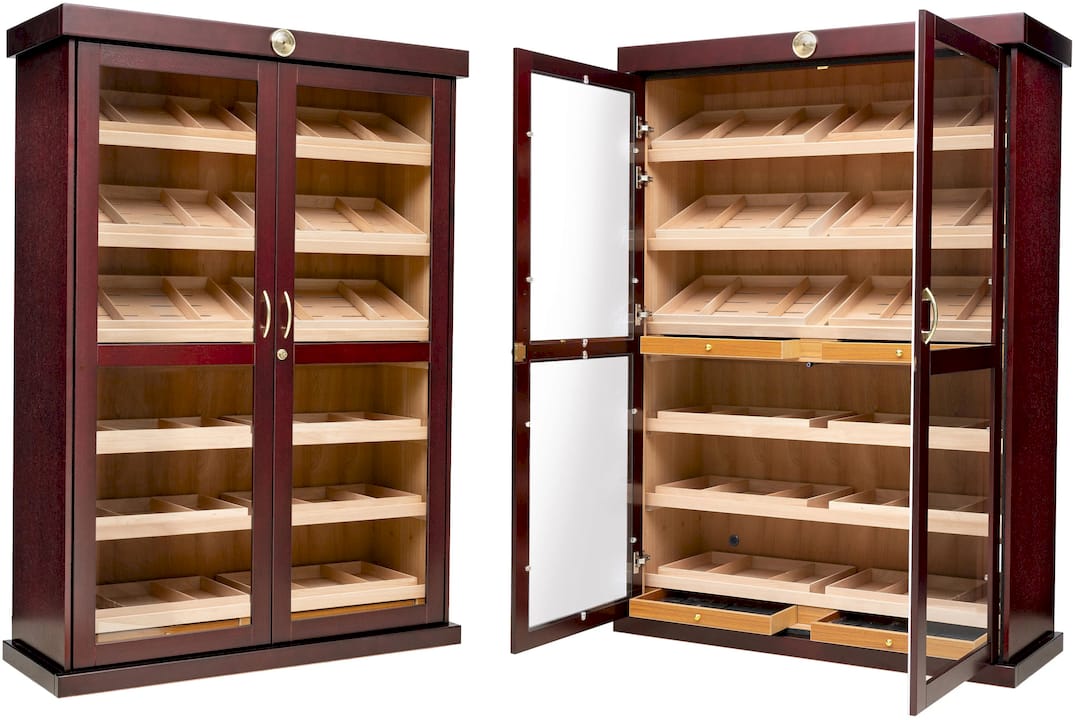
Storage placement deserves its own thought. A piece like the Bermuda cabinet works as both a functional humidor and a visual anchor when placed against an interior wall, away from exterior doors that swing humidity with every open and close. A 17-locker cabinet in dark cherry suits a lounge hosting multiple members or guests who each want their own secured compartment. For a room built around presentation as much as preservation, a Milano display puts curated cigars on visible rotation while keeping them inside a humidity-controlled case.
What Maintenance Keeps a Cigar Room Fresh Long-Term?
A short weekly and seasonal routine prevents the slow odor creep that ruins most home cigar rooms within a year.
- Seal the room properly first. Install a door sweep, gasket the electrical outlets, cap or damper any HVAC registers connected to the main system, and caulk baseboard gaps.
- Wipe down hard surfaces after every session using a mild cleaner on leather and a standard hard-surface cleaner on flooring and tabletops.
- Replace HEPA and carbon media on schedule. Every 3 to 6 months under heavy use, longer under light or occasional use.
- Recalibrate hygrometers twice a year and top off humidification systems as needed.
- Call a professional annually to verify your exhaust fan is still delivering its rated CFM and to service ductwork, since duct leaks and filter loading both quietly erode ACH over time.
Where Bespoke Storage Fits Into an Engineered Room
Ventilation removes moisture from the air along with the smoke, which is precisely why room-level RH control and dedicated cabinet or walk-in storage need to work as a pair, not a substitute for one another. A walk-in humidor holds its climate independent of whatever your exhaust fan is doing that day, which is the threshold moment for collectors: once a collection exceeds a few hundred sticks or represents real capital, off-the-shelf storage stops being adequate protection. Bespoke walk-in and cabinet humidors are built around exactly that threshold, paired with specialized delivery and hands-on consultation for collectors planning a serious room. For more on pairing storage design with room-level air systems, see our cigar lounge air solutions guide.
How Do You Manage Sound in a Home Cigar Lounge?
A cigar room lives or dies on comfort, and sound is half of that equation. Hard flooring and wipeable paint solve the odor problem, but those same surfaces bounce sound around a small space, turning quiet conversation into an echo chamber.
Balance the acoustics without reintroducing porous, odor-trapping materials. Leather furniture already absorbs some sound simply by virtue of its cushioning, and a well-chosen leather sectional does double duty as both seating and a sound buffer. Solid wood paneling on one or two walls adds warmth and breaks up hard reflective surfaces without the odor retention of fabric wall coverings.
Ceiling treatments offer the biggest opportunity most homeowners skip. A coffered wood ceiling or acoustic wood panels overhead absorb reflected sound while staying entirely wipeable, unlike a fabric-wrapped acoustic panel that would soak up smoke residue along with echo.
Your ventilation system itself is a sound source worth planning around. An undersized fan working hard against high static pressure hums louder than a properly sized one running at a comfortable duty cycle, which is another reason to specify fan curves rather than shopping on CFM numbers alone. Mounting the inline fan mid-duct, away from the seating area, and lining the first several feet of ductwork with acoustic insulation cuts perceived noise substantially without touching airflow.
Area rugs on hard flooring split the difference nicely: a low-pile, easily cleaned rug softens footfall and echo in a seating zone without the odor retention of wall-to-wall carpet.
What Fire Safety Steps Does a Cigar Room Need?
Open flame and hot ash in an enclosed room raise the stakes on fire safety in ways a typical living room never faces. Every home cigar lounge needs a dedicated smoke detector, but here’s the catch: a standard photoelectric or ionization smoke detector will false-alarm constantly in a room full of actual smoke, which leads too many owners to simply disable it. That’s the wrong fix.
The right approach is a heat detector rather than a smoke detector for the cigar room itself, paired with standard smoke detectors in adjoining hallways and rooms where they’ll function normally. Heat detectors trigger on temperature rise rather than particulate density, so they stay useful for their actual job, catching an ashtray fire or an electrical fault, without nuisance triggering on ordinary cigar smoke.
Ashtrays and ash disposal deserve real thought, not an afterthought. Use only heavy, stable ceramic or crystal ashtrays that won’t tip, and empty them into a metal container with a lid rather than a wastebasket, since a cigar butt can smolder for hours after it looks fully out.

Keep a small fire extinguisher mounted discreetly but accessibly inside or immediately outside the room. A Class ABC extinguisher covers the realistic risk profile: fabric, wood, and any electrical fault from lighting or the ventilation system itself.
Finally, if your exhaust and makeup-air system ties anywhere near gas appliances elsewhere in the house, the interlock and backdraft cautions from the ventilation section above apply directly here. A poorly balanced system doesn’t just smell bad; it can pull combustion gases from a water heater or furnace back into occupied space.
How Should You Arrange Furniture in a Cigar Room?
Furniture layout in a cigar room answers to a different set of priorities than a standard den, starting with smoke path and ending with how long you can comfortably sit in one chair.
Position seating so smoke naturally drifts toward the exhaust intake rather than across the room toward a doorway or a seating cluster on the opposite wall. If your exhaust fan sits on the exterior wall, arrange chairs and sofas to face generally toward that wall, letting the room’s air movement carry smoke away from faces rather than through them.
Chair selection matters more than most people realize before they’ve spent three hours in one. A proper cigar lounge chair has a high back, supportive armrests at the right height for resting a cigar-holding hand, and enough seat depth to lean back fully. Club chairs and deep leather sofas both work; a dining chair repurposed into a lounge does not.
Give each seat its own side table or shared low table within easy reach, sized to hold an ashtray, a drink, and a cutter without crowding. Nothing disrupts a cigar session faster than reaching across another person for the ashtray.
Leave real walking clearance, at least 36 inches between seating clusters, so guests and staff carrying drinks or trays can move without disturbing anyone’s smoke or spilling on the leather. If the room doubles as a small bar or lounge, keep the pour station and any counter display positioned along a wall away from the primary seating zone, both for traffic flow and to keep that area’s task lighting distinct from the room’s warmer ambient layer.
Is It Legal to Build an Indoor Smoking Room in Your Home?
Private residences are typically exempt from public indoor-smoking bans, since those laws generally govern workplaces, bars, and other public-facing spaces rather than a homeowner’s private rooms. That said, exemption from public smoking laws doesn’t mean zero restriction. Local building codes still govern ventilation, electrical work, and any structural changes involved in building the room, and those permits are non-negotiable regardless of what you’re using the space for.
If you’re in a condo, co-op, or rented home, check your lease, HOA rules, or building bylaws before building anything. Multiunit housing policy varies significantly by building and by state, and secondhand smoke migrating through shared ductwork or wall cavities is one of the most common sources of neighbor disputes and lease violations in multifamily buildings.
Worth stating plainly: ventilation reduces smoke exposure for everyone else in the house, but it doesn’t eliminate it. The CDC’s own position on secondhand smoke is that only eliminating indoor smoking entirely fully protects nonsmokers, no matter how well-engineered the exhaust system is. That’s not a reason to abandon the project, but it is a reason to take the isolation and sealing work in this guide seriously if anyone in your household has respiratory sensitivities, rather than assuming a good fan solves everything.
Why Ventilation and Storage Should Drive Every Design Decision
Decor is the part everyone gets excited about, and it’s the part that matters least if the engineering underneath it is wrong. I’ve seen the inverse mistake constantly: gorgeous rooms with beautiful leather and a stunning cabinet, built around an undersized fan that never quite clears the air, or a humidor rated for the wrong volume that lets a collection dry out slowly over a year. Get the exhaust, the seal, and the storage right first. If you’re building toward a serious collection or a walk-in installation, talk to a specialist before you talk to a decorator.
— Belle Dunn
Ready to Build Your Cigar Room? Start With Storage That Fits the Space
You can access options for high-grade preservation without needing to reverse-engineer a generic cabinet into your room’s specific humidity and space constraints. Where a big-box humidor gets you close, a bespoke consultation gets you exact.

For collectors who’ve outgrown desktop storage, the Bermuda cabinet serves as a standalone humidor and a room centerpiece in one piece of furniture. If your lounge hosts multiple smokers who each want secured, separate storage, the 17-locker cabinet in dark cherry solves that without sacrificing style. Want your collection visible as part of the room’s design? The Milano display puts curated cigars on rotation behind humidity-controlled glass. Browse the full cabinet humidor collection or explore electronic humidors for climate-controlled options with digital monitoring built in.
For collectors planning a full walk-in installation, Dunn’s Bespoke pairs custom design with white-glove delivery and expert consultation, tailored to your room’s dimensions, your collection size, and the ventilation plan you’ve already worked out using the guidance above. Start a consultation today to talk through your space and get a storage plan that matches the engineering you’ve already put into the room.
Sources
- Residential Smoking Room Calculator — LakeAir
- Smoke-Free Indoor Air — CDC State System factsheet
- Cigar room smoke ventilation: codes, sizing & hiring guidance — Man Cave Insider
- The blueprint: how to build a professionally ventilated home cigar room — Commercial Air Purifiers
FAQ
What Are the Must-Haves for a Home Cigar Room?
Every functional cigar room needs three things: engineered exhaust ventilation rated for 15 to 20 ACH, an airtight seal isolating it from the rest of the home’s HVAC, and dedicated storage holding cigars at 65 to 70% relative humidity. Skip any one of the three and the room underperforms no matter how good the furniture looks.
How Do I Build a Cigar Room in My House?
Start by scoping the room size and confirming exterior wall access for exhaust ductwork, then design the ventilation system around your target ACH before finalizing humidification or furniture. Seal the room, install exhaust and makeup air, add HEPA plus carbon filtration, then bring in humidified storage like a cabinet humidor or a bespoke walk-in installation once the air system is verified working.
How Do You Ventilate a Room for Cigar Smoke?
Calculate required exhaust CFM from your room’s cubic footage and a target of 15 to 20 ACH, then install an inline exhaust fan with matched makeup air sized at 80 to 100% of exhaust volume. Add an in-room HEPA and carbon purifier for another 8 to 10 ACH to handle residual haze the exhaust alone misses.
Is It Legal to Smoke Cigars Indoors at Home?
Private residences are generally exempt from public indoor-smoking bans that govern workplaces and public venues, but building codes still apply to any ventilation and electrical work. Condo, co-op, or rental restrictions can override that exemption, so check your lease or HOA bylaws, and remember that the CDC notes only eliminating indoor smoking fully protects nonsmokers in shared living spaces.
What Humidity Should a Cigar Storage Cabinet Hold?
Cigar storage should sit at 65 to 70% relative humidity, verified with a calibrated digital hygrometer rather than an uncalibrated analog dial. A dedicated cabinet or walk-in humidor holds this range independent of the room’s ambient air, which matters once your exhaust system is pulling in outside air that may run far drier.
Do I Need a Heat Detector Instead of a Smoke Detector?
Yes, a heat detector belongs in the cigar room itself since a standard smoke detector will false-alarm constantly in a room full of cigar smoke. Install standard smoke detectors in adjoining hallways and rooms instead, where they’ll function normally without nuisance triggering.
How Much Does It Cost to Build a Home Cigar Room?
Costs vary widely based on ventilation complexity, sealing work, and storage choices, ranging from a modest desktop-humidor setup in a converted den to a full walk-in installation with custom ductwork. Dunn’s Luxury Selections offers bespoke consultation to scope your specific room and budget; current pricing and project details are available directly through the Dunn’s Bespoke page.
Recommended
You May Also Enjoy
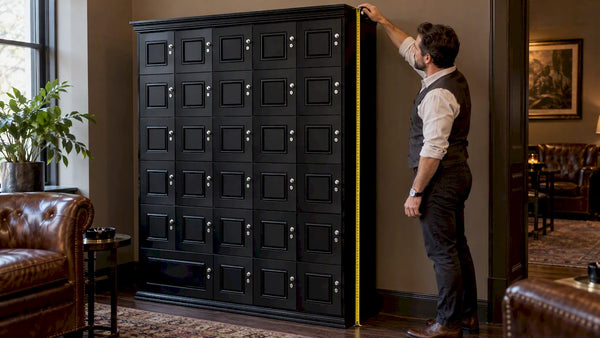
Cigar Locker Dimensions: Sizing Guide for Collectors and Lounges
Cigar locker dimensions explained: compartment sizes, cabinet footprints, capacity math and clearances, so you size a locker bank...
Read Article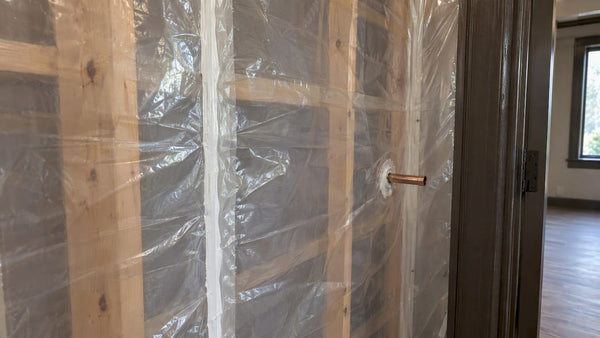
Sealing a Walk-In Humidor: Envelope, Door and Penetrations
How to seal a walk-in humidor properly: vapor barrier placement, door gasket, penetrations and the controlled airflow a...
Read Article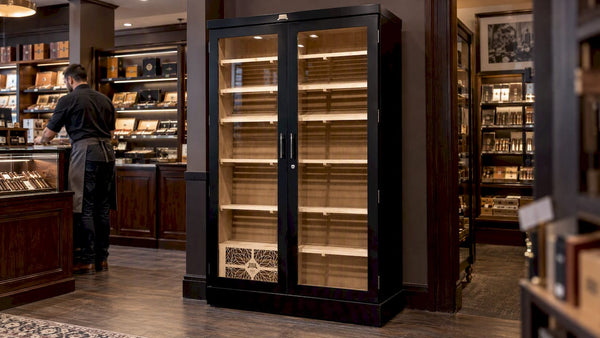
Retail Humidor ROI: How to Measure What a Display Earns
What does a retail or lounge humidor really return? A practical framework for cigar shops, lounges and clubs:...
Read Article