

Discover effective methods for recording cigar notes, including essential templates and tasting strategies to enhance your smoking experience.
The most practical way to record cigar notes is a three-part entry: objective specs, smoke-by-thirds sensory notes, and a final scored evaluation. Write the entry while you smoke, not after. Memory softens flavors within minutes, and the distinction between “cedar-forward with a hint of espresso” and “just earthy” disappears fast.
Every entry should capture at minimum:
- Cigar specs: brand, line, vitola, wrapper, origin, price, date
- Smoke thirds: flavor notes, strength, draw, burn, and ash for each third
- Final evaluation: construction, overall impression, and a numeric score (0–100 or 1–10)
- Storage context: humidor name or model, hygrometer reading, calibration date
The Certified Cigar Reviews (CCR) template from Tobacconist University formalizes this structure into a reproducible worksheet covering Cigar Specs, Component Data, Pre-Smoke, Smoke Thirds, Flavor and Sensation Descriptors, Pairing Comments, and Final Thoughts. It is the closest thing the industry has to a standardized review protocol, and it is available as a free printable download. Dunnluxuryselections integrates this kind of humidor-aware workflow into its consultation process, connecting storage precision to the quality of every note you record.
Key Takeaways
Recording cigar notes with a consistent three-part entry, objective specs, smoke-by-thirds sensory notes, and a weighted final score, is the single most effective method for building a personal reference library that improves both palate and purchasing decisions over time.
| Point | Details |
|---|---|
| Use the three-part entry | Capture specs, smoke thirds, and a final score during every smoke, not after. |
| Standardize with the CCR worksheet | The free Tobacconist University printable covers all fields and produces comparable entries. |
| Log humidor conditions | Record hygrometer readings and calibration dates alongside each entry to control for storage variables. |
| Train palate with descriptor categories | Anchor to six base tastes, then use the Tobacconist University flavor chart to assign specific descriptors. |
| Dunnluxuryselections for storage precision | Precision humidors from Dunnluxuryselections provide the stable RH environment that makes tasting notes reliable and repeatable. |
Table of Contents
- Why should you keep a cigar journal at all?
- What objective specs should every entry capture?
- How do you record sensory notes through each third of a smoke?
- What do printable templates and scoring rubrics look like?
- How do you identify and describe flavor notes accurately?
- Paper or digital: which tools work best for your journal?
- What mistakes do collectors make when recording notes?
- Sample annotated entries you can copy into your journal
- How do you organize and review your notes over time?
- What does an authoritative tasting methodology look like?
- Dunnluxuryselections: precision storage for collectors who take notes seriously
- Sources
- FAQ
Why should you keep a cigar journal at all?
A cigar journal is a palate-training instrument as much as a record. Each entry you write sharpens your ability to distinguish flavors, because naming a sensation forces you to move past “I liked it” into the specific vocabulary that makes the experience repeatable and comparable.
The practical benefits compound over time:
- Memory aid: Flavor impressions fade within hours; a written entry preserves the distinction between a Nicaraguan puro’s pepper-forward entrance and a Dominican blend’s creamy mid-smoke.
- Better buying decisions: Query your notes by wrapper type, region, or score to identify patterns before spending on a new box.
- Aging benchmarks: A dated entry on a freshly purchased Robusto becomes the baseline against which you measure the same cigar two years later from your aging room.
- Pairing refinement: Notes on food and drink pairings let you build a curated tasting menu from your own data rather than generic recommendations.
What success looks like is simple: a collection of entries consistent enough that you can search by region, wrapper, or score and reliably repeat a great smoke. That requires standardized fields and a neutral tasting environment. Tobacconist University’s Tasting School curriculum warns that pleasant circumstances, a vacation, a celebration, a favorite lounge, can inflate ratings and make entries incomparable. Controlling for environment is not pedantry; it is the difference between a journal and a scrapbook.
Pro Tip: Smoke the same cigar twice: once in a social setting and once alone in a neutral environment. Compare your scores. The gap reveals how much your mood, not the tobacco, is driving your ratings.
What objective specs should every entry capture?
Specs are the searchable skeleton of your journal. Without them, a glowing sensory note is orphaned from the cigar that produced it. The fields below form the minimum viable data set for a searchable, comparable entry.
| Field | Example |
|---|---|
| Brand / Maker | Arturo Fuente |
| Line | Opus X |
| Vitola / Shape | Robusto |
| Length & Ring Gauge | 5 × 5 |
| Wrapper | Cameroon / Dominican |
| Binder | Dominican |
| Filler | Dominican |
| Origin / Country | Dominican Republic |
| Factory / Blender | Tabacalera A. Fuente |
| Date Purchased | March |
| Price per Stick | $28 |
| Storage Humidor | Bermuda Cabinet |
| Shelf / Divider | Top shelf, cedar divider |
| Hygrometer Reading | 70% RH / 70°F |
| Calibration Note | Boveda kit calibrated Feb |
The humidor-related fields deserve particular attention. Recording which shelf and cedar divider a cigar rested on matters because Spanish cedar imparts aromatic influence over time, and position within a large cabinet affects the microclimate the cigar experienced. Logging the hygrometer reading at the time of the smoke, alongside a calibration note, lets you correlate storage conditions with flavor outcomes across dozens of entries.
The 135 rule offers a useful framework here: rather than rigidly targeting 70°F / 70% RH, it allows flexible temperature-humidity pairs whose sum approximates 135, preserving wrapper integrity and aging potential. Recording your actual readings, rather than your target settings, makes this flexibility visible in your notes.
Tracking the maker and blender is equally worth the effort. Patterns emerge across a blender’s portfolio that help you predict whether a new release will suit your palate, a point developed further in Dunnluxuryselections’s guide to artisanal cigar makers.
How do you record sensory notes through each third of a smoke?
The tercio method, dividing a smoke into entrance (first third), center (middle third), and finish (last third), is the most reliable structure for capturing how a cigar evolves. A cigar that opens with bright pepper and closes with dark chocolate tells a different story than one that stays flat across all three stages, and only a thirds-based entry captures that arc.
Pre-light ritual
- Examine the wrapper: note color, sheen, visible veins, and any soft spots.
- Smell the foot and the wrapper before lighting.
- Take a cold draw: note resistance (draw tightness) and any flavor impressions.
First third (entrance)
- Light evenly and take the first three puffs without inhaling.
- Note the dominant flavor immediately (pepper, cream, cedar, earth).
- Record secondary notes, mouthfeel (dry, oily, creamy), and initial nicotine perception.
- Check draw resistance and note whether the burn line is even.
Middle third (center)
- Record how flavors have shifted from the entrance.
- Note strength and body changes: has nicotine intensity increased?
- Observe ash length and color; note whether it holds or falls.
- Record any defects: harshness, bitterness, uneven burn, or tunneling.
Last third (finish)
- Note the dominant finish flavor and any retronasal impressions from retro-haling.
- Record whether the cigar becomes harsh or retains complexity.
- Note where you chose to put it down, if you did not finish it.
Immediate post-smoke summary
- Write the overall impression while the finish is still on your palate.
- Assign a preliminary score before reviewing the entry.
Retro-haling, gently exhaling a small amount of smoke through the nasal passage, reveals aromatic compounds that taste buds alone cannot detect. It is not optional for a serious entry; it is the technique that separates a surface-level note from a complete one.
What do printable templates and scoring rubrics look like?
Two template formats serve different contexts. The compact tear-sheet fits a lounge visit or a quick smoke; the full CCR-style worksheet suits in-depth reviews and aging benchmarks.
Compact tear-sheet (lounge use)
A single half-page with five fields: cigar name and vitola, date and price, one line per third, a draw/burn/ash line, and a final score box. It fits in a shirt pocket and takes under three minutes to complete. The goal is consistency, not depth.
Full CCR-style worksheet (in-depth review)
The CCR template expands each section into labeled fields: Cigar Specs, Component Data, Pre-Smoke observations, three Smoke Thirds with flavor and sensation descriptors, Pairing Comments, and Final Thoughts. It is the format of record for collectors who want entries that hold up to comparison years later.
Scoring rubric
A component-weighted rubric keeps scores objective across different moods and sessions. One practical allocation:
- Flavor complexity and evolution: 40%
- Draw: 15%
- Construction and burn: 15%
- Overall impression: 15%
- Appearance: 5%
- Ash: 10%
Apply each component on a 0–10 scale, weight the scores, and sum to a final 0–100 figure. This prevents a single spectacular flavor note from inflating the score of a cigar with a plugged draw.
To create a printable version, copy the worksheet fields into a word processor or Google Docs, set margins to 0.5 inches, and export as a PDF. A pocket journal format works well at 4 × 6 inches, printed two-up on letter paper and cut in half. The Dunnluxuryselections journal resources page offers additional templates and downloadable worksheets for collectors who prefer a ready-made format.
How do you identify and describe flavor notes accurately?
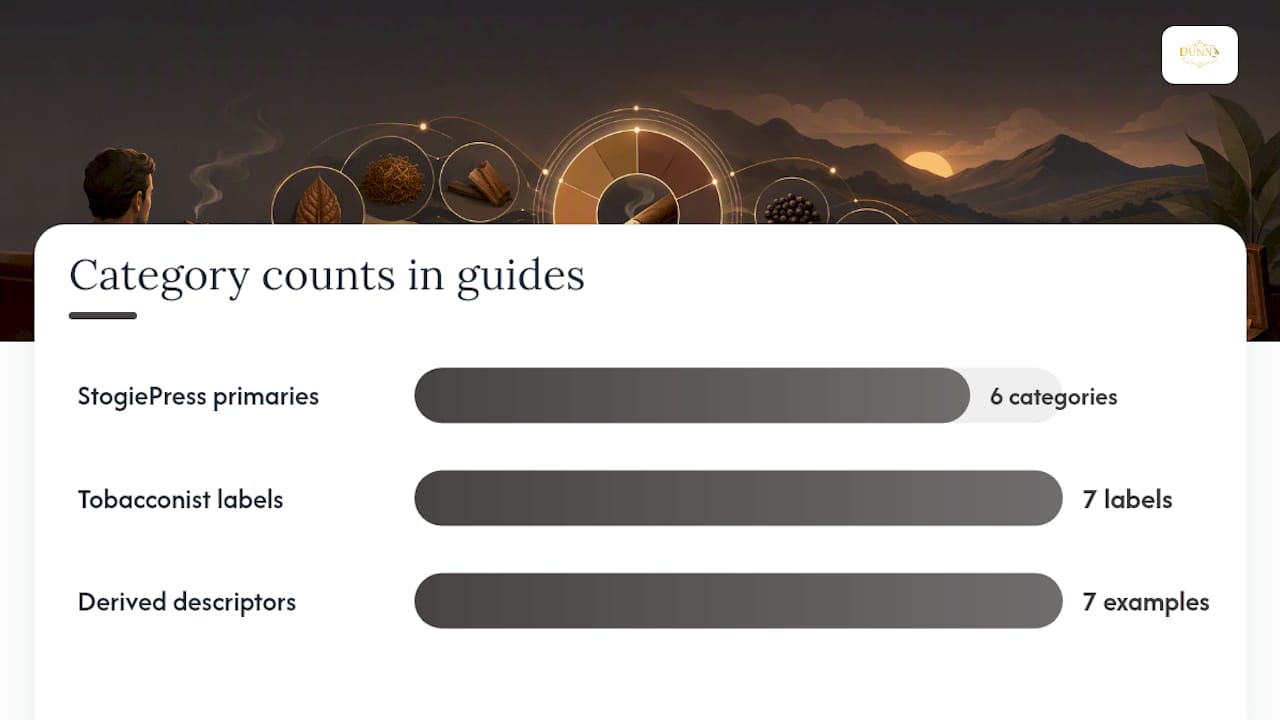
Flavor identification is a skill, not a talent. The most reliable approach starts broad and narrows: anchor perceptions to the six primary taste and aroma categories before reaching for specific descriptors.
StogiePress’s palate guide recommends beginning with sweet, sour, salty, peppery, bitter, and umami as the foundational layer. Once you have placed a sensation in one of those categories, you can move to derived descriptors: cedar, cocoa, leather, espresso, dried fruit, barnyard, floral.
The Tobacconist University flavor chart organizes dozens of descriptors under seven categorical labels: Animal, Sweet, Spicy, Woody, Vegetal, Earthy, and Chemical. Keeping a printed copy beside your journal during a smoke gives you a vocabulary scaffold rather than a blank page.
A practical palate-training sequence:
- Smell the wrapper before lighting. Note one or two impressions without overthinking.
- Take the cold draw and identify the dominant category (sweet? earthy?).
- On the first puffs, retro-hale gently and note what changes in the aromatic register.
- After the first third, compare your impressions to the flavor chart and assign the closest descriptor.
- Repeat at the middle and final thirds, noting any shift in category.
The most common mistake at this stage is writing emotional labels: “great,” “smooth,” “complex.” These are judgments, not descriptors. “Complex” tells you nothing about what the cigar actually tastes like. “Cedar-forward with a secondary note of dark chocolate and a white pepper finish” is a record you can compare to another entry six months from now.
Pro Tip: Practice blind sniffing with common pantry items: coffee grounds, cocoa powder, dried herbs, and cedar chips. Naming them without visual cues trains the same cognitive pathway you use when identifying cigar flavors.
Paper or digital: which tools work best for your journal?
Both formats have genuine strengths, and the best collectors often use a hybrid of both.
Paper journals offer a tactile experience that suits the ritual of cigar smoking. You can paste the band directly onto the page, write freely without a screen, and keep the journal inside or near your humidor. Dedicated logbooks, including purpose-built products like Humidor Notes and pocket-sized logbooks available on Amazon, include pre-printed fields for name, price, smoke date, duration, and tasting notes. The r/cigars community frequently recommends simple three-ring binders with pasted bands as a beginner-friendly entry point.

Digital apps offer searchability, photo uploads, and cloud sync. My Humidor supports per-puff notes, image uploads, and searchable ratings, making it a practical option for collectors who want to query entries by region, wrapper, or score. When evaluating any cigar app, look for: image upload capability, per-third or per-puff entry fields, a numeric rating system, export options (PDF or CSV), and integration with hygrometer data.
Hygrometer integration is where digital tools earn their keep for serious collectors. Devices like Govee and SensorPush log humidity and temperature continuously and export CSV files for trend analysis. Linking a hygrometer log timestamp to a journal entry creates a complete environmental record for each smoke, which becomes invaluable when you are trying to understand why a cigar from the same box tasted different six months apart.
Calibration matters.
Pro Tip: Photograph the band and the lit cigar at the start of each third using your phone, then import the images into your app entry. The visual record helps you recall construction details and burn quality when reviewing notes weeks later.
How to preserve cigar bands and memorabilia in your journal
A band attached to the facing page of its entry transforms a journal from a data log into a timeline of memories. The method matters: aggressive adhesives yellow paper, bleed through thin pages, and damage the band’s lithography.
- Let the band cool completely before removing it. A warm band tears easily and may leave tobacco residue on the page.
- Use glue dots or archival photo corners rather than tape or liquid glue. Glue dots hold firmly without chemical bleed; photo corners allow removal without damage.
- Place the band on the left-hand page of a two-page spread, with the entry notes on the right. This keeps the written record fully readable without the band obscuring text.
- For ribbons, box labels, or larger memorabilia, use a small archival pocket (available at most craft stores) adhered to the page. Slide the item in rather than gluing it flat.
- Store the journal in a cool, dry environment. If your humidor has a display area with humidity-tolerant materials, a sealed archival sleeve protects the journal from moisture while keeping it accessible.
Pro Tip: Number each band entry sequentially and cross-reference it with a master index at the front of the journal. When you have 200 entries, finding the Padron 1964 Anniversary from March 2024 takes seconds rather than minutes.
What mistakes do collectors make when recording notes?
The most persistent error is confusing personal judgment with descriptive recording. Writing “I loved this cigar” is not a tasting note. It tells you nothing about what made it exceptional, and it gives you no basis for comparison when you smoke a similar blend next year. Descriptors create an educational record; judgments create a diary.
Other common pitfalls, and how to correct them:
- Inconsistent scoring scales: Using a 1–10 scale one week and a 0–100 scale the next makes entries incomparable. Choose one scale and apply it everywhere.
- Ignoring storage conditions: A cigar that was stored at 80% RH for six months will smoke differently than the same cigar at 65%. Without a hygrometer reading in the entry, you cannot account for that variable.
- Smoking after strong food or drink: Coffee, spicy food, and alcohol all alter palate sensitivity. The La Aurora blog recommends a neutral cracker or plain bread to reset the palate before tasting.
- Writing entries hours after the smoke: Flavor memory degrades quickly. Write during the smoke or within ten minutes of finishing.
- Emotional inflation: Smoking on vacation or with close friends in a celebratory setting tends to produce inflated scores. Tobacconist University’s Tasting School curriculum specifically flags this as a source of unreliable notes.
Pro Tip: Every three months, re-read your ten oldest entries and re-score them based on your current palate. If your scores have drifted systematically upward or downward, you have identified a calibration bias in your rubric.
Sample annotated entries you can copy into your journal
Three short examples illustrate how objective fields and sensory notes combine into a final score. Each follows the same structure: one-line spec header, tercio bullets, construction notes, and a scored rationale.
Entry 1 — Mild profile
- First third: Cream, toasted bread, light cedar. Draw: open. Burn: even. Ash: firm, light gray.
- Middle third: Slight sweetness emerges, hint of white pepper on retro-hale. Strength stays mild.
- Last third: Creaminess holds; no harshness. Clean finish.
Construction: Excellent. Draw remained open throughout. Score: 88/100. Consistent, well-constructed mild smoke. Ideal as an introduction to a tasting flight.
Entry 2 — Medium profile
- First third: Leather, dark earth, mild pepper. Draw: slightly firm but manageable. Burn: minor touch-up needed.
- Middle third: Coffee and cocoa develop; pepper fades. Body increases to medium-full.
- Last third: Rich, slightly sweet finish with lingering espresso. Ash dropped at the halfway point.
Construction: Good overall; one relight required. Score: 91/100. Complex evolution from earth to cocoa. Worth aging an additional six months.
Entry 3 — Full profile Specs: Liga Privada No.
- First third: Dark chocolate, black pepper, barnyard. Draw: perfect. Burn: razor-even.
- Middle third: Leather and espresso dominate; pepper recedes. Full body, significant nicotine.
- Last third: Dark fruit emerges briefly before a long, dry cocoa finish. Complexity holds to the nub.
Construction: Flawless. Score: 96/100. One of the most consistent full-bodied smokes in this journal. Reorder immediately.
Adapt these samples to your own rubric by substituting your component weights. The structure, not the specific scores, is what you are copying.
How do you organize and review your notes over time?
A journal that cannot be queried is just a diary. The tagging taxonomy you apply from the first entry determines whether your notes become a searchable reference or an archive you never open.
Suggested tagging categories:
- Region (Nicaragua, Dominican Republic, Honduras, Cuba)
- Wrapper type (Connecticut, Habano, Maduro, Cameroon)
- Strength category (mild, medium, full)
- Purchase year
- Personal preference tags (reorder, age further, avoid)
Organization workflow:
- Immediate entry: complete the three-part entry during or within ten minutes of the smoke.
- Weekly sync (digital): tag new entries, add photos, and export the week’s CSV from your hygrometer app to attach environmental data.
- Weekly index update (paper): add the new entry to a master index at the front of the journal, sorted by region or wrapper type.
- Monthly review: scan recent entries for patterns. Are Nicaraguan puros consistently scoring higher than Honduran blends in your notes? Is your medium-strength category underrepresented?
Review cadence for long-term value:
- Quarterly: identify top-scoring cigars from the past three months and flag aging candidates for re-evaluation.
- Annually: review the full year’s entries to refine your buying strategy and identify which humidor storage conditions produced the best results.
The notable cigar regions guide from Dunnluxuryselections is a useful companion for tagging entries by origin, particularly when distinguishing between sub-regions within Nicaragua or the Dominican Republic.
What does an authoritative tasting methodology look like?
The Certified Cigar Reviews (CCR) worksheet from Tobacconist University is the most structured publicly available protocol for cigar evaluation. Its sections map directly to the three-part entry system described throughout this article:
- Cigar Specs: brand, line, vitola, dimensions, wrapper, binder, filler, origin
- Component Data: construction observations before lighting
- Pre-Smoke: cold draw, wrapper appearance, foot aroma
- Smoke Thirds: flavor, sensation, and strength notes for each third
- Flavor and Sensation Descriptors: drawn from the categorical flavor chart
- Pairing Comments: food, beverage, and occasion notes
- Final Thoughts: overall score and buying recommendation
Palate protocol for repeatable results:
- Avoid food, strong beverages, and intense scents for 30–60 minutes before tasting.
- Cleanse with unsalted crackers or plain bread immediately before lighting.
- Retro-hale on the first puffs of each third to capture aromatic complexity.
- Record tercio-stage changes in real time, not from memory.
- Use the Tobacconist University flavor chart as a live reference during the smoke.
The CigarSense tasting methodology reinforces a key discipline: the most common hobbyist error is confusing personal judgment with descriptive recording. Descriptors build an educational record that trains the palate over time; judgments produce entries that are useless for comparison.
Pro Tip: Print the CCR worksheet and the Tobacconist University flavor chart on a single double-sided sheet. Keep it in your humidor alongside a pen. The physical proximity removes every excuse for skipping an entry.
A note on how consistent journaling shapes collecting and storage decisions
Keeping a disciplined journal changes the way you collect. After a year of consistent entries, patterns emerge that no amount of reading reviews can replicate: you discover that your palate consistently favors Habano-wrapped Nicaraguan blends in the medium-full range, that cigars stored at 65% RH in your Bermuda Cabinet for at least six months score four to six points higher than the same cigars smoked fresh, and that your scores inflate reliably when you smoke after dinner with a glass of port.
Those insights are not available from a retailer’s catalog or a magazine’s annual rankings. They come from your own data, recorded in your own voice, against your own palate. The journal becomes the very heart of your collecting practice, a living instrument that sharpens every purchase decision and every aging choice.
Dunnluxuryselections’s consultation process is built around exactly this kind of data. When collectors arrive with a clear picture of what they store, how long they age, and what storage conditions their best smokes came from, the conversation about which humidor configuration suits them becomes precise rather than speculative. A bespoke storage solution, whether a Reagan Electronic Cabinet Humidor for precision climate control or a large-format cabinet for a growing collection, is a better investment when it is matched to documented storage habits rather than estimated ones.
Dunnluxuryselections: precision storage for collectors who take notes seriously
Collectors who record hygrometer readings alongside every entry quickly discover that storage consistency is not a background variable. It is one of the most powerful predictors of how a cigar will smoke.

Dunnluxuryselections offers a curated range of precision storage solutions, from the Humidor Supreme 9200 Series Double-Door Electronic Humidor for collectors who demand electronic climate control, to the Barbatus Cabinet Humidor for long-term aging, to bespoke walk-in installations designed around your collection’s specific needs. Every product is selected and tested for the kind of storage stability that makes tasting notes reliable. White-glove delivery, expert consultation, and financing options are available for collectors ready to invest in a storage environment that matches the quality of what they smoke. Visit Dunnluxuryselections to explore the full collection or request a consultation.
Sources
A short annotated list of the most practical references cited in this article:
- How to detect a cigar’s flavor notes — StogiePress
- Tobacconist University — Tasting School curriculum
- My Humidor — Cigar Journal (App Store)
- Sigars
- Humidor Notes cigar journal — Cigar Aficionado
FAQ
How do you record cigar notes while smoking?
Write the entry in three stages during the smoke: specs before lighting, sensory notes at each third, and a final score immediately after finishing. Never rely on memory after the fact.
How do you keep a cigar journal?
Choose a format, paper logbook, printable CCR worksheet, or a digital app like My Humidor, and standardize your fields from the first entry. Consistent field names and a fixed scoring scale are what make entries comparable over time.
What app works best for a cigar diary?
My Humidor, available on the App Store, supports image uploads, per-puff notes, and searchable ratings, making it one of the most practical digital options for U.S.-based collectors.
How do you identify flavor notes in a cigar?
Start with the six primary taste categories (sweet, sour, salty, peppery, bitter, umami), then narrow to specific descriptors using the Tobacconist University flavor chart. Retro-haling on each third reveals aromatic notes that taste buds alone cannot detect.
What is the 135 rule for cigars?
The 135 rule is a storage guideline where the sum of your storage temperature (°F) and relative humidity percentage should approximate 135, allowing flexible RH and temperature combinations that preserve wrapper integrity and aging potential beyond the traditional 70/70 target.
Recommended
You May Also Enjoy
Cigar Locker Dimensions: Sizing Guide for Collectors and Lounges
Cigar locker dimensions explained: compartment sizes, cabinet footprints, capacity math and clearances, so you size a locker bank...
Read Article
Sealing a Walk-In Humidor: Envelope, Door and Penetrations
How to seal a walk-in humidor properly: vapor barrier placement, door gasket, penetrations and the controlled airflow a...
Read Article
Retail Humidor ROI: How to Measure What a Display Earns
What does a retail or lounge humidor really return? A practical framework for cigar shops, lounges and clubs:...
Read Article