

Learn where to mount humidifiers for steady 65–72% RH: lower shelf corners, sealed cable holes, distilled water, and symmetric units for large cabinets.
For most multi-shelf cigar cabinets, the humidifier belongs on a lower shelf, tucked into a corner, so rising moisture drifts upward through the whole cabinet. Box and desktop humidors do better with lid or sidewall mounting. Aim for stability in the 65–72% RH range rather than a single perfect number, and remember that large or multi-shelf cabinets often need more than one unit, with cable holes fully sealed.
TL;DR:
- In multi-shelf cabinets, placing the humidifier on a lower corner leverages upward airflow for even humidity distribution.
- Passive humidifiers are suitable for small boxes, while active electronic units are needed for larger or multi-shelf cabinets requiring greater moisture output.
- Sealing cable entry points and placing hygrometers at cigar level helps ensure accurate humidity monitoring and stable conditions.
- Proper installation includes using distilled water, avoiding direct contact with cigars, and running the cabinet closed for 24 hours to verify seal integrity.
- Purpose-built cabinets with integrated wiring and designated humidifier bays simplify placement and promote consistent humidity from the start.
Table of Contents
- Where Should the Humidifier Go in a Cabinet?
- Why Placement Follows Airflow, Not Guesswork
- How to Set Up a Humidifier So It Stays Sealed
- Where to Put the Hygrometer for Accurate Readings
- Common Placement Mistakes and How to Fix Them
- How Purpose-Built Cabinets Solve the Placement Problem
- What Collectors Get Wrong About Humidifier Placement
- Get a Cabinet Built for Stable Humidity From Day One
- Sources
- FAQ
Where Should the Humidifier Go in a Cabinet?
Placement decisions come down to two questions: how big is the cabinet, and how many shelves are you trying to condition evenly. A single-shelf desktop box behaves nothing like a six-foot cabinet holding four thousand cigars, and treating them the same is where most placement mistakes start.
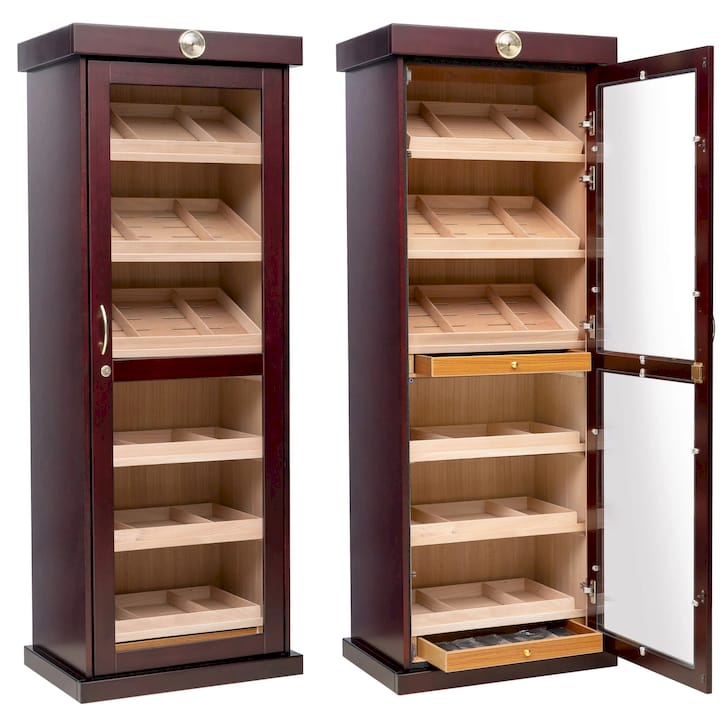
Lower-shelf corner placement works best for multi-shelf cigar cabinets. Corners give you a stable mounting point away from the door swing, and because moisture naturally rises through an enclosed space, a lower-shelf humidifier pushes humidity up through the cabinet instead of pooling at the bottom. Many practical installation guides point to this exact configuration, and it holds up in real cabinets because it uses convection instead of fighting it.
Lid or sidewall mounting suits box and desktop humidors where there is no lower shelf to speak of. A lid-mounted unit disperses moisture downward over a shallow interior. A sidewall unit works well when lid space is already occupied by branding or a tray. Choose based on how much clearance you have and whether cigars sit close enough to the lid to risk direct contact.
For larger installations, consider:
- One humidifier per shelf zone in cabinets over roughly 300 cigars, spaced for symmetry rather than crammed into one corner.
- Wall-mounted or ceiling units for walk-in scale spaces, following manufacturer cubic-foot guidance for the specific model.
- Active electronic humidifiers for large or multi-shelf cabinets, since they can push moisture farther than passive gel or Boveda-style packs, which are better suited to small boxes or travel cases.
Active units need a power source and a mounting bracket or shelf footprint. Passive units need only space and airflow, which makes them easier to tuck into odd corners but weaker at conditioning a large volume on their own.
Why Placement Follows Airflow, Not Guesswork
Moisture in a sealed cabinet does not distribute itself evenly by default. It rises, pools near the top if there is no circulation, and settles unevenly around obstructions like trays and drawers. Placing the humidifier low, in a corner, uses that upward drift to your advantage instead of relying on a fan to correct a bad starting position.
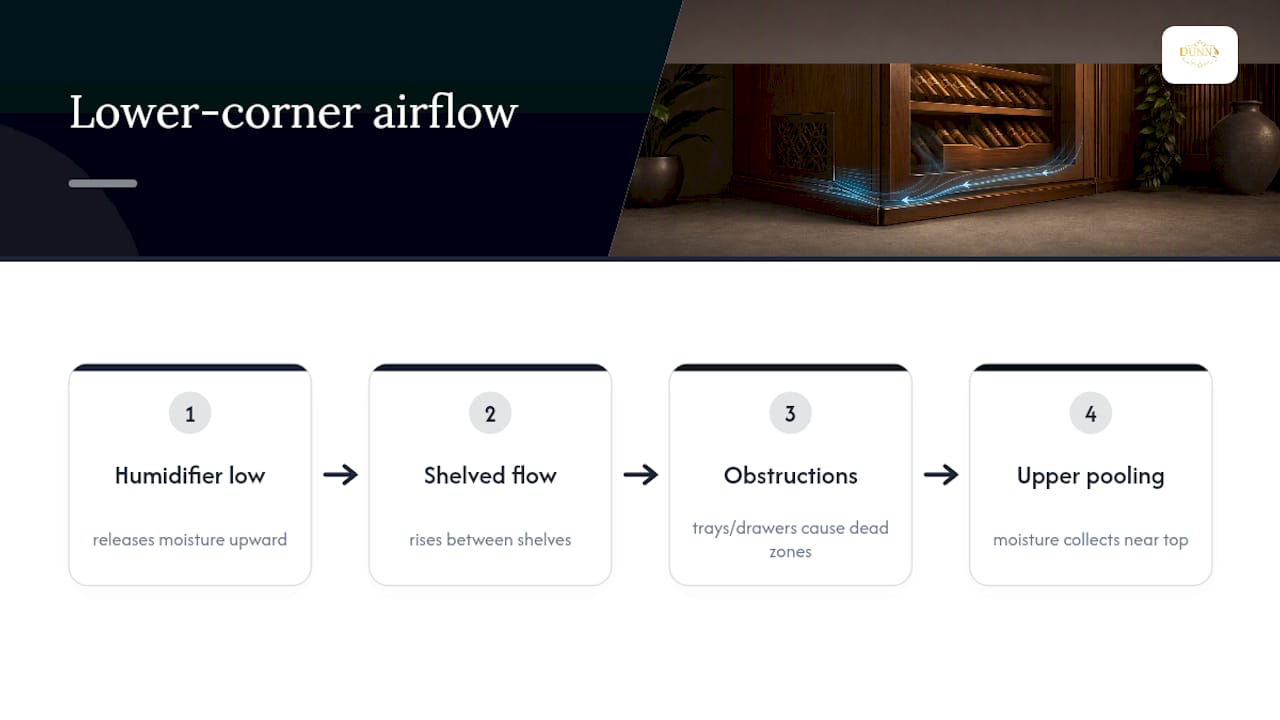
Proximity matters more than most collectors expect. A humidifier touching or sitting inches from your cigars creates a localized hotspot of moisture, which can lead to condensation on wrapper leaves and eventually mold. The fix isn’t distance for its own sake. It’s separation plus circulation.
A small, consistent RH swing does less damage than a large occasional one. The industry consensus, reflected in walk-in humidor humidity guidance, treats 65–72% RH at 65–70°F as the workable band, and treats stability within that band as more important than hitting an exact figure like 69%. A cabinet with stable humidity is in better shape than one experiencing wide swings chasing a target.
How to Set Up a Humidifier So It Stays Sealed
Getting the placement right means nothing if the installation leaks air or water. Here is the sequence that keeps a cabinet performing the way it’s designed to:
- Check for a built-in power socket first. Cabinets designed for active humidification usually include one behind a shelf or panel.
- If there is no socket, route the cord through the reserved cable hole at the rear of the cabinet, then seal the remaining gap with a sponge grommet or foam insert. An open cable hole lets outside air exchange freely with the cabinet interior, which undoes your humidity control before it starts.
- Mount the unit free-standing on the lower shelf, bracketed to a sidewall, or fixed to the lid, depending on cabinet type. Avoid any position that blocks a vent path or sits inside a cigar tray.
- Fill with distilled water only. Tap water introduces minerals and bacteria that shorten the life of the unit and can taint the air inside the cabinet, a point cigar storage guides flag repeatedly.
- Confirm no cigar box or bundle touches the humidifier directly, and that airflow paths around shelves are clear before closing the door.
Pro Tip: Run the cabinet closed for 24 hours before loading cigars. If the hygrometer reading holds steady without you touching anything, your seal and placement are working. If it drifts, fix the leak before you fix the placement.
If your cabinet lacks a reserved cable path or integrated socket entirely, that’s usually a sign it was built for passive humidification only, and forcing an active unit into it may be more trouble than it’s worth. At that point, professional installation or a purpose-built cabinet is the more reliable route.
Where to Put the Hygrometer for Accurate Readings
A hygrometer placed next to the humidifier will lie to you. It reads the moisture bubble immediately around the unit, not the air your cigars are actually breathing.
- Place the sensor at cigar level, centrally located in the cabinet, away from the humidifier itself.
- In cabinets with more than two shelves, run at least two hygrometers at opposite ends or on separate shelves, and compare readings rather than trusting one number.
- A gap of more than a couple of points between sensors tells you the cabinet has an uneven zone, usually near a door seam or an unsealed cable hole.
Digital hygrometers drift over time, so calibration guidance from cigar cabinet specialists recommends the salt test: seal the sensor in a small container with a damp salt solution overnight, and it should read close to 75% RH. Check daily for the first week of a new setup, then monthly once readings hold steady. A swing of 1–3% RH is normal and not worth chasing. Anything wider, sustained for more than a few days, means it’s time to redistribute humidifiers or inspect the door seal.
Common Placement Mistakes and How to Fix Them
Most humidity problems trace back to a handful of repeat offenses, not exotic failures.
- Over-humidification symptoms (a musty smell, visible dampness, or white bloom on wrappers) call for immediate action: move affected cigars to a dry, ventilated space, cut back on refill frequency, and confirm you’re using distilled water, not tap.
- Uneven RH between shelves usually means one zone needs its own humidifier, or existing units need repositioning toward the center of the cabinet rather than clustered in one corner.
- Loose or unsealed cable holes let outside air leak in continuously, which is often the real cause of a cabinet that “just won’t hold humidity” no matter how often you refill.
- Persistent gradients despite fixes are a sign the cabinet itself, not the humidifier placement, is the problem. At that point a properly insulated cabinet is worth more than another humidifier.
How Purpose-Built Cabinets Solve the Placement Problem
Every guideline above exists because most cabinets weren’t engineered with humidification in mind. Dunnluxuryselections builds that engineering in from the start.
- Barbatus and Spartacus cabinet humidors include reserved power routing and lower-shelf humidifier bays, so there’s no cable hole to seal or bracket to improvise.
- Saint Regis is built for multi-shelf capacity, with symmetric internal outlets positioned to support distributed humidification across every zone rather than one corner doing all the work.
- Some services include on-site placement and calibration to verify hygrometer and humidifier positions before the cabinet is loaded with cigars.
Pro Tip: In some large-format installations, splitting humidification across two symmetric lower-shelf outlets rather than one central unit can cut the RH gradient between top and bottom shelves significantly within the first week.
What Collectors Get Wrong About Humidifier Placement
Most advice online treats humidifier placement like a puzzle with one right answer. It isn’t. The corner-of-the-lower-shelf rule is a strong default, and it works in the overwhelming majority of cabinets, but the actual goal is uniform, stable RH across every shelf your cigars occupy. A perfectly placed single humidifier in a cabinet with a leaky door seal will lose to a mediocre placement in a well-sealed one every time.
Where conventional guidance falls short is in treating placement as a one-time decision. It isn’t. It’s a system you monitor: hygrometers cross-checked, cable holes inspected, water swapped for distilled, and units added as a collection grows past what one humidifier can reasonably condition. Collectors who skip the monitoring step are the ones who end up chasing mold six months later and blaming the humidifier for a sealing problem.
If you take one thing from this, prioritize sealing and circulation over chasing an exact RH figure. A cabinet that holds 67% steady beats one oscillating between 63% and 74% while aimed at a textbook 69%.
— Belle Dunn
Get a Cabinet Built for Stable Humidity From Day One
Dunnluxuryselections designs cabinet humidors so placement is solved before the cabinet ever reaches your home, with reserved power routing, lower-shelf humidification bays, and sensor positions built into the architecture rather than improvised after purchase.
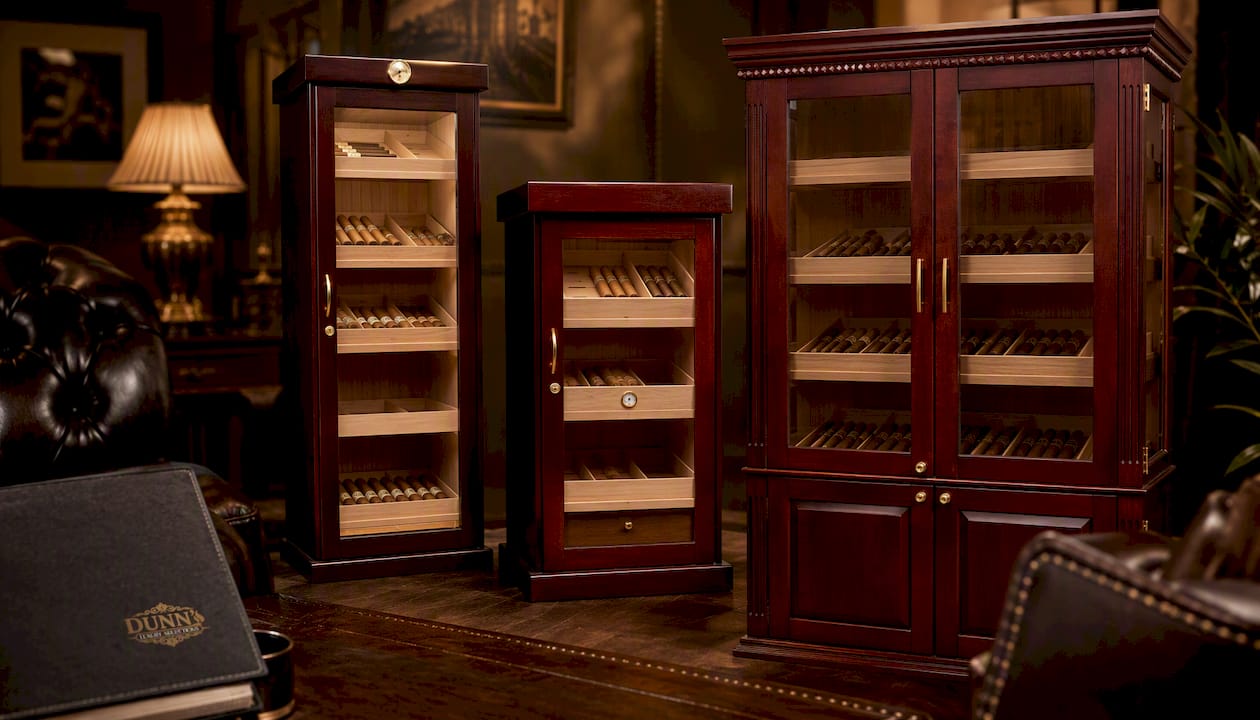
The Barbatus, Spartacus, and Saint Regis lines cover everything from a first serious collection to a multi-shelf archive, each with white-glove delivery that includes on-site calibration of humidifier and hygrometer placement. If you’re weighing a retrofit against a purpose-built cabinet, start with a consultation: have your cigar count, room dimensions, and any photos of the intended space ready. Explore the Barbatus cabinet humidor, the Spartacus cabinet humidor, or the Saint Regis cabinet humidor to see which fits your collection, or visit Dunnluxuryselections to begin a consultation.
Sources
For hands-on installer detail beyond this guide, GetAirify’s placement walkthrough covers sealing technique in more depth, and The House of Hydro’s humidity guidance explains the reasoning behind the 65–72% RH target. Dunn’s own cabinet insulation guide addresses sealing issues that often masquerade as placement problems.
- Walk-in humidor humidity guidance — The House of Hydro
- Where to place the cigar humidifier? — GetAirify
- The ultimate guide to cigar humidifiers — CigarAccessoriesSupplier
- Walk-in humidor humidification guide — Sonic Humidifiers
FAQ
Where Should You Never Place a Humidifier in a Cabinet?
Never place it in direct contact with cigars or wrapped in a tray, since the localized moisture can cause condensation and eventually mold on the wrapper leaves.
What Is the Best Location for a Humidifier in a Cigar Cabinet?
For multi-shelf cabinets, the lower shelf in a corner is the best default, since it lets rising moisture circulate upward through the whole space; box humidors do better with lid or sidewall mounting.
Should the Humidifier Sit on a Shelf or the Floor of the Cabinet?
A lower shelf is preferable to the bare cabinet floor, since it keeps the unit clear of moisture pooling at the bottom and away from any debris or spilled water collecting below.
Should I Keep the Cabinet Door Closed After Placing the Humidifier?
Yes. Keeping the door sealed is what allows the target 65–72% RH range to hold steady; frequent opening or an unsealed gap lets outside air disrupt the humidity you’ve worked to stabilize.
How Many Humidifiers Does a Large Cigar Cabinet Need?
Cabinets holding roughly 300 cigars or more, or spanning multiple shelves, typically need more than one humidifier positioned symmetrically rather than a single unit doing all the work.
How Often Should I Check the Hygrometer After Installation?
Check daily during the first week of a new setup, then shift to monthly checks once readings hold steady within a couple of points.
Recommended
You May Also Enjoy
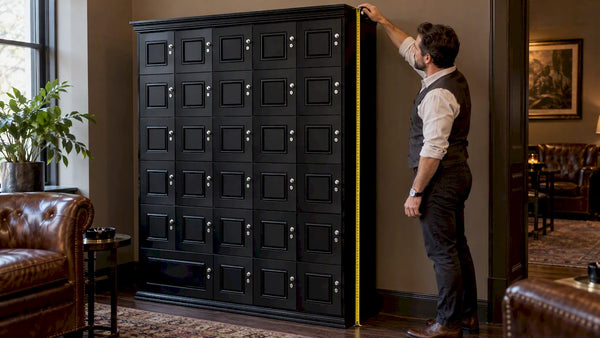
Cigar Locker Dimensions: Sizing Guide for Collectors and Lounges
Cigar locker dimensions explained: compartment sizes, cabinet footprints, capacity math and clearances, so you size a locker bank...
Read Article
Sealing a Walk-In Humidor: Envelope, Door and Penetrations
How to seal a walk-in humidor properly: vapor barrier placement, door gasket, penetrations and the controlled airflow a...
Read Article
Retail Humidor ROI: How to Measure What a Display Earns
What does a retail or lounge humidor really return? A practical framework for cigar shops, lounges and clubs:...
Read Article