

Discover the best water to use in your humidor for optimal cigar preservation. Learn why distilled water is essential and avoid common mistakes.
Distilled water is the answer for any humidor system that regulates itself, meaning electronic units and crystal or gel bead systems. If you rely on two-way packs like Boveda, add nothing at all, since the pack does its own regulating. Never reach for tap, spring, or filtered water in any of these systems.
That’s the short version. Here’s the device breakdown that keeps every one of these systems working the way it was engineered to work:
- Electronic humidifiers and crystal/gel beads → distilled water only, no exceptions
- Foam-bar or oasis-style passive humidifiers → 50/50 propylene glycol and distilled water
- Two-way humidity packs (Boveda and similar) → no added liquid, ever
- Tap, spring, or mineral water → avoid across every system type
Key Takeaways
Matching the correct liquid to your specific humidification device, rather than picking a “best” liquid in isolation, is what actually protects a cigar collection long-term.
| Point | Details |
|---|---|
| Distilled water for regulated devices | Use distilled water only in electronic humidifiers and crystal or gel bead systems. |
| Propylene glycol for passive units | Mix 50/50 with distilled water in foam or oasis-style humidifiers to cap humidity near 70% RH. |
| Never supplement two-way packs | Boveda-style packs regulate on their own and need no added liquid of any kind. |
| Skip tap and spring water entirely | Minerals and microbes in non-distilled water raise the risk of mold and calcification. |
| Dunn’s products follow device rules | Humidity Beads, the Chardonnay desktop humidor, and the Cigar Oasis Plus each match a specific system Dunnluxuryselections recommends. |
Table of Contents
- How Distilled Water, Propylene Glycol, and Two-Way Packs Actually Work
- Match the Liquid to Your Humidifier
- How to Season, Fill, and Maintain Your Humidor
- The Mistakes That Ruin a Collection
- Where Dunn’s Products Fit This System
- Why the Liquid Debate Is the Wrong Debate
- Get the Right Humidification Setup From the Start
- Sources
- FAQ
How Distilled Water, Propylene Glycol, and Two-Way Packs Actually Work
Your humidor is a closed ecosystem, and every liquid you introduce into it either stabilizes that environment or slowly undermines it. Understanding the mechanism behind each option is what separates a collector who guesses at maintenance from one who manages it with confidence.
Distilled water starts as the baseline for good reason. The distillation process strips out the minerals, chlorine, and microscopic contaminants that occur naturally in tap or spring water, leaving pure H2O with nothing left behind to precipitate out. That matters because minerals don’t evaporate cleanly. They accumulate on foam, beads, and reservoir surfaces as a white, chalky residue, a process called calcification, and that residue becomes a breeding ground for the exact bacteria and mold spores you’re trying to keep away from your cigars.
Propylene glycol does something distilled water can’t: it self-regulates. Mixed at a 50/50 ratio with distilled water, PG solution stabilizes humidity near 70% RH and effectively caps how much moisture the humidifier releases, acting as a humectant that resists over-saturating the air around it. That’s precise, but it’s also limited. The same source notes that adding PG to bead or electronic systems can damage them, so it belongs strictly in passive foam and oasis-style units, never anywhere near a reservoir designed for pure water.
Two-way packs work through an entirely different mechanism: a saturated-salt solution sealed behind a semi-permeable membrane that releases moisture when the air is too dry and absorbs it when the air is too wet. There’s no liquid to add because the pack IS the liquid system, self-contained and bidirectional by design.
The real limitation to remember: propylene glycol solution can prevent over-humidification, but it can’t reverse it once it’s happened. Distilled water alone has no ceiling at all without a device built to regulate it.
Match the Liquid to Your Humidifier
Every humidification failure Dunnluxuryselections sees traces back to the same root cause: the wrong liquid paired with the wrong device. The fix isn’t complicated once you know what’s sitting inside your humidor.
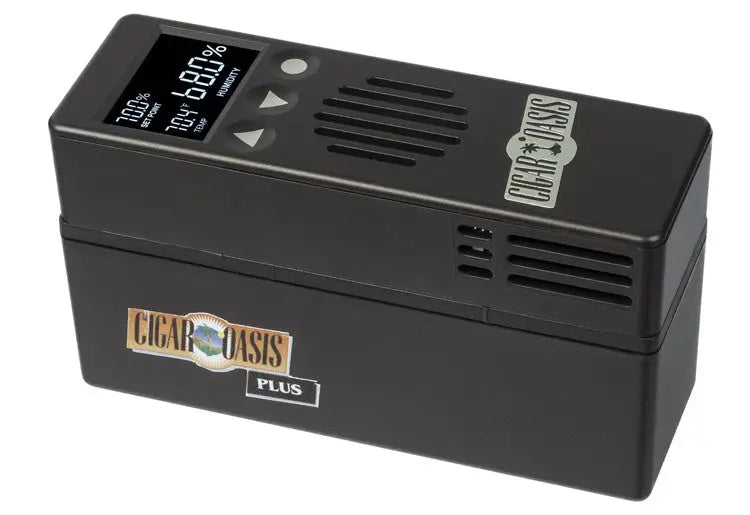
Electronic humidifiers run on distilled water exclusively. Units like the Cigar Oasis Plus use a fan-driven reservoir and internal sensor to hold humidity within a tight band automatically, but that precision depends entirely on a clean water source. Mineral buildup inside an electronic reservoir doesn’t just risk mold. It can foul the sensor and throw off the entire calibration. Always follow the manufacturer’s device instructions for fill volume and refill intervals.
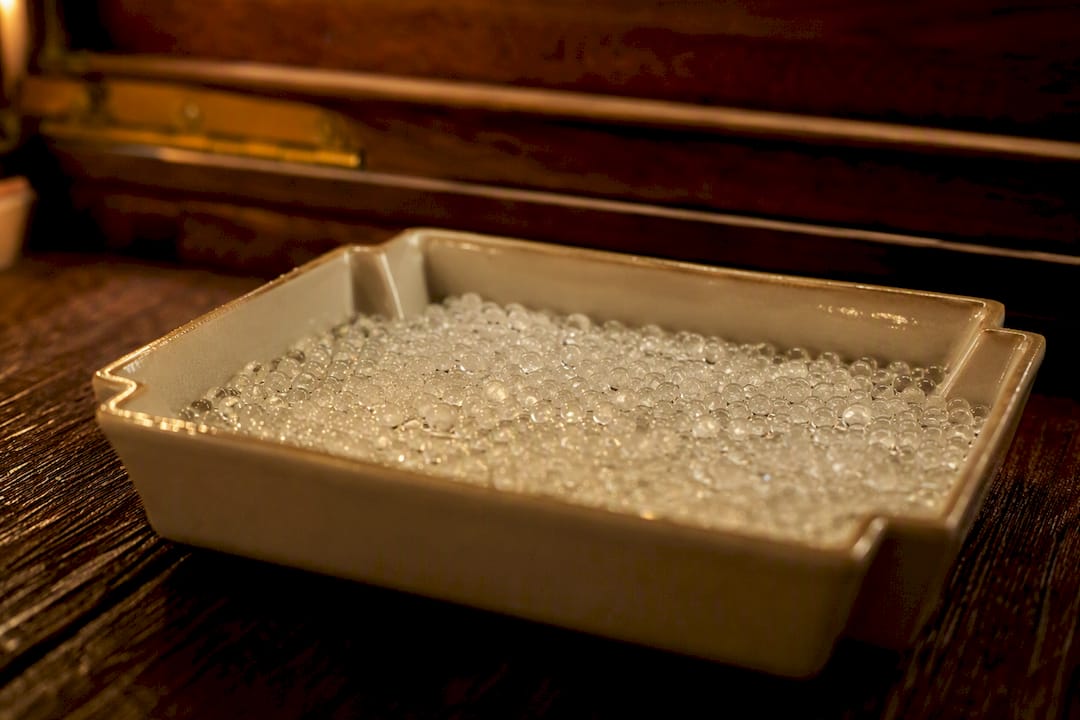
Crystal and gel bead systems work similarly. The beads form a matrix that absorbs and releases moisture as conditions shift, and that matrix is calibrated for pure water. Introduce minerals or glycol into a bead tray and you change how the beads swell and release, throwing off the very regulation you bought the system to achieve.
Foam-bar and oasis-style passive units are the one category built for propylene glycol. These humidifiers have no sensor and no fan. They rely entirely on the solution’s own chemistry to create a ceiling, which is exactly why the 50/50 PG mix exists.
Two-way packs need nothing added, period. Set your target RH level, drop the packs in, and let the membrane do its work.
Pro Tip: Check your refill schedule against how often the humidor gets opened. A desktop box opened daily needs more frequent top-offs than a cabinet or walk-in that stays sealed most of the week, since every opening lets humidified air escape and pulls ambient air back in.
How to Season, Fill, and Maintain Your Humidor
Getting the liquid right is only half the equation. How you introduce it, and how consistently you check it, determines whether your cigars actually benefit from that precision.
- Season a new humidor before it ever holds a cigar. Wipe interior Spanish Cedar surfaces with distilled water on a clean cloth, then place a small dish of distilled water inside and seal the box for 24 to 48 hours. This lets the wood absorb enough moisture to stop pulling humidity away from your humidification system the moment cigars go in.
- Fill devices according to their design, not by feel. Overfilling a bead tray or oasis reservoir doesn’t extend how long it lasts between refills. It just raises the risk of pooling and drips onto wood or tobacco.
- Check your hygrometer weekly. Maintenance guides recommend weekly checks as standard practice, along with periodic deep cleaning of the interior.
- Calibrate digital hygrometers using the salt-test method (a damp salt cap sealed with the sensor for eight hours should read 75%) and recalibrate any unit that drifts more than a couple of points.
- Adjust your maintenance cadence to usage. Infrequent openers can often stretch checks to biweekly once a box holds steady; heavy users opening daily should stick to weekly checks without exception, and anyone running a high-traffic cabinet should read our care guides for cadence specific to larger enclosures.
Target range throughout: 65% to 70% relative humidity, the band where cigars age properly without inviting mold.
The Mistakes That Ruin a Collection
Most humidification failures aren’t exotic. They’re the same handful of errors repeated by collectors who never got clear device-specific guidance in the first place.
- Using tap, spring, or filtered water. Retailer guidance is blunt on this point: minerals and microbes in non-distilled water sharply raise your odds of mold and calcification, and there’s no upside to the risk.
- Mixing systems. Running a tray of water alongside two-way packs, or bead systems next to a foam unit, creates two humidity sources fighting for control. The result is destabilization, not redundancy.
- Mistaking plume for mold. Plume, sometimes called cigar bloom, appears as fine, powdery, and crystalline. Mold looks fuzzy, spreads in irregular blue-green or white patches, and carries a musty smell. If you’re unsure, isolate the cigar and inspect it again in a day; plume won’t spread, mold will.
- Over-humidifying and not knowing how to correct it. If your hygrometer reads above 72% for more than a day or two, open the humidor to ventilate, remove any affected cigars, and consider a brief desiccant pass to pull excess moisture back down.
Propylene glycol solution creates a ceiling on humidity, but it cannot lower humidity that’s already too high. Once a box is oversaturated, only ventilation, airflow, or desiccant will bring it back down.
Where Dunn’s Products Fit This System
Every recommendation above maps directly to something in the Dunnluxuryselections catalog, chosen specifically because it follows these rules rather than fighting them.
- Humidity Beads (1 lb) are charged exclusively with distilled water, giving the bead matrix the clean moisture source it needs to regulate accurately over months of use.
- The Chardonnay desktop humidor offers a properly sealed enclosure built to pair with either a bead tray or an electronic unit, giving collectors flexibility without sacrificing seal integrity. Browse the full desktop humidors collection to compare sizes.
- The Cigar Oasis Plus delivers automated, sensor-driven control for collectors who want to check a box once a month instead of once a week, provided it’s filled with distilled water on the schedule its instructions specify.
Pro Tip: If you’re building a collection large enough to consider a cabinet or walk-in, Dunn’s consultation and white-glove delivery exist precisely so your climate system gets specified and installed correctly the first time, not retrofitted after a humidity scare.
Why the Liquid Debate Is the Wrong Debate
Collectors spend an enormous amount of energy arguing over which liquid is “best,” and that argument misses the actual point. Propylene glycol isn’t superior to distilled water, and distilled water isn’t superior to a two-way pack. Each one solves a different engineering problem, and the failure almost always traces back to using the right liquid in the wrong device, not to choosing an inferior liquid outright.
What the research here actually supports is narrower and more useful: distilled water is the non-negotiable baseline for anything with a reservoir or a bead matrix, propylene glycol is a specialized tool for passive units without electronics, and two-way packs are their own closed system that should never be supplemented. The conventional advice on forums tends to frame this as a brand or preference question. It isn’t. It’s a compatibility question, and getting it wrong doesn’t just waste a bottle of solution. It can quietly ruin a box of cigars you can’t replace.
If you take one thing from this, prioritize identifying your device type correctly before you ever open a bottle of anything. Everything downstream, calibration, top-off frequency, seasoning, depends on getting that first match right.
— Belle Dunn
Get the Right Humidification Setup From the Start
Dunnluxuryselections built its catalog around the exact device-liquid matching this guide walks through, so you’re never left guessing which solution belongs in which box.
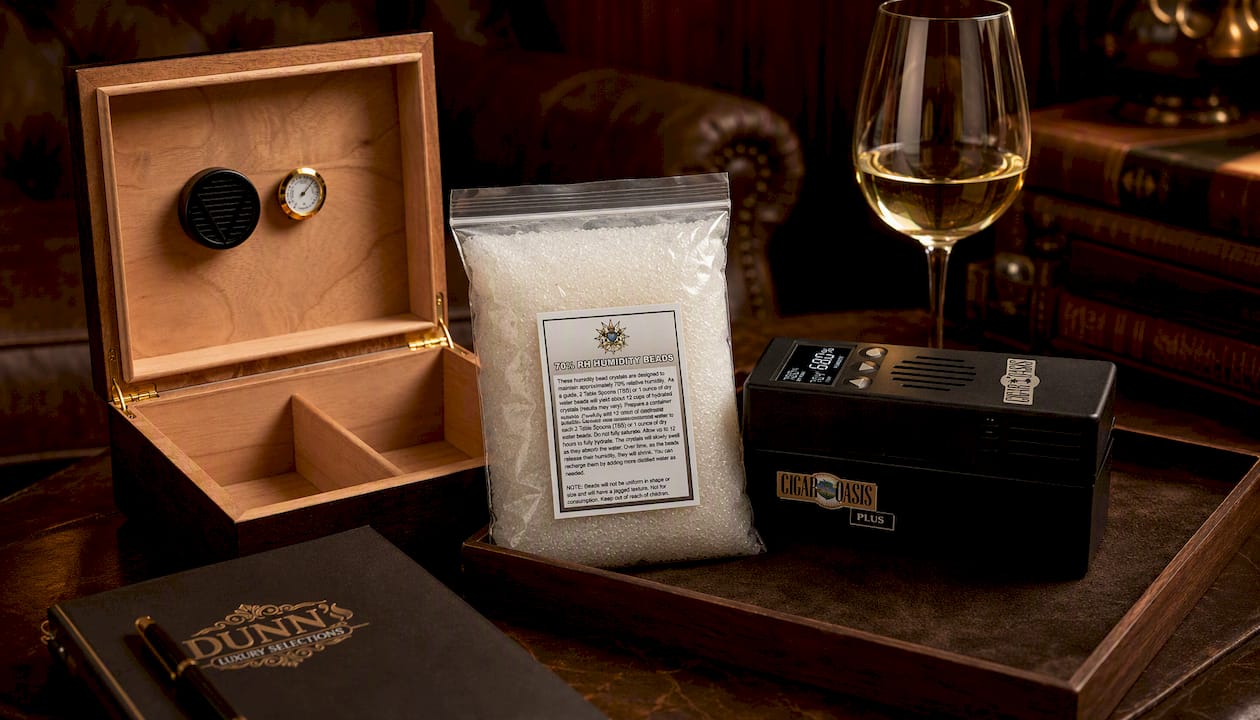
The Humidity Beads (1 lb) are ready to charge with distilled water and drop straight into any bead-compatible tray, while the Chardonnay desktop humidor gives you a properly sealed enclosure sized for a serious personal collection. For hands-off precision, the Cigar Oasis Plus automates the humidity work entirely once it’s filled correctly. Collectors return to Dunn’s because every product ships with the right specifications attached, and because our consultation team will walk through your exact setup, desktop, cabinet, or a custom walk-in, before you spend a dollar on the wrong system. Browse the catalog or request a consultation at Dunnluxuryselections to get your humidification matched correctly from day one.
Sources
- Propylene Glycol vs Distilled Water Humidor | Cigarro
- Why Your Humidor Water Matters | Holt’s Cigar Company
- Humidor Maintenance Guide | After Action Cigars
FAQ
What Water Should I Use in a Humidor?
Use distilled water for electronic humidifiers and bead systems, a 50/50 propylene glycol and distilled water mix for passive foam units, and no added liquid at all with two-way packs.
Can I Use Tap Water in My Humidor?
No. Tap water carries minerals and microbes that raise the risk of mold and calcification inside your humidor.
Why Does Propylene Glycol Cap Humidity Near 70%?
The 50/50 solution behaves as a self-limiting humectant, releasing moisture until it reaches equilibrium near 70% RH and then holding steady rather than continuing to climb.
Is Distilled Water Safe for Every Humidifier Type?
Distilled water is the recommended base for electronic units and bead systems, but passive foam humidifiers typically need the added propylene glycol to prevent over-humidification.
How Often Should I Check My Humidor’s Hygrometer?
Check weekly as a general standard, though boxes that hold steady and see infrequent opening can often move to biweekly checks.
What’s the Difference Between Plume and Mold?
Plume appears as fine, powdery, crystalline deposits that won’t spread, while mold looks fuzzy, spreads in irregular patches, and carries a musty odor.
Can I Mix a Two-Way Pack With a Water Tray?
No. Combining systems creates conflicting humidity sources that destabilize your target range instead of reinforcing it.
Recommended
You May Also Enjoy
Cigar Locker Dimensions: Sizing Guide for Collectors and Lounges
Cigar locker dimensions explained: compartment sizes, cabinet footprints, capacity math and clearances, so you size a locker bank...
Read Article
Sealing a Walk-In Humidor: Envelope, Door and Penetrations
How to seal a walk-in humidor properly: vapor barrier placement, door gasket, penetrations and the controlled airflow a...
Read Article
Retail Humidor ROI: How to Measure What a Display Earns
What does a retail or lounge humidor really return? A practical framework for cigar shops, lounges and clubs:...
Read Article