

Discover what modular humidor design is and how it offers flexible, precise climate control for your expanding cigar collection. Get details now!
TL;DR:
- Modular humidors are expandable storage systems that maintain precise climate control and organize cigars effectively. They allow collectors to grow their collection over time while buffering humidity swings and preventing aroma contamination. Automated systems with digital sensors provide consistent preservation and reduce ongoing maintenance efforts.
Modular humidor design is defined as a system of expandable, interconnected storage units engineered to deliver precise climate control and organizational flexibility for cigar collections. Unlike a fixed desktop box or a single sealed cabinet, a modular system grows with you. Units connect via rare-earth magnets, interlocking shelves, or side-by-side cabinetry, creating a scalable sanctuary that adapts as your collection deepens. The industry standard for cigar preservation sits at 65–70% relative humidity and 65–70°F, and a well-configured modular system holds those conditions with a precision that static humidors simply cannot match.
What is modular humidor design and how does it work?
Modular humidor design refers to expandable storage systems that connect via magnets, modular shelving, or interlocking cabinets to grow capacity without replacing the entire unit. The core principle is architectural flexibility. Each module functions as a self-contained climate zone, but when linked together, the units share or complement one another’s humidity and temperature regulation.
The interior lining is the foundation of what makes a good humidor. Spanish Cedar remains the gold standard for interior surfaces because it absorbs and releases moisture gradually, buffers humidity swings, and naturally repels tobacco beetles. Exterior cabinetry in premium modular systems uses hardwoods, carbon fiber panels, or lacquered finishes that seal against ambient air intrusion.
Connection methods vary by format. Tabletop collectors often stack units using rare-earth magnets, which allow repositioning without tools. Cabinet-scale systems use interlocking rails or flush-mount hardware that creates a unified visual profile while maintaining independent climate zones per drawer or shelf. The result is a living storage architecture, not a static box.
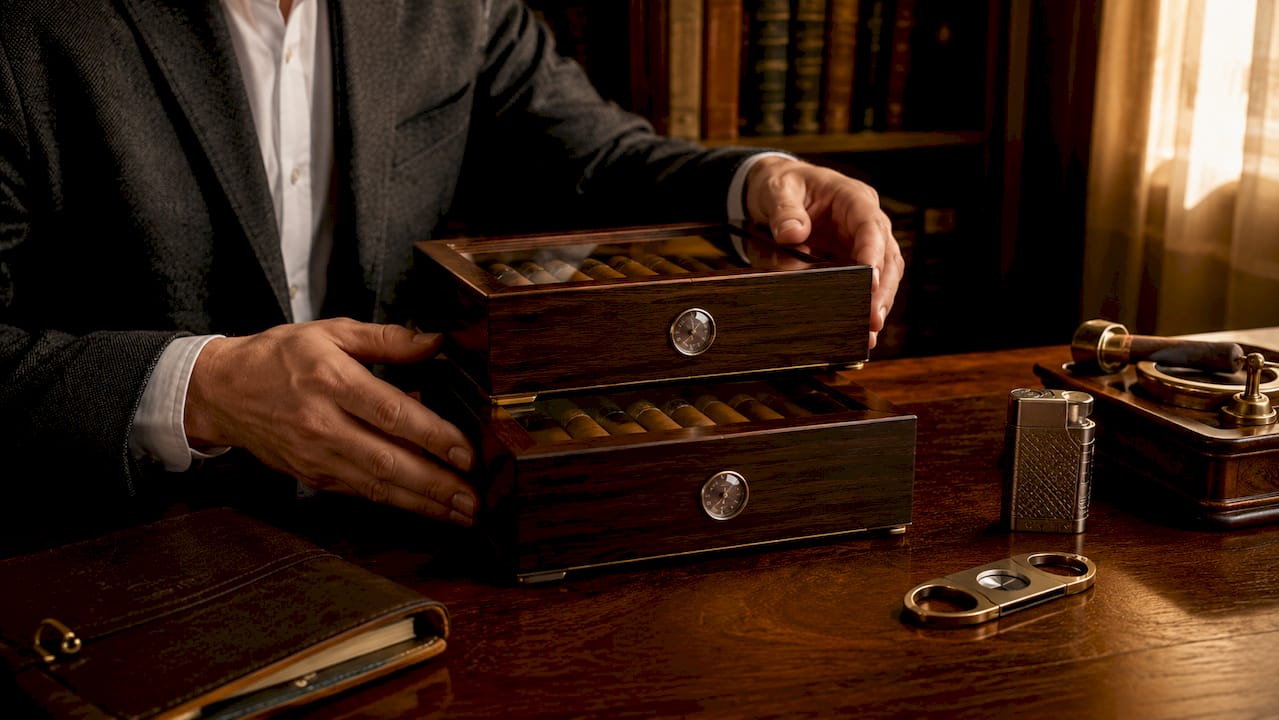
Pro Tip: When evaluating any modular system, open and close a single module while monitoring the adjacent unit’s humidity sensor. If the reading shifts more than 2% RH, the inter-module sealing needs improvement.
The key components of a complete modular system include:
- Spanish Cedar interior lining for moisture regulation and aroma preservation
- Modular drawers, shelves, and locker compartments for organized separation
- Electronic humidification units using ultrasonic or evaporative technology
- Digital sensors providing real-time humidity and temperature readouts
- Automated circulation fans that distribute conditioned air evenly across all modules
How does modular design benefit collectors compared to traditional humidors?
The most significant advantage is scalability without disruption. A collector who starts with a 150-cigar desktop module can add a matching cabinet module later, preserving the same climate environment and aesthetic without starting over. Traditional humidors force a binary choice: keep the box you have or buy an entirely new one.
Climate stability improves dramatically as interior volume increases. Larger internal volume buffers humidity swings caused by door openings, active circulation, and temperature fluctuations. This buffering effect is one of the most undervalued advantages in modular cabinet design. A single desktop humidor loses a measurable percentage of its conditioned air every time you open the lid. A cabinet with 800 cubic inches of conditioned space recovers far faster.
- Scalability. Add modules as your collection grows without replacing existing storage or recalibrating from scratch.
- Climate buffering. Greater internal volume absorbs the humidity drop from door openings, protecting cigars during routine access.
- Aroma isolation. Separate drawers for infused and natural cigars prevent cross-contamination that permanently alters flavor profiles.
- Cellaring discipline. Compartmentalization by wrapper or strength builds inventory awareness and reduces unnecessary handling.
- Reduced maintenance. Electronic modular systems cut manual upkeep from weekly sessions to periodic visual checks every few weeks.
- Display integration. Glass-front modules and integrated lighting turn your collection into a curated exhibition, not just storage.
“The real discipline of collecting isn’t acquiring cigars. It’s knowing exactly what you have, where it is, and what condition it’s in. Modular design is the physical infrastructure that makes that discipline possible.”
Organizational separation deserves particular emphasis. Modular cabinet systems allow collectors to dedicate specific drawers to Maduros, separate shelves to Connecticut Shade wrappers, and isolated compartments to infused blends. Aroma cross-contamination is a real and irreversible problem in mixed storage. Once a delicate Connecticut wrapper absorbs the sweetness of an infused cigar, that character is gone.
What design variations and customization options are available?
Modular humidor systems come in three primary formats, each suited to different collection sizes and spatial constraints.
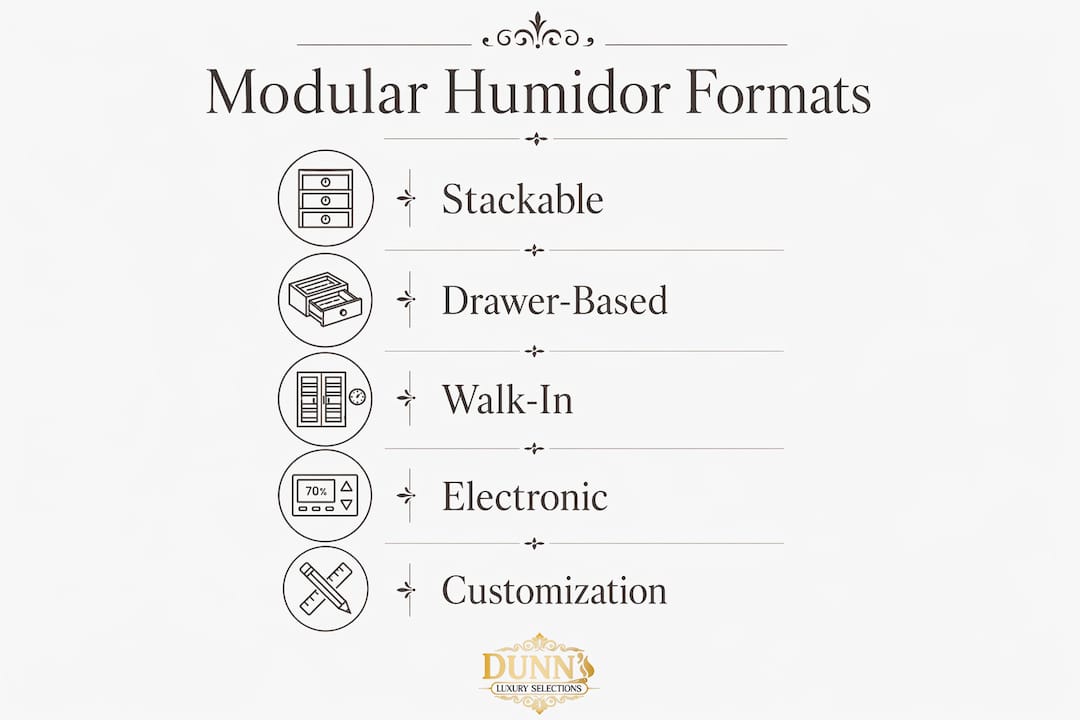
| Format | Capacity range | Best for | Control type |
|---|---|---|---|
| Stackable tabletop units | 50–300 cigars | Growing collectors with limited space | Manual or basic electronic |
| Drawer-based cabinet systems | 300–1,500 cigars | Serious collectors requiring organized separation | Electronic with digital sensors |
| Walk-in modular cabinetry | 1,500+ cigars | Lounges, estates, and dedicated cigar rooms | Zonal climate control systems |
Walk-in configurations use modular cabinetry and shelving that can be arranged to fit any room dimension. Shelving units mount to wall tracks, drawers slide into cabinet frames, and the entire system can be reconfigured as the collection evolves. This format suits collectors who treat their humidor room as a statement of legacy, not merely a storage solution.
Stackable tabletop units appeal to collectors who want modular flexibility without committing to a full cabinet installation. Rare-earth magnets align units precisely and prevent shifting. The visual profile remains clean, and the collector can add a second or third tier as the collection grows.
Drawer-based cabinet systems offer the most refined organizational experience. Each drawer maintains its own microclimate, and the separation between compartments limits aroma migration. Finishes range from matte black lacquer and walnut veneer to carbon fiber and brushed aluminum. Integrated LED lighting, available in warm or neutral tones, illuminates the collection without generating heat that would destabilize the interior temperature.
What factors should collectors consider when choosing a modular humidor?
Selecting the right modular system requires honest assessment of where your collection is today and where it will be in five years. Buying for current capacity almost always leads to an undersized system within 18 months.
The critical decision factors are:
- Target capacity and growth trajectory. A 500-cigar system that you fill in a year costs more to replace than buying a 1,000-cigar cabinet from the start.
- Materials and sealing quality. Spanish Cedar lining, tight drawer tolerances, and quality gaskets determine whether the system holds humidity between 65–70% RH consistently.
- Climate control technology. Electronic systems with digital humidity monitoring outperform passive systems for collections valued above a few thousand dollars.
- Organization requirements. Collectors with diverse wrapper types need dedicated compartments. A single open cabinet with no separation serves a uniform collection far better than a mixed one.
- Room environment. A humidor placed near a south-facing window or in a room with significant seasonal temperature swings requires active climate control, not passive regulation.
- Manufacturer support and warranty. Electronic humidors often carry warranties of 1–3 years. Confirm parts availability and service access before committing to a system.
- Budget and investment value. A well-built modular cabinet protects cigars worth multiples of its purchase price. Treat it as infrastructure, not an accessory.
Pro Tip: Before purchasing, measure your room’s ambient humidity range across seasons. If it swings more than 15% RH between summer and winter, passive humidification will not hold target conditions. You need an active electronic system.
The room environment factor is frequently underestimated. Collectors in humid coastal climates face different challenges than those in arid inland regions. A modular system with active dehumidification capability is not a luxury in Florida or Houston. It is a necessity.
How do electronic modular humidors improve preservation and reduce maintenance?
Electronic modular humidors automate what passive systems require you to manage manually. Automated humidity and temperature regulation maintains conditions within ±2% RH of the target setting, a precision level that passive sponge-based systems cannot reliably achieve. That consistency is the difference between a cigar that ages gracefully and one that dries or molds.
The maintenance reduction is substantial. Traditional manual humidors demand weekly attention: refilling humidification elements, calibrating hygrometers, and rotating cigars to equalize exposure. Electronic modular systems reduce that routine to a visual check every few weeks. The system monitors itself, alerts you to deviations, and adjusts output automatically.
Digital sensor arrays in premium electronic systems display real-time humidity and temperature on external panels, eliminating the need to open the cabinet for a status check. Every door opening introduces ambient air. Reducing those openings is one of the most effective ways to maintain stable conditions, and electronic monitoring makes it possible to check status without disturbing the interior climate.
Ultrasonic humidification, used in many electronic cabinet systems, produces a fine cool mist that distributes evenly through active circulation fans. Evaporative systems use a water reservoir and fan to maintain humidity through natural evaporation. Both outperform passive sponge or crystal systems in consistency and longevity. The choice between them depends on cabinet size and the collector’s preference for maintenance frequency.
Pro Tip: Set your electronic system’s target humidity at 68% RH rather than the maximum 70%. That 2% buffer gives the system room to respond to door openings without spiking above the safe range, which can encourage mold in tightly packed drawers.
Key Takeaways
Modular humidor design is the most effective storage approach for serious collectors because it combines scalable capacity, electronic climate precision, and organizational discipline into a single adaptable system.
| Point | Details |
|---|---|
| Scalability without replacement | Add modules as your collection grows without disrupting existing climate conditions. |
| Volume buffers humidity swings | Larger internal volume absorbs the humidity drop from door openings, protecting cigars during access. |
| Aroma isolation is non-negotiable | Separate compartments for infused and natural cigars prevent permanent flavor contamination. |
| Electronic control reduces maintenance | Automated systems cut manual upkeep from weekly sessions to periodic checks every few weeks. |
| Room environment drives system choice | Seasonal humidity swings above 15% RH require active electronic humidification, not passive regulation. |
Why cellaring discipline matters more than capacity
I have seen collectors invest in beautiful modular cabinets and then undermine every advantage by opening drawers constantly, mixing cigar types carelessly, and ignoring the sensor readouts. The hardware is only half the equation. The other half is how you use it.
The most underappreciated benefit of a modular system is what it does to your habits. When your collection has dedicated compartments, you stop rummaging. You know exactly where your 2019 Nicaraguan Maduros are aging. You know which drawer holds the infused blends you keep for guests. That inventory clarity reduces unnecessary door openings, and limiting door openings is one of the most effective ways to maintain stable conditions during long-term aging.
Collectors transitioning from traditional desktop humidors often expect the modular system to do all the work. It does most of it. But the discipline of logging what you add, rotating cigars periodically, and respecting the separation between compartments is still yours to maintain. The system creates the conditions. You protect them.
One practical note on aesthetics: do not let the visual appeal of a glass-front display cabinet override your climate judgment. Glass-front units with integrated lighting are stunning, but they require UV-filtering glass and careful lighting placement to avoid heat buildup near the top shelf. I have seen collectors lose an entire top row of aged cigars to heat damage from poorly placed LED strips. Beauty and function must coexist, and in a well-designed modular system, they do.
— Belle Dunn
Precision storage, curated for collectors
Dunnluxuryselections carries a curated selection of modular and electronic cabinet humidors built for collectors who refuse to compromise on preservation. From the Reagan Electronic Cabinet Humidor with its automated climate control and organized drawer system, to the Humidor Supreme 9200 Series double-door electronic cabinet, every piece in the collection is verified for craftsmanship and climate performance.

Each product ships with white-glove delivery and expert consultation, so your system is configured correctly from day one. Whether you are building a dedicated cigar room or adding a precision cabinet to an existing collection, Dunnluxuryselections offers the expertise and the inventory to match your vision. Explore the full cabinet humidor collection and find the modular system your collection deserves.
FAQ
What is modular humidor design in simple terms?
Modular humidor design is a storage system made of expandable, connectable units that grow with your cigar collection. Each module maintains climate control independently while integrating with adjacent units for scalable, organized storage.
What humidity level should a modular humidor maintain?
The industry standard for cigar preservation is 65–70% relative humidity and 65–70°F. Electronic modular systems maintain these conditions within ±2% RH through automated humidification and digital sensor monitoring.
What are the best materials for humidor interiors?
Spanish Cedar is the best material for humidor interiors because it regulates moisture gradually, buffers humidity swings, and naturally repels tobacco beetles. Premium exterior cabinetry uses hardwoods, carbon fiber, or lacquered finishes that seal against ambient air intrusion.
How do modular humidors prevent aroma cross-contamination?
Modular systems use dedicated drawers and compartments to separate infused cigars from natural ones. Physical separation limits aroma migration between cigar types, preserving the intended flavor profile of each blend during aging.
Are electronic modular humidors worth the investment?
Electronic modular humidors are worth the investment for collections valued above a few thousand dollars. Automated climate control reduces maintenance time significantly and eliminates the collection loss risk that comes with passive system failures.
Recommended
You May Also Enjoy
Cigar Locker Dimensions: Sizing Guide for Collectors and Lounges
Cigar locker dimensions explained: compartment sizes, cabinet footprints, capacity math and clearances, so you size a locker bank...
Read Article
Sealing a Walk-In Humidor: Envelope, Door and Penetrations
How to seal a walk-in humidor properly: vapor barrier placement, door gasket, penetrations and the controlled airflow a...
Read Article
Retail Humidor ROI: How to Measure What a Display Earns
What does a retail or lounge humidor really return? A practical framework for cigar shops, lounges and clubs:...
Read Article