

Checklist for collectors moving a humidor: stabilize humidity before the move, use a tupperdor for uncontrolled trips, protect from heat, and know when to...
You can move a humidor safely if you stabilize the relative humidity before it ever leaves the house, protect it from temperature swings in transit, and secure the lid so it can’t pop open during handling. Check your hygrometer first, adjust or remove the humidification device, and either keep cigars sealed inside or transfer them to an airtight pack for the drive. The steps below walk through each stage, from prep to settling in at the new address.
TL;DR:
- Accurate hygrometer calibration and humidity stabilization are crucial, especially with analog models that can drift by up to ten percentage points.
- For large humidors, professional movers with climate-controlled vehicles are strongly recommended to maintain seal integrity and prevent environmental fluctuations.
- Moving smaller collections or for short distances, airtight containers with two-way humidity packs provide safer, more reliable protection than transporting the entire humidor.
- After relocation, allow the humidor to settle in a stable environment for several days or weeks, re-calibrate the hygrometer, and check for mold, cracks, or beetle activity before resuming regular use.
- Proper disassembly, wrapping, and upright transportation of large units are essential, and consulting professionals can prevent damage during complex or high-volume moves.
Table of Contents
- How Do You Prepare a Humidor Before Moving It?
- What’s the Best Way to Pack and Transport a Humidor?
- Should You Use a Tupperdor Instead of Moving the Whole Humidor?
- How Long Should a Humidor Settle After a Move?
- When Should You Call in Professional Help for a Move?
- What Collectors Get Wrong When Moving a Collection
- Let Dunn’s Handle the Details of Your Next Move
- Sources
- FAQ
How Do You Prepare a Humidor Before Moving It?
The biggest mistake collectors make before a move isn’t packing too little padding. It’s trusting a hygrometer they haven’t checked in months. Before you touch a box or a dolly, confirm your readings are accurate.
Pro Tip: Run a salt test on your hygrometer at least a week before moving day: seal it in a bag with a bottle cap of table salt and a few drops of water for 24 hours. Anything off by more than a couple of points means your readings during the move can’t be trusted.
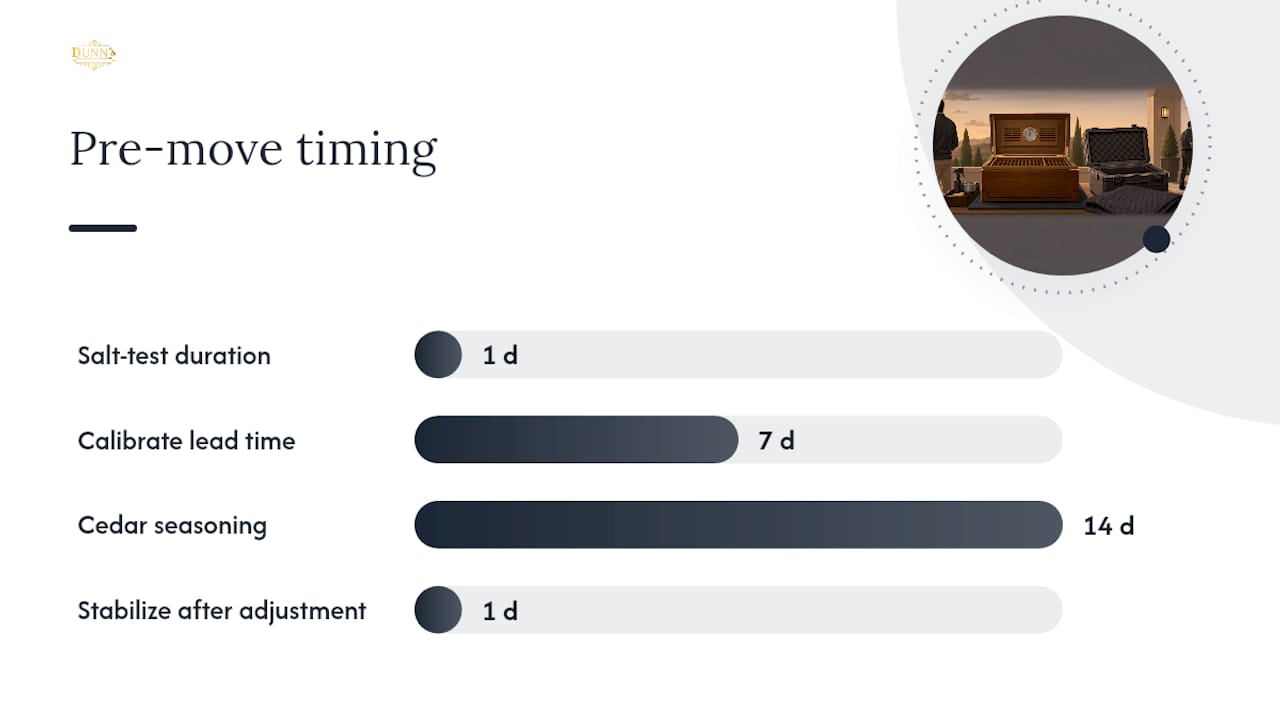
Analog dials can drift by up to 10 percentage points, which is exactly why relying on a decorative dial hygrometer during a move is risky. A digital reference unit provides a truer baseline before you disrupt the environment.
Follow this sequence in the days before the move:
- Calibrate your hygrometer and log the current reading alongside the ambient room temperature.
- If humidity reads above the commonly recommended range, pull the humidification device a day or so before loading day so the box isn’t sealed at peak saturation.
- If it reads low, introduce two-way humidity packs rather than adding water directly, and let the box stabilize for a day.
- Never load fresh cigars into a wooden box that hasn’t been properly seasoned. Cedar-lined humidors need roughly 14 days of high-humidity seasoning before the wood can hold moisture reliably, so a brand-new box is the worst possible container for moving day.
- Remove trays and dividers, wrap them separately, and either lock the lid or add painter’s tape across the seam.
Aim for a target near the 135 rule, meaning temperature in Fahrenheit plus relative humidity should land close to 135, such as 70°F and 65% RH. Photograph your inventory and your hygrometer reading before you close the lid.
What’s the Best Way to Pack and Transport a Humidor?
Packing method depends almost entirely on size. A desktop box travels differently than a 300 count cabinet, and a built-in wall unit isn’t something you pack at all.
For a desktop humidor, if the seal is tight and the lid locks securely, cigars can often stay inside for the move. Cushion the interior with soft cloth so nothing shifts, wrap the exterior in moving blankets, and transport it upright, never on its side or stacked under heavier boxes.
For a cabinet or larger freestanding humidor, treat it like a piece of fine furniture rather than a box:
- Remove and individually wrap all shelves, drawers, and glass panels.
- Secure the door with painter’s tape or a strap, never rope that can mark the finish.
- Keep it upright at all times. Cabinets are not designed to travel on their backs.
- For units this size, professional movers offering climate-controlled vehicles and continuous monitoring reduce risk significantly compared with a standard moving truck.
If you’re facing a long-distance move or a truck without climate control, don’t gamble on the cabinet holding its environment for six or eight hours in transit. Transfer the cigars to airtight containers with two-way packs instead, a method cigar owners commonly call a tupperdor, and carry that container in your own vehicle.
Whatever you choose, keep the temperature below roughly 70°F (21°C) throughout. A hot trunk or a dashboard in direct sun can push a sealed box past 90°F in under an hour, which is more than enough to soften wrapper leaf and invite tobacco beetle activity. Log your humidity reading again once everything is loaded, and once more after unloading, so you have a clear before-and-after record if anything looks off.
Should You Use a Tupperdor Instead of Moving the Whole Humidor?
For many moves, yes. If your humidor’s seal is questionable, the distance is long, or the vehicle has no climate control, moving the box itself is the riskier option compared with a short-term airtight solution.
The tupperdor/coolerdor method works well for this:
- Choose a food-grade airtight container with a tight gasket seal and clean it thoroughly first.
- Leave cellophane sleeves on the cigars for an added layer of protection.
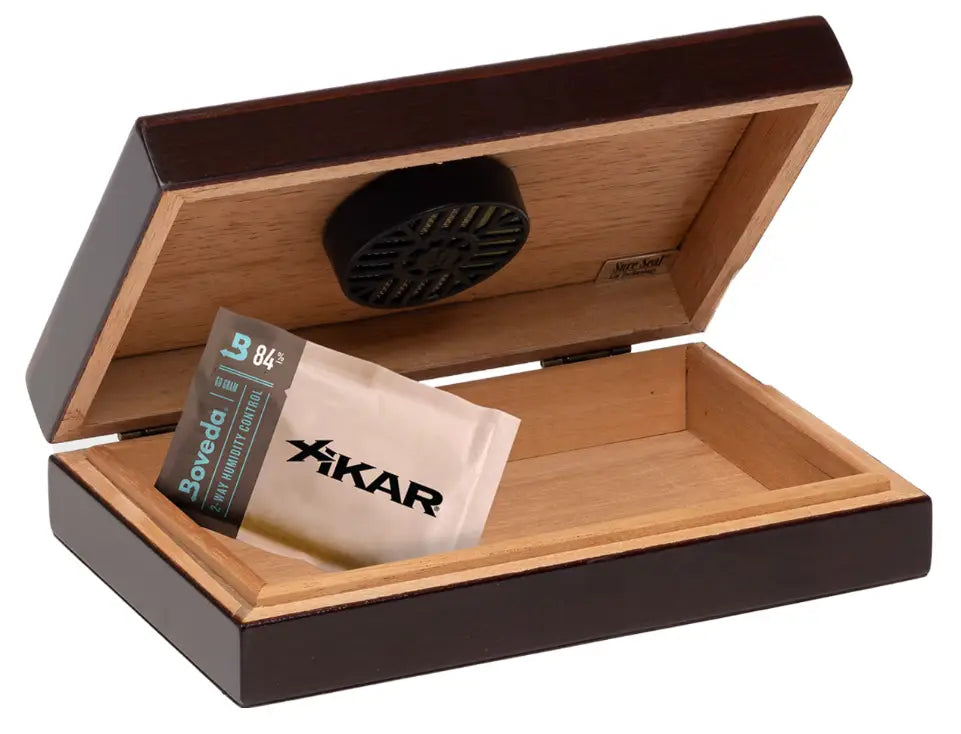
- Use one appropriately sized two-way humidity pack proportionate to your container’s cigar capacity, set near 69% RH.
- Keep the container cool and out of direct light during transport.
For shorter delays, a heavy-duty zip-seal freezer bag with a single 69% pack, air squeezed out, will hold cigars safely for weeks if kept away from heat.
If you’re only moving a handful of sticks, a compact travel humidor is the cleanest option. Cigar travelers consistently favor keeping cigars in carry-on bags rather than checked luggage or a car trunk, and the same logic applies to a household move. Choose temporary storage over moving the full humidor whenever the seal is uncertain or the trip runs longer than a few hours in an uncontrolled vehicle.
How Long Should a Humidor Settle After a Move?
Give the box time before you trust it again. Place it in its new spot away from windows, vents, and any heat source, and check that the door or lid still seals flush. Moving trucks and elevators can rack a cabinet just enough to throw off a seal that was perfect at the old address.
- Re-calibrate your hygrometer once the humidor is in place, before restoring humidification.
- Let readings stabilize for several days to a couple of weeks before resuming regular use, especially for cabinet and walk-in units.
- If humidity reads high, remove the humidifier temporarily rather than adding a fan or wiping the interior with water.
- If it reads low, add a two-way pack rather than misting the box directly.
- Inspect cigars for mold, cracked wrappers, or beetle activity, and quarantine anything suspicious in a sealed bag away from the rest of the collection.
Patience here matters more than most collectors expect.
When Should You Call in Professional Help for a Move?
Some moves are simply outside the DIY category. A 500 count cabinet or a built-in walk-in humidor involves disassembly, seal integrity, and climate control that a standard moving crew isn’t trained to handle. Professional handling is recommended for complex moves involving large humidors.
- Large cabinets and walk-ins: professional handling matters most here, since these units can’t simply be wrapped in a blanket and carried.
- High-volume or commercial moves: retailers, lounges, and clubs relocating display cases benefit from a unit like the Humidor Supreme® Commercial Display 4000 Humidor Kit, built to hold volume without sacrificing seal integrity.
- Larger commercial footprints: the Humidor Supreme® Commercial Display Humidor 4500 suits collectors and businesses consolidating multiple smaller cabinets into one relocation-ready unit.
- Short trips or transitional housing: a compact option like the Humidor Supreme® Traveler 5 Humidor keeps a working collection stable without hauling the full cabinet.
Consultation ahead of a move can flag disassembly steps and climate planning most collectors overlook until it’s too late.
What Collectors Get Wrong When Moving a Collection
Most damage during a move traces back to overconfidence, not bad luck. Collectors delay the hygrometer check because “it read fine last month.” They trust a seal that’s been loose for a year because it never mattered before. They leave a sealed box in a car trunk for an afternoon errand and don’t think about the 90 degree spike happening inside it.
The fix isn’t complicated: inventory and photograph before you pack, calibrate before you trust a reading, and keep two-way packs on hand as insurance rather than an afterthought. Dunn’s has walked enough collectors through white-glove relocations to know the moves that go smoothly are the ones planned a week out, not the night before.
— Belle Dunn
Let Dunn’s Handle the Details of Your Next Move
Specialized options exist beyond what a standard moving crew offers, including portable travel humidors and commercial display cabinets designed for large collections.
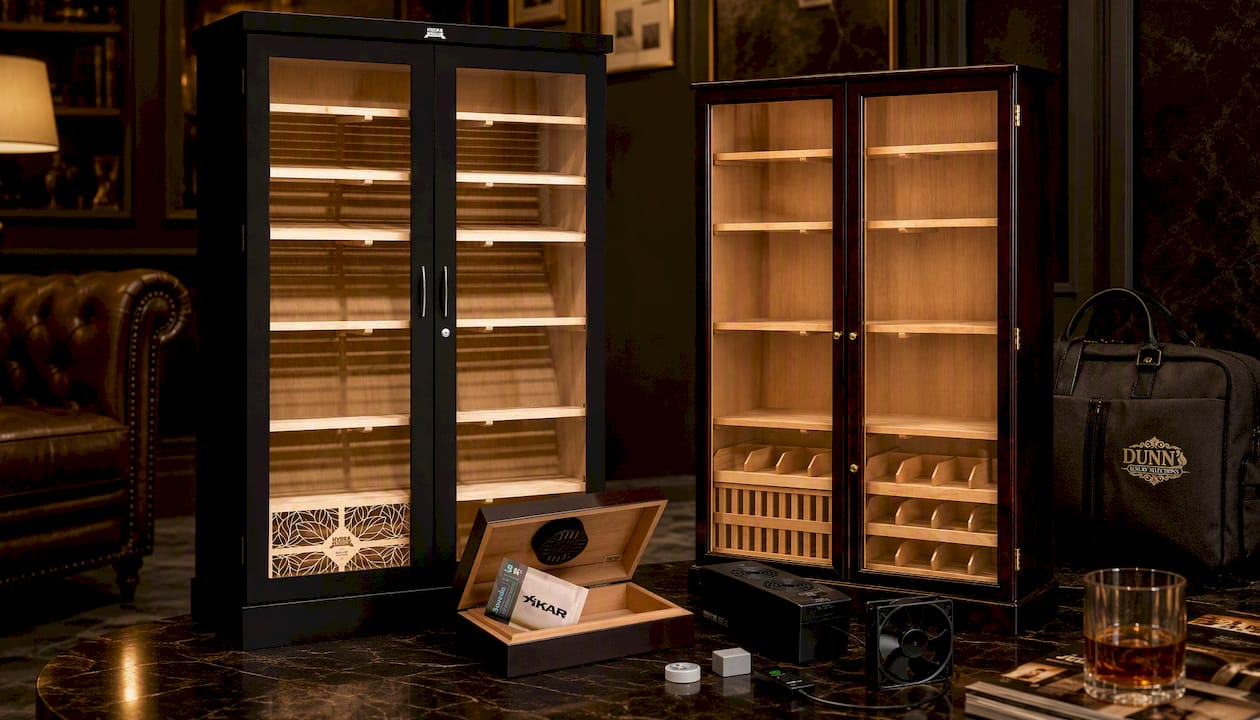
If you’re relocating a working collection for a trip or a transitional period, the Humidor Supreme® Traveler 5 Humidor keeps cigars stable without the bulk of a full cabinet. Managing a lounge, club, or retail-scale collection instead? The Commercial Display 4000 Humidor Kit and the Commercial Display Humidor 4500 are both built for volume without sacrificing seal quality during transport. Pair either with a digital hygrometer for accurate pre- and post-move readings. Reach out to Dunn’s Luxury Selections for a consultation on your specific humidor, collection size, and moving timeline, and get a straight answer on whether white-glove handling makes sense for your situation.
Sources
For deeper detail on pack sizing, review the complete storage guide from Cigarro. For flying with cigars, see After Action’s TSA packing guide. For hygrometer logging, see Dunn’s guide to tracking humidity data.
- How to Store Cigars: The Complete Storage Guide | Cigarro
- Traveling with Cigars: Packing & TSA Tips | After Action
- Humidors & cigars: pack and carry with care | Edson’s Movers
- What is the 135 Rule for Cigar Humidity? | NHCigars
FAQ
What Is the 135 Rule for Cigar Humidity?
The 135 rule is a quick guideline stating that temperature in Fahrenheit plus relative humidity in percent should total close to 135, such as 70°F and 65% RH, to keep cigars balanced and reduce beetle risk.
How Long Can a Cigar Sit Out of a Humidor?
Cigars can typically handle a few hours outside a humidor without lasting damage, but for anything beyond that, use a travel humidor or an airtight bag with a two-way humidity pack to prevent the wrapper from drying out.
How Long Does It Take for a Humidor to Stabilize?
A humidor can take anywhere from several days to a couple of weeks to fully stabilize after a move or a fresh seasoning, so hold off on heavy use until your hygrometer readings hold steady.
Can I Move a Humidor With Cigars Still Inside?
Yes, if the seal is tight and you’ve stabilized humidity beforehand, though for long or uncontrolled transport, moving cigars separately in an airtight two-way pack container is the safer choice.
Do I Need to Empty a Cabinet Humidor Before Moving?
For large cabinets, removing shelves, drawers, and glass panels before the move protects both the contents and the finish, and treating the unit as furniture rather than a sealed box reduces the odds of seal damage.
Recommended
You May Also Enjoy
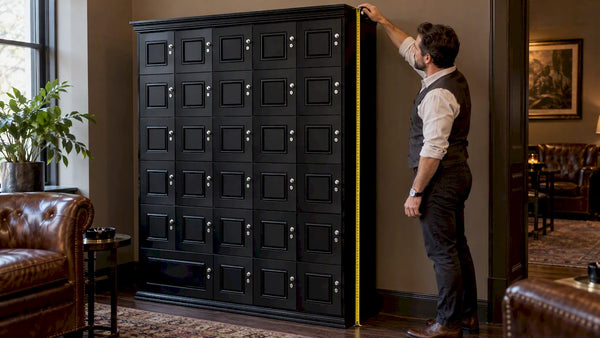
Cigar Locker Dimensions: Sizing Guide for Collectors and Lounges
Cigar locker dimensions explained: compartment sizes, cabinet footprints, capacity math and clearances, so you size a locker bank...
Read Article
Sealing a Walk-In Humidor: Envelope, Door and Penetrations
How to seal a walk-in humidor properly: vapor barrier placement, door gasket, penetrations and the controlled airflow a...
Read Article
Retail Humidor ROI: How to Measure What a Display Earns
What does a retail or lounge humidor really return? A practical framework for cigar shops, lounges and clubs:...
Read Article