

Discover the crucial role of craftsmanship in cigar storage. Learn how quality affects humidity, temperature, and your collection's longevity.
TL;DR:
- Craftsmanship in humidors directly impacts their ability to maintain stable humidity, temperature, and airflow, ensuring cigars age and smoke properly. High-quality materials like kiln-dried Spanish cedar and precise joinery are essential for long-term performance, while construction features like airtight seals and accessible humidifiers improve reliability. Custom humidors offer predictable climate control tailored to collectors’ specific needs, backed by thorough testing and professional setup.
Craftsmanship determines a humidor’s ability to deliver consistent humidity, temperature stability, and serviceability — the three performance drivers that separate a sanctuary for your collection from an expensive box that slowly ruins it. The role of craftsmanship in cigar storage is not decorative. It is structural, measurable, and directly traceable to how your cigars age, smoke, and survive the years between purchase and lighting.
The bottom line, before anything else:
- Target RH: generally between 63% and 72%, with luxury-grade humidors designed to maintain humidity very close to the set point
- Temperature: below 75°F; the 135 Rule (temperature °F + RH % ≈ 135) gives you a flexible, practical guide
- Top craftsmanship cues to verify: Spanish cedar lining, compression or knife-edge gasket seal, precision hygrometer fitment, accessible humidification system, and tight dovetail or miter joinery
- Serviceability: a humidor you cannot recalibrate, reseal, or refill without a technician is a liability, not an asset
Every number above is a threshold you can verify before you buy. The sections that follow explain exactly how to do that.
Table of Contents
- How a well-built humidor creates a stable microclimate
- The craftsmanship features that actually determine performance
- How craftsmanship priorities shift by humidor type
- Seasoning and maintenance: where craftsmanship reduces your workload
- How to physically inspect a humidor before you buy
- Aging versus protection: matching craftsmanship to your goal
- When bespoke craftsmanship is the right investment
- Common mistakes collectors make — and how craftsmanship cues help you avoid them
- Key Takeaways
- Why craftsmanship still matters alongside smart humidor technology
- What to expect when you commission a bespoke humidor
- FAQ
How a well-built humidor creates a stable microclimate
A humidor does three mechanical things: it buffers humidity, slows temperature exchange with the surrounding room, and permits controlled airflow across the tobacco. Every craftsmanship decision you evaluate — cedar thickness, seal type, cabinet mass, humidifier placement — affects one or more of those three functions.
Humidity buffering works because Spanish cedar is hygroscopic. It absorbs moisture when RH rises and releases it when RH falls, acting as a passive reservoir that smooths out the swings your active humidifier creates. A thicker, properly kiln-dried cedar lining buffers more aggressively than thin or improperly seasoned wood. That is why lining thickness is a spec worth asking about, not a decorative detail.
Temperature exchange is governed by the cabinet’s thermal mass and insulation. A solid hardwood cabinet with thick walls changes temperature slowly, giving your humidifier time to compensate before the interior drifts. A thin-walled desktop unit responds to room temperature almost immediately. Practical shop guidance recommends targeting slightly below 70/70 in warm climates — 68–70°F and 65–68% RH — because ambient heat pressure is constant and a humidor with low thermal mass cannot resist it.
Airflow matters because stagnant air creates humidity gradients. A well-designed interior uses shelf spacing and tray placement to let air circulate without drying out exposed wrappers. Two-way humidity systems, such as Boveda packs, regulate in both directions and are particularly effective in small to medium humidors where air volume is limited. Boveda recommends specific RH levels commonly between 69% and 72%, with pack sizing advised based on cigar quantity for effective regulation.
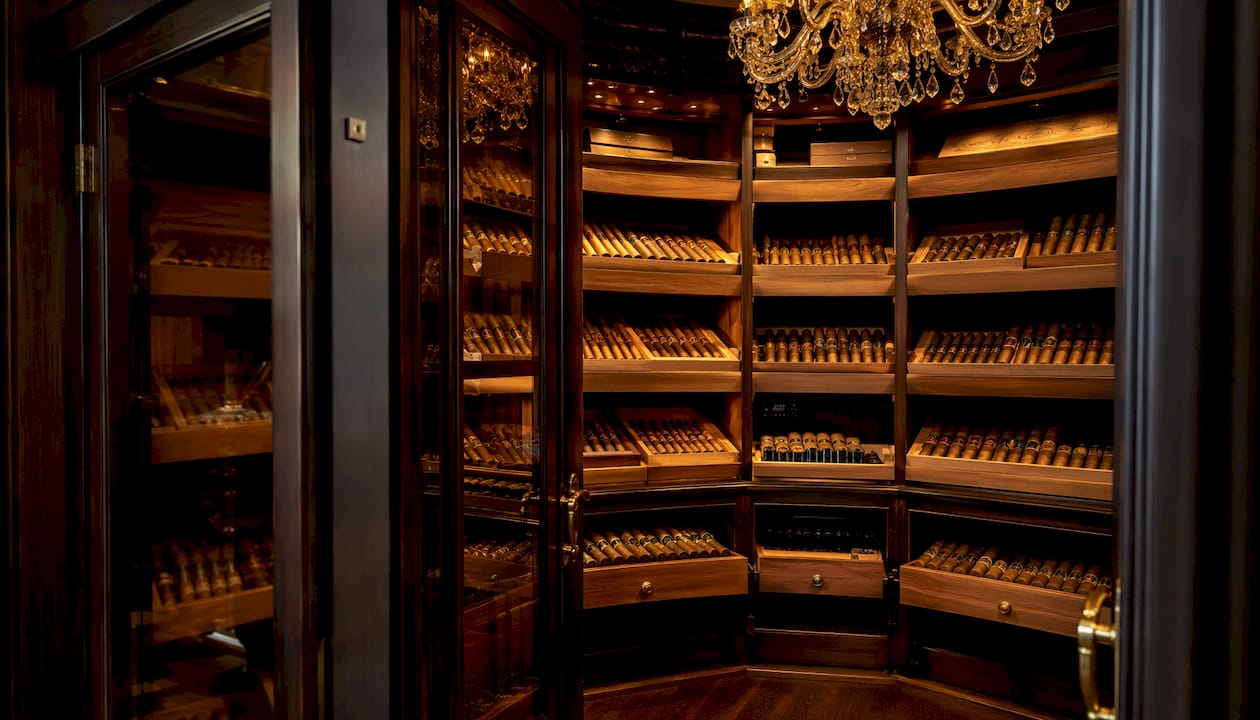
Hygrometer placement is often overlooked. A sensor mounted near the humidifier reads higher than the actual cabinet average. Mount it at the midpoint of the interior, away from direct moisture output, and calibrate it with a salt test before trusting any reading. A hygrometer with high accuracy tolerance is standard for luxury humidors; less precise units hinder effective RH management.
The craftsmanship features that actually determine performance
Build quality in a humidor is not about finish or hardware shine. It is about the precision of the components that control your storage environment. Here is what to examine, feature by feature.
The spec targets collectors should verify
| Feature | Luxury Target | Acceptable Variance | What Fails |
|---|---|---|---|
| RH stability | 63% to 72% set point | narrow tolerance range | wider drifts degrade performance |
| Temperature stability | mid-60s to 70s °F | minimal fluctuation | Fluctuations tied to room swings |
| Hygrometer accuracy | ±1% RH | ±2% RH | Analog units, uncalibrated |
| Spanish cedar lining | moderate thickness kiln-dried | Consistent grain, no knots | Thin veneer, MDF substrate |
| Seal compression | Full perimeter contact | No light gap at corners | Knife-edge gaps, warped lid |
Spanish cedar lining and thickness. The grade and thickness of the cedar lining is the single most consequential material choice in a humidor. Thin cedar veneer over MDF substrate cannot buffer humidity effectively and will warp when moisture levels fluctuate. Proper kiln-dried Spanish cedar at 3–5mm thickness, with consistent grain and no knots, is the standard for a humidor that will perform over decades. Run your hand across the interior surface: it should feel uniform, slightly aromatic, and free of rough patches where the lining meets the frame.
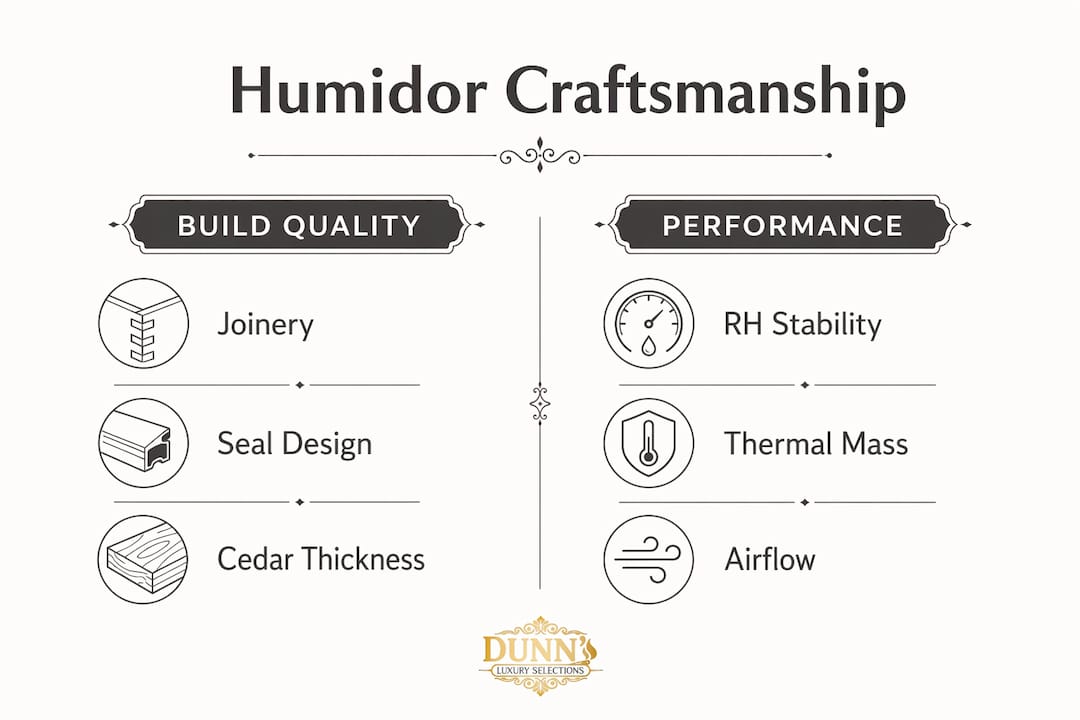
Seal design and gasket quality. The seal is where most mid-range humidors fail. A compression gasket that runs the full perimeter of the lid creates an airtight closure that holds RH without constant humidifier cycling. Knife-edge seals, where the lid’s edge meets a recessed channel, are more demanding to manufacture but deliver superior long-term performance. Test any humidor by closing the lid on a thin piece of paper: if you can pull it out without resistance at any point around the perimeter, the seal is inadequate.
Joinery and structural integrity. Dovetail joinery at the corners resists racking and seasonal wood movement better than butt joints or miter joints reinforced only with glue. A humidor that shifts or opens slightly at the corners during seasonal humidity changes will never hold a stable interior environment. Examine the corners under good light: tight, even joinery with no visible gaps is a reliable indicator of the overall build standard.
Humidifier accessibility and system type. A humidification system you cannot reach, refill, or replace without disassembling the interior is a design failure. Premium builds mount humidifiers on accessible rails or in recessed panels with service access from the front or side. Two-way systems are preferable to single-direction sponge humidifiers because they absorb excess moisture as readily as they release it, reducing the risk of oversaturation.
Pro Tip: Before buying any humidor, close the lid in a darkened room and look for light around the perimeter. Even a hairline gap at a corner will cost you 5–10% RH stability over time, especially in dry climates.
How craftsmanship priorities shift by humidor type
Not every collector needs the same build. The craftsmanship features that matter most for a travel case are almost the opposite of what you prioritize in a walk-in cabinet.
| Type | Capacity | Humidity Strategy | Maintenance Cadence | Key Craftsmanship Priority |
|---|---|---|---|---|
| Travel case | 3–10 cigars | Boveda packs, sealed shell | Per trip | Shell rigidity, airtight seal |
| Desktop | — | Two-way packs or passive | Weekly check | Even RH distribution, serviceability |
| Cabinet | — | Active + two-way hybrid | Bi-weekly | Thermal mass, zonal control |
| Walk-in | — | Active HVAC, two-way | Daily monitoring | Climate engineering, airflow design |
Travel humidors live or die by their shell. A rigid outer case — aircraft-grade aluminum or high-density polymer — protects against pressure changes and physical impact. The seal must be airtight enough to hold RH through a flight without a humidification system running. Boveda packs sized for the interior volume are the standard solution. The travel humidor collection at Dunnluxuryselections illustrates how shell construction and seal engineering translate into practical protection for cigars in transit.
Desktop humidors serve daily users who rotate stock frequently. The craftsmanship priority here is evenness: RH should be consistent from the front tray to the back corner, which requires thoughtful interior layout and a humidifier positioned to circulate moisture without creating wet spots. Serviceability matters too — you will be refilling and calibrating this unit regularly. The Palermo by Humidor Supreme® is a premium tabletop option built to hold tight RH tolerance across its full interior, making it a strong choice for collectors who want desktop convenience without sacrificing performance.
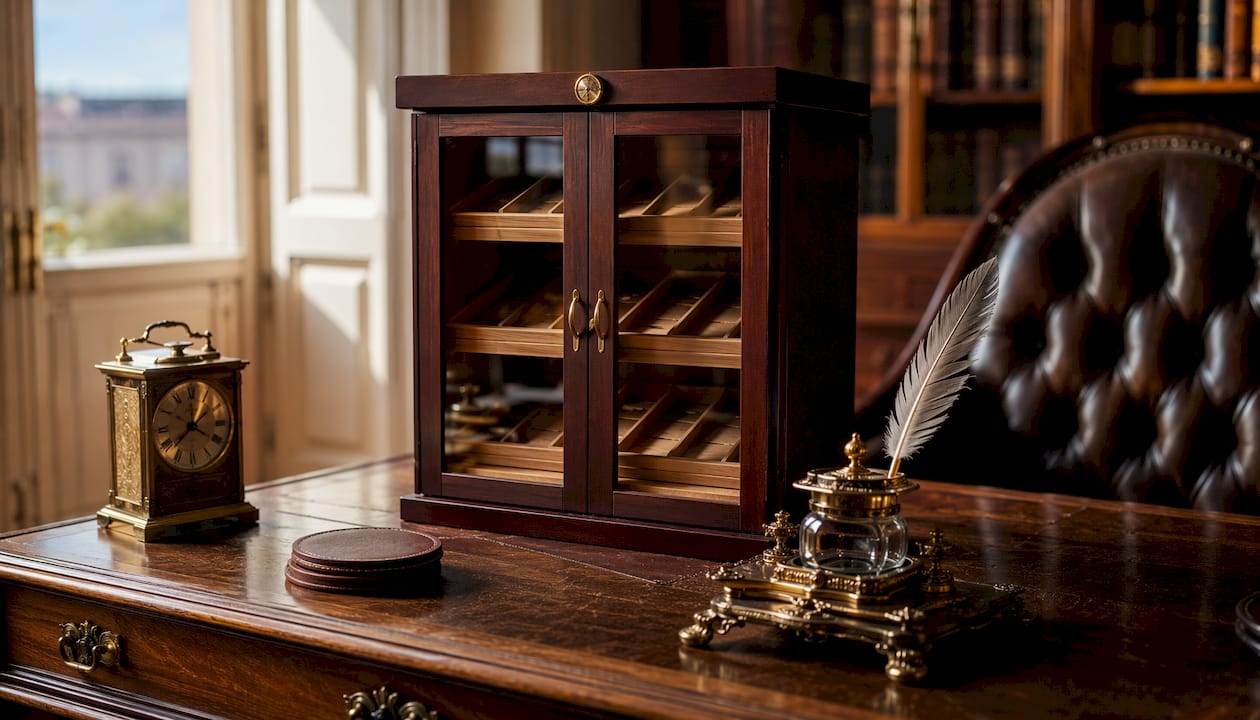
Cabinet humidors serve medium to large collections and are where thermal mass becomes the dominant craftsmanship variable. A solid hardwood cabinet with thick walls resists ambient temperature swings far better than a thin-walled unit. Walk-in humidors in high-humidity climates rely on two-way systems and active monitoring to maintain stability across tens of thousands of cigars — the same principle applies at cabinet scale. The Santiago Cigar Humidor is built for collectors at this level, with a 700-stick capacity and the construction quality to hold a stable environment without constant intervention.
Walk-in humidors are climate-engineering projects as much as furniture. Airflow design, zonal temperature control, and the integration of active HVAC with passive cedar buffering all require bespoke specification. The Bermuda Cabinet represents the high-capacity end of this category, designed for serious collectors whose collections have outgrown conventional cabinet solutions.
Seasoning and maintenance: where craftsmanship reduces your workload
A well-built humidor seasons faster, holds calibration longer, and requires less intervention between service intervals. That is not a marketing claim — it is a direct consequence of material quality and seal precision.
Seasoning a new humidor correctly sets the cedar lining at the right moisture level before you introduce cigars. The process:
- Wipe the interior lightly with a cloth dampened with distilled water — never tap water, which deposits minerals that degrade cedar over time.
- Place a small dish of distilled water or a 84% Boveda seasoning pack inside, close the lid, and monitor daily.
- Once RH stabilizes above 70% for several consecutive days, the cedar is conditioned.
- Transfer cigars in their original cellophane first, then adjust packaging based on your aging goals.
A humidor with thin cedar or improperly sealed adhesives will absorb moisture unevenly, creating hot spots and requiring repeated seasoning cycles. Quality materials — proper cedar, food-safe adhesives, and a tight seal — resist mold and warping through this process and beyond.
Routine monitoring should follow a consistent schedule. Incorrect RH leads to dry, brittle cigars or overly moist, plugged draws and creates conditions for mold and tobacco beetles at temperatures above 75°F. A practical schedule:
- Regularly check hygrometer readings and humidifier output
- Periodically rotate stock and inspect for mold or odors
- Recalibrate hygrometers periodically using standard methods; adjust RH set points according to temperature changes following practical guidelines
Pro Tip: Calibrate your hygrometer with a salt test every 90 days. Place it in a sealed bag with a saturated salt solution for 8 hours — it should read 75% RH. Any deviation tells you exactly how much to adjust your target reading.
How to physically inspect a humidor before you buy
Prioritize measurable stability and serviceability over decorative extras. A humidor that photographs beautifully but leaks at the corners is a liability for your collection.
Pre-purchase inspection checklist:
- Lid and hinge test: open and close the lid 10 times. It should move smoothly, with no play in the hinges and no torque that twists the frame. Loose hinges allow the lid to settle unevenly, breaking the seal.
- Gasket compression test: close the lid on a thin strip of paper at four points around the perimeter. Resistance should be equal at all four. Any point where the paper slides freely indicates a gap.
- Cedar quality check: the interior should smell distinctly of cedar, not of glue, lacquer, or MDF. Press lightly on the lining — it should feel solid, not hollow or thin. Look for consistent grain with no knots or voids.
- Hygrometer mounting: the sensor should be recessed or flush-mounted, not sitting loose inside the cabinet. Ask whether it is calibrated from the factory and what the stated accuracy tolerance is.
- Humidifier access: open the humidification panel or tray without tools. If you need a screwdriver to refill it, that is a design flaw you will resent within six months.
- Joinery inspection: examine all four corners under direct light. Tight, even joinery with no visible gaps or filler indicates a build standard that will hold through seasonal wood movement.
- Warranty and spare parts: ask specifically whether replacement gaskets, hygrometer sensors, and humidifier components are available. A maker who cannot supply spare parts is selling you a disposable product at a premium price.
Questions to ask the maker or retailer:
- What is the stated RH tolerance at the set point?
- What cedar species and thickness is used for the lining?
- Is the humidification system two-way or single-direction?
- What is the warranty period, and does it cover the seal and humidification components?
Pro Tip: Ask for the humidor’s calibration record before purchase. A reputable maker tests each unit at the target RH and temperature for a minimum of 72 hours before delivery. If no record exists, that absence tells you something important about the production standard.
Aging versus protection: matching craftsmanship to your goal
The craftsmanship features you prioritize depend entirely on what you want your humidor to do. Long-term aging and short-term protection place different demands on the same cabinet.
For long-term aging, the interior environment needs to permit micro-oxygenation — the slow, controlled exchange of oxygen through the tobacco that develops complexity over years. This means:
- Favor exchange-friendly cedar interiors over heavily lacquered or sealed surfaces
- Use larger cabinet volume, which moderates the rate of flavor exchange between cigars
- Consider whether to remove cellophane: cellophane is porous cellulose and allows gradual moisture exchange, so removing it in a large cabinet accelerates the aging process modestly; in a smaller desktop humidor, removing cellophane accelerates flavor marriage more aggressively due to constrained air volume
- Note that aluminum tubos with tight caps can effectively seal cigars and halt aging unless loosened or opened — a critical nuance for collectors using tubos in aging projects
For short-term protection, the priorities reverse. A robust seal, shock-resistant shell, and stable passive humidification matter more than micro-oxygenation. Keep cellophane on for protection and slower, more controlled aging. In large humidors, leaving cigars in cellophane provides a protective buffer that stabilizes aging without preventing it entirely.
The collector’s decision framework:
- Daily rotation stock: desktop humidor, cellophane on, Boveda at 69%, prioritize serviceability
- Medium-term aging (1–5 years): cabinet humidor, mixed cellophane strategy, two-way system, prioritize thermal mass
- Long-term aging (5+ years): walk-in or large cabinet, cellophane removed for prized blends, active climate control, prioritize cedar quality and airflow design
When bespoke craftsmanship is the right investment
Bespoke humidor work is worth the premium when you need long-term, predictable stability, curated aesthetics, and serviceability that production humidors cannot provide. The threshold is not purely about collection size — it is about the value of what you are protecting and the precision you require.
A custom humidor commission typically involves:
- Consultation: climate specification based on your location, collection size, and aging goals
- Materials selection: cedar species, lining thickness, exterior hardwood or lacquer, hardware grade
- Calibration and testing: the finished unit is tested at the target RH and temperature before delivery, with documented results
- White-glove delivery and setup: installation, initial seasoning, and hygrometer calibration on-site
- Warranty and service plan: replacement parts, recalibration visits, and a named contact for ongoing support
Bespoke builders should supply signed climate specs, testing records, and a service plan before delivery. Request those documents prior to purchase — they confirm the finished cabinet meets its stated RH tolerance and temperature stability promises, and they give you recourse if it does not.
What to request from any bespoke maker:
- Signed specification sheet stating target RH, acceptable variance, and temperature range
- 72-hour calibration test record from the production facility
- Named service contact and spare-parts availability confirmation
- Written warranty covering seal, humidification system, and cedar lining
Dunnluxuryselections approaches every commission this way. Their bespoke humidor process covers climate specification, material selection, calibration testing, and white-glove delivery — the full chain of custody from design to your collection room. For collectors whose cigars represent a serious investment, that level of documented accountability is not a luxury. It is the standard.
For collectors who want to understand how maker-level craft connects to storage needs, the artisanal cigar makers guide on the Dunnluxuryselections blog offers useful context on how production decisions at the rolling table translate into storage requirements at the humidor.
Common mistakes collectors make — and how craftsmanship cues help you avoid them
Most storage failures are predictable. They follow from a small set of recurring errors, and nearly all of them have a craftsmanship signal that would have warned you in advance.
The most frequent mistakes:
- Trusting a cosmetic seal. A humidor with beautiful lacquer and tight-looking corners can still leak at the gasket. Always perform the paper-strip test before purchase, not after.
- Skipping hygrometer calibration. An uncalibrated analog hygrometer can read 10–15% off its actual value. You may believe you are holding 68% RH while your cigars are sitting at 55% or 80%. Calibrate with a salt test before trusting any reading.
- Oversizing the humidifier. A humidifier rated for twice your cabinet volume will oversaturate the interior, creating mold risk and plugged draws. Match humidifier output to cabinet volume, and use a two-way system to prevent overshooting.
- Mixing flavored cigars with traditional blends. Infused cigars transfer strong aromatic compounds through shared air. Store them in a separate unit or a sealed section — a craftsmanship feature worth requesting in a bespoke build.
- Ignoring thin cedar or poor joinery. A humidor with thin cedar veneer over MDF will warp within two to three seasonal cycles, breaking the seal and destabilizing RH. Tap the interior lining: a hollow sound indicates veneer over composite substrate, not solid cedar.
Craftsmanship defects that produce predictable failures:
- Poor-quality adhesives off-gas into the interior and contaminate tobacco aroma — detectable as a chemical smell when you open a new humidor
- Sloppy joinery at corners allows seasonal wood movement to open micro-gaps in the seal, causing gradual RH drift that is difficult to diagnose without a data-logging hygrometer
- Single-direction humidifiers with no absorption capacity will overshoot RH in humid seasons and require constant manual adjustment
Pro Tip: When evaluating a used or display humidor, bring a calibrated digital hygrometer and place it inside for 30 minutes with the lid closed. If the reading drifts more than 3% from the stated set point, the seal or humidification system needs attention before you trust it with a serious collection.
Key Takeaways
Craftsmanship in cigar storage is measurable: the humidors that protect and age fine cigars correctly are built to specific tolerances — ±1–2% RH stability, temperatures below 75°F, and Spanish cedar lining at 3–5mm — and every build decision either supports or undermines those targets.
| Point | Details |
|---|---|
| RH stability is the primary metric | Luxury humidors hold within ±1–2% RH of the set point, typically between 63% and 72%; anything wider compromises aging and preservation. |
| Spanish cedar grade and thickness matter | Kiln-dried cedar at 3–5mm buffers humidity passively; thin veneer over MDF warps and fails within a few seasonal cycles. |
| Seal quality determines long-term performance | A full-perimeter compression or knife-edge gasket is the single most testable craftsmanship feature before purchase. |
| Match humidor type to your goal | Desktop for daily rotation, cabinet for medium aging, walk-in for large long-term projects — craftsmanship priorities shift with scale. |
| Dunnluxuryselections for bespoke needs | When standard production humidors cannot meet your RH tolerance or aesthetic requirements, Dunnluxuryselections offers custom-built, tested, and white-glove-delivered solutions. |
Why craftsmanship still matters alongside smart humidor technology
Smart humidors with digital sensors, app-connected controls, and automated humidification have made precision more accessible than ever. That is genuinely useful. But the technology does not replace the underlying build — it amplifies it, for better or worse.
A smart sensor mounted in a poorly sealed cabinet will report accurate readings of an inaccurate environment. Automated humidification cycling in a thin-walled unit will fight ambient temperature swings constantly, wearing out components and creating RH oscillations that stress tobacco. The electronics are only as good as the structure they are installed in.
What I find collectors consistently underestimate is the compounding effect of craftsmanship over time. A well-built humidor with quality cedar and a tight seal requires less intervention, holds calibration longer, and ages cigars more evenly than a technologically sophisticated unit with a compromised structure. When you are protecting a collection that represents years of curation and real financial value, the material decisions made at the workbench matter more than the firmware version. Choose the build first, then the features.
What to expect when you commission a bespoke humidor
When a production humidor cannot meet your specifications — whether for RH tolerance, capacity, aesthetics, or serviceability — a bespoke commission is the right path. The process should be transparent, documented, and built around your collection’s specific requirements.
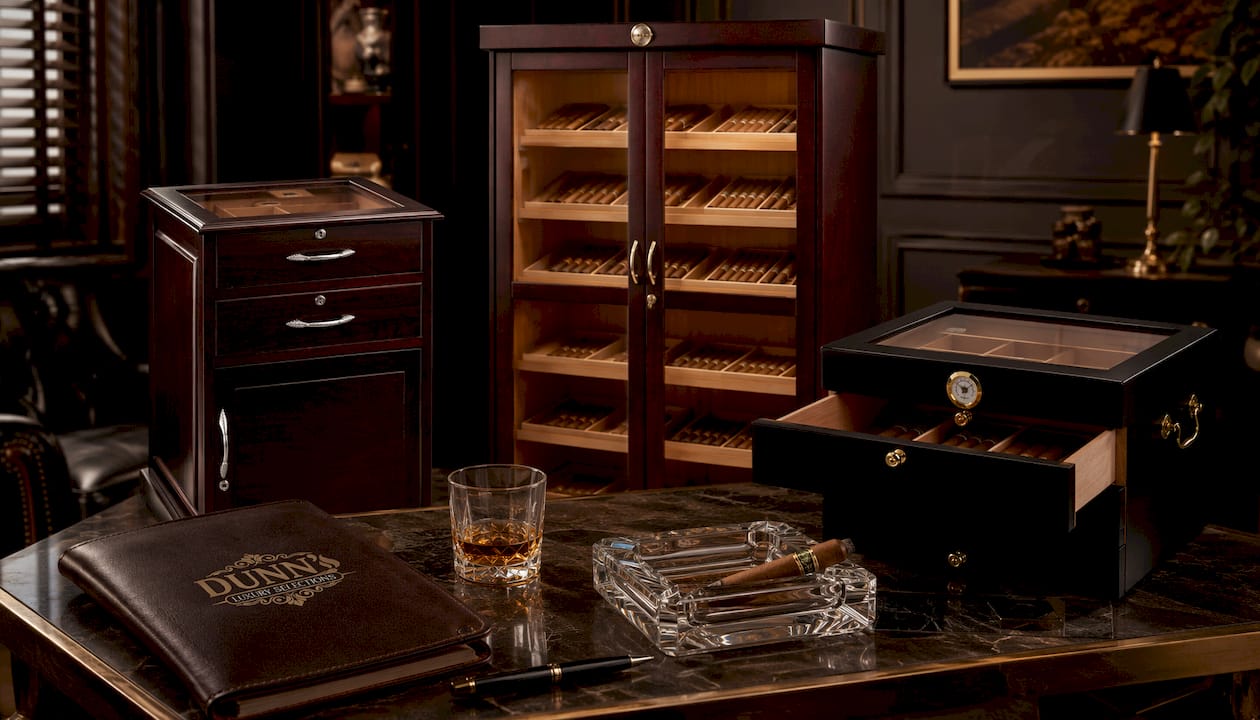
Dunnluxuryselections specializes in exactly this: custom-built humidors designed around your climate, your collection size, and your long-term aging goals, delivered with white-glove setup and ongoing service support. Every unit is tested and calibrated before it leaves the workshop, with signed specs you can verify against your own hygrometer on delivery day.
What a quality bespoke engagement includes:
- Discovery consultation: your location’s ambient climate, collection size, target RH, and aesthetic preferences
- Material samples: cedar species, exterior hardwood or lacquer options, hardware grade
- Calibration validation: documented 72-hour test at target RH and temperature before shipping
- White-glove delivery and setup: on-site installation, initial seasoning, and hygrometer calibration
- Warranty and service plan: named contact, spare parts availability, and recalibration visits
Whether you are considering the Bermuda Cabinet for a high-capacity collection or a fully custom walk-in specification, the starting point is a conversation about what your cigars actually need. Contact Dunnluxuryselections directly at dunnluxuryselections.com to begin that conversation.
FAQ
What is the 135 rule for cigars?
The 135 Rule states that the sum of your humidor’s temperature in °F and relative humidity percentage should total approximately 135 — for example, 70°F + 65% RH = 135. This guideline keeps cigars in a recommended relative humidity range of 63% to 72% and at temperatures below 75°F.
What is a cigar storage unit called?
A cigar storage unit is called a humidor — a sealed enclosure lined with Spanish cedar that maintains a controlled relative humidity environment to preserve and age cigars. Humidors range from small desktop boxes to large walk-in cabinet rooms.
Is it better to keep cigars in cellophane inside the humidor?
It depends on your goal. Cellophane is porous cellulose and allows gradual moisture exchange, so leaving it on provides protection and slower aging; removing it accelerates flavor marriage, particularly in smaller humidors where air volume is constrained. In large cabinets, cellophane acts as a stabilizing buffer without preventing aging.
What was John F. Kennedy’s favorite cigar?
According to his press secretary Pierre Salinger, Kennedy’s preferred smoke was the H. Upmann Petit Corona — a small Cuban cigar he smoked four to five times daily.
When does a bespoke humidor justify the investment?
A custom humidor is worth commissioning when your collection’s value, size, or aging goals exceed what production units can reliably deliver — specifically when you need documented RH tolerance within ±1–2%, a specific capacity, or integrated climate control that a standard cabinet cannot provide. Dunnluxuryselections builds and tests each bespoke unit to signed specifications before delivery.
Recommended
You May Also Enjoy
Cigar Locker Dimensions: Sizing Guide for Collectors and Lounges
Cigar locker dimensions explained: compartment sizes, cabinet footprints, capacity math and clearances, so you size a locker bank...
Read Article
Sealing a Walk-In Humidor: Envelope, Door and Penetrations
How to seal a walk-in humidor properly: vapor barrier placement, door gasket, penetrations and the controlled airflow a...
Read Article
Retail Humidor ROI: How to Measure What a Display Earns
What does a retail or lounge humidor really return? A practical framework for cigar shops, lounges and clubs:...
Read Article