

Explore the essential types of cigar clubs featuring humidors tailored for lounges. Discover the best options for your space and needs.
For most cigar lounges and private clubs, a custom walk-in humidor or a zoned commercial cabinet system is the right foundation. These two classes of storage deliver the capacity, climate precision, and aesthetic authority that serious operations demand. That said, the best solution for your specific space depends on square footage, membership model, and budget:
- Cigar locker systems suit membership clubs where individual collectors store personal inventory under lock and key.
- Display cabinet humidors work well as secondary retail or tasting stations within a larger lounge.
- Desktop units serve private collectors or VIP rooms where a curated selection of a few hundred cigars needs a dedicated, elegant home.
One clarification before we go further: in this guide, “types of cigar clubs” refers exclusively to humidor and storage solutions specifically for clubs and lounges, not membership tiers, subscription boxes, or social cigar societies. If you manage a lounge, run a private club, or curate a serious personal collection, every recommendation here is written for you.
Key Takeaways
Custom walk-in humidors and zoned commercial cabinet systems are the correct specification for most cigar lounges and private clubs, with locker systems added where individual member storage is a membership benefit.
| Point | Details |
|---|---|
| Match humidifier to cubic footage | Undersizing humidification is the most common and costly commercial mistake; require sizing calculations in every proposal. |
| Specify RO water and redundancy | Tap water clogs ultrasonic units; a backup humidification unit protects inventory if the primary system fails overnight. |
| Demand a site survey before any quote | Vapor barrier, HVAC proximity, and seasonal temperature range all affect performance and must be assessed before specification. |
| Budget realistically by scope | Entry cabinet units run in the lower thousands; mid-range custom installs fall into the mid-thousands range; bespoke walk-ins begin above that, with lead times varying from a few weeks to several months. |
| Dunnluxuryselections for club projects | The Bermuda Cabinet, Humidor Supreme® Locker, and Barbatus Cabinet cover the full range of club and lounge storage needs with white-glove delivery and expert consultation. |
Table of Contents
- What separates a $500 humidor from a $50,000 one?
- Which humidor type fits your club’s scale and style?
- What technical specs should every club humidor proposal include?
- How do you select the right humidor vendor for a club or lounge?
- What do club humidors cost, and how long do they take to deliver?
- What mistakes do lounges and collectors most often make?
- Why bespoke storage is the only honest answer for serious clubs
- Dunnluxuryselections brings precision and craft to every club installation
- Sources
- FAQ
What separates a $500 humidor from a $50,000 one?
The answer is not size. It is the convergence of material integrity, climate engineering, and craft that separates a piece of furniture from a precision instrument. That level of performance demands Spanish cedar interiors, gasketed seals, calibrated hygrometry, and redundant humidification — not as optional upgrades, but as baseline specifications.
The material and craft markers that define premium builds
Solid Spanish cedar is the interior standard for a reason: it absorbs and releases moisture gradually, buffers RH swings, and imparts the subtle aromatic character that ages tobacco beautifully. Dovetail joinery at cabinet corners, precision-milled door frames, and premium exterior finishes — lacquered burl, hand-rubbed leather, or brushed metal hardware — signal that a build was engineered rather than assembled. Cedar dividers and shelving inside the cabinet extend that same buffering capacity to every tier of your collection.
- Solid Spanish cedar interior lining (not veneer)
- Dovetail or mortise-and-tenon joinery at structural corners
- Gasketed, compression-seal doors with no visible light gap
- Calibrated digital hygrometers (not analog dial gauges)
- Active humidification with circulation fans
- Redundant monitoring: at least two hygrometers per zone
- Verified sourcing documentation for cedar and hardware
Trust signals to demand from any vendor
Before signing a proposal, request a site survey. A credible vendor will assess your room’s vapor barrier, existing HVAC, ambient temperature range, and traffic patterns before specifying a single component. Ask for calibrated pre-delivery testing results, a written service plan with response time commitments, and a warranty that covers both the humidification system and the cabinetry. White-glove delivery and professional installation are not luxuries at this price point — they are the minimum standard of care for a precision instrument.
Luxury humidor specification targets: interior RH 65–68%, never exceeding 72%; temperature 65–70°F; hygrometer calibration verified against a salt-test reference or a factory-calibrated instrument before installation.
Pro Tip: *Ask any vendor to provide a 48-hour pre-delivery soak test on the cabinet at your target RH before it ships.
Which humidor type fits your club’s scale and style?
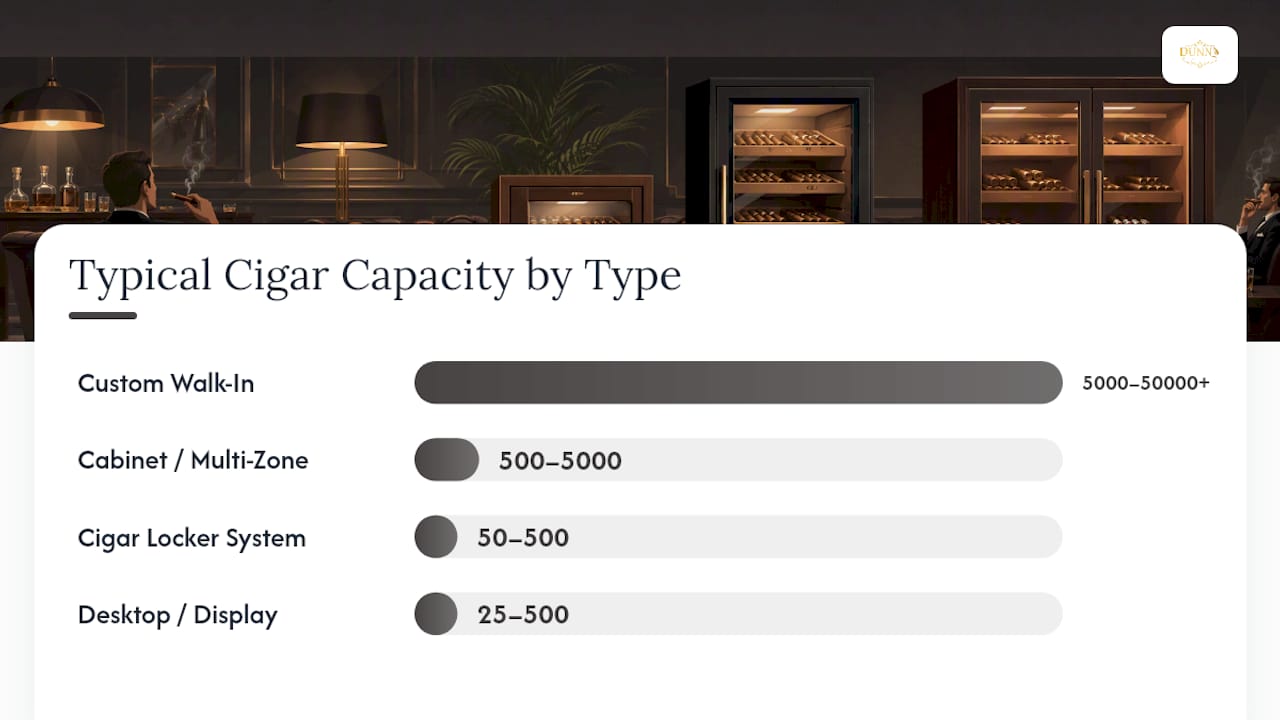
Four practical categories cover the full range of club and collector storage. Each solves a different problem at a different scale.
| Custom Walk-In | Cabinet / Multi-Zone | Cigar Locker System | Desktop / Display | |
|---|---|---|---|---|
| Best for | High-volume lounges, flagship retail | Mid-size lounges, private club rooms | Membership clubs with personal storage | VIP rooms, tasting stations, collectors |
| Typical capacity | 5,000–50,000+ cigars | 500–5,000 cigars | 50–500 cigars per locker | 25–500 cigars |
| Customization | Full bespoke: layout, cedar, finishes, lighting | High: wood species, finish, zoning | Moderate: locker count, lock type, finish | Limited: exterior finish, tray layout |
| Climate-control precision | ±1–2% RH with multi-zone control | ±1–2% RH with electronic humidification | ±2–3% RH (shared or individual zone) | ±2–5% RH depending on unit quality |
| Installation complexity | High: framing, vapor barrier, plumbing, HVAC | Moderate: electrical, plumbing connection | Low to moderate: floor anchoring, wiring | Minimal: plug-and-play |
| Typical price range | $15,000 and above | $5,000–$15,000 | $2,000–$5,000 | $500–$5,000 |
| Service / warranty | White-glove delivery, professional install, full service plan | White-glove delivery, install, warranty | Delivery, basic install, limited warranty | Delivery, self-install, manufacturer warranty |
| Security options | Keyed zones, access control, CCTV integration | Keyed cabinet locks, alarm integration | Individual keyed or combination locks | Keyed lid or drawer locks |
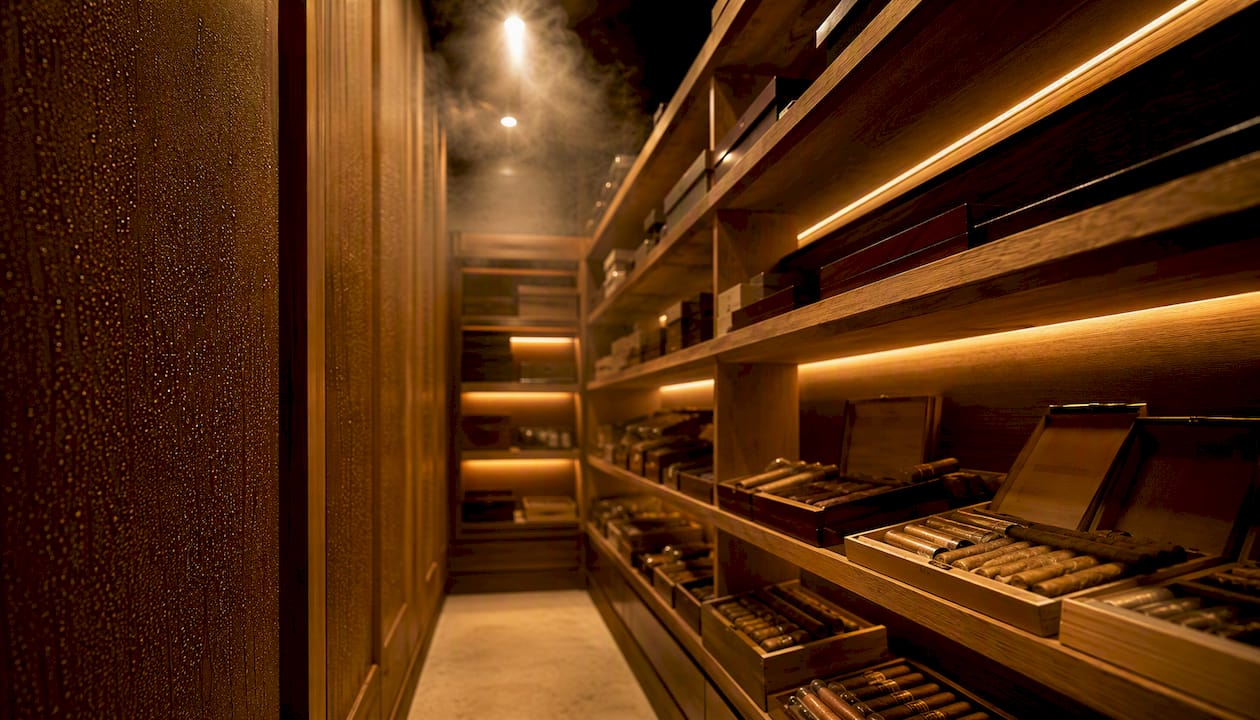
Custom walk-in humidors
A walk-in is the sanctuary of serious lounge operations. Design guidance recommends 8-foot ceilings and 36-inch aisles to allow proper shelving height and comfortable member traffic. The humidification system must be sized to the room’s cubic footage — undersizing here is the single most expensive mistake a lounge can make. For moderately sized rooms, wall-mounted ultrasonic units are standard; larger rooms require commercial multi-unit arrays with backup capacity. A dedicated mini-split or continuous-circulation HVAC keeps temperature stable independent of the main building system.
Cabinet and multi-zone humidors
For clubs that lack the square footage or budget for a full walk-in, a premium cabinet system delivers near-equivalent climate precision in a fraction of the footprint. Electronic humidification units like the Cigar Oasis Plus handle mid-sized inventories of 100–3,000 cigars with reliable RH control. Multi-zone configurations allow a single cabinet run to maintain different RH targets for different tobacco origins — a meaningful advantage for clubs that stock both Nicaraguan and Connecticut-shade selections.
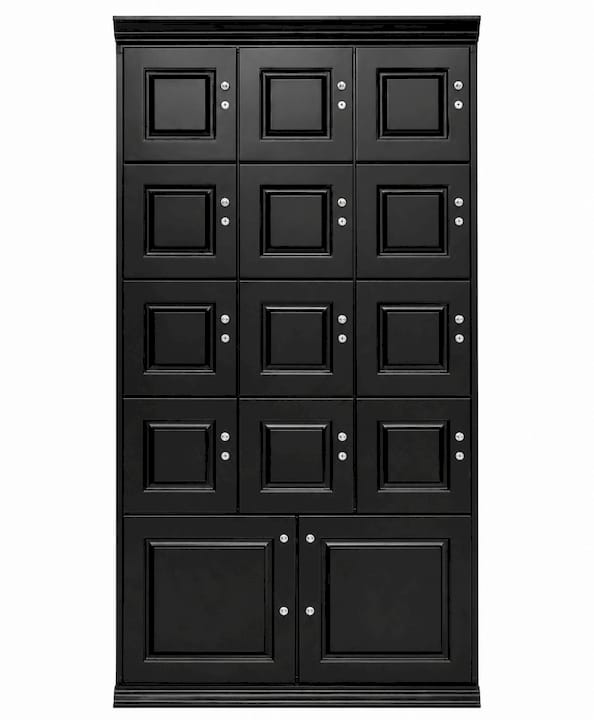
Cigar locker systems
Locker humidors are the defining feature of membership-based clubs. Each member stores their personal inventory in a dedicated, lockable compartment within a shared climate-controlled cabinet. The Humidor Supreme® Commercial Cigar Locker Humidor holds up to 5,000 cigars across individual locker bays, making it the right specification for clubs where personal storage is a core membership benefit.
Desktop and display humidors
Desktop units belong at the tasting station or in the VIP room, not as the primary storage for a working lounge. They excel at presenting a curated selection of 25–500 cigars in an aesthetically compelling way, and they require minimal installation. For a collector who wants a bespoke piece for a private study or home office, a high-quality desktop humidor with a precision electronic humidifier is a genuinely satisfying investment.
What technical specs should every club humidor proposal include?
A proposal without these specifications is incomplete. Use this checklist when evaluating vendors and comparing bids.
- RH control: ±1–2% of target (65–68% for most tobacco; never above 72%)
- Temperature stability: 65–70°F maintained independently of ambient room temperature
- Interior lining: solid Spanish cedar throughout, including shelving and dividers
- Door seals: compression gaskets with no visible light gap when closed
- Circulation: dedicated fans to eliminate stagnant zones and corner drift
- Humidification system: sized to cubic footage per industry standards (evaporative for under 100 cu ft; ultrasonic for 100–500 cu ft; commercial multi-unit for larger rooms)
- Water supply: reverse osmosis feed or distilled water only — tap water minerals clog ultrasonic units and deposit white dust on cigars
- Monitoring: minimum two calibrated digital hygrometers per zone, positioned at opposite ends
- Redundancy: backup humidification capacity that activates automatically if the primary unit fails
- Backup power: UPS or generator connection for climate-critical installations
Active humidification systems — fan-over-wick cartridge units and larger reservoir systems — are the commercial standard. Their most common failure points are mineral-clogged wicks (from tap water) and float or valve failures in reservoir units. Specifying RO water and scheduling quarterly cartridge inspections eliminates most of these failures before they affect your inventory.
RH reference: target 65–68% for long-term storage; 70% is acceptable for short-term retail display; anything above 72% risks mold and wrapper damage.
Pro Tip: *Request that your vendor place hygrometers at both the top shelf and the floor level during the acceptance test.
How do you select the right humidor vendor for a club or lounge?
The procurement sequence matters as much as the product specification. Follow these steps in order.
Site survey first. No credible vendor should quote a commercial humidor without visiting your space. The survey should document room dimensions, existing vapor barrier condition, HVAC proximity, electrical capacity, and ambient temperature range across seasons. For clubs in hot climates, lounge air and cooling solutions become a central design variable — a thermoelectric unit that pulls only 15–20°F below ambient will not maintain cellar temperatures in a room that reaches 85°F in summer.
Ask the right questions. When reviewing a proposal, press vendors on these points:
- What is the hygrostat’s control tolerance, and how is it verified?
- Does the design include an RO water feed, or will the system require manual distilled-water refilling?
- What is the backup humidification plan if the primary unit fails overnight?
- What warranty covers the humidification system separately from the cabinetry?
- What is the service-level agreement for emergency response?
Watch for these red flags. A proposal that specifies a single hygrometer for a room over 200 cubic feet is undersized for monitoring. A design with no dedicated circulation plan will develop corner drift — a diagnostic pattern where humidity drift in one corner points to a seal or circulation failure rather than a humidification problem. Any vendor who cannot provide a pre-delivery test report should be asked to explain why.
Verify before you sign off. Request a written acceptance test plan that includes: 48-hour soak at target RH, hygrometer readings at a minimum of four positions within the space, temperature stability log across a full 24-hour cycle, and door-seal inspection under load. These are not unusual requests — they are standard practice for any precision climate installation.
What do club humidors cost, and how long do they take to deliver?
Budget and timeline planning prevents the most common stakeholder surprises.
Price bands and what you get
- $2,000–$5,000: Entry-level commercial cabinet units and locker systems. Electronic humidification, basic Spanish cedar lining, standard finishes. Suitable for small clubs or secondary storage rooms.
- $5,000–$15,000: Mid-range custom cabinets and multi-zone installs. Premium wood species, precision electronic humidification, professional installation, extended warranty. The right range for most private club rooms and mid-size lounges.
- $15,000 and above: Bespoke walk-in humidors and ultra-luxury cabinetry. Full custom design, refrigeration integration, RO plumbing, zonal climate control, white-glove delivery, and comprehensive service plans. The standard for flagship lounges and serious collectors who treat their inventory as a long-term asset.
| Price Band | Typical Scope | Typical Lead Time |
|---|---|---|
| $2,000–$5,000 | Cabinet or locker unit, standard finish | 2–4 weeks |
| $5,000–$15,000 | Custom cabinet, multi-zone, professional install | 6–12 weeks |
| $15,000+ | Bespoke walk-in, full build-out, RO plumbing | 12–24 weeks |
The investment rationale
A premium humidor is not a furniture purchase — it is inventory protection. A lounge holding $50,000 in cigar stock that loses humidity control for 72 hours can sustain losses that dwarf the cost of a properly specified backup system. Beyond loss prevention, a bespoke walk-in or a beautifully appointed cabinet system is a tangible signal of quality to members and guests. Clubs that invest in visible, precision storage consistently report stronger member retention and higher average spend per visit. The humidor is, in that sense, both a preservation instrument and a revenue asset.
What mistakes do lounges and collectors most often make?
Most humidor failures are predictable and preventable. These are the errors that appear most frequently in commercial installations.
- Undersizing the humidification system. The most costly mistake. Humidifier capacity must be matched to cubic footage — a unit rated for 100 cubic feet will fail to maintain RH in a 300-cubic-foot room. Fix: require cubic-footage calculations in every proposal and verify them independently.
- Using tap water. Mineral deposits clog ultrasonic humidifiers and leave white residue on cigars and shelving. Fix: specify RO or distilled water in the contract and install an RO feed line for any walk-in build.
- Ignoring airflow. Stagnant zones develop when circulation fans are absent or poorly positioned. Corner drift — where one area of the humidor reads 5–8% lower RH than the center — is the signature symptom. Fix: require a circulation plan and test for corner drift during acceptance.
- Trusting a single hygrometer. One instrument cannot tell you whether a drift is localized or systemic. For inventories over roughly 500 cigars, multiple hygrometers and redundancy are advised. Fix: specify a minimum of two calibrated instruments per zone, positioned at opposite ends of the space.
- Skipping the site survey. A humidor specified without a site survey is a guess. Vapor barrier condition, HVAC proximity, and seasonal temperature swings all affect performance. Fix: make the site survey a contractual prerequisite, not an optional service.
- No redundancy plan. A single humidification unit with no backup means one component failure can damage an entire inventory overnight. Fix: require a backup humidification unit or a UPS-connected system as a contract line item.
- Accepting delivery without a performance test. A humidor that looks perfect may drift outside spec within 48 hours if the seals or humidification are marginal. Fix: hold final payment until the written acceptance test is complete and documented.
- Neglecting maintenance schedules. Cartridge replacement, hygrometer calibration, and door-seal inspection are not one-time tasks. Fix: build a quarterly maintenance schedule into the service agreement from day one.
Why bespoke storage is the only honest answer for serious clubs
The conventional wisdom in commercial humidor procurement is to buy the largest unit you can afford and assume the climate will follow. That logic fails in practice, and it fails expensively.
A humidor is not a passive container. It is a living system — one that responds to ambient conditions, traffic patterns, seasonal humidity swings, and the thermal mass of the cigars themselves. A bespoke solution, specified after a proper site survey and engineered to the actual cubic footage and traffic load of your space, performs in a fundamentally different category from a standard cabinet dropped into a room and left to manage itself.
The clubs and collectors who protect their inventory most effectively share one habit: they treat the humidor specification as seriously as they treat the cigar selection itself. The tobacco inside a premium walk-in represents years of aging and significant capital. The storage environment is not a secondary consideration — it is the condition on which every other investment depends.
Dunnluxuryselections brings precision and craft to every club installation
When the stakes are this high, the vendor you choose matters as much as the product you specify. Dunnluxuryselections curates and delivers premium humidor solutions for lounges, private clubs, and serious collectors, combining white-glove delivery, expert consultation, and pre-delivery performance testing in every project.
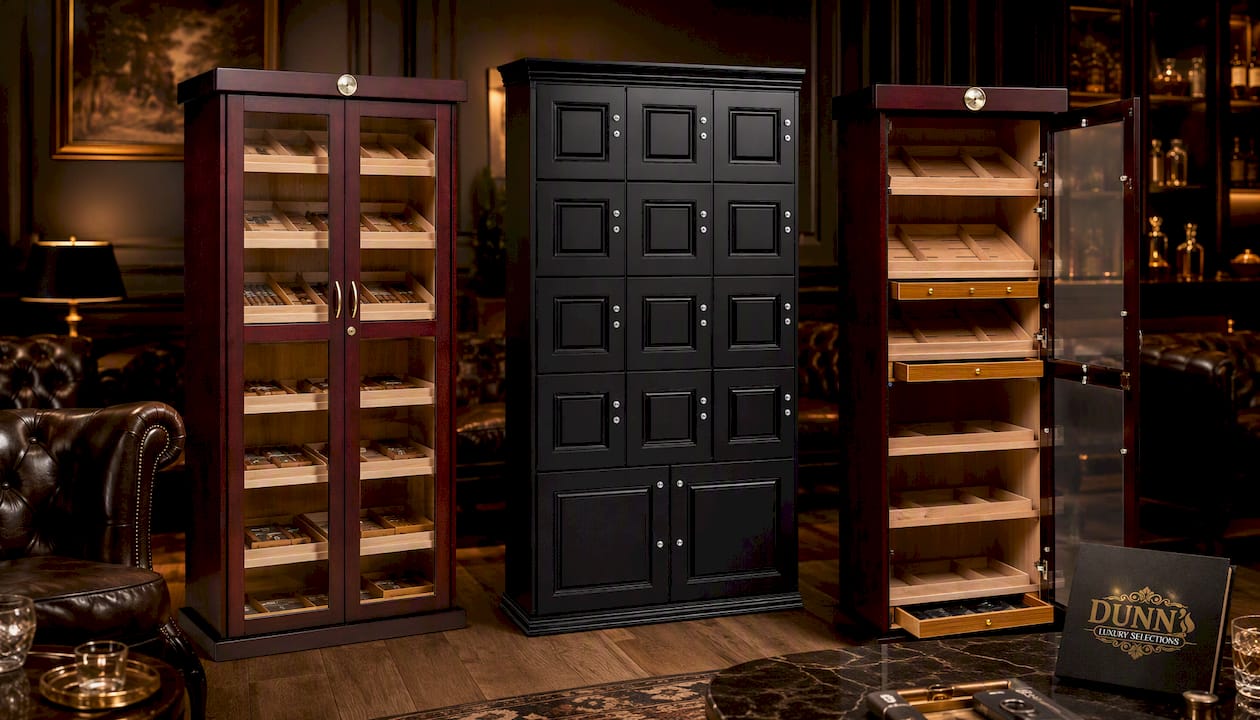
Three products anchor the club and lounge offering:
- Bermuda Cabinet Humidor: A large-format, high-end cabinet built for lounges that want a commanding aesthetic presence alongside precision climate control. Ideal for flagship rooms and private club libraries where the humidor is as much a statement as a storage solution.
- Humidor Supreme® Commercial Cigar Locker Humidor: A 5,000-cigar-capacity commercial locker system designed for membership clubs where individual storage is a core benefit. Each bay locks independently within a shared, climate-controlled cabinet.
- Barbatus Cabinet Humidor: A high-capacity cabinet solution for clubs that need serious storage volume without committing to a full walk-in build. The Barbatus handles up to 2,000 cigars with the same precision climate control and Spanish cedar craftsmanship as the flagship line.
Every Dunnluxuryselections project begins with a consultation and, for commercial installations, a site survey. Financing options are available for qualifying projects. To start your project, contact Dunnluxuryselections directly to schedule your consultation and receive a proposal tailored to your space.
Sources
The references and product pages below support the specifications and recommendations in this guide.
- Commercial Humidor Humidity Control: Cigar Lounge Repair · Berne
- Walk-In Humidor Design for Cigar Shops: Everything You Need to Know
- How to Build a Walk-In Humidor | Expert Planning Guide – Sonic Humidifiers
- How to Humidify Cigars in a Retail Humidor - MDC Wholesale Cigars
FAQ
What does “types of cigar clubs” mean in a storage context?
In a procurement context, the phrase refers to the categories of humidor and storage solutions used by cigar lounges and private clubs: custom walk-in humidors, cabinet systems, cigar locker arrays, and desktop display units.
What RH level should a club humidor maintain?
How many hygrometers does a commercial humidor need?
A minimum of two calibrated digital hygrometers per climate zone, positioned at opposite ends of the space. For inventories over roughly 500 cigars, additional instruments and redundant monitoring are standard practice.
Why is tap water a problem for commercial humidifiers?
Tap water contains minerals that accumulate in ultrasonic humidifier heads, causing clogs and depositing white residue on cigars and shelving. Reverse osmosis or distilled water eliminates this failure mode.
What is the lead time for a custom walk-in humidor?
Bespoke walk-in builds typically require 12–24 weeks from signed proposal to installation, depending on custom cabinetry complexity, refrigeration requirements, RO plumbing, and permitting.
Which Dunnluxuryselections product suits a membership club with personal lockers?
The Humidor Supreme® Commercial Cigar Locker Humidor, with a 5,000-cigar capacity across individually lockable bays, is the right specification for clubs where personal member storage is a core offering.
How often should a commercial humidor be professionally serviced?
Quarterly inspections covering cartridge replacement, hygrometer calibration, door-seal condition, and circulation fan performance are the standard maintenance interval for commercial installations.
What is the minimum site requirement for a walk-in humidor?
A walk-in can begin at roughly 4×6 feet, but design guidance recommends 8-foot ceilings for full shelving height and 36-inch aisles for comfortable traffic flow and restocking access.
Recommended
You May Also Enjoy
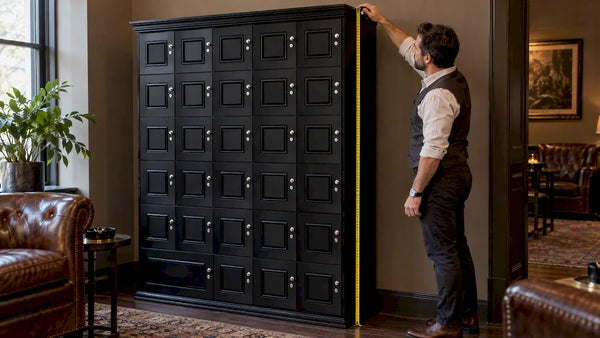
Cigar Locker Dimensions: Sizing Guide for Collectors and Lounges
Cigar locker dimensions explained: compartment sizes, cabinet footprints, capacity math and clearances, so you size a locker bank...
Read Article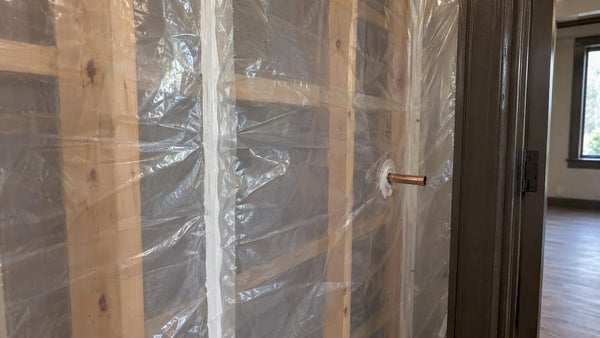
Sealing a Walk-In Humidor: Envelope, Door and Penetrations
How to seal a walk-in humidor properly: vapor barrier placement, door gasket, penetrations and the controlled airflow a...
Read Article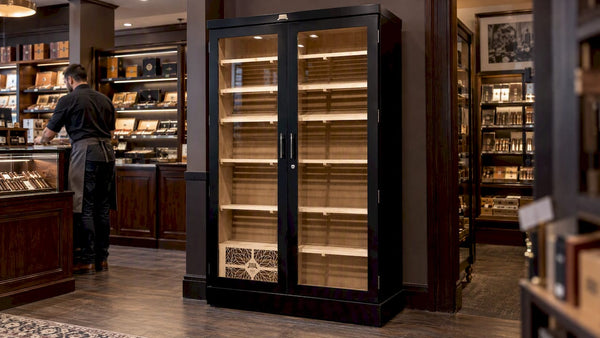
Retail Humidor ROI: How to Measure What a Display Earns
What does a retail or lounge humidor really return? A practical framework for cigar shops, lounges and clubs:...
Read Article