

Discover the essential types of cigar wrappers and how they influence flavor and experience. Enhance your cigar knowledge today!
Cigar wrappers fall into a few core families — Connecticut, Habano/Corojo, Sumatra/Cameroon, and Broadleaf/Maduro — while the wrapper sets a cigar’s first impression before you ever light it: the color you see, the oils you smell on a cold draw, and the sweetness or spice that greets your palate in the opening third. Understanding the different types of cigar wrappers is the single fastest way to predict what a cigar will taste like before you commit to a box.
Here is a quick-reference snapshot of the main families and what each signals:
- Connecticut Shade: Pale tan to golden; creamy, mild, low-to-medium strength
- Habano/Corojo: Medium brown, slightly oily; spicy, complex, medium to full strength
- Sumatra/Cameroon: Reddish-brown to dark brown; earthy, sweet-spiced, medium strength
- Broadleaf/Maduro: Dark chocolate to near-black; cocoa, coffee, molasses, medium-full to full
- Candela: Bright green; grassy, vegetal, mild
For a quick visual ID at the shop or when opening a box, check these four cues:
- Color uniformity: Premium boxes match shade across every cigar; inconsistency signals commodity sorting.
- Surface oiliness: A slight sheen indicates well-fermented, healthy oils — not grease, just a gentle luster.
- Vein structure: Fine, flat veins that seem to disappear into the leaf are a hallmark of wrapper-grade tobacco.
- Tooth: Tiny, grain-like texture on the leaf surface; more tooth often correlates with richer flavor compounds.
The wrapper matters more on first draws than the filler or binder because its oils and aromatic compounds are in direct contact with your lips and the air you pull through the cigar. That surface contact is why two cigars with identical filler blends can taste dramatically different when dressed in different wrappers.
Key Takeaways
The wrapper is the single fastest predictor of a cigar’s flavor profile, and understanding its origin, shade, and processing history is the foundation of informed collecting and storage.
| Point | Details |
|---|---|
| Wrapper families define first impressions | Connecticut, Habano/Corojo, Sumatra/Cameroon, Broadleaf/Maduro, and Candela each deliver a distinct flavor and strength signature. |
| Shade is not a strength guarantee | Wrapper color reflects fermentation intensity and origin, not nicotine content — the filler blend determines overall body. |
| Wrapper yield drives premium pricing | Roughly 40–50% of a tobacco harvest meets wrapper-grade physical criteria, making wrapper yield a primary cost driver in premium cigars. |
| Fermentation shapes both color and flavor | Microbial and enzymatic processes during fermentation develop aroma precursors and darken leaf color — processing decisions can shift a wrapper’s shade class. |
| Dunnluxuryselections for collector-grade storage | Dunnluxuryselections offers precision humidors, from the Barbatus Cabinet to bespoke custom builds, designed to preserve wrapper integrity across mixed collections. |
Table of Contents
- What are cigar wrappers and why do they matter?
- What makes a wrapper leaf worth the premium price?
- How do wrapper shade names actually map to flavor?
- A practical glossary of popular wrapper types
- How growing conditions and processing shape wrapper color and flavor
- Common myths about wrappers that beginners get wrong
- How to choose a wrapper that matches your taste
- Quick glossary of wrapper-related terms
- Diseases and pests that threaten wrapper leaf quality
- A collector’s perspective on wrappers and what they demand from storage
- Precision storage for collectors who take wrappers seriously
- Sources
- FAQ
What are cigar wrappers and why do they matter?
A cigar has three structural components: the filler (the interior tobacco blend), the binder (a single leaf that holds the filler together), and the wrapper (the outermost leaf that you see and touch). The wrapper is the most visible and, in many ways, the most consequential of the three.
Under U.S. regulatory classification, wrapper leaves occupy their own formal category — Class 6 — distinct from binder and filler classes. That separation exists because wrapper-grade tobacco must meet physical standards that most harvested leaves simply cannot satisfy. The leaf must be wide enough to spiral around a cigar from foot to cap, thin enough not to add harsh bulk, elastic enough to roll without cracking, and visually uniform enough to present a consistent appearance.
Why does the wrapper dominate flavor perception so heavily? A few reasons:
- The outermost leaf concentrates essential oils and volatile aromatic compounds developed during fermentation and aging.
- On a cold draw, your lips and nose interact exclusively with the wrapper — the filler is sealed inside.
- In the first third of a smoke, combustion begins at the foot where wrapper, binder, and filler all burn together, but the wrapper’s oils volatilize first and set the aromatic tone.
- Wrapper thickness relative to the overall cigar is small, yet its contribution to perceived flavor can account for a substantial share of the smoking experience, particularly in thinner ring gauges where the wrapper-to-filler ratio is higher.
The federal shade-grown classification system distinguishes Connecticut Valley Shade-grown (Type 61) from Georgia/Florida shade types (Type 62), reflecting how seriously the U.S. tobacco trade treats regional and growing-method distinctions in wrapper production. These aren’t marketing labels — they are codified production categories with real agronomic meaning.
What makes a wrapper leaf worth the premium price?
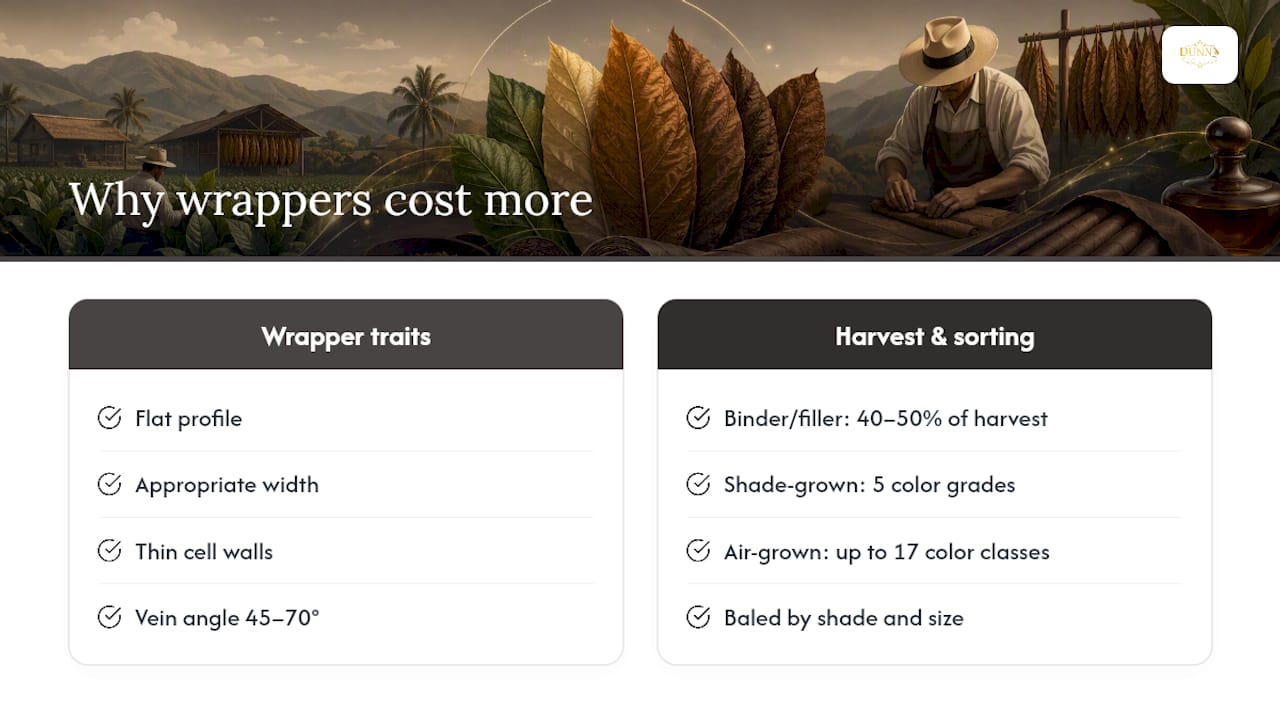
Wrapper-grade tobacco is rare by nature. Roughly 40–50% of a harvest ends up as binder or filler rather than wrapper, because most leaves fail to meet the strict physical criteria: flat profile, appropriate width, thin cell walls, fine vein angles between 45° and 70°, and surface smoothness. That yield constraint is one of the primary cost drivers in premium cigar pricing.
Breeders and growers work specifically to produce leaves with the morphological traits wrapper production demands. Genetic research has identified loci associated with leaf flatness, thickness, vein diameter, and vein angle as targets for wrapper-focused breeding programs, which explains why certain seed varieties — Connecticut Shade seed, Corojo '98, Criollo '98 — are so closely guarded and regionally specific.
After harvest, factories sort and grade leaves by color class and physical quality before they ever reach a rolling table. Shade-grown tobacco commonly uses five color grades; some air-grown varieties are sorted into as many as 17 distinct color classes to achieve the visual uniformity that premium cigar lines demand. Leaves are then sized and bundled into bales matched by shade and dimension, so every cigar in a box receives a wrapper from the same color class.
For collectors, this sorting discipline is visible in the box. Open a premium box and hold two cigars side by side: if the wrappers match in shade, sheen, and texture, the factory exercised rigorous quality control. Broader visual variation across a box is a reliable signal of commodity-grade sorting, regardless of what the band says.
Pro Tip: When buying a box, remove three cigars from different positions — top left, center, and bottom right — and compare them under natural light. Consistent shade and vein fineness across all three is the clearest indicator of premium factory discipline you can assess without smoking a single cigar.
How do wrapper shade names actually map to flavor?
The cigar industry uses a loose but widely recognized shade vocabulary to describe wrapper color. These terms originated in the trade as shorthand for visual grading, not as flavor guarantees — a distinction worth understanding before you rely on them at the shop counter.
| Shade Name | Typical Color | Common Flavor Notes | Rough Strength |
|---|---|---|---|
| Claro / Double Claro | Very light tan to pale gold | Mild, slightly sweet, grassy | Mild |
| Candela (Verde) | Bright green | Vegetal, grassy, light | Mild |
| Colorado Claro | Light to medium brown | Creamy, cedar, subtle spice | Mild-Medium |
| Colorado | Medium reddish-brown | Balanced, earthy, light spice | Medium |
| Colorado Maduro | Dark brown | Rich earth, dried fruit, leather | Medium-Full |
| Maduro | Very dark brown to black | Cocoa, coffee, molasses, sweetness | Medium-Full to Full |
| Oscuro | Near-black | Intense earth, dark chocolate, pepper | Full |
| Rosado | Pinkish-red hue | Floral, sweet spice, complexity | Medium |
A few important caveats about reading this table:
- Shade correlates with fermentation intensity and leaf origin, not directly with nicotine content. A dark Maduro from a mild-bodied filler blend can smoke at medium strength; a pale Colorado Claro over a powerful Nicaraguan filler can hit full body.
- Candela’s green color comes from rapid heat-curing that locks in chlorophyll before it breaks down — the process actually arrests fermentation rather than deepening it, which is why Candela tends toward mild and grassy rather than rich.
- Rosado wrappers develop their distinctive hue from specific soil conditions and seed genetics, not from a separate curing process.
The shade name tells you what to expect from the wrapper itself. The blend tells you what the cigar will actually deliver.
A practical glossary of popular wrapper types
Understanding each wrapper family by origin, flavor, and typical use in a blend gives you a real framework for choosing cigars — and for knowing what to store together in your humidor.
Connecticut Shade
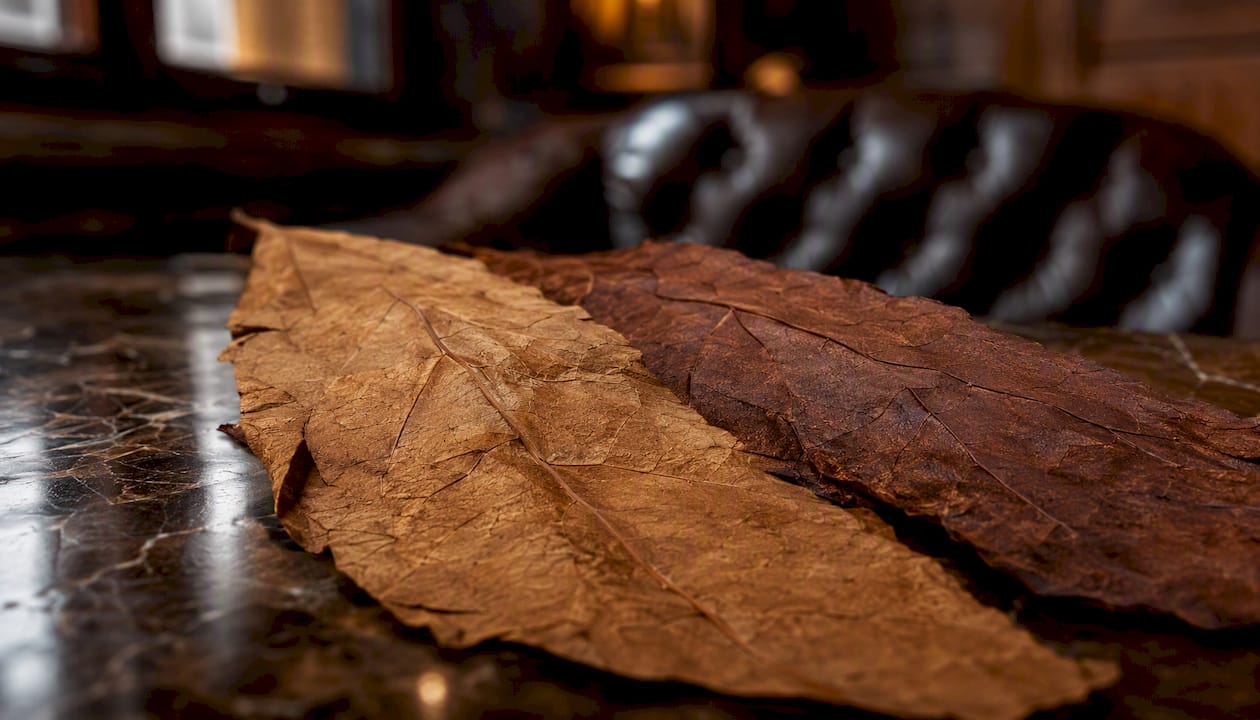
Grown under cheesecloth canopies in the Connecticut River Valley, this wrapper is the benchmark for mild, elegant smoking. The leaf is light tan to golden, thin, and notably elastic — qualities that make it expensive to produce and prized by rollers. Flavor runs toward cream, cedar, and toasted nuts, with minimal pepper. Connecticut Shade is the wrapper of choice for morning cigars and for collectors who appreciate refinement over power. Connecticut Broadleaf, its sibling, is a thicker, darker leaf grown in full sun and used primarily for Maduro production rather than natural wrappers.
Habano and Corojo
Both originate from Cuban seed genetics, though today’s finest examples come from Nicaragua, Honduras, and Ecuador. Habano wrappers are medium to dark brown, slightly oily, and carry a characteristic spice — white pepper on the retrohale, leather, and cedar underneath. Corojo '98 and Corojo '99 are specific seed selections that produce a richer, more complex profile with dried fruit and dark earth alongside the spice. These are medium-to-full wrappers that pair well with Nicaraguan or Honduran filler for a cohesive, high-complexity blend.
Criollo
Another Cuban-heritage seed, Criollo tends toward a slightly lighter color than Habano and a more restrained spice profile. The flavor leans earthy and woody, with a natural sweetness that makes it versatile as both a wrapper and a binder. Many blenders use Criollo as a binder precisely because it contributes flavor without overwhelming the filler, but as a wrapper it delivers a medium-strength smoke with genuine complexity.
Sumatra
Grown on the Indonesian island of Sumatra, this wrapper is reddish-brown with a fine tooth and a distinctive sweet-spiced character. Sumatra wrappers contribute notes of cinnamon, earth, and dried fruit, at medium strength. The leaf is particularly well-suited to blends that aim for balance — enough complexity to interest experienced smokers, approachable enough for those newer to full-flavored cigars.
Cameroon
Cameroon wrappers from Central Africa are among the most distinctive in the world: reddish-brown with a pronounced tooth, a slightly rough texture, and a flavor profile that blends sweet cedar, cocoa, and a subtle earthiness found nowhere else. The leaf is notoriously difficult to grow consistently, which keeps supply limited and prices elevated. Cameroon wrappers are medium in strength and pair beautifully with Dominican or Honduran filler for a nuanced, aromatic smoke.
Ecuadorian
Ecuador’s high-altitude growing regions, particularly around the Jalisco Valley, produce both shade-grown and sun-grown wrappers of exceptional quality. Ecuadorian Connecticut (grown under shade using Connecticut seed) delivers a creamier, slightly more complex profile than its Connecticut Valley counterpart, with a silkier texture. Ecuadorian Habano and Sumatra seed wrappers grown in the same region offer medium-to-full profiles with rich earth and spice. Ecuador has become one of the most versatile wrapper origins in the world precisely because its climate suits multiple seed varieties.
Broadleaf and Brazilian
Connecticut Broadleaf, grown in full sun, is the classic American Maduro base leaf: thick, dark, and rich in natural sugars that caramelize during extended fermentation. Brazilian wrappers, particularly from the Arapiraca region, are similarly dark and sweet, contributing notes of dark chocolate and molasses. Both are used almost exclusively for Maduro production rather than natural wrappers, and both benefit from long aging to soften any residual harshness.
San Andrés
Grown in the Veracruz region of Mexico, San Andrés is the other great Maduro base leaf alongside Connecticut Broadleaf. The leaf is dark, oily, and naturally sweet, with a distinctive cocoa and coffee profile that has made it the wrapper of choice for some of the most celebrated Maduros in the market. San Andrés wrappers tend to be slightly more peppery than Connecticut Broadleaf Maduros, adding a complexity that collectors find particularly compelling.
Candela
Candela, sometimes called “American Market Selection” or “AMS,” was the dominant wrapper style in the U.S. market through the mid-20th century. The bright green color comes from rapid heat-curing that preserves chlorophyll. Flavor is mild and grassy, with a vegetal quality that divides opinion sharply — some collectors find it refreshing, others find it thin. Candela has experienced a modest revival among aficionados interested in historical cigar styles.
The comparison below maps each family across the key dimensions collectors use when selecting or storing cigars:
| Wrapper | Typical Flavor Notes | Typical Strength | Typical Color | Primary Region(s) | Common Use |
|---|---|---|---|---|---|
| Connecticut Shade | Cream, cedar, toasted nuts | Mild | Light tan to gold | Connecticut River Valley, Ecuador | Wrapper |
| Habano/Corojo | Spice, leather, dried fruit | Medium-Full | Medium to dark brown | Nicaragua, Honduras, Ecuador | Wrapper |
| Criollo | Earth, wood, mild sweetness | Medium | Light to medium brown | Nicaragua, Honduras, Dominican Republic | Wrapper or binder |
| Sumatra | Sweet spice, cinnamon, earth | Medium | Reddish-brown | Indonesia, Ecuador | Wrapper |
| Cameroon | Sweet cedar, cocoa, earth | Medium | Reddish-brown, rough tooth | Cameroon (Central Africa) | Wrapper |
| Broadleaf/Brazilian | Cocoa, molasses, dark fruit | Medium-Full | Very dark brown | Connecticut, Brazil (Arapiraca) | Maduro wrapper |
| San Andrés | Cocoa, coffee, pepper | Medium-Full to Full | Dark brown to near-black | Veracruz, Mexico | Maduro wrapper |
| Candela | Grassy, vegetal, light | Mild | Bright green | Connecticut, Honduras | Wrapper |
For collectors building a curated humidor collection, understanding these regional distinctions is as important as knowing the blend — the origin tells you what growing conditions shaped the leaf before fermentation ever began.
How growing conditions and processing shape wrapper color and flavor
The character of any wrapper begins in the field, long before fermentation. Two growing methods dominate wrapper production, and they produce fundamentally different leaves.
Reduced light slows photosynthesis, which produces thinner, wider, more elastic leaves with finer veins and a lighter color. The controlled environment also reduces wind damage and insect pressure, contributing to the smooth surface texture wrapper-grade leaves require. Connecticut Valley Shade and Ecuadorian Connecticut are the most celebrated examples of this method.
Sun-grown tobacco develops under direct sunlight, producing thicker leaves with more pronounced veins, higher sugar content, and deeper color. The stress of full sun exposure concentrates oils and flavor compounds in ways that shade-growing cannot replicate. Habano, Corojo, and San Andrés wrappers are predominantly sun-grown, and their intensity reflects it.
After harvest, leaves go through curing — typically air-curing in barns over several weeks — which reduces moisture and begins the enzymatic breakdown of chlorophyll and starches. Then comes fermentation, the process that most dramatically transforms both color and flavor.
Microbial action and enzymatic oxidation during fermentation break down proteins and starches, convert chlorogenic acids, and generate the volatile aroma precursors that define a wrapper’s finished character. Genera including Aerococcus, Corynebacterium, Pseudomonas, and Staphylococcus play documented roles in aroma development and material cycling during staged fermentation. The biochemical cascade is not random — manufacturers increasingly manage microbial communities to hit target color and aroma profiles.
Research has demonstrated that adding specific bacterial strains during fermentation can significantly deepen wrapper color by enhancing polyphenol oxidation. Three strains — Sphingomonas parapaucimobilis DS1, Kosakonia cowanii DS101, and Comamonas thiooxydans DS309 — produced measurable color deepening (measured as ∆E) under scaled stack fermentation conditions. This means wrapper color is not purely a function of seed genetics or growing method; processing decisions at the fermentation stage can shift a leaf’s shade class.
Maduro wrappers undergo the most aggressive fermentation: higher temperatures, longer duration, and often multiple fermentation cycles. This extended process caramelizes the leaf’s natural sugars and converts harsh compounds into the cocoa, coffee, and molasses notes that define the style. Connecticut Shade wrappers, by contrast, undergo gentler fermentation that preserves their delicate oils and light color.
After fermentation, leaves are sorted by color class and intended use before aging. Different leaf types ferment at different rates and require separate handling — wrapper leaves are processed apart from binder and filler stock to maintain the color consistency that premium production demands.
Pro Tip: When a cigar’s wrapper appears noticeably darker or lighter than others from the same line, the most likely cause is a fermentation batch variation rather than a growing-region change. Ask your tobacconist whether the box is from a recent production run or an older vintage — fermentation outcomes can shift meaningfully between production years.
Common myths about wrappers that beginners get wrong
A few persistent misconceptions lead collectors astray when they are learning to read wrappers. Here is the real picture on each:
- “Darker always means stronger.” This is the most common error. A dark Maduro wrapper over a mild Dominican filler can smoke at medium strength, while a pale Colorado Claro over a full Nicaraguan core can deliver a powerful experience. Strength comes from the blend as a whole — particularly the filler — not from wrapper shade alone.
- “Candela is always the mildest option.” Candela’s rapid heat-curing does produce a mild wrapper, but the filler blend determines overall body. A Candela-wrapped cigar with a heavy Nicaraguan filler is not a mild smoke.
- “A larger ring gauge means the wrapper has more influence.” The opposite is closer to the truth. In a larger ring gauge, the wrapper represents a smaller proportion of the total tobacco by volume, so filler and binder flavors dominate more. Thinner ring gauges (lanceros, panatelas) give the wrapper proportionally more influence over the smoking experience.
- “Oily wrappers always taste richer.” Surface oiliness reflects fermentation quality and leaf health, but it does not guarantee a specific flavor profile. A well-fermented Connecticut Shade can be quite oily and still deliver a mild, creamy smoke.
- “The wrapper tells you everything about the cigar.” The wrapper sets the first impression and contributes meaningfully to flavor, but the binder and filler determine body, complexity, and finish. Reading a wrapper is the beginning of understanding a cigar, not the end.
The practical takeaway: use wrapper shade as a starting point for flavor expectations, then read the blend notes, ask about the filler origin, and smoke a single before committing to a box.
How to choose a wrapper that matches your taste
A structured approach to wrapper selection saves you from expensive mistakes and helps you build a collection with genuine range. Work through these steps when evaluating a new cigar:
- Assess the wrapper visually. Check color uniformity, surface oiliness, vein fineness, and tooth under natural light. These cues tell you about leaf quality and fermentation before you smoke.
- Take a cold draw. Before lighting, draw air through the unlit cigar. The aroma you detect — cream, spice, cocoa, grass — comes almost entirely from the wrapper and gives you a preview of the first third.
- Match shade to your strength preference. Start with Colorado Claro or Connecticut Shade if you prefer mild-to-medium; move toward Habano or Cameroon for medium complexity; choose Maduro or San Andrés for rich, full-bodied smoking.
- Sample different ring gauges in the same wrapper. A 50-ring Habano and a 38-ring lancero in the same blend will taste different because the wrapper-to-filler ratio changes. Knowing which ring gauge suits your palate is as important as knowing the wrapper family.
- Read the band and ask about origin. “Ecuadorian Habano” and “Nicaraguan Habano” are not the same leaf. Origin shapes flavor as much as seed variety, so ask your tobacconist for specifics.
- Check box shade consistency. As noted above, matched shades across a box signal premium factory discipline and predict a consistent smoking experience from first cigar to last.
- Request a single-origin sampler. Many premium tobacconists can build a sampler of the same blend in two or three different wrapper options. This is the most direct way to isolate wrapper influence on flavor.
- Consider storage requirements. Oily Maduro wrappers and delicate Connecticut Shade wrappers have different humidity tolerances. A collection mixing both benefits from a humidor that maintains ±1–2% relative humidity with precision — cedar dividers also help prevent aromatic cross-contamination between strong and delicate wrapper families.
For pairing guidance at a high level: Connecticut Shade wrappers complement mild, creamy fillers (Dominican, Ecuadorian); Habano and Corojo wrappers work with Nicaraguan and Honduran fillers for spice-forward complexity; Maduro wrappers pair naturally with Nicaraguan or Peruvian fillers that can stand up to the wrapper’s sweetness without being overwhelmed.
Quick glossary of wrapper-related terms
These definitions cover the vocabulary you will encounter on bands, in reviews, and in conversations with tobacconists:
- Shade-grown: Tobacco cultivated under fabric canopies that filter sunlight, producing thinner, lighter, more elastic leaves suited to wrapper use.
- Sun-grown: Tobacco grown under direct sunlight; produces thicker, darker, more flavorful leaves with higher sugar content.
- Broadleaf: A thick, wide tobacco leaf grown in full sun, used primarily as a Maduro wrapper base due to its high sugar content.
- Priming: The position of a leaf on the stalk; lower primings (closer to the ground) are milder and lighter, upper primings are stronger and darker.
- Stalk-cut: A harvesting method where the entire stalk is cut at once rather than leaves being picked individually by priming; produces more uniform fermentation.
- Fermentation: The controlled microbial and enzymatic process that develops flavor precursors, reduces harshness, and darkens leaf color after curing.
- Plume: A fine, powdery white crystalline deposit on a cigar’s wrapper caused by the natural migration of oils to the surface during aging — harmless and often a sign of proper storage.
- Mold: A fuzzy, irregular growth on a wrapper caused by excessive humidity or poor air circulation — a storage problem that can damage the leaf and the smoke.
- Tooth: The fine, grain-like texture visible on a wrapper’s surface; associated with oil content and, in many cases, flavor complexity.
- ∆E (Delta E): A colorimetric measurement used in wrapper grading to quantify color difference between leaves or between fermentation batches.
Distinguishing plume from mold: Plume wipes away cleanly with a dry finger, leaving the wrapper smooth and undamaged. Mold does not wipe away cleanly, often leaves a stain or soft spot, and carries a musty odor. When in doubt, consult this visual guide to cigar markings before discarding a cigar that may simply be aging well.
Diseases and pests that threaten wrapper leaf quality
Wrapper-grade tobacco is among the most vulnerable crops in agriculture precisely because the physical standards it must meet leave no margin for leaf damage. Any blemish, hole, or discoloration that would be acceptable in a filler leaf disqualifies a wrapper candidate.
Blue mold (Peronospora tabacina) is the most destructive fungal disease in wrapper production. It spreads rapidly in cool, humid conditions and can devastate an entire shade-grown crop within days. Infected leaves develop yellow lesions on the upper surface and a blue-gray mold on the underside. Even partial infection renders a leaf unusable as a wrapper.
Tobacco mosaic virus (TMV) causes mottled, distorted leaf growth that disrupts the uniform color and surface smoothness wrapper grading requires. TMV spreads through mechanical contact — tools, hands, clothing — and has no chemical cure. Infected plants must be removed immediately to protect the surrounding crop.
Black shank (Phytophthora nicotianae) is a soil-borne disease that attacks the root system and stalk, causing wilting and dark lesions at the base of the plant. It thrives in waterlogged soils, which is one reason shade-grown operations invest heavily in drainage infrastructure.
Tobacco hornworm (Manduca sexta) and budworm (Heliothis virescens) are the primary insect threats. Hornworms can consume entire leaves overnight; even partial feeding creates holes that disqualify wrapper candidates. Shade-grown operations benefit from the physical barrier of the canopy fabric, which reduces insect pressure compared to open-field sun-grown crops.
Root-knot nematodes (Meloidogyne spp.) damage root systems and reduce nutrient uptake, producing stunted plants with thinner, less elastic leaves that struggle to meet wrapper physical criteria. Crop rotation and resistant rootstock are the primary management tools.
The cumulative effect of these threats on wrapper yield is significant. When disease or pest pressure is high in a growing region, wrapper-grade output from that harvest drops, prices rise, and blenders sometimes substitute alternative origins — which is why a beloved cigar’s wrapper origin can shift between production years without any announcement on the band.
A collector’s perspective on wrappers and what they demand from storage
The wrapper is not merely the cigar’s aesthetic face. For collectors, it is the most fragile and the most revealing element of a cigar’s long-term condition.
Wrapper shade consistency within a box is a reliable indicator of factory discipline, as noted earlier — but it is also a baseline you want to preserve through the life of your collection. Oils migrate. Color shifts. A Connecticut Shade wrapper stored at inconsistent humidity will dry, crack, or develop an uneven patina that signals compromised leaf integrity long before you light the cigar. An oily Maduro stored too wet will develop surface bloom that, while often harmless, can mask the early signs of genuine mold if you are not inspecting regularly.
Collections that mix wrapper families — delicate Connecticut Shade alongside intensely oily San Andrés Maduros — present a particular storage challenge. Strong wrapper oils can transfer aromatic compounds to neighboring cigars over time, subtly altering the flavor profile of a cigar you have been aging carefully for two years. Cedar sheets between rows or between different wrapper families are one of the most practical tools for managing this cross-contamination risk.
The collectors who build the most coherent, satisfying collections are not necessarily those who own the most cigars. They are the ones who understand what each wrapper demands from its environment and who invest in storage that can deliver it — consistently, over years, not just for the first few months after purchase.
Precision storage for collectors who take wrappers seriously
The wrapper you select deserves a sanctuary worthy of its character. Dunnluxuryselections offers a curated range of premium humidors built specifically for collectors who understand that wrapper integrity depends on climate precision, not approximation.

For collectors building mixed-wrapper inventories, the Barbatus Cabinet Humidor provides the capacity and climate stability that diverse collections require. Those who prioritize electronic precision for oily Maduros and delicate Connecticut Shade alike will find the Humidor Supreme® 9200 Series Double-Door Electronic Humidor maintains the ±1–2% RH tolerance that preserves wrapper oils and color across long aging periods. For collectors commissioning a bespoke solution tailored to a specific collection’s wrapper profile and aesthetic, Dunnluxuryselections’s custom melamine humidors with precision climate control represent the apex of personalized storage craftsmanship. Browse the full collection at Dunnluxuryselections and consult with the team to match your storage to your wrappers.
Sources
- Microbial and enzymatic processes in tobacco fermentation (Springer article)
- CFR § 30.31 — Classification of cigar leaf types (filler, binder, wrapper)
- The wrapper leaf: characteristics and production notes (Cigar & Cocktail Magazine)
FAQ
What is the most popular cigar wrapper?
Connecticut Shade is widely regarded as the most popular wrapper in the U.S. market, prized for its mild, creamy profile and elegant appearance. Maduro wrappers — particularly Connecticut Broadleaf and San Andrés — are the most popular among collectors who prefer fuller, sweeter smoking experiences.
What are the differences between a Habano wrapper and a Maduro wrapper?
A Habano wrapper is a sun-grown leaf, typically medium to dark brown, that delivers spice, leather, and complexity at medium-to-full strength. A Maduro wrapper is defined by its extended fermentation process — which caramelizes natural sugars and produces cocoa, coffee, and molasses notes — rather than by a specific seed variety or region. A Habano leaf can be fermented into a Maduro; the terms describe different things.
What is the mildest cigar wrapper?
Connecticut Shade is the mildest wrapper in common use, delivering a creamy, low-spice profile at mild-to-medium strength. Candela (the bright green wrapper) is also mild, though its grassy, vegetal character makes it less universally appealing than Connecticut Shade.
What are cigar wraps called?
The outermost leaf of a cigar is called the wrapper. In U.S. regulatory classification, wrapper leaves occupy Class 6, formally distinct from binder and filler categories. Colloquially, you may also hear the term “leaf” or “capa” (the Spanish word for wrapper used in many production contexts).
Does a darker wrapper always mean a stronger cigar?
No. Wrapper shade reflects fermentation intensity and leaf origin, not nicotine content. A dark Maduro wrapper over a mild Dominican filler can smoke at medium strength, while a pale Colorado Claro over a powerful Nicaraguan core can deliver a full-bodied experience. Strength is a function of the entire blend, with the filler contributing most of the body.
Recommended
You May Also Enjoy
Cigar Locker Dimensions: Sizing Guide for Collectors and Lounges
Cigar locker dimensions explained: compartment sizes, cabinet footprints, capacity math and clearances, so you size a locker bank...
Read Article
Sealing a Walk-In Humidor: Envelope, Door and Penetrations
How to seal a walk-in humidor properly: vapor barrier placement, door gasket, penetrations and the controlled airflow a...
Read Article
Retail Humidor ROI: How to Measure What a Display Earns
What does a retail or lounge humidor really return? A practical framework for cigar shops, lounges and clubs:...
Read Article