

Luxury technical guide for collectors and clubs commissioning walk in humidors. Includes −5 to −7 Pa pressure targets, ASHRAE guidance, materials, and...
Anything looser than that is a display case wearing a humidor’s name. What follows is the specification that a premium provider should put in writing before a single panel is cut.
TL;DR:
- Continuous vapor barriers and sealed construction are critical to maintain a stable microclimate and prevent moisture migration through walls and ceilings.
- Sliding doors with automatic closers significantly reduce air leakage and door ajar incidents that can compromise humidity control.
- Maintaining a relative humidity around two-thirds and a stable temperature within a narrow span is essential to prevent cigar damage from drying or mold.
- A pressure differential of minus 5 to minus 7 pascals paired with exhaust ducts outside ensures high exhaust efficiency and effective containment.
- Proper commissioning includes verifying vapor seal details, setting precise pressure targets, and calibrating hygrometers against NIST standards to preserve long-term performance.
Table of Contents
- Design fundamentals for luxury custom walk-in humidors
- Engineering environment: humidity, temperature, ventilation, and air handling
- Materials, joinery, and craftsmanship that define premium performance and luxury
- Planning layout, shelving, lockers, and capacity for collectors and commercial operators
- Commissioning a custom walk-in humidor: consultation, drawings, approvals, and timeline
- Maintenance cycles, hygrometer calibration, and service plans to preserve performance
- Security features and access control
- Humidity system types and automation options
- Common issues and troubleshooting tips for walk-in humidors
- Author perspective: lessons from commissioning luxury walk-in humidors
- How Dunn’s Luxury Selections helps: bespoke design, white-glove delivery, and next steps
- Sources
- FAQ
Design fundamentals for luxury custom walk-in humidors
A walk-in humidor is, at its heart, a sealed envelope asked to hold a precise microclimate against the pressures of the room around it. Every design decision, from the vapor barrier to the door hinge, either protects that seal or quietly undermines it. Get the envelope right and the room becomes a sanctuary for the collection inside; get it wrong and even the finest cedar paneling is cosmetic.
The envelope itself needs a continuous vapor barrier, insulation sized to your climate, and construction that minimizes thermal bridges where framing members meet exterior walls. Spanish cedar remains the standard lining because its natural oils discourage tobacco beetles and its porous grain helps regulate moisture exchange with the cigars themselves, though it must be sealed with finishes that will not off-gas into the enclosed air.
- Continuous vapor barriers prevent moisture migration through walls, floors, and ceilings.
- Spanish cedar lining, properly sealed, protects cigars while adding warmth and pedigree to the room.
- Sliding doors reduce the leakage that occurs each time a swing door is opened and closed.
- Automatic closers eliminate the human error of a door left ajar during a busy service night.
Display glazing is where aesthetics and performance most often collide. Tempered, low-E glass in a sealed frame can showcase a collection beautifully, but every glazed panel is a potential thermal and vapor weak point, so a bespoke plan balances visible inventory against a majority of solid, fully insulated wall.
Pro Tip: Ask your designer to show you the vapor barrier detail at every door and glass junction before approving final drawings. That single drawing tells you more about long-term performance than any finish sample.
Engineering environment: humidity, temperature, ventilation, and air handling
The number that matters most is relative humidity held in the recommended range of approximately two-thirds humidity, with control tight enough to stay within a couple of percentage points of setpoint, alongside a stable temperature band. Cigars aged outside that range either dry out and crack their wrappers or swell with excess moisture that invites mold and uneven combustion. Precision here is not a luxury flourish. It is the entire point of commissioning a room instead of buying a cabinet.
Ventilation strategy follows the same logic used in engineered smoking room design: dedicated exhaust to the outside, no recirculation into adjoining spaces, and make-up air calculations sized to the room’s volume and door traffic. Guidance drawn from ASHRAE’s position on environmental tobacco smoke recommends isolating these spaces with dedicated exhaust, noting that ventilation and air cleaning help with comfort and odor but are not a substitute for containment.
- Insist on exhaust ductwork that terminates outside, never into a shared return air system.
- Ask for make-up air sizing calculations, not an estimate scribbled on a proposal.
- Request a written pressure differential target rather than a vague promise of “negative pressure.”
- Confirm HEPA or carbon filtration is treated as a secondary odor control, not the primary containment strategy.
A pressure differential between −5 and −7 Pa, paired with an exhaust-to-outside strategy, achieved exhaust efficiencies of 90% or higher in laboratory testing of enclosed smoking rooms. That figure is the benchmark a serious provider should be designing toward, not guessing at.
Materials, joinery, and craftsmanship that define premium performance and luxury
Spanish cedar remains the benchmark lining material, and a detailed comparison of walk-in humidor materials is worth reviewing before you commit to a finish package, since not every cedar grade or sealant behaves the same way once the room is sealed. Alternatives exist, but few match cedar’s combination of moisture regulation and resistance to tobacco beetles.
- Choose sealants and stains explicitly rated as low-VOC to avoid off-gassing into a sealed environment.
- Design shelving and racking with airflow gaps, not solid surfaces that trap stagnant pockets of air.
- Specify gasketed thresholds and automatic door closers as standard, not upgrades.
- Require vapor-tight penetrations wherever lighting, sensors, or HVAC lines pass through the envelope.
Joinery quality shows up years later, not on installation day. Seams that were not properly sealed, penetrations patched instead of engineered, and finishes chosen for looks over chemical compatibility are the quiet failures that surface only once a collection has already suffered. A premium build includes inspection checkpoints, seam by seam and penetration by penetration, before handover, along with a finish compatibility test confirming nothing in the room will interact poorly with the enclosed air over time.
Planning layout, shelving, lockers, and capacity for collectors and commercial operators
Layout planning starts with an honest inventory of what you are storing today and what you expect to store in five years. Modular shelving systems let a collector’s room grow without a second renovation, while commercial operators need to decide early whether shared shelving or individual lockers suits their clientele.
- Reserve display zones near sightlines and storage-dense zones toward the rear or sides of the room.
- Keep lighting fixtures low-heat and positioned to avoid direct exposure on any single shelf.
- Route staff traffic away from the most humidity-sensitive storage zones.
For commercial and club settings, the choice between shared shelving and private lockers often defines the member experience. The Humidor Supreme® Commercial Display 4000 Humidor Kit suits a retail-facing display role where inventory needs to be seen and sold. The Humidor Supreme® Commercial Cigar Locker Humidor fits lounges offering members a private, lockable space for their own cigars. The Humidor Supreme® Large 29-Unit Commercial Cigar Locker Humidor answers the capacity question for clubs and larger retail floors serving many members at once.
- Inventory your current collection and project growth over the next three to five years.
- Decide whether display, private lockers, or bulk storage best serves your clientele.
- Match shelving density and locker count to that decision before finalizing room dimensions.
Commissioning a custom walk-in humidor: consultation, drawings, approvals, and timeline
A bespoke project moves through a sequence that protects the buyer at every stage. It begins with a site survey and consultation, moves into engineered drawings and equipment selection, proceeds through fabrication and installation, and ends with commissioning, where the finished room is tested against its performance targets before handover.
- Site survey and consultation to establish space, climate, and collection goals.
- Engineered drawings covering HVAC layout, pressure targets, and equipment cut sheets.
- Permit and code review, including any municipal mechanical questions specific to enclosed rooms.
- Fabrication and white glove installation on site.
- Commissioning tests confirming RH stability and pressure differential before final handover.
Buyers should leave the consultation phase with more than a rendering. Request HVAC diagrams, the specified pressure differential, equipment cut sheets, and a written maintenance plan as deliverables, not afterthoughts. Some providers, as documented by vendors like LakeAir, also assist with plan submission for municipal review, which spares commercial clients the friction of navigating mechanical code questions alone.
Pro Tip: Never approve final drawings without a written pressure differential target. “Negative pressure” without a number is a promise no one can verify later.
Maintenance cycles, hygrometer calibration, and service plans to preserve performance
A humidor’s performance on installation day means little without a maintenance plan behind it. Humidification systems and HVAC components need scheduled checks, not reactive visits after a problem surfaces, and hygrometers need periodic calibration against a trusted reference.
- Schedule preventive HVAC and humidification checks on a fixed calendar, not an as-needed basis.
- Keep spare parts for humidification components on hand to shorten any service response.
- Ask whether remote monitoring is available so drift is caught before it becomes damage.
NIST’s Hybrid Humidity Generator supports primary-standard humidity calibration services across a relative humidity range of 2% to 98%, giving reference hygrometers a traceable benchmark. Asking your provider whether reference instruments carry NIST-traceable calibration is a fair, and revealing, question. Documented maintenance is what turns a beautiful installation into a preserved investment over the years a serious collection is meant to last.
Security features and access control
A room holding a serious collection deserves security proportional to its value. Access control ranges from simple keyed entry to electronic locks tied to a keypad or card system, and commercial installations often layer in activity logging so a lounge or club knows who accessed the room and when.
For multi-member environments, individual locker access matters as much as room-level security. Assigning each member or client their own lockable compartment, rather than open shelving, removes ambiguity about whose cigars are whose and reduces the friction that comes with shared storage. Glazed display sections, meanwhile, should be treated as a visibility feature, not a security one. Reinforced frames and laminated glass reduce risk, but the real protection for high-value inventory still comes from the room’s access control and, where warranted, alarm integration tied into an existing security system.

Retailers and clubs commissioning a walk-in room should also think about staff workflow. Access needs to be simple enough for daily restocking or member service, yet restrictive enough that unsupervised entry is never routine. A well-designed system logs entries automatically rather than relying on staff to record them, which matters most during busy hours when a manual log is the first thing to get skipped.
Humidity system types and automation options
Walk-in humidors rely on active humidification rather than the passive gel packs suited to small cabinets, since the volume of air in a room-sized space needs continuous, controlled input to hold a tight range. Options generally fall into ultrasonic misting systems, evaporative units, and steam-based humidifiers, each paired with a controller that reads room conditions and adjusts output automatically.

Automation is where a bespoke system distinguishes itself from a converted closet. A properly integrated controller ties humidification, dehumidification if needed, and temperature control into a single feedback loop, adjusting continuously rather than cycling on a timer. Some systems add remote monitoring, sending alerts if RH or temperature drifts outside the specified band, which matters most for commercial operators who cannot check the room daily. The choice of system should be driven by room volume and door traffic, not by whichever unit happens to be smallest or cheapest, since undersized equipment is the single most common reason a beautifully built room still struggles to hold its setpoint.
Common issues and troubleshooting tips for walk-in humidors
Most walk-in humidor problems trace back to one of three causes: door leakage, undersized equipment, or a compromised vapor barrier. A room that seems to lose humidity every time it is entered almost always points to door design rather than the humidification system itself, which is why sliding doors and automatic closers are worth the investment from the start.
Mold or a musty smell inside the room usually signals humidity running too high relative to the room’s temperature, often paired with stagnant airflow near shelving. Adjusting the humidification setpoint and improving air circulation around stored cigars typically resolves it faster than adding more equipment. A room that runs too dry, on the other hand, often means the humidification unit is undersized for the space or that a vapor barrier gap is letting conditioned air escape faster than the system can replace it.
Temperature swings tied to the time of day, rather than the humidification system, usually point to insulation gaps or a thermal bridge somewhere in the envelope, the kind of detail a proper vapor barrier inspection catches before handover rather than after. Any recurring issue is worth diagnosing against the original engineered drawings first, since a room built to specification rarely drifts without a specific, findable cause.
Author perspective: lessons from commissioning luxury walk-in humidors
The most expensive mistakes I have seen collectors make are the quiet ones: under specifying ventilation because it seemed like an afterthought, ignoring how much air a swing door pumps out of a room with every use, or choosing a beautiful cedar finish without confirming the sealant behind it. None of these mistakes are visible on installation day. They surface months later, in wrappers gone brittle or a musty note that should never touch a well-aged cigar.
A bespoke consultation exists to catch these decisions before they become expensive lessons. The right questions, asked early, about pressure differentials, door type, and calibration plans, cost nothing. Asked later, after a collection has already suffered, they cost considerably more.
— Belle Dunn
How Dunn’s Luxury Selections helps: bespoke design, white-glove delivery, and next steps
Commissioning a walk-in humidor should feel like working with a partner who understands both the engineering and the collection at stake, not like translating your own research into a contractor’s blueprint. A bespoke consultation walks collectors, lounges, and retailers through site survey, engineered drawings, and installation, with attentive delivery handling important details.

- Dunn’s Bespoke covers consultation through installation for a fully custom walk-in room.
- The bespoke walk-in humidor design and installation page details the full workflow from first conversation to handover.
- Commercial buyers can review the Humidor Supreme® Commercial Display 4000 Humidor Kit for display roles or the Humidor Supreme® Large 29-Unit Commercial Cigar Locker Humidor for high-capacity locker needs.
- Collectors furnishing a finished room can round out storage with Cabinet Humidors or protect travel cigars with an airtight option like the ONGROK Smell Proof Airtight Aluminum Storage Puck.
Request a site survey through Dunn’s Bespoke to start the conversation about what a commissioned room could look like in your space.
Sources
Serious commissioning decisions rest on more than a showroom visit. ASHRAE’s position on environmental tobacco smoke frames ventilation and isolation strategy. The Lawrence Berkeley National Laboratory containment study established the pressure and door leakage benchmarks used above. NIST’s humidity calibration program provides the reference standard for verifying hygrometer accuracy.
- California Study of Smoking Rooms (Lawrence Berkeley National Laboratory / Public Health Institute)
- ASHRAE position document on environmental tobacco smoke
- Humidity calibration services at NIST
FAQ
What relative humidity should a walk-in humidor hold?
That range preserves wrapper integrity and even aging without inviting mold from excess moisture.
Why does door type matter for humidity control?
Sliding doors leak far less room air per opening than swing doors, since a swing door physically pumps air out of the room as it moves. Laboratory testing found sliding doors reduced that pumped volume to roughly 5.4 cubic feet per opening, compared to substantially more with a swing door.
Should a walk-in humidor recirculate air with the rest of the building?
No. Dedicated exhaust to the outside, with no recirculation into adjoining occupied spaces, is the containment strategy recommended by ASHRAE’s guidance on isolated smoking spaces. Recirculating conditioned or contaminated air undermines both odor control and containment.
How often should hygrometers be calibrated?
Reference hygrometers should be calibrated on a documented schedule against a traceable standard, with NIST’s primary-standard calibration services offering accuracy across a 2% to 98% relative humidity range. Ask any provider for calibration records rather than taking accuracy claims on faith.
How much does a bespoke walk-in humidor cost?
Pricing for a fully custom walk-in humidor depends on room size, finish level, and equipment specification, and Dunn’s Bespoke does not publish a fixed price for these commissions. Buyers can request a quote through Dunn’s Bespoke consultation process based on their specific space and goals.
Recommended
You May Also Enjoy
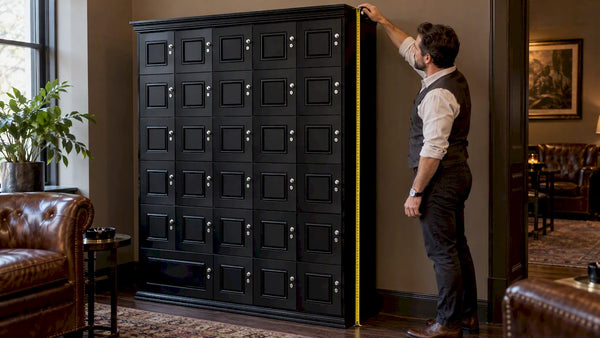
Cigar Locker Dimensions: Sizing Guide for Collectors and Lounges
Cigar locker dimensions explained: compartment sizes, cabinet footprints, capacity math and clearances, so you size a locker bank...
Read Article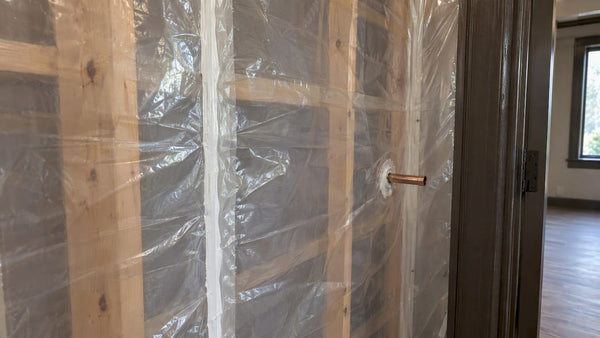
Sealing a Walk-In Humidor: Envelope, Door and Penetrations
How to seal a walk-in humidor properly: vapor barrier placement, door gasket, penetrations and the controlled airflow a...
Read Article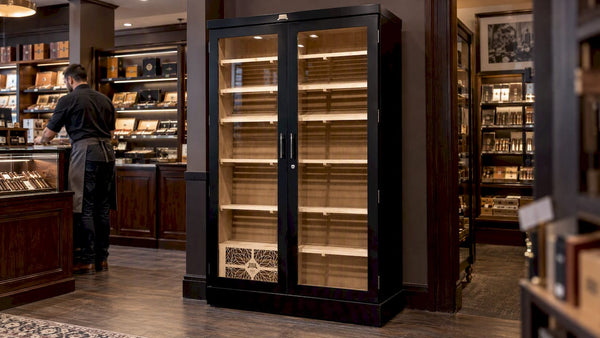
Retail Humidor ROI: How to Measure What a Display Earns
What does a retail or lounge humidor really return? A practical framework for cigar shops, lounges and clubs:...
Read Article