

Unlock the secrets of explaining humidor air circulation for better cigar quality. Enhance aging, taste, and your collection's value today!
Air circulation in a humidor is defined as the continuous movement of air that distributes moisture uniformly across every shelf, corner, and cigar within the storage environment. Without it, humidity stratifies into pockets, tobacco degrades unevenly, and the collection you have spent years curating suffers in silence. Explaining humidor air circulation is not simply a technical exercise. It is the foundation of every decision you make about how your cigars age, how they burn, and how they taste. Whether you rely on Boveda humidity packs in a desktop box or a cabinet humidor fitted with internal fans, understanding airflow separates a serious collector from someone who merely stores cigars.
Why is air circulation critical for cigar quality and aging?
Air movement is one of the most critical factors in cigar aging, ranking alongside relative humidity itself. That claim deserves unpacking, because most collectors focus almost exclusively on humidity percentage while treating airflow as an afterthought.
Tobacco does not become inert after rolling. It continues to respire, releasing ammonia as a byproduct of ongoing fermentation inside the leaf. In a sealed, still environment, that ammonia accumulates. Ammonia in stagnant air produces harsh, bitter flavors that mask the nuanced profile a premium cigar was crafted to deliver. Active ventilation disperses ammonia and replaces it with fresh oxygen, allowing the tobacco to mellow and develop its true character over time.
Beyond chemistry, still air creates microclimates. A microclimate is a localized zone inside your humidor where temperature and humidity differ measurably from the rest of the space. The cigars sitting in that zone experience conditions the rest of your collection does not. Some age faster. Some absorb excess moisture. Some dry out. The result is a collection that performs inconsistently, which is the opposite of what precision storage is meant to achieve.
“Humidity stability in humidors is fundamentally an airflow distribution problem. Good airflow leads to uniform moisture and less condensation risk.” — Why Airflow Design Is Critical in Environmental Test Chambers
Pro Tip: If you notice that cigars on one shelf consistently smoke differently from those on another, uneven airflow is the most likely cause before you blame the tobacco itself.
The engineering principle here applies across controlled environments. Inadequate airflow causes localized humidity differences and condensation risk, while overly aggressive airflow dries cigars out. The goal is balance, not maximum movement.
How do different humidor airflow systems compare?
The role of ventilation in humidors varies significantly depending on the system design. Two primary approaches exist: passive diffusion and active mechanical circulation.
Passive humidors rely on moisture evaporating naturally from a humidity source, such as Boveda packs or a traditional floral foam humidifier, and diffusing through the enclosed space. There are no fans, no designed airflow loops, and no mechanical assistance. Moisture moves slowly and unevenly, which means the cigars closest to the humidity source receive more moisture than those stored at the opposite end or on a lower shelf.
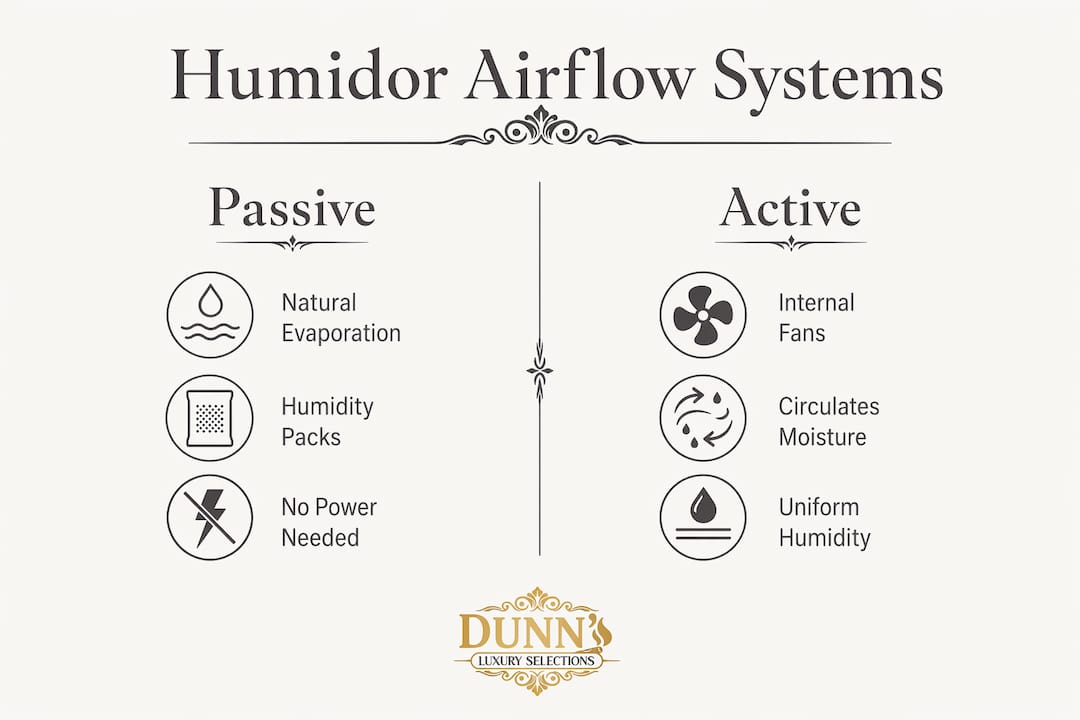
Active humidors, including most cabinet humidors and electronic models, use internal fans to create a deliberate circulation loop. Active 360-degree airflow creates a designed loop that breaks up heavy, stagnant air pockets and exposes every cigar to consistent conditions. This is the architecture that serious collectors rely on for large collections.
| System type | Airflow method | Humidity uniformity | Best use case |
|---|---|---|---|
| Passive desktop humidor | Natural diffusion via Boveda packs or foam | Moderate, prone to stratification | Small collections under 50 cigars |
| Active cabinet humidor | Internal fans with 360-degree circulation | High, consistent across all shelves | Large collections, long-term aging |
| Electronic humidor | Automated fans with digital humidity control | Highest, with real-time adjustment | Precision collectors and walk-in setups |
| Travel humidor | Sealed passive diffusion | Low, short-term only | Transport and temporary storage |
The practical implication of this comparison is direct. If your collection exceeds 50 cigars or includes aged sticks you intend to hold for years, passive diffusion introduces unacceptable risk. The electronic humidor features available at the premium tier exist precisely because collectors at that level cannot afford inconsistency.
Key distinctions between the two approaches:
- Passive systems cost less upfront but require more frequent manual rotation of cigars to compensate for uneven moisture distribution.
- Active systems maintain humidity uniformity without manual intervention, reducing the risk of localized over-humidification.
- Cabinet models with Spanish Cedar lining benefit most from active airflow because cedar absorbs and releases moisture, amplifying the effect of circulation.
What factors affect proper air circulation inside a humidor?
Proper humidor airflow setup depends on more than the system you choose. Several practical variables determine whether your airflow design actually performs as intended.
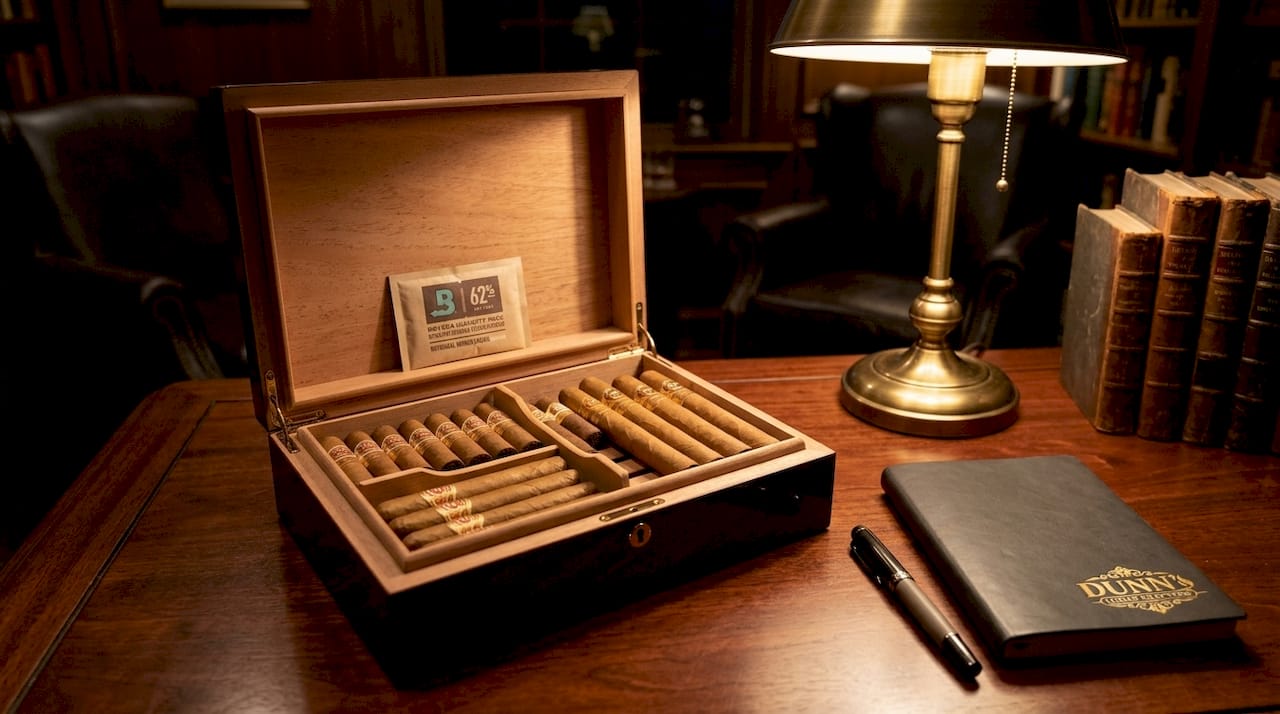
Cigar spacing is the factor most collectors underestimate. Overcrowding a humidor blocks airflow and prevents even humidity distribution across shelves and corners. Dense packing suffocates the circulation path, creating the same stagnant pockets you were trying to avoid. Treat loading your humidor as a deliberate act of circulation design, not simply a storage exercise.
Humidity device placement matters equally. Boveda packs should be distributed evenly throughout the humidor rather than concentrated in one corner. Boveda packs require 24 to 72 hours to stabilize humidity after placement, and frequent opening during that window disrupts the equalization process. Monitoring with a calibrated hygrometer during this period is the only way to confirm that moisture is reaching all zones.
Humidor size and shelf design also shape airflow paths. Shelves that run edge to edge without gaps create horizontal barriers that prevent vertical air movement. A well-designed cabinet humidor incorporates shelf spacing and perforations that allow air to move freely between levels.
Best practices for optimizing internal airflow:
- Leave at least a finger’s width of space between cigar rows and between cigars and the humidor walls.
- Place Boveda packs or humidity devices on alternating shelves rather than all on one level.
- Monitor relative humidity with a digital hygrometer placed at the center of the humidor, not adjacent to the humidity source.
- After any significant adjustment, allow 24 to 72 hours before drawing conclusions about humidity levels.
- Rotate cigars between upper and lower shelves every few months if using a passive system.
Pro Tip: When you first set up or restock a humidor, resist the urge to check humidity every few hours. Humidity equalization lags because air must slowly circulate to reach uniform moisture levels. Patience during this window protects the entire collection.
How does airflow influence mold and uneven burns?
The importance of air circulation in humidors becomes most visible when things go wrong. Two of the most common storage failures, mold growth and uneven burns, share the same root cause: stagnant air.
Mold requires two conditions to colonize a cigar: moisture and a still surface. Microclimates inside humidors create pockets of high humidity that provide exactly that environment. Constant airflow agitates the cigar surface, making it physically difficult for mold spores to establish a foothold. This is not a marginal benefit. It is the primary mechanical defense against mold in any well-designed humidor.
Uneven burns tell a different story, but airflow is still the protagonist. Consider what happens when moisture distributes unevenly from the wrapper to the core of a cigar. The drier side burns faster than the wetter side, producing the characteristic canoe burn that ruins an otherwise exceptional smoke. Balanced moisture from proper air circulation results in a straight burn and a firm, consistent ash. That outcome is not luck. It is the direct product of airflow doing its job.
Here is how poor airflow produces specific, predictable problems:
- Stagnant air allows ammonia to accumulate near cigars, producing harsh, bitter flavors that persist even after lighting.
- Humidity pockets form near the humidification source, over-conditioning nearby cigars while leaving distant ones under-humidified.
- Mold spores settle on still surfaces, particularly on cigars stored in corners or against walls where air movement is weakest.
- Uneven moisture penetration from wrapper to filler causes structural inconsistency, leading to tunneling during the smoke.
- Condensation forms on the humidor walls or lid in passive systems with poor circulation, dripping onto cigars and causing water spots or wrapper damage.
Each of these failures is preventable. The solution in every case is the same: deliberate, consistent air movement throughout the storage environment.
Key takeaways
Proper humidor air circulation requires active airflow design, correct cigar spacing, and calibrated humidity monitoring to preserve cigar quality and prevent mold, ammonia buildup, and uneven burns.
| Point | Details |
|---|---|
| Airflow prevents ammonia buildup | Stagnant air traps ammonia from fermentation, degrading flavor; active ventilation disperses it. |
| Active systems outperform passive ones | Cabinet and electronic humidors with internal fans deliver uniform humidity across all shelves. |
| Spacing is a circulation decision | Overcrowding blocks airflow paths; leave deliberate gaps between cigars and walls. |
| Humidity stabilization takes time | Allow 24 to 72 hours after adjustments before evaluating humidity levels with a hygrometer. |
| Airflow prevents mold and uneven burns | Constant air movement disrupts mold colonization and ensures moisture penetrates evenly from wrapper to core. |
What I have learned from years of managing serious collections
I spent years treating humidity percentage as the only variable that mattered. A hygrometer reading of 70% felt like success, regardless of whether that 70% was distributed evenly or pooled in one corner of the box. The cigars I pulled from the back of a passive desktop humidor smoked differently from those in front, and I blamed the tobacco, the roller, the vintage. It took upgrading to a cabinet humidor with a built-in circulation system to understand what I had been missing.
The misconception I encounter most often among collectors is that airflow is a luxury feature reserved for walk-in humidors or commercial operations. That belief is wrong, and it costs people cigars they cannot replace. A 50-count desktop humidor with poor air distribution is a more dangerous environment for a rare Cohiba Behike than a well-circulated cabinet holding 500 sticks. Volume is not the threshold. Airflow quality is.
What I find most compelling about the current direction of humidor design is the shift toward zonal climate control in premium cabinets. The ability to maintain distinct humidity levels on different shelves, each with its own airflow path, changes what long-term aging means for a collector. You can age a young Nicaraguan puro at slightly lower humidity than a Connecticut shade wrapper in the same cabinet, without compromise. That level of precision was not accessible to collectors a decade ago.
My practical advice: if you are serious about your collection, invest in a digital hygrometer before you invest in more cigars. Place it at the center of your humidor, away from the humidity source. If the reading drifts more than three percentage points from your target over 48 hours, your airflow setup needs attention before anything else.
— Belle
Discover humidors engineered for precision airflow
For collectors who refuse to leave aging to chance, Dunnluxuryselections offers a curated selection of premium humidors built around the principles this article describes.

The cabinet humidor collection at Dunnluxuryselections features models with integrated internal fans, Spanish Cedar lining, and 360-degree airflow architecture designed to eliminate microclimates across every shelf. For collectors who prefer a precision desktop format, the desktop humidor range is engineered with airflow-conscious interior layouts that maximize humidity uniformity without mechanical assistance. Every piece in the Dunnluxuryselections catalog reflects the conviction that a humidor is not merely a box. It is the sanctuary your collection deserves.
FAQ
What is humidor air circulation?
Humidor air circulation is the movement of air within a humidor that distributes moisture uniformly across all stored cigars. Without it, humidity stratifies into pockets that cause uneven aging, mold, and flavor degradation.
How does airflow prevent mold in a humidor?
Constant air movement agitates cigar surfaces, making it difficult for mold spores to colonize. Microclimates with stagnant, high-humidity air are the primary environment where mold establishes itself.
Do I need a fan in my humidor?
A fan is not required for small collections under 50 cigars, but active airflow significantly improves humidity uniformity in larger or cabinet-style humidors. Passive systems using Boveda packs can work for modest collections if cigars are spaced correctly and rotated periodically.
How long does it take for humidity to stabilize after adjusting a humidor?
Humidity equalization typically requires 24 to 72 hours after placing or adjusting humidity devices. Frequent opening during this window disrupts the process and produces misleading hygrometer readings.
Why do my cigars burn unevenly even at the right humidity?
Uneven burns are often caused by inconsistent moisture distribution from wrapper to filler, a direct result of poor airflow inside the humidor. Balanced air circulation allows moisture to penetrate uniformly, producing a straight burn and consistent ash.
Recommended
You May Also Enjoy
Cigar Locker Dimensions: Sizing Guide for Collectors and Lounges
Cigar locker dimensions explained: compartment sizes, cabinet footprints, capacity math and clearances, so you size a locker bank...
Read Article
Sealing a Walk-In Humidor: Envelope, Door and Penetrations
How to seal a walk-in humidor properly: vapor barrier placement, door gasket, penetrations and the controlled airflow a...
Read Article
Retail Humidor ROI: How to Measure What a Display Earns
What does a retail or lounge humidor really return? A practical framework for cigar shops, lounges and clubs:...
Read Article