

Discover the crucial role of humidor size in preserving cigar quality and enhancing value. Learn how to choose the right one for your collection!
Every serious cigar collector eventually confronts the same quiet realization: the humidor they chose is no longer serving their collection the way it once did. Size is rarely the first thing people consider when selecting a humidor, yet it shapes nearly every aspect of cigar preservation, from relative humidity (RH) stability to the long-term development of flavor and aroma. This guide cuts through the assumptions and gives you a precise, experience-backed framework for understanding how humidor size affects cigar quality, collection growth, and the true value of what you’re storing.
Table of Contents
- Understanding humidor size: More than just numbers
- How size affects cigar preservation and quality
- Choosing the right humidor: Assessing your needs
- Common pitfalls and expert strategies
- Why most collectors underestimate humidor size: Our hard-won perspective
- Explore expertly crafted humidors for every collection
- Frequently asked questions
Key Takeaways
| Point | Details |
|---|---|
| Capacity benchmarks | Most cigar collectors need a humidor sized for 25 to 250 cigars, with actual capacity at roughly 75 percent of what’s advertised. |
| Impact on preservation | Larger humidors can improve humidity stability but require proper circulation and monitoring to protect cigar quality. |
| Growth planning | Choose a humidor that allows space for your collection to grow over time, not just your current inventory. |
| Common mistakes | Overfilling, under-circulating, and relying on inaccurate hygrometers are key pitfalls that can spoil cigars regardless of humidor size. |
Understanding humidor size: More than just numbers
Many people think a bigger humidor is just about storing more cigars, but there’s more beneath the surface. The size of your humidor determines the internal environment your cigars inhabit every single day, influencing everything from moisture retention to how evenly temperature distributes across your collection.
Humidors fall into three broad classifications. Desktop humidors are compact, personal units designed for everyday access and modest collections. Cabinet humidors serve the dedicated enthusiast or serious collector, offering structured shelving, Spanish Cedar lining, and often electronic humidity management. Walk-in humidors represent the pinnacle of cigar storage, functioning as fully climate-controlled rooms that can house thousands of cigars while maintaining precise zonal climate control.
Understanding capacity benchmarks helps you plan realistically:
| Collector Type | Recommended Capacity | Typical Humidor Style |
|---|---|---|
| Casual smoker | 25-50 count | Desktop |
| Enthusiast | 50-100 count | Desktop or small cabinet |
| Serious collector | 100-250 count | Cabinet |
| Dedicated aficionado | 250+ count | Large cabinet or walk-in |
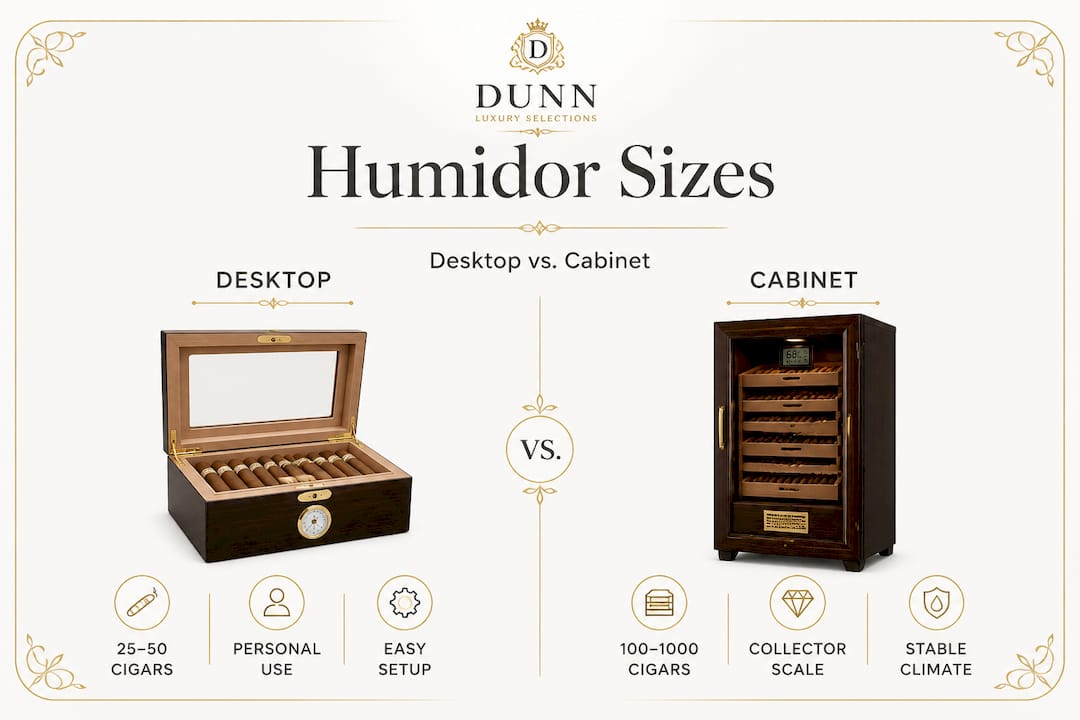
Here’s what most manufacturers won’t tell you upfront: rated capacity assumes every cigar is the same size, stored individually, and placed with maximum efficiency. In real-world collecting, you’re mixing Toros, Churchills, Robustos, and boxed selections. The practical result is that real capacity runs around 75% of what’s stated on the label.
Boxes consume space differently than singles. A box of 25 Maduros doesn’t stack like a uniform row of singles. Add a few bundles, a few loose aged sticks, and your “100-count” humidor fills to its functional ceiling well before you reach 100 cigars.
Exploring our desktop humidor collections or stepping up to cabinet humidors becomes a much clearer decision once you understand the gap between rated and actual capacity.
Pro Tip: Always plan for roughly 25% less usable space than the stated capacity. If you’re eyeing a 100-count humidor, treat it as a 75-count unit for practical planning purposes.
How size affects cigar preservation and quality
Now that we know the physical differences, it’s important to see how humidor size drives cigar freshness and quality over time.

The relationship between humidor size and climate stability is not linear. A larger humidor does not automatically mean better preservation. What it does offer, when properly equipped and managed, is greater thermal mass and a more buffered internal environment. Think of it as the difference between a small pot of water and a large reservoir: the larger body resists rapid temperature and humidity swings far more effectively.
Electronic cabinet humidors equipped with circulation fans demonstrate this well. Tests on large electronic units show they can achieve less than 2% RH variation from top shelf to bottom shelf when fans are operating correctly. That’s a remarkable level of consistency, one that passive desktop humidors simply cannot replicate during seasonal changes or in environments with fluctuating ambient conditions.
Here’s a performance comparison that illustrates the real-world differences:
| Humidor Type | Avg. RH Variation | Humidity Management | Best For |
|---|---|---|---|
| Small desktop (25-50 ct) | 5-10% RH swing | Passive sponge or beads | Casual rotation |
| Mid-size desktop (75-100 ct) | 3-7% RH swing | Beads or Boveda packs | Active enthusiasts |
| Electronic cabinet (150-500 ct) | Less than 2% RH swing | Active fan and sensor | Serious collectors |
| Walk-in humidor | Less than 1% RH swing | Zonal climate control | Investment-grade collections |
One of the most overlooked risks in larger humidors is humidity layering. Warm, moist air rises. Without active circulation, the top shelves of a tall cabinet may read 72% RH while the lower shelves hover around 65%. That 7-point spread, sustained over months, produces noticeably different aging results across the same collection.
“Built-in hygrometers are often inaccurate by 4 to 8 percentage points, which means collectors relying solely on the factory gauge are flying partially blind when managing their collection’s climate.” Source: Humidor Review, Early Impressions
This is why we consistently recommend understanding the benefits of electronic humidors before committing to a large passive unit. Our humidor care guides also walk through calibration techniques that every collector should practice at least twice a year.
Pro Tip: Place digital hygrometers at multiple levels inside any cabinet humidor, not just at eye level. The readings will likely surprise you, and that data is invaluable for making informed adjustments.
Choosing the right humidor: Assessing your needs
With a solid understanding of the science, it’s time to match your personal habits and aspirations to the right humidor.
Selecting the correct size is less about where your collection stands today and more about where it’s headed in the next two to three years. Most collectors who purchase a humidor based on their current inventory find themselves outgrowing it within 18 months. The acquisition instinct is powerful, and a well-curated collection has a way of expanding with every visit to a premium cigar shop or online retailer.
Before purchasing or upgrading, work through these essential questions:
- How frequently do you smoke? A casual smoker who enjoys two or three cigars per week has very different storage needs than someone who smokes daily or hosts regular cigar events.
- Are you aging cigars intentionally? Long-term aging, typically 5 to 20 years for premium Habanos or limited releases, requires dedicated, undisturbed storage space that shouldn’t be mixed with your regular rotation.
- Do you prefer singles or boxes? Box storage dramatically reduces the number of usable slots in any humidor. If you buy by the box, factor that into your sizing calculation from the start.
- What’s your acquisition pace? If you regularly purchase limited releases, seasonal blends, or collector editions, your inventory can grow faster than you anticipate.
- Is display part of the experience? Some collectors want their humidor to function as a centerpiece, a visible expression of their passion. Cabinet humidors with glass doors and interior lighting serve both preservation and presentation.
- What’s your budget for humidity management? Larger humidors require more sophisticated and often more expensive humidity systems. Passive beads and sponges that work fine in a 50-count desktop will fall short in a 300-count cabinet.
The capacity benchmarks we referenced earlier provide a reliable starting point: 25 to 50 count for casual collectors, 50 to 100 for enthusiasts, 100 to 250 for dedicated collectors, and 250-plus for those whose passion has grown into a genuine investment.
For those whose collections have grown beyond cabinet territory, walk-in humidors for collectors represent the ultimate commitment to preservation and presentation, offering uncompromising climate control and the ability to store entire collections without compromise.
Pro Tip: When you’re unsure between two sizes, always choose the larger option. An overfilled humidor is far more damaging to cigar quality than one that has room to breathe. Crowded cigars restrict air circulation and create unpredictable humidity pockets.
Common pitfalls and expert strategies
Even experienced collectors stumble when sizing up or down. Let’s cover what trips most people up and how to sidestep common headaches.
The most frequent mistake is underestimating collection growth. A collector who starts with 40 cigars and purchases a 50-count humidor often finds themselves at 80 cigars within a year. Once a humidor is consistently filled beyond its practical capacity, the internal climate becomes harder to manage, and the risk of mold, uneven aging, and tobacco beetle activity increases significantly.
The second major pitfall is ignoring air circulation in larger units. Many collectors upgrade to a beautiful cabinet humidor, fill it with prized cigars, and assume the humidity system will handle everything. Without proper fan placement and regular monitoring, humidity stratification takes hold quietly. By the time you notice a problem, some of your most valued sticks may already be compromised.
Here are the most common sizing mistakes and how to avoid them:
- Buying for aesthetics over performance. A stunning piece of furniture that can’t maintain stable RH is a liability, not an asset. Always verify the humidity management system before falling in love with the exterior.
- Relying on a single hygrometer. As we noted earlier, built-in hygrometers are often inaccurate by 4 to 8 points. Use calibrated digital units placed at multiple heights.
- Mixing aging and rotation stocks. Cigars you’re aging long-term should be in a dedicated, undisturbed section or a separate unit entirely. Frequent opening and closing of the humidor disrupts the stable environment that aging demands.
- Skipping the seasoning process. A new humidor, regardless of size, must be properly seasoned before use. Rushing this step leads to the Spanish Cedar lining drawing moisture away from your cigars.
- Ignoring seasonal ambient changes. A humidor that performs beautifully in summer may struggle in a dry winter. Size and system capacity both influence how well a unit weathers seasonal transitions.
“The most elegant strategy for large cabinet collections is modular zonal organization: designate specific shelves for aging, rotation, and gifting, each with its own humidity monitoring point.” This approach transforms a large humidor from a simple storage vessel into a precision instrument for curating your collection’s lifecycle.
Our cigar care guides go deeper on seasoning protocols, humidity system calibration, and long-term organization strategies that protect both your cigars and your investment.
Why most collectors underestimate humidor size: Our hard-won perspective
After learning the mechanics and best practices, it helps to hear what years of hands-on experience with serious collectors has taught us about humidor size choices.
Here’s the uncomfortable truth we’ve observed repeatedly: the “just right” humidor rarely stays just right. Collections grow with passion, and passion rarely plateaus. The collector who purchases a 75-count desktop with the best of intentions is often the same person standing in front of a 500-count cabinet two years later, wishing they had planned further ahead.
What even seasoned enthusiasts overlook is the relationship between collection size and climate stability as a collection matures. When a collection is small and active, cigars rotate frequently, and minor humidity fluctuations are less consequential. But as a collection grows and aging becomes a priority, the stakes for climate precision rise considerably. A single humidity event, a power outage, a failed humidification system, can compromise years of careful aging in a matter of days.
We also see collectors fall into the false economy of iterative undersizing. Purchasing two or three progressively larger humidors over five years costs significantly more than investing in the right-sized unit from the beginning. Each transition involves the risk of disrupting aged cigars, the cost of a new unit, and the time required to re-season and stabilize a new environment.
The balance we advocate at our humidor philosophy is straightforward: buy for where you want to be, not where you are. Size up with intention, invest in quality humidity management, and treat your humidor as a long-term partner in your collecting journey rather than a temporary solution. The cigars you’re aging today deserve the sanctuary they were promised when you acquired them.
Explore expertly crafted humidors for every collection
Armed with new knowledge and real-world perspective, you’re now positioned to make a humidor decision that truly serves your collection’s unique path.
At Dunn Luxury Selections, we’ve built our reputation on pairing collectors with humidors that match their precision, their passion, and their vision for the future. Whether you’re beginning your journey with our shop desktop humidors or ready to invest in a statement piece from our range of discover cabinet humidors, every unit in our collection is selected for its ability to deliver consistent, reliable preservation.

For collectors who demand the highest level of climate control and the most sophisticated humidity management available, our browse electronic humidors represent the finest instruments available for protecting what you’ve worked to build. Your collection deserves nothing less than precision, prestige, and presence.
Frequently asked questions
How much smaller is the actual storage versus stated humidor size?
Actual storage is approximately 75% of rated capacity once you account for mixed cigar sizes, box storage, and practical spacing needs.
Is a bigger humidor always better for long-term cigar quality?
Not automatically. While large electronic units achieve under 2% RH variation with proper fan circulation, a larger humidor without active management can actually create more humidity inconsistency than a well-maintained smaller unit.
What is the ideal humidor size for a beginner collector?
A 25 to 50 count humidor is the recommended starting point for casual or beginner collectors, offering manageable humidity control and room to develop your palate and preferences.
Why do some cigars dry out even in a large humidor?
Dryness in large humidors is most often caused by humidity stratification, inadequate circulation, or reliance on inaccurate built-in hygrometers that can read 4 to 8 points off from actual conditions.
How often should I upgrade my humidor as my collection grows?
Plan to upgrade when your collection consistently occupies more than 75% of rated capacity, or when you begin intentionally aging cigars long-term and need a more stable, dedicated environment.
Recommended
You May Also Enjoy
Save Flavor in 14 Days: Cleaning a Humidor for Collectors
For collectors: clean mold or plume without tainting cedar. Keep or toss decision rules, 14 days reseasoning, hygrometer...
Read Article
6 to 26 Weeks: Custom Humidor Timeline for Collectors & Gift Buyers
Plan a bespoke humidor with a realistic production calendar. See stage-by-stage timings, what typically adds weeks, and how...
Read Article
50/50 Propylene Glycol Ratio + 90/10 Flush for Collectors & Installers
Use a 50/50 propylene glycol ratio to hold passive humidors near 70% RH. Installer tested: occasional 90/10 water...
Read Article