

Discover the critical role of humidity in cigar storage. Learn how proper RH ensures your cigars taste great and last longer.
Humidity is the single most critical variable in cigar storage, controlling the moisture balance that determines how a cigar burns, tastes, and ages. Without proper relative humidity (RH), even the finest Nicaraguan or Cuban leaf loses its complexity and structural integrity within weeks. The role of humidity in cigar storage extends far beyond preventing dryness. It governs draw resistance, wrapper elasticity, flavor development, and long-term preservation. Tools like digital hygrometers, Spanish Cedar humidors, and Boveda humidity packs exist precisely because this variable demands constant, precise attention.
How does humidity affect cigar flavor and structure?
Humidity governs the moisture equilibrium inside every tobacco leaf, and that equilibrium determines everything you experience when you light a cigar. When RH drops below 62%, tobacco leaves lose moisture faster than they can reabsorb it from the surrounding air. The result is a brittle wrapper prone to cracking, a harsh and uneven burn, and a smoke that tastes thin and acrid rather than complex and layered.
High humidity creates the opposite problem, and it is just as damaging. Over-humidification causes tight draws and muted flavors, conditions that many smokers incorrectly attribute to poor construction. A cigar that is hard to light or refuses to stay lit is almost always suffering from excess moisture, not a manufacturing defect. The tobacco swells, restricting airflow through the filler and binder, and the resulting smoke tastes flat.
The effects of humidity on flavor are not subtle:
- Low humidity (below 62% RH): Harsh, bitter smoke; rapid, uneven burn; cracked wrappers; loss of aromatic oils
- Optimal humidity (62–69% RH): Full flavor expression; even, slow burn; supple wrapper; proper draw resistance
- High humidity (above 75% RH): Spongy texture; tight or plugged draw; muted, ammonia-tinged flavors; mold risk increases significantly
Pro Tip: If your cigar tastes flat or burns unevenly, check your hygrometer before blaming the blend. Humidity is the culprit far more often than the roller.
Why is humidity stability more important than the exact number?
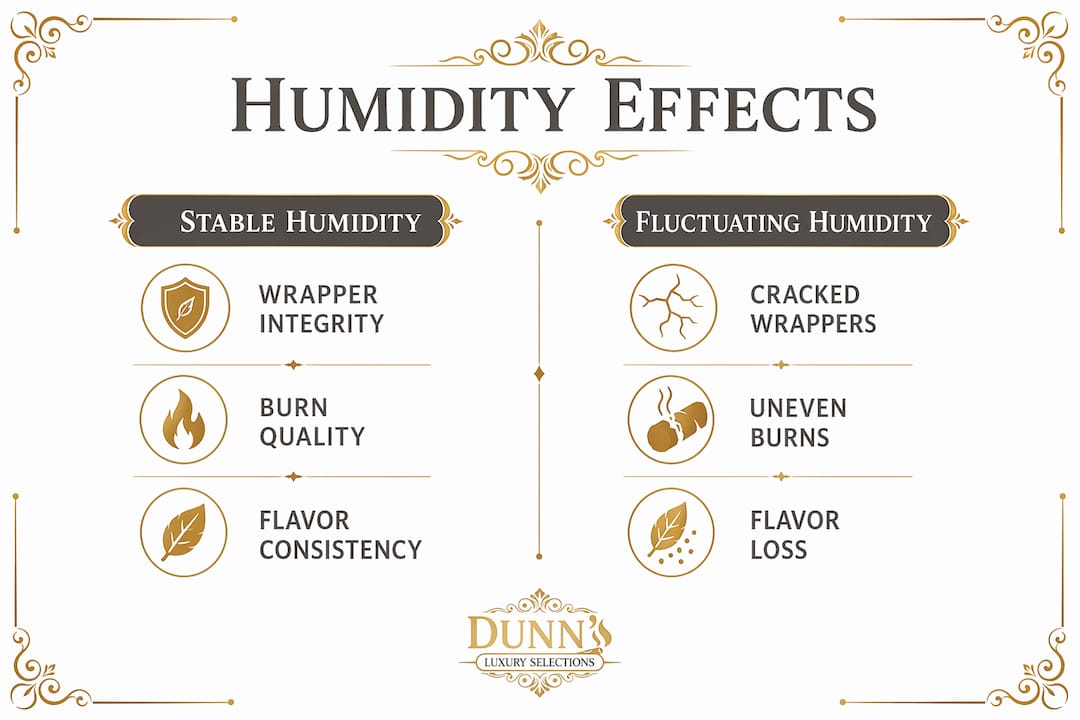
The most common mistake among cigar collectors is obsessing over a specific RH target while ignoring the damage caused by constant fluctuation. Rapid swings between 62% and 74% RH cause tobacco leaves to expand and contract repeatedly, breaking down wrapper integrity and producing uneven burns over time. A cigar stored at a steady 67% will always outperform one that oscillates between 62% and 74%, even if 67% is not your personal ideal.
Consider the comparison below:
| Storage Condition | Wrapper Integrity | Burn Quality | Flavor Consistency |
|---|---|---|---|
| Stable at 65% RH | Excellent | Even and slow | Full and complex |
| Fluctuating 62–74% RH | Cracking over time | Uneven, runs | Inconsistent, degraded |
| Stable at 70% RH | Good | Slightly slower | Rich but can be muted |
| Fluctuating 68–75% RH | Softening, mold risk | Tight draw | Flat, ammonia notes |
The practical implication is clear. Precision matters less than consistency. A digital hygrometer from a brand like Caliber or Xikar gives you an accurate, real-time reading so you can catch drift before it becomes damage. Digital hygrometers are more accurate and reliable than analog models, making them the standard choice for serious collectors.
Pro Tip: Resist the urge to adjust your humidification source every time the hygrometer shifts by one or two percentage points. Small, natural fluctuations are normal. Overcorrecting creates the very instability you are trying to prevent.
What is the ideal relative humidity for different cigar types?
The traditional 70/70 rule, storing cigars at 70% RH and 70°F, was designed as a practical guideline for cigar lounges managing large, rotating inventory. It works as a buffer, but experienced collectors favor lower humidity around 65% RH for flavor clarity, better draw, and reduced mold risk. The 70/70 rule is a starting point, not a destination.
Cigar type and origin significantly change the optimal range:
- Cuban cigars: Store at 60–65% RH. Thin Cuban wrappers swell readily at 70% RH, restricting airflow and producing bitter, ammonia-laced smoke. Plugging in Cuban cigars is almost always a humidity problem, not a construction flaw.
- Nicaraguan and Honduran cigars: Perform well in the 65–68% RH range. Fuller-bodied leaves tolerate slightly more moisture without losing draw quality.
- Dominican and Connecticut-wrapped cigars: The 65–69% RH range suits these well. Lighter wrappers are sensitive to over-humidification but less prone to plugging than Cuban leaf.
- Aged or vintage cigars: Store at 62–65% RH. Older tobacco has already released much of its ammonia and benefits from a drier environment that preserves the developed flavor profile.
Temperature also shapes how humidity behaves inside a humidor. Warmer air holds more moisture, so a humidor set to 68% RH at 75°F delivers more actual moisture to the tobacco than the same setting at 65°F. The role of temperature in cigar preservation is inseparable from humidity management. Keeping your humidor between 65°F and 70°F gives you the most predictable and stable environment.
Storing all cigars at exactly 70% RH ignores their specific characteristics and your personal preferences. Customizing your humidity range by cigar origin and blend improves the smoking experience in ways that a one-size approach never can.
How to maintain ideal humidity: tools and methods that work
Maintaining consistent humidity requires the right combination of storage vessel, monitoring equipment, and humidification source. Each element of this system supports the others, and a weakness in any one area undermines the whole.
-
Choose the right humidor. Spanish Cedar is the preferred lining material because it absorbs and releases moisture gradually, acting as a natural buffer against rapid RH swings. A well-crafted desktop humidor with a tight seal is the foundation of any serious storage setup. For larger collections, a cabinet humidor provides zonal climate control and the capacity to age multiple blends simultaneously.
-
Season your humidor before use. A new humidor must absorb moisture before it can regulate humidity effectively. Wipe the interior cedar with distilled water, place a small dish of distilled water inside, and allow the wood to season for 24–48 hours before adding cigars. Skipping this step causes the dry cedar to pull moisture from your cigars immediately.
-
Use Boveda humidity packs for two-way control. Boveda packs release or absorb moisture as needed, maintaining a stable environment without constant monitoring. They are available in specific RH ratings (62%, 65%, 69%, 72%) so you can match the pack to your target range precisely.
-
Monitor with a digital hygrometer. Place it in the center of your humidor, away from the humidification source, for the most accurate ambient reading. Check it every few days rather than hourly.
-
Control the room environment. Avoid placing your humidor near heating vents, windows, or air conditioning units. Ambient temperature swings in the room translate directly into humidity instability inside the humidor.
Pro Tip: Use distilled water exclusively when refilling any humidification device. Tap water introduces minerals that clog humidification elements and promote bacterial growth on the cedar lining.
How do humidity and temperature together affect long-term aging?
Long-term cigar aging is where the interplay between humidity and temperature becomes most consequential. Controlled conditions allow tobacco oils to mature, reduce wrapper cracking, and improve smoke quality in ways that cannot be replicated by simply buying an older cigar. The aging process requires patience and a stable microclimate.
The key considerations for long-term preservation include:
- Temperature ceiling of 72°F. Humidity above 75% combined with temperatures above 72°F promotes rapid tobacco beetle egg hatching. Beetle damage is catastrophic and spreads through an entire collection within days.
- Flavor maturation timeline. Cigars aged at 65% RH and 65–68°F develop smoother, more integrated flavor profiles over 12–36 months. The ammonia released during fermentation continues to dissipate in proper storage, revealing the tobacco’s natural sweetness and complexity.
- Wrapper preservation. Consistent humidity prevents the micro-cracking that begins when wrapper leaves cycle through repeated expansion and contraction. A crack in the wrapper is not cosmetic. It creates an air channel that causes the cigar to burn unevenly and run.
- Rotation practice. Rotate cigars within the humidor every few months to expose all sides to consistent humidity. Cigars resting against the cedar wall absorb moisture differently than those in the center.
For collectors aging rare or limited-edition cigars, an electronic humidor with precise digital controls removes the guesswork entirely, maintaining both temperature and humidity within tight tolerances automatically.
Key takeaways
Proper humidity control in cigar storage is the defining factor in preserving flavor, structure, and longevity across every cigar type and origin.
| Point | Details |
|---|---|
| Stability over perfection | A steady 65% RH outperforms constant swings between 62% and 74% every time. |
| Match humidity to cigar type | Cuban cigars need 60–65% RH; Nicaraguan and Dominican blends tolerate 65–69% RH. |
| Use Boveda packs for control | Two-way humidity packs maintain target RH without daily adjustments or monitoring. |
| Temperature and humidity work together | Keep your humidor at 65–70°F to prevent tobacco beetles and support proper aging. |
| Digital hygrometers are non-negotiable | Analog models lack the precision needed for consistent, reliable humidity readings. |
The myth of the perfect humidity number
I have spent years watching collectors chase a specific RH percentage as if it were a finish line. They calibrate obsessively, swap out humidity packs weekly, and still end up with cigars that smoke worse than they should. The number is not the problem. The instability created by constant intervention is.
What I have found actually works is this: choose a target range that suits your primary cigar collection, season your humidor properly, install a quality Boveda pack at the right RH rating, and then leave it alone. Check your digital hygrometer every few days. If the reading drifts by one or two points, that is normal. If it drifts by five or more points consistently, investigate the seal on your humidor before touching the humidification source.
The other misconception worth addressing is the idea that higher humidity means better preservation. It does not. A cigar stored at 72% RH is not more protected than one at 65% RH. It is wetter, slower to burn, and far more vulnerable to mold. The care guides at Dunnluxuryselections reinforce this point consistently. Precision and restraint produce better results than excess. Treat your humidor as a sanctuary for your collection, not a greenhouse.
— Brian
Protect your collection with Dunnluxuryselections
Every insight in this article points to the same conclusion: the quality of your humidor determines the quality of your cigars over time. Dunnluxuryselections offers a curated collection of premium cabinet humidors, desktop models, travel cases, and electronic units, each engineered to maintain the precise humidity and temperature conditions your collection deserves. Whether you are curating a rotating selection of Nicaraguan puros or aging a rare Cuban vintage, Dunnluxuryselections has the instrument to protect it.

From Spanish Cedar-lined desktop humidors for the everyday aficionado to fully automated electronic humidors for the serious collector, every product in the Dunnluxuryselections catalog reflects the same commitment to precision, prestige, and the art of preservation. Your cigars represent a legacy worth protecting.
FAQ
What is the ideal humidity level for storing cigars?
Most collectors store cigars between 62% and 69% RH, with 65% being the most widely recommended target for flavor clarity and draw quality. Cuban cigars perform best at the lower end, around 60–65% RH, to prevent plugging.
Why do cigars dry out in storage?
Cigars dry out when the relative humidity inside the humidor drops below 62% RH, causing tobacco leaves to lose moisture faster than the environment replenishes it. A failing humidification source, an unsealed humidor lid, or low ambient humidity in the room are the most common causes.
How do you fix dry cigars step by step?
Place dry cigars in a sealed humidor or zip-lock bag with a 65% Boveda pack and allow them to rehydrate gradually over 1–2 weeks. Avoid exposing dry cigars to high humidity immediately, as rapid moisture absorption causes wrappers to crack.
Does temperature affect cigar humidity?
Temperature directly influences how much moisture air can hold, which affects the actual moisture delivered to tobacco at any given RH setting. Keeping your humidor between 65°F and 70°F prevents tobacco beetle activity and supports stable, predictable humidity control.
Are boveda packs better than traditional humidification devices?
Boveda packs provide two-way humidity regulation, absorbing excess moisture and releasing it when levels drop, without requiring distilled water refills or manual adjustments. Traditional sponge-based humidifiers only add moisture and require more frequent monitoring to prevent over-humidification.
Recommended
You May Also Enjoy
Cigar Locker Dimensions: Sizing Guide for Collectors and Lounges
Cigar locker dimensions explained: compartment sizes, cabinet footprints, capacity math and clearances, so you size a locker bank...
Read Article
Sealing a Walk-In Humidor: Envelope, Door and Penetrations
How to seal a walk-in humidor properly: vapor barrier placement, door gasket, penetrations and the controlled airflow a...
Read Article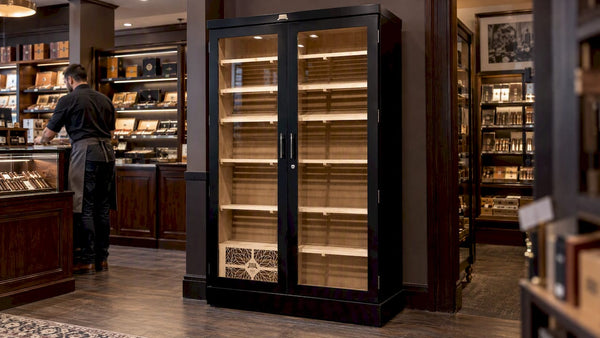
Retail Humidor ROI: How to Measure What a Display Earns
What does a retail or lounge humidor really return? A practical framework for cigar shops, lounges and clubs:...
Read Article