

Discover what is humidor etiquette and learn the essential rules every cigar lover should know to protect and enjoy quality cigars.
Humidor etiquette is defined as the set of respectful, hygiene-focused practices governing how you handle, store, and interact with cigars in any humidor environment. These practices protect cigar quality, preserve shared spaces, and honor the craftsmanship behind every leaf. Whether you are a seasoned aficionado curating a personal collection or a novice stepping into a retail walk-in for the first time, understanding what is humidor etiquette separates a respectful patron from a careless one. The industry standard for proper storage sits at 65–70% relative humidity and 65–70°F, and the social rules that surround that environment are just as exacting.
What is humidor etiquette and why does it matter?
Humidor etiquette is the code of conduct that protects cigars, the people who enjoy them, and the shared spaces where they are stored. Cigars are perishable, handcrafted products. A single careless squeeze or an unclean hand can crack a wrapper, introduce bacteria, or permanently alter a cigar’s draw. The rules exist because the consequences of ignoring them are real and often irreversible.
The stakes are highest in retail and communal settings, where dozens of patrons share the same inventory. Shared humidors require impeccable sanitation because cigars are perishable consumables that ultimately contact the smoker’s mouth. That single fact reframes etiquette from social nicety to genuine health practice.

For personal humidors, the etiquette is equally demanding. Maintaining the right environment, organizing your collection with care, and calibrating your instruments on schedule are all expressions of respect for the cigars themselves. Etiquette, at its core, is the discipline of preservation.
What are the basic rules of handling cigars inside a humidor?
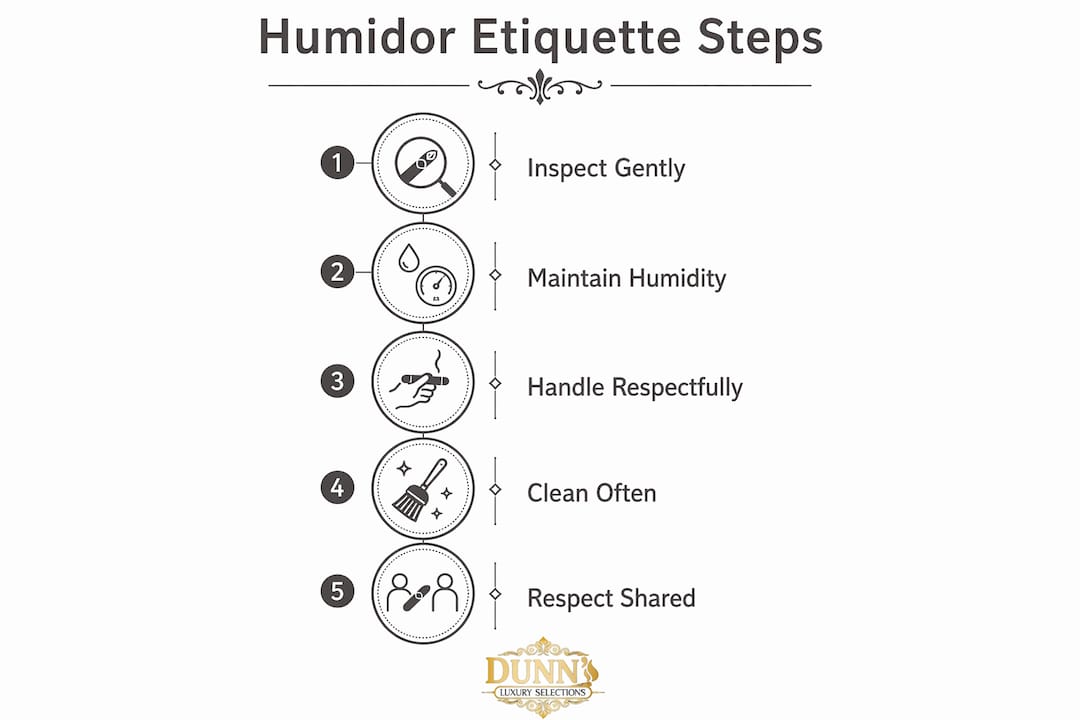
Physical handling is where most novices make their first mistake. The instinct to squeeze a cigar to test its freshness is understandable, but it is also one of the most damaging things you can do. Touching cigars physically can bruise and crack fragile wrappers, and a cracked wrapper cannot be repaired. Inspect with your eyes first. If you need to assess a cigar’s condition, ask a staff member.
The core handling rules every aficionado follows:
- Never squeeze or pinch a cigar. Visual inspection is the correct method. Pressure damages the filler and wrapper simultaneously.
- Handle cigars by the band. The band protects the wrapper from the oils on your fingers. Touching bare wrapper above the band transfers skin oils that degrade the leaf.
- Do not touch cigars you do not intend to purchase. Browsing by touch is not browsing. It is damage.
- Do not smell cigars unless you are purchasing. Bringing a cigar to your nose requires handling it fully, which risks contamination and wrapper stress.
- Ask staff for assistance in retail humidors. Trained tobacconists can guide you to the right cigar without unnecessary handling of the inventory.
- Keep your hands clean before entering any humidor. Hand sanitizer is not optional in shared spaces. It is the baseline.
Pro Tip: If you are unsure whether a cigar is properly humidified, ask the staff to demonstrate. A gentle visual inspection of the foot and the wrapper’s sheen tells you more than a squeeze ever will.
The underlying principle is simple. Every cigar you touch without buying becomes a cigar someone else will smoke. Treat the inventory as you would want your own collection treated.
How should a humidor be maintained to meet etiquette and preservation standards?
Proper humidor maintenance is not a one-time setup. It is an ongoing discipline that defines the quality of every cigar stored inside. The industry standard for cigar storage is 65–70% relative humidity and a temperature of 65–70°F (18–21°C). Temperatures above 72°F create conditions where mold can establish itself, destroying entire collections. That number is not a suggestion.
The maintenance sequence for a well-kept humidor follows a clear order:
- Season the wood before first use. Wooden humidors, particularly those lined with Spanish Cedar, must be conditioned before storing cigars. Proper seasoning involves wiping the interior with distilled water or using two-way humidity packs over a 7–14 day period. Skipping this step causes the wood to pull moisture directly from your cigars.
- Place your hygrometer correctly. Mount the hygrometer at the center of the humidor at cigar height, away from the humidifier and away from walls. Placement near a humidity source creates a wet bias that makes your readings unreliable.
- Calibrate your hygrometer every 6–12 months. The salt test is the recognized calibration method. Seal the hygrometer with a damp salt solution for 8–12 hours. It should stabilize at 75% RH. Any significant deviation means the instrument needs adjustment or replacement.
- Avoid overstuffing. Airflow inside the humidor is what distributes humidity evenly. A packed humidor creates humid pockets and dry zones, neither of which is acceptable for long-term storage.
- Clean surfaces with non-aromatic agents only. Scented cleaners contaminate the cedar and, by extension, every cigar stored inside. Unscented, food-safe solutions are the correct choice.
| Maintenance Task | Frequency | Standard |
|---|---|---|
| Hygrometer calibration | Every 6–12 months | Stabilize at 75% RH via salt test |
| Humidity check | Weekly | Maintain 65–70% RH |
| Temperature check | Daily in warm months | Keep at 65–70°F |
| Interior cleaning | Monthly | Non-aromatic agents only |
| Re-seasoning assessment | Seasonally | Check wood for dryness |
Pro Tip: Seasoning is an ongoing process. Hygroscopic wood continues to respond to seasonal humidity changes year-round. Check your readings every time the seasons shift and re-season if the wood shows signs of drying.
A digital hygrometer with temperature monitoring removes the guesswork from daily checks and gives you a reliable baseline to act from.
What are the social and communal etiquette rules for shared humidors and cigar lounges?
A cigar lounge is a sanctuary. Shared cigar lounge spaces function as sanctuaries where respect, discretion, and positive interaction create the experience. The rules that govern behavior in these spaces exist to protect that atmosphere for every patron present.
The non-negotiable social rules:
- No smoking inside the humidor. Smoking cigarettes, cigars, or vaping inside humidors damages stored aromas and creates a fire hazard. This rule applies without exception in every reputable facility.
- Keep noise low. Phone calls on speaker, loud conversations, and disruptive behavior violate the atmosphere every other patron came to enjoy.
- Never reorganize cigar boxes. Treating a retail humidor like a boutique means leaving inventory exactly as staff arranged it. Moving boxes disrupts organization and signals disrespect for the establishment.
- Avoid unsolicited advice. Every aficionado has preferences. Offering unrequested opinions on another patron’s cigar selection is presumptuous and unwelcome.
- No heavy cologne or perfume. Strong fragrances contaminate the aromatic environment of the humidor and interfere with other patrons’ sensory experience.
- Do not share puffs or handle another patron’s cigar. Hygiene and personal space both apply here.
- Do not monopolize seating. Lounges are communal. Extended occupation of prime seating while others wait is poor form.
- Report unsanitary conditions. If you observe a hygiene issue, inform staff. Staying silent makes you complicit in a degraded environment.
Pro Tip: Etiquette is about shared respect, not rigid formality. A simple acknowledgment of fellow patrons and a quiet, self-contained presence elevates the entire room’s experience without a single word of instruction.
The lounge is not a stage. It is a shared space where every person present has equal claim to comfort and enjoyment.
Why is hygiene the most critical element of humidor etiquette?
Hygiene surpasses every other concern in shared humidor environments. Sanitation is the primary etiquette concern in shared humidors because cigars contact the smoker’s mouth directly. This is not a matter of preference. It is a matter of health.
The hygiene practices that define responsible humidor behavior:
- Use hand sanitizer before touching any cigar. Clean hands are the baseline requirement, not a courtesy.
- Touch only the band area. Skin oils transferred to the wrapper above the band degrade the leaf and introduce contaminants.
- Do not handle multiple cigars in sequence. Each cigar you touch without purchasing spreads whatever is on your hands to the next one.
- Avoid smelling cigars without intent to buy. The act requires full handling and brings the cigar close to your face, both of which introduce contamination risk.
- Sanitize communal cutters and accessories. Shared tools contact the foot and cap of cigars before they contact your mouth. Treat them accordingly.
“Cigars are perishable consumables that come into contact with mouths. Shared humidors require impeccable sanitation as a baseline, not an afterthought.” — Tobacconist University
Professional humidors maintain cleanliness through non-aromatic cleaning agents, floor mats at entry points, and staff protocols for handling returned or inspected cigars. As a patron, your responsibility is to arrive clean and leave the inventory undisturbed.
Key takeaways
Humidor etiquette is the intersection of hygiene, environmental discipline, and communal respect that protects cigar quality and the shared spaces where cigars are stored and enjoyed.
| Point | Details |
|---|---|
| Never squeeze cigars | Visual inspection protects fragile wrappers from bruising and cracking. |
| Maintain 65–70% RH and 65–70°F | These are the industry standards that prevent both drying and mold growth. |
| Calibrate your hygrometer regularly | Use the salt test every 6–12 months to confirm accurate humidity readings. |
| Hygiene is non-negotiable | Clean hands and minimal contact protect cigars that will later contact someone’s mouth. |
| Respect communal spaces | No smoking, no reorganizing, no unsolicited advice — the lounge belongs to everyone. |
What I have learned from years of watching people get this wrong
The most common mistake I see is treating humidor etiquette as a set of arbitrary rules invented by gatekeepers. It is not. Every rule traces directly to a consequence. Squeeze a cigar and you crack its wrapper. Skip hygrometer calibration and you store cigars in conditions you cannot actually measure. Wear heavy cologne into a walk-in humidor and you contaminate inventory that other people paid for.
What surprises most novices is how much of this etiquette is about hygiene rather than ceremony. The social rules, the quiet voices, the hands-off approach to inventory, all of it connects back to the fact that a cigar ends up in someone’s mouth. That realization changes how you think about every interaction inside a humidor.
The environmental side of etiquette is where I see even experienced collectors cut corners. Seasoning a new humidor once and never revisiting it is a mistake. Wood is hygroscopic. It responds to every seasonal shift. I have seen collections ruined in summer because an aficionado trusted a reading from a hygrometer that had not been calibrated in two years. The discipline of maintenance is the discipline of respect for what you are storing.
Etiquette also evolves. Electronic humidification systems, precision climate controls, and digital monitoring tools have raised the standard of what is achievable. The expectation in 2026 is not just that you maintain a humidor. It is that you maintain it well, with instruments and methods that reflect the quality of the cigars inside.
— Brian
Precision storage starts with the right equipment
A cigar collection is only as protected as the humidor housing it. Dunnluxuryselections carries a curated range of cabinet humidors and desktop humidors engineered to hold the 65–70% RH standard without constant manual intervention.

Every collection has a starting point. Dunnluxuryselections stocks hygrometers, electronic humidifiers, and maintenance accessories alongside its humidor collections, so you can build a complete storage system rather than piece one together. Whether you are protecting a dozen cigars or several hundred, the right instrument makes the difference between a collection that ages beautifully and one that quietly deteriorates. Browse the full range at Dunnluxuryselections and find the setup that matches your collection.
FAQ
What is the correct humidity level for a humidor?
The industry standard is 65–70% relative humidity. Levels outside this range cause cigars to dry out or develop mold.
How often should I calibrate my hygrometer?
Calibrate every 6–12 months using the salt test. Seal the hygrometer with a damp salt solution for 8–12 hours and confirm it reads 75% RH.
Can I smoke inside a retail humidor?
No. Smoking cigars, cigarettes, or vaping inside any humidor contaminates stored aromas and creates a fire hazard. This prohibition applies in all reputable facilities.
Why should I never squeeze a cigar in a shop?
Squeezing bruises and cracks the wrapper, permanently damaging the cigar’s draw and appearance. Inspect visually or ask staff for guidance instead.
Where should I place my hygrometer inside the humidor?
Place it at the center of the humidor at cigar height, away from the humidifier and walls. Placement near a humidity source produces inaccurate wet-biased readings.
Recommended
You May Also Enjoy
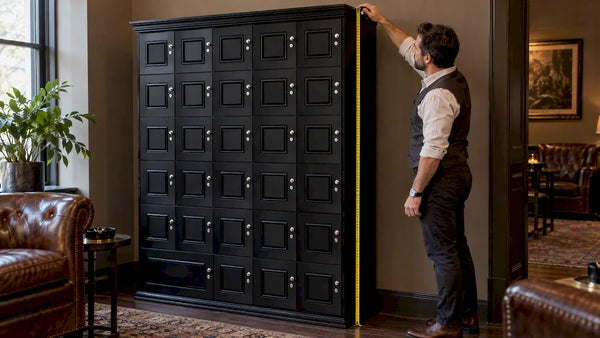
Cigar Locker Dimensions: Sizing Guide for Collectors and Lounges
Cigar locker dimensions explained: compartment sizes, cabinet footprints, capacity math and clearances, so you size a locker bank...
Read Article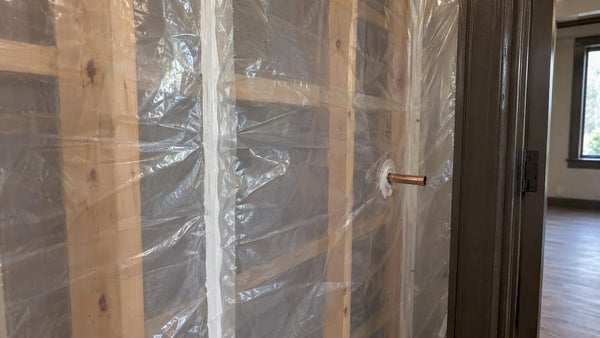
Sealing a Walk-In Humidor: Envelope, Door and Penetrations
How to seal a walk-in humidor properly: vapor barrier placement, door gasket, penetrations and the controlled airflow a...
Read Article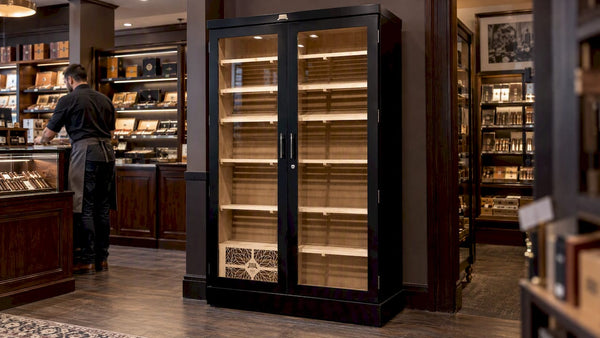
Retail Humidor ROI: How to Measure What a Display Earns
What does a retail or lounge humidor really return? A practical framework for cigar shops, lounges and clubs:...
Read Article