

Discover what are humidor trays and how they maximize your cigar storage. Learn to enhance aging and ensure optimal climate control!
Not every humidor needs a tray, and yet most aficionados assume otherwise. That assumption, left unchallenged, can quietly undermine months of careful conditioning and aging. The truth is that trays aid separation but can hinder if overfilled or non-vented, meaning the wrong tray, placed in the wrong humidor, can disrupt the very climate you’ve worked so hard to maintain. In the sections ahead, we’ll walk you through exactly what humidor trays are, how they function, where they shine, where they fall short, and how to use them with the precision your collection deserves.
Table of Contents
- What are humidor trays and why do they matter?
- Key benefits and common drawbacks of using humidor trays
- Types of humidor trays and best use cases
- Tips for getting the most from your humidor trays
- Why the best cigar storage often means thinking beyond the tray
- Explore luxury humidor collections and expert guidance
- Frequently asked questions
Key Takeaways
| Point | Details |
|---|---|
| Trays are optional tools | Humidor trays can help with organization but aren’t required for every setup. |
| Proper ventilation is crucial | A tray without slats or holes can cause uneven humidity and harm cigars. |
| Tailor to your humidor size | Large humidors benefit most from trays, while small boxes may work better without them. |
| Care boosts cigar longevity | Regular cleaning and correct cigar rotation preserve quality and prevent issues. |
| Expert choices enhance storage | Adapting your tray use to your unique collection and humidor design brings the best results. |
What are humidor trays and why do they matter?
Now that you’re aware that using a tray isn’t a one-size-fits-all solution, let’s clarify exactly what humidor trays are and how they work.
A humidor tray is a removable shelf or platform placed inside a humidor to organize and separate cigars. Most trays are constructed from Spanish Cedar, the same aromatic wood that lines the interior of premium humidors. Spanish Cedar is prized for its natural ability to absorb and release moisture, which helps maintain stable relative humidity throughout the storage environment. Some trays are made from acrylic or composite materials, particularly in modern or electronic humidor designs where aesthetics and visibility take priority.
Structurally, trays vary from simple flat platforms to slotted designs that cradle individual cigars. The slotted format keeps cigars from rolling, prevents contact between wrappers, and allows conditioned air to circulate beneath and around each stick. That airflow matters enormously. When humidity is unevenly distributed, cigars closest to the humidification source can become over-humidified, while those farther away may dry out.
Here’s a quick overview of the most common tray materials and their characteristics:
| Material | Humidity absorption | Airflow design | Best for |
|---|---|---|---|
| Spanish Cedar | Excellent | Slotted or open | Traditional wood humidors |
| Acrylic | None | Slotted or solid | Modern and electronic humidors |
| Composite wood | Moderate | Varies | Mid-range desktop humidors |
| Solid hardwood | Low | Solid (limited airflow) | Decorative or display humidors |
The core functions of a humidor tray include:
- Separation: Keeps cigars from touching, which protects delicate wrappers from bruising and prevents flavor transfer between different blends.
- Organization: Allows collectors to sort cigars by brand, vitola, ring gauge, or vintage, turning a humidor into a curated library rather than a pile.
- Airflow support: When properly vented, trays create micro-channels that help conditioned air reach every cigar in the stack.
- Inventory management: Trays make it far easier to rotate stock, inspect for mold, and track aging timelines without disturbing the entire collection.
For serious collectors storing 50 or more cigars, a well-designed tray system is practically indispensable. However, as noted in our humidor care guides, smaller humidors may actually perform better without trays, particularly when the tray sits too close to the humidification source and creates a barrier that skews humidity distribution.
Key benefits and common drawbacks of using humidor trays
With a clear definition in hand, it’s critical to weigh the real pros and cons of including a tray in your cigar storage setup.
| Benefit | Drawback |
|---|---|
| Separates cigars to protect wrappers | Can block airflow if solid or overfilled |
| Enables organized, curated storage | Reduces total cigar capacity in the humidor |
| Supports even humidity distribution (when vented) | Non-vented trays create humidity dead zones |
| Simplifies rotation and inspection | Adds cost and complexity to the setup |
| Protects against cross-flavor contamination | Misplaced trays near humidifiers can cause over-humidification |
The decision to use a tray should be deliberate, not default. Here is a numbered guide to help you decide:
- Use a tray when your humidor holds 50 or more cigars and you need structured organization to manage your collection without disturbing every stick during each access.
- Use a tray when you store multiple brands or blends and want to prevent the subtle but real phenomenon of flavor migration between cigars stored in close contact.
- Use a tray when your humidor is a cabinet or tower design where vertical space allows for multiple tray levels without crowding.
- Skip the tray when you own a compact desktop humidor holding fewer than 25 cigars, where a tray may sit directly beside the humidification element and create uneven moisture distribution.
- Skip the tray when your preferred humidor is a travel model, where space is at a premium and cigars are already nestled snugly in a foam or cedar-lined cavity.
- Skip the tray when the tray you’re considering is solid-bottomed with no ventilation slots, as it will act as a barrier rather than a facilitator of airflow.
The risk of overfilling a tray is one of the most overlooked mistakes in cigar storage. When cigars are packed too tightly into a tray, the slots designed to allow airflow become obstructed. The result is a localized pocket of stagnant, often over-humidified air that can encourage mold growth on the wrappers of cigars in that zone. As trays can hinder if overfilled or non-vented, maintaining generous spacing within the tray is not optional; it is foundational.
Pro Tip: To test whether your tray allows adequate air movement, place a very thin strip of tissue paper beneath the tray after loading it with cigars. Open the humidor briefly and observe whether the tissue shows any movement from circulating air. If it lies completely still, your tray may be blocking airflow and you should consider a slotted replacement or reduce the number of cigars on the tray.
The most overlooked risk in tray use isn’t the tray itself. It’s the assumption that any tray is better than no tray. A solid, overcrowded tray can create the very conditions it was meant to prevent: uneven humidity, stagnant air, and compromised cigars.
For aficionados exploring desktop humidor options or compact travel humidors, understanding this distinction before purchasing is far more valuable than learning it after a prized Cohiba develops an unwanted bloom.
Types of humidor trays and best use cases
Knowing the pros and cons is only part of the picture. Choosing the right tray depends on your specific setup and needs.
The market offers several distinct tray formats, each suited to a different humidor type and collector profile. The table below maps tray types to their ideal environments:
| Tray type | Material | Airflow | Ideal humidor size | Best use case |
|---|---|---|---|---|
| Slotted Spanish Cedar | Spanish Cedar | Excellent | Large cabinet, tower | Aging collections of 100+ cigars |
| Solid Spanish Cedar | Spanish Cedar | Poor | Small desktop | Display only; avoid for active storage |
| Acrylic slotted | Acrylic | Good | Electronic humidors | Visibility-focused modern collections |
| Wire or mesh | Metal | Excellent | Walk-in or commercial | High-volume storage with zonal control |
| Composite slotted | Composite wood | Moderate | Mid-range desktop | Everyday collectors, 25 to 75 cigars |
Slotted Spanish Cedar trays are the gold standard for traditional humidors. The wood itself participates in humidity regulation, absorbing excess moisture and releasing it when levels drop. For large cabinet humidor choices, multiple tiers of slotted Spanish Cedar trays create a perfectly balanced ecosystem where every cigar receives consistent conditioning regardless of its position in the stack.
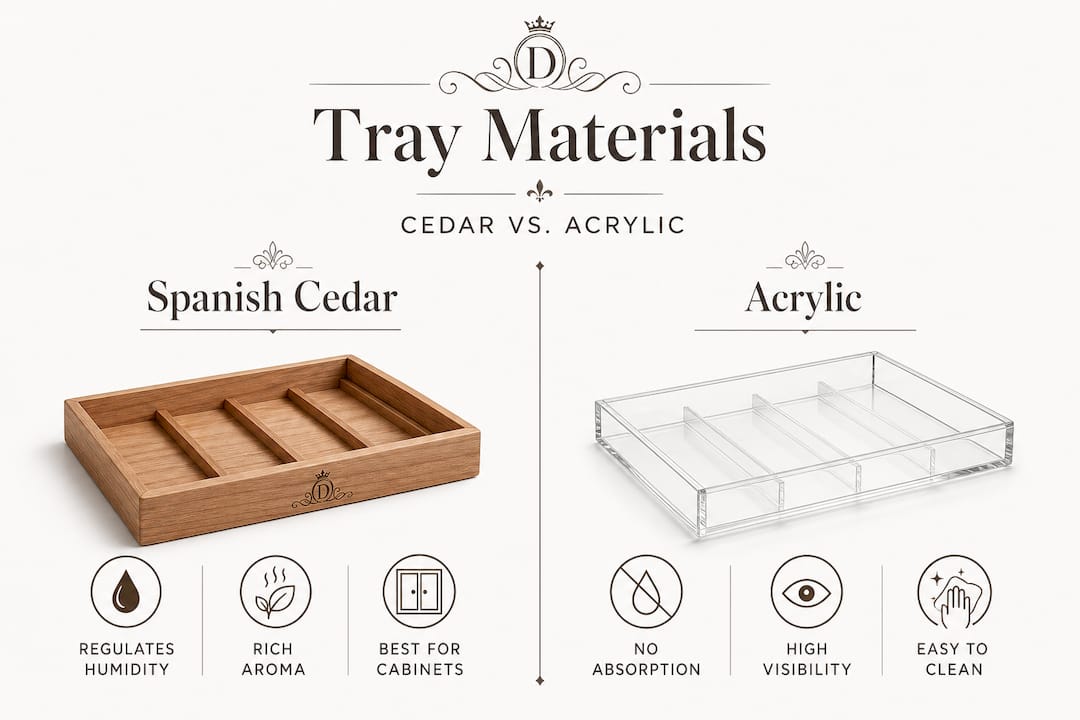
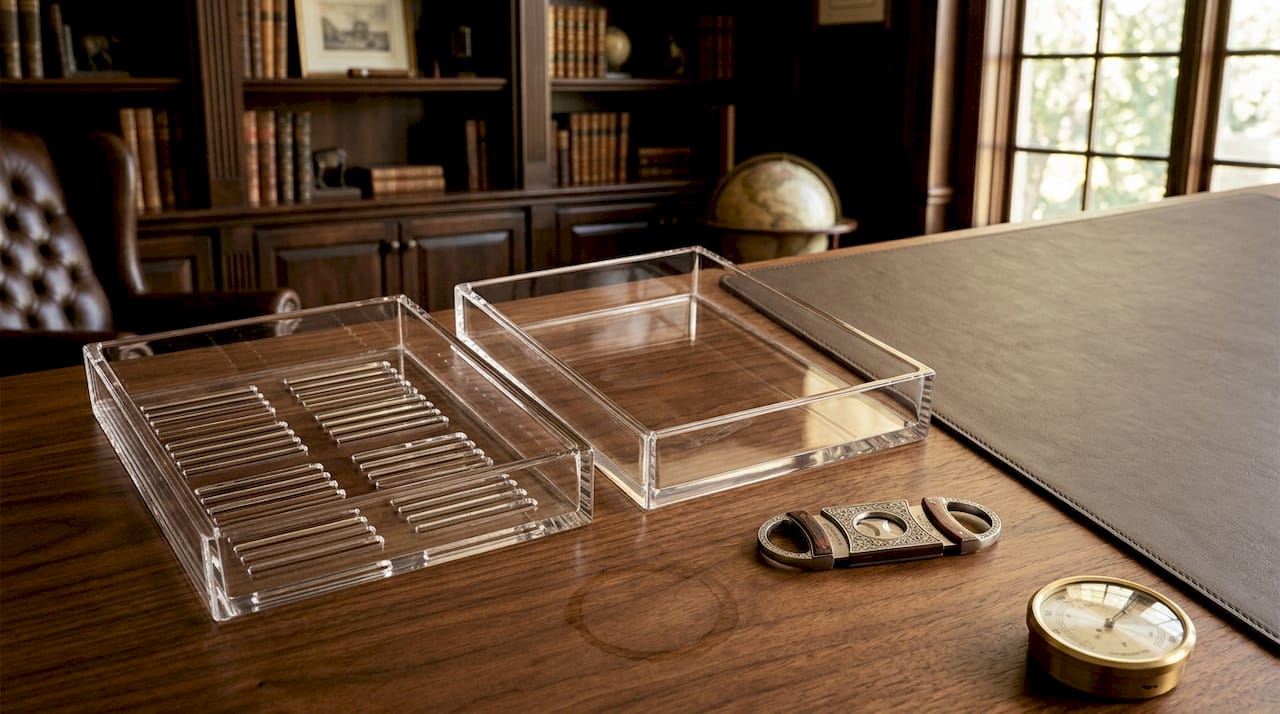
Acrylic trays serve a different purpose. They do not interact with humidity at all, which means the humidor’s active system carries the full burden of climate control. However, their transparency makes them ideal for collectors who want to view their inventory at a glance without opening the humidor unnecessarily. They pair well with electronic humidor options that use digital sensors and fans to maintain precise relative humidity levels.
Wire and mesh trays are almost exclusively found in commercial or walk-in humidors. Their open structure offers virtually no resistance to airflow, making them ideal for environments where zonal climate control systems push conditioned air through the space in a deliberate pattern.
Key considerations when selecting a tray type:
- For collections under 25 cigars, small humidors may avoid trays entirely to prevent uneven humidity near the humidifier source.
- For collections between 25 and 75 cigars, a single composite or slotted cedar tray provides organization without over-engineering the setup.
- For collections exceeding 100 cigars, a multi-tier slotted Spanish Cedar tray system within a cabinet humidor is the most reliable approach to maintaining consistent aging conditions across the entire inventory.
Some seasoned collectors who maintain smaller desktop humidors deliberately forgo trays and instead lay cigars directly on the Spanish Cedar floor of the humidor, rotating them manually every few weeks. This approach eliminates any risk of tray-related airflow obstruction and keeps the humidity environment as open and natural as possible.
Tips for getting the most from your humidor trays
Once you’ve chosen the right tray, smart habits go a long way toward consistently high-quality cigar storage.
Even the finest tray in the most precisely engineered humidor will underperform without attentive maintenance. The following practices will help you protect your investment and honor the craftsmanship of every cigar in your collection.
Do’s:
- Rotate cigars every three to four weeks, moving those on the upper tray to the lower position and vice versa, to ensure every cigar spends equal time at every humidity level within the humidor.
- Clean trays every two to three months using a dry, lint-free cloth. Never use water or cleaning solutions on Spanish Cedar trays, as moisture can warp the wood and introduce unwanted odors.
- Inspect every cigar during rotation for any signs of mold, which appears as a white or blue-gray powdery bloom on the wrapper. Mold spreads rapidly in a closed environment, and early detection is essential.
- Leave space between cigars on the tray. A tray filled to 70 percent capacity performs significantly better than one packed to the brim.
- Use separate trays for flavored or infused cigars. Flavored cigars release aromatic compounds that can transfer to natural cigars stored nearby, subtly altering their taste profile over time.
Don’ts:
- Do not stack cigars in multiple layers on a single tray. Each layer reduces airflow to the cigars beneath it.
- Do not place a solid-bottomed tray directly above the humidification source. The tray will trap humidity beneath it and create an over-humidified zone.
- Do not use trays made from unfinished or untreated composite wood that may off-gas chemicals into the humidor environment.
- Do not neglect the smell of your tray. A musty or sour odor from the tray itself is a warning sign that mold or bacteria have taken hold in the wood grain.
Pro Tip: Use your trays as a living catalog of your collection. Designate one tray for cigars you plan to smoke within the next 30 days, a second for those aging between one and three years, and a third for long-term reserves. This system transforms your humidor from a simple storage box into a curated timeline of memories, and it makes tray-based separation work in your favor rather than against you. Our humidor care guides offer additional strategies for organizing collections of every size.
Why the best cigar storage often means thinking beyond the tray
With practical tips in hand, the real mastery comes with understanding when conventions no longer apply and adapting your approach.
We’ve observed something consistent among the most experienced collectors we work with: they treat tray usage as a variable, not a constant. The conventional wisdom that every humidor should have a tray is a starting point, not a destination. Rigid adherence to that rule misses the nuance that makes the difference between a humidor that merely stores cigars and one that actively elevates them.
Consider the collector who maintains a 25-count desktop humidor alongside a 500-count cabinet. The same tray strategy applied to both setups would be a mistake. In the desktop unit, a tray placed near the humidification element can create a localized zone of excess moisture that softens wrappers and accelerates the risk of mold. As trays can hinder if overfilled or non-vented, and small humidors may avoid trays to prevent uneven humidity, the experienced collector removes the tray from the smaller unit entirely and relies on the cedar floor and careful placement to do the work.
In the cabinet humidor, that same collector uses three tiers of slotted Spanish Cedar trays, each dedicated to a different aging stage. Airflow moves freely through the slotted design, the cedar participates in humidity regulation, and the organization allows for precise inventory management without disturbing aging cigars unnecessarily.
The lesson is that humidor design, cigar inventory size, and airflow patterns all interact in ways that no single rule can capture. We believe, at Dunn Luxury Selections, that the finest cigar storage is always bespoke in its approach. It honors the specific characteristics of the humidor, the collection, and the aficionado’s habits. The tray is a tool. Like any tool, its value depends entirely on how thoughtfully it is applied.
Explore luxury humidor collections and expert guidance
If you’re ready to take your cigar collection to the next level, the right humidor and expert support can make all the difference.
At Dunn Luxury Selections, we’ve built our reputation on precision, prestige, and the unwavering belief that every cigar deserves a sanctuary worthy of its craftsmanship. Whether you’re curating a compact personal collection or building a legacy cellar, our range of solutions is designed to match your ambition.

Explore our cabinet humidor collections, engineered for collectors who demand zonal climate control and multi-tier tray systems that perform as beautifully as they look. Pair your humidor with our expert care guides to develop the maintenance habits that protect your investment for decades. We are not just a destination for luxury humidors. We are the partners who help you get every detail right, from the first cigar you store to the last one you savor.
Frequently asked questions
Should I use a tray in a small desktop humidor?
In most cases, no. Small humidors often work better without trays because a tray positioned near the humidification source can block airflow and cause uneven humidity distribution across the interior.
How do I know if my humidor tray has proper ventilation?
A properly designed tray will feature slats or perforations that allow conditioned air to circulate freely beneath and around your cigars. If your tray has a solid bottom with no ventilation, it will act as a barrier rather than a facilitator of airflow and should be replaced.
Is it safe to store different cigar types or flavors on the same tray?
It is generally not recommended. Flavored and infused cigars release aromatic compounds that migrate to natural cigars stored nearby, and using trays for separation is one of the most effective ways to prevent cross-contamination and preserve the integrity of each blend.
How often should I clean and rotate my humidor tray?
Rotate your cigars every three to four weeks and clean your trays every two to three months using a dry cloth. Consistent rotation and inspection help prevent mold and ensure that overfilling or non-vented conditions don’t quietly compromise your collection between maintenance sessions.
Recommended
You May Also Enjoy
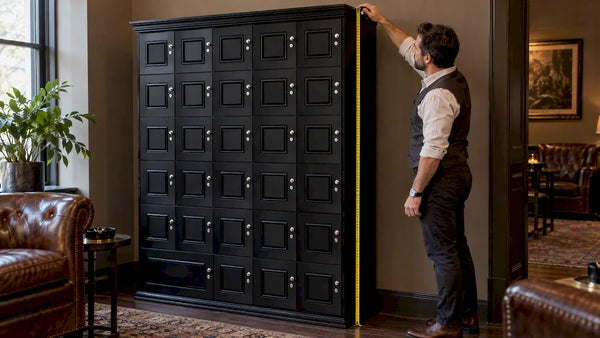
Cigar Locker Dimensions: Sizing Guide for Collectors and Lounges
Cigar locker dimensions explained: compartment sizes, cabinet footprints, capacity math and clearances, so you size a locker bank...
Read Article
Sealing a Walk-In Humidor: Envelope, Door and Penetrations
How to seal a walk-in humidor properly: vapor barrier placement, door gasket, penetrations and the controlled airflow a...
Read Article
Retail Humidor ROI: How to Measure What a Display Earns
What does a retail or lounge humidor really return? A practical framework for cigar shops, lounges and clubs:...
Read Article