

Discover the crucial role of proper humidor placement to preserve your cigars. Learn the best conditions for optimal flavor and quality.
Proper humidor placement is defined as situating your cigar sanctuary in a stable, temperature-controlled environment, away from direct sunlight, drafts, and heat sources, to preserve the integrity of every cigar inside. The role of proper humidor placement is not secondary to the humidor’s construction. It is the foundation upon which every preservation technique rests. A bespoke Spanish Cedar-lined cabinet, even one as precise as the Raching MON1800A, cannot compensate for a volatile room environment. Ideal conditions sit at 65°F to 70°F and 65% to 70% relative humidity. Placement determines whether those conditions hold.
What are the ideal temperature and humidity conditions for humidor placement?
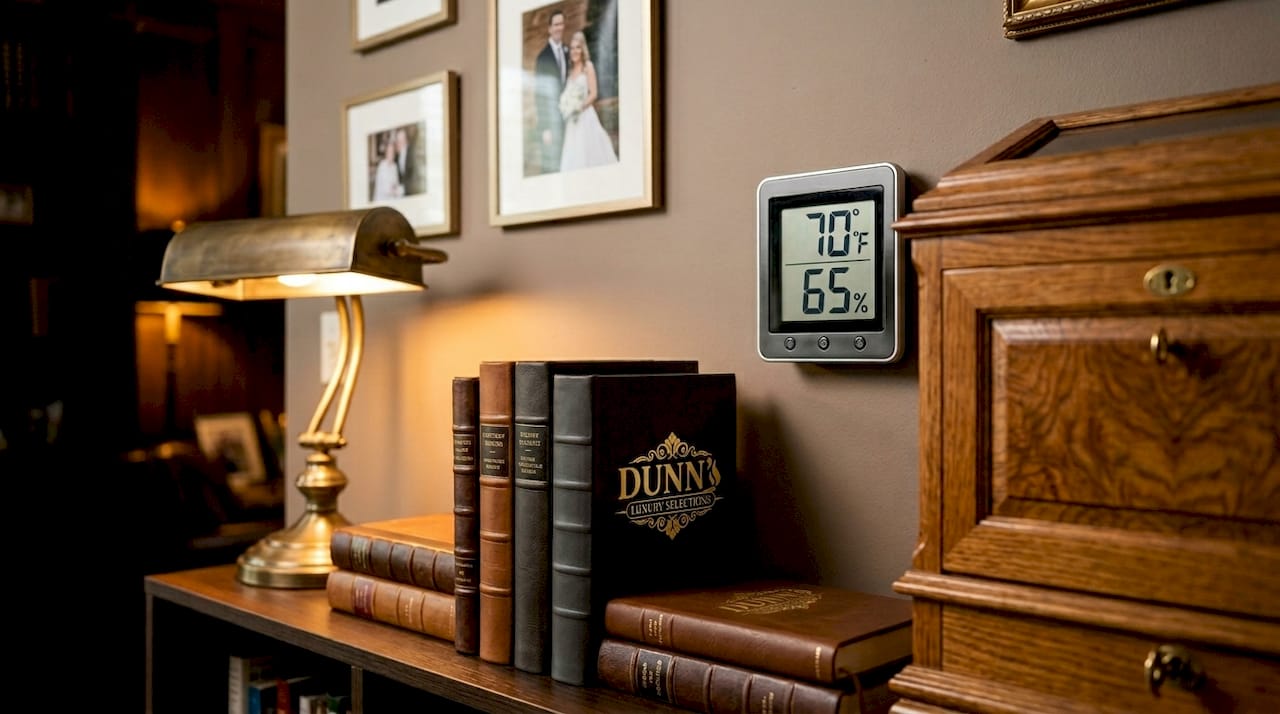
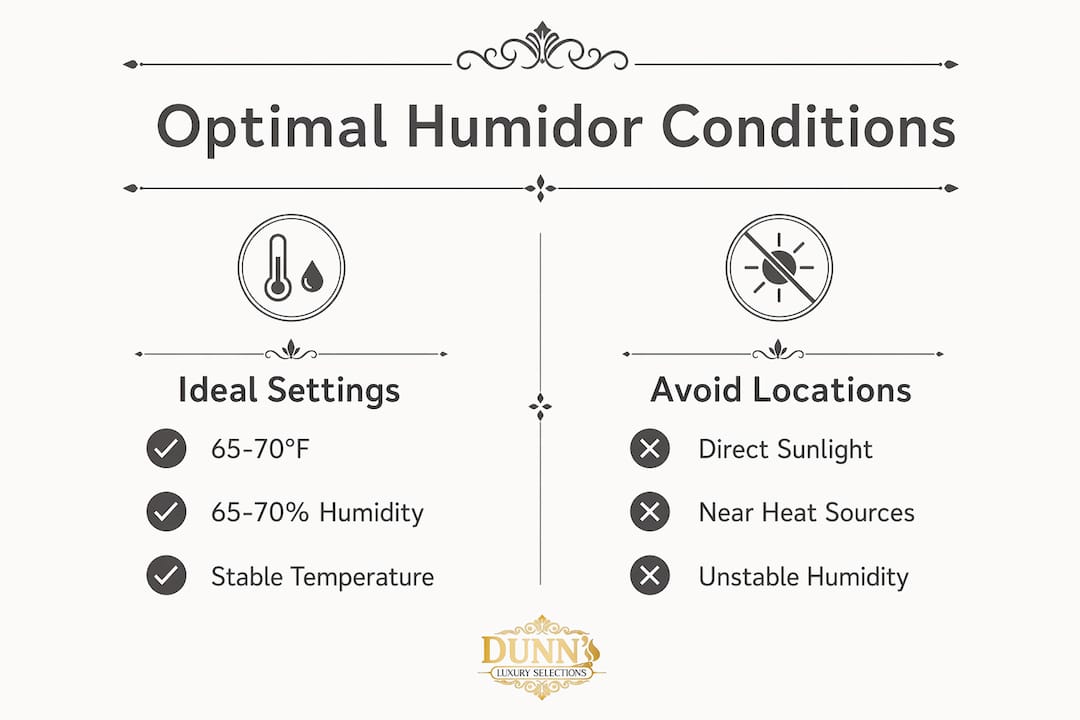
The optimal ambient temperature for a humidor sits between 65°F and 70°F, with 68°F recognized as the gold standard by experienced collectors. At this temperature, tobacco oils remain stable, the aging process continues at a measured pace, and the risk of tobacco beetle activity stays negligible. Stray above 72°F consistently, and you create conditions where beetle larvae can hatch, destroying an entire collection.
Relative humidity should be maintained concurrently at 65% to 70%. This range keeps the wrapper leaf supple without encouraging mold growth, which typically appears above 75% humidity. The two variables are inseparable. A room that holds 68°F but swings between 40% and 80% humidity across seasons will still compromise your cigars.
The table below illustrates how different ambient environments compare against the ideal storage window:
| Environment | Typical Temp Range | Typical Humidity | Suitability |
|---|---|---|---|
| Climate-controlled interior room | 65°F to 72°F | 45% to 60% | Excellent with humidification |
| Finished basement | 60°F to 68°F | 55% to 65% | Good, monitor for cold spikes |
| Home office with HVAC | 68°F to 74°F | 40% to 55% | Acceptable, supplement humidity |
| Kitchen or bathroom | 65°F to 80°F | 60% to 85% | Poor, too variable |
| Garage or attic | 40°F to 100°F+ | Highly variable | Unacceptable |
Fluctuations, not averages, cause the most damage. A room that averages 68°F but swings 15 degrees between morning and night puts cigars through repeated cycles of expansion and contraction. The wrapper leaf, which is the most delicate component of any premium cigar, absorbs and releases moisture with every shift. Over weeks, this degrades both texture and flavor with measurable precision.
Pro Tip: Install a digital hygrometer and thermometer in the room where your humidor lives, not just inside the humidor itself. Monitoring ambient conditions gives you the full picture before problems reach your cigars.
Where should you avoid placing your humidor?
Certain locations in a home are categorically unsuitable for cigar storage, regardless of the humidor’s quality. Experts warn against placing humidors in garages, attics, basements, kitchens, and bathrooms. Each of these spaces shares a common flaw: they are subject to temperature swings that no passive humidor can absorb.
The most damaging single factor is direct sunlight. UV radiation penetrates wrapper leaf and degrades the essential oils that give a premium cigar its character. Beyond UV damage, a south-facing windowsill can raise the internal temperature of a desktop humidor by 10°F to 15°F within an hour. That spike alone can trigger the conditions for mold or beetle activity.
Locations to avoid, and the specific reason each fails:
- Near heating and cooling vents: Forced air creates rapid humidity swings and desiccates cigars faster than almost any other placement error.
- On exterior walls: These walls conduct outdoor temperature changes directly into the room, creating a cold or hot zone that the humidor absorbs.
- Near windows or glass doors: Even without direct sun exposure, glass radiates cold in winter and heat in summer, creating a microclimate that works against stable storage.
- In kitchens: Cooking generates steam, grease particles, and heat spikes. Cigars absorb ambient odors, and a kitchen-stored collection will eventually taste like the room.
- In bathrooms: Humidity in bathrooms is erratic and often extreme. Shower steam followed by dry air creates the exact fluctuation cycle that damages wrapper integrity.
- In garages or attics: These spaces are effectively outdoors in terms of temperature range. Summer attic temperatures can exceed 130°F in many American climates.
Pro Tip: If your only available space runs warm in summer, place the humidor on an interior shelf at mid-height rather than on the floor or near the ceiling. Heat stratifies upward, and even a few feet of vertical distance can reduce ambient temperature by 3°F to 5°F.
How does placement affect internal humidor climate control?
The humidor is an instrument of stability, not an active climate controller. A humidor maintains a steady microclimate but cannot correct for poor external conditions. This distinction separates collectors who preserve their cigars beautifully from those who wonder why their collection deteriorates despite owning a quality box.
Rapid temperature changes cause cigars to expand and contract, damaging wrappers and degrading burn quality. Spanish Cedar lining provides thermal mass that resists sudden shifts, but this buffer has limits. A humidor placed near a heating vent will cycle through temperature stress every time the furnace runs, multiple times per day in winter. No amount of Spanish Cedar compensates for that frequency of disruption.
The comparison between passive and electric humidors clarifies the stakes:
| Feature | Passive humidor | Electric climate-controlled humidor |
|---|---|---|
| Temperature regulation | Relies entirely on ambient room conditions | Active cooling and heating within ±1°F to 2°F |
| Humidity regulation | Passive humidification device, requires monitoring | Automated, maintains target RH consistently |
| Sensitivity to placement | High. Poor placement directly degrades performance | Moderate. Reduces but does not eliminate placement impact |
| Best use case | Stable, climate-controlled rooms | Any serious collection, long-term aging |
| Example product | Desktop or cabinet humidor with Spanish Cedar | Raching MON1800A electric cabinet |
Electric climate-controlled humidors maintain temperature and humidity within ±1% to 2%, which reduces manual monitoring and seasonal adjustments significantly. For a collector aging Cohiba Behike or Arturo Fuente Opus X over years, that precision is not a luxury. It is the difference between a cigar that reaches its peak and one that never gets there.
Pro Tip: Open your humidor when the temperature difference between the room and the humidor interior is smallest, typically in the evening when room temperatures stabilize. This minimizes humidity loss and preserves equilibrium.
Practical tips for choosing the best humidor location at home
Selecting the right location is a deliberate act of curation, not an afterthought. The following numbered framework reflects the priorities that serious collectors apply when positioning their humidors for long-term performance.
-
Choose an interior room with stable HVAC coverage. A climate-controlled study, library, or dedicated cigar room represents the ideal placement environment. These spaces maintain consistent temperature year-round and are insulated from outdoor extremes.
-
Position away from all exterior walls, windows, and heat sources. The center of an interior room, or against an interior wall, provides the most thermally stable position. Distance from windows reduces UV exposure and radiant temperature transfer.
-
Place on a sturdy, level surface. A humidor that sits unevenly allows humidity to pool in one section and starve another. Solid wood furniture or purpose-built shelving distributes weight and keeps the seal consistent.
-
Keep the humidor at least half full. A partially filled humidor loses humidity faster because there is less tobacco mass to absorb and release moisture gradually. If your collection is small, use a smaller humidor or fill empty space with cedar spills to maintain equilibrium.
-
Adjust placement seasonally. Seasonal changes in home climate require active attention to humidor location. A spot that works perfectly in October may sit too close to a radiator by January. Reassess every time you change your home’s heating or cooling settings.
-
Never use quick-fix temperature solutions. Placing ice packs near a humidor causes condensation and erratic temperature swings that are more damaging than the original problem. Relocate the humidor to a stable environment instead.
-
Consider a dedicated electronic humidor if your home lacks a consistently stable room. For collectors in climates with extreme seasonal variation, an electric unit removes the dependency on ambient conditions entirely.
The humidor location importance compounds over time. A cigar stored correctly for two years develops complexity that no shortcut can replicate. Every placement decision you make today is an investment in the experience you will have when you finally light that cigar.
Key takeaways
Proper humidor placement, not just humidor quality, determines whether your cigars age with distinction or deteriorate before their time.
| Point | Details |
|---|---|
| Ideal ambient conditions | Maintain 65°F to 70°F and 65% to 70% relative humidity in the room where the humidor lives. |
| Locations to avoid | Garages, attics, kitchens, bathrooms, and any area near vents, windows, or exterior walls damage cigars over time. |
| Passive vs. electric humidors | Electric units like the Raching MON1800A maintain conditions within ±1% to 2%, reducing placement sensitivity for serious collectors. |
| Seasonal adjustment | Reassess humidor position every season, as heating and cooling changes alter the ambient environment significantly. |
| Stability over perfection | A consistently good location outperforms a theoretically perfect spot that fluctuates. Stability is the primary criterion. |
The placement detail most collectors get wrong
Belle here. After years of working with cigar collectors across the country, the single most common mistake I see is this: a collector invests in a beautiful, well-constructed humidor and then places it on a sideboard directly beneath an air conditioning vent. The humidor is excellent. The location undoes it within weeks.
Many collectors underestimate how much room selection affects humidor performance. The humidor’s environment is as important as its construction. I have seen collectors move a desktop humidor from a kitchen counter to an interior hallway shelf and report a dramatic improvement in consistency within a single month. No new equipment. No new humidification device. Just a better location.
My honest recommendation for anyone aging cigars beyond six months: consider an electric climate-controlled cabinet. Electric humidors provide peace of mind by eliminating manual seasonal adjustments and the climate instability caused by poor placement. They are not a substitute for thoughtful placement, but they reduce the margin for error considerably. For a Padron 1964 Anniversary or an Ashton VSG that you plan to age for three years, that margin matters.
Reassess your humidor’s location at least twice a year. Walk the room in summer and winter. Feel the air near the vent, the window, the exterior wall. Your cigars are telling you what they need. The question is whether you are listening.
— Belle
Discover precision humidor storage at Dunnluxuryselections
At Dunnluxuryselections, we understand that a cigar collection is a legacy, and every detail of its preservation deserves the same care as the cigars themselves.

Our curated selection spans desktop humidors, cabinet humidors built for serious collectors, travel cases, and high-precision electronic units designed to hold your collection at the exact conditions it deserves. Each piece in our catalog is selected for construction quality, climate performance, and the kind of presence that honors what you have built. Whether you are placing your first humidor in a home office or outfitting a dedicated cigar room, Dunnluxuryselections offers the instruments worthy of the occasion. Explore our full range and find the humidor that matches both your collection and your space.
FAQ
What is the ideal room temperature for humidor placement?
The ideal room temperature for humidor placement is between 65°F and 70°F, with 68°F cited most frequently as optimal. Temperatures above 72°F increase the risk of tobacco beetle activity and accelerate humidity loss.
Why does humidor location matter for cigar preservation?
A humidor maintains a stable internal microclimate but cannot correct for poor external conditions. Placing it in a room with temperature swings or high humidity variation forces the humidor to work against its environment, degrading cigar quality over time.
Can direct sunlight damage cigars in a humidor?
Direct sunlight causes internal temperature spikes and UV damage to wrapper leaf, even through a closed humidor lid. Position your humidor away from all windows and glass doors to protect both the cigars and the humidor’s exterior finish.
Should I use an electric humidor if my home has seasonal climate changes?
Electric climate-controlled humidors maintain temperature and humidity within ±1% to 2%, making them the preferred choice for collectors in regions with significant seasonal variation. They reduce the need for manual adjustments and protect long-term aging investments.
How often should I reassess my humidor’s placement?
Reassess humidor placement at least twice a year, ideally when you transition between heating and cooling seasons. Changes in your home’s HVAC usage alter the ambient environment and can shift a previously stable location into a problematic one.
Recommended
You May Also Enjoy
Cigar Locker Dimensions: Sizing Guide for Collectors and Lounges
Cigar locker dimensions explained: compartment sizes, cabinet footprints, capacity math and clearances, so you size a locker bank...
Read Article
Sealing a Walk-In Humidor: Envelope, Door and Penetrations
How to seal a walk-in humidor properly: vapor barrier placement, door gasket, penetrations and the controlled airflow a...
Read Article
Retail Humidor ROI: How to Measure What a Display Earns
What does a retail or lounge humidor really return? A practical framework for cigar shops, lounges and clubs:...
Read Article