

Discover effective humidity control methods to preserve your cigars' quality. Learn how to protect your collection and investment today!
Every serious collector knows the feeling: you reach for a prized Nicaraguan puro or a well-aged Dominican blend, only to find it has dried out, cracked, or worse, developed the faint mustiness that signals mold. Even the finest cigars in the world surrender their character without precise humidity control. The landscape of solutions ranges from time-honored traditions to sophisticated electronic systems, and sorting through the noise of marketing claims and hobbyist folklore can feel overwhelming. This guide cuts through that confusion, giving you a clear, experience-backed framework for choosing the method that best protects your collection, your investment, and the rituals you’ve built around it.
Table of Contents
- What makes an effective humidity control method?
- Traditional solutions: Distilled water and sponge methods
- Modern approaches: Two-way humidity packs
- Electronic humidity control systems
- Comparison of top humidity control methods
- Situational recommendations: Which method fits your collection?
- Experience counts: Why context matters more than tech
- Premium humidors, perfect control: Find your next upgrade
- Frequently asked questions
Key Takeaways
| Point | Details |
|---|---|
| Precision matters | Accurate humidity control directly preserves your cigars’ flavor and structure. |
| Match method to need | Choose humidity solutions based on collection size, budget, and storage duration. |
| Modern packs simplify | Two-way humidity packs offer set-and-forget ease for travel or small boxes. |
| Monitor consistently | Regularly check your humidor’s RH with a quality hygrometer for best results. |
| Context is key | The right method depends on your climate, storage habits, and personal preferences. |
What makes an effective humidity control method?
Before you commit to any system, you need a clear set of criteria. Not every method performs equally across different collection sizes, climates, or storage goals, and understanding what separates a reliable solution from a frustrating one will save you both money and heartbreak.
The single most important metric is the ability to maintain relative humidity (RH) consistently between 65% and 72%. This range preserves the natural oils and tobaccos that define a cigar’s aroma, draw, and flavor profile. Stray below 65% and your cigars begin to dry, the wrapper cracks, and the blend loses its complexity. Push above 72% and you invite mold, beetle activity, and a spongy, unpleasant draw.
Beyond that core target, consider these key criteria when evaluating any humidity control method:
- Adaptability: Can the system respond to seasonal changes in ambient temperature and humidity?
- Ease of use: Does it require daily attention, or can it operate reliably for weeks at a time?
- Maintenance demands: How often does it need refilling, replacing, or recalibrating?
- Scalability: Is it suited to a 20-count desktop box, a 500-count cabinet, or a walk-in room?
- Mold risk: Does the method introduce standing liquid or excessive moisture that could compromise your cigars?
The risks at either extreme are real. Insufficient humidity causes splitting, flavor loss, and a harsh, uneven burn. Excessive humidity encourages Aspergillus mold and tobacco beetles, both of which can devastate an entire collection in a matter of weeks. Reviewing our humidor care guides will give you a deeper understanding of how these variables interact across different storage environments.
Pro Tip: Always monitor RH with a calibrated digital hygrometer, regardless of which humidity control method you use. Analog gauges are notoriously inaccurate and can give you a false sense of security. Calibrate your hygrometer using the salt test at least twice a year.
Traditional solutions: Distilled water and sponge methods
With those criteria in mind, let’s start with the standby most hobbyists try first: the classic distilled water method. It has endured for generations because it is accessible, inexpensive, and requires no specialized equipment. The setup is straightforward: a small sponge or foam reservoir is saturated with distilled water and placed inside a sealed humidor. As the air inside dries, the moisture evaporates from the sponge and raises the ambient RH.
The appeal is undeniable. You likely have everything you need already, and the learning curve is minimal. For a collector just beginning to build a small desktop collection, this approach can work reasonably well when managed attentively. As distilled water in a sponge is a classic solution, it does require frequent monitoring to avoid mold and swings in RH.
That said, the limitations become apparent quickly. The method is inherently imprecise. The rate of evaporation depends on ambient temperature, the quality of your humidor’s seal, and how often you open it. Without consistent attention, RH can swing wildly, and overfilling the sponge is an easy mistake that creates pooling moisture.
Pros of the distilled water method:
- Very low upfront cost
- Widely available materials
- Simple to set up and understand
- Good entry point for new collectors
Cons of the distilled water method:
- Requires frequent inspection and refilling
- Difficult to achieve or maintain precision RH
- High mold risk if overfilled or neglected
- Not suitable for large collections or long-term aging
“Improper maintenance can result in uneven humidity, affecting cigar quality.”
For collectors who store their cigars in cabinet humidor methods, the distilled water approach becomes even less practical. The larger the storage volume, the more difficult it is to maintain consistent RH with a passive sponge system. It simply cannot scale.
Modern approaches: Two-way humidity packs
While tradition has its place, many collectors are adopting newer solutions designed for precision and convenience. Two-way humidity packs represent one of the most significant practical advances in cigar storage over the past two decades. Brands like Boveda have made these packs nearly ubiquitous in the cigar world, and for good reason.
The science is elegant in its simplicity. Each pack contains a saturated salt solution sealed within a semi-permeable membrane. When ambient RH drops below the pack’s rated level, the solution releases moisture. When RH rises above that level, the pack absorbs it. The result is a self-regulating microclimate that requires no active intervention from you.
Sealed-container approaches using two-way humidity packs are ideal for travel or temporary storage and avoid the risks associated with open liquid reservoirs entirely. This makes them particularly valuable for collectors who travel with their cigars or store smaller lots in airtight containers.
Pros of two-way humidity packs:
- Consistent, preset RH with no manual adjustment
- Zero active maintenance for weeks or even months
- Dramatically reduced mold risk compared to open liquid systems
- Available in multiple RH ratings (58%, 62%, 65%, 69%, 72%)
- Compact and portable, ideal for travel humidors
Cons of two-way humidity packs:
- Recurring cost as packs deplete and require replacement
- Less customizable for large-volume or long-term aging environments
- Cannot compensate for a poorly sealed humidor
Pro Tip: Combine two-way packs with airtight travel humidor solutions for foolproof results on the road. A well-sealed travel humidor with a single properly rated pack can maintain optimal RH for the duration of most trips without any intervention.
For collectors managing a small to mid-size desktop collection, two-way packs offer an exceptional balance of precision, convenience, and reliability. The cost per pack is modest, and the peace of mind they provide is considerable.
Electronic humidity control systems
For large or growing collections, or if you want to age cigars for years, it’s worth considering digital solutions. Electronic humidity control systems represent the pinnacle of precision in cigar storage, and for collectors who treat their humidors as long-term aging sanctuaries, the investment is entirely justified.
These systems typically consist of a digital humidity sensor, an automatic humidification unit that activates when RH drops below a set threshold, and in more advanced configurations, a small fan that ensures even moisture distribution throughout the storage space. The result is a climate that responds dynamically to changes in ambient conditions without any manual input.
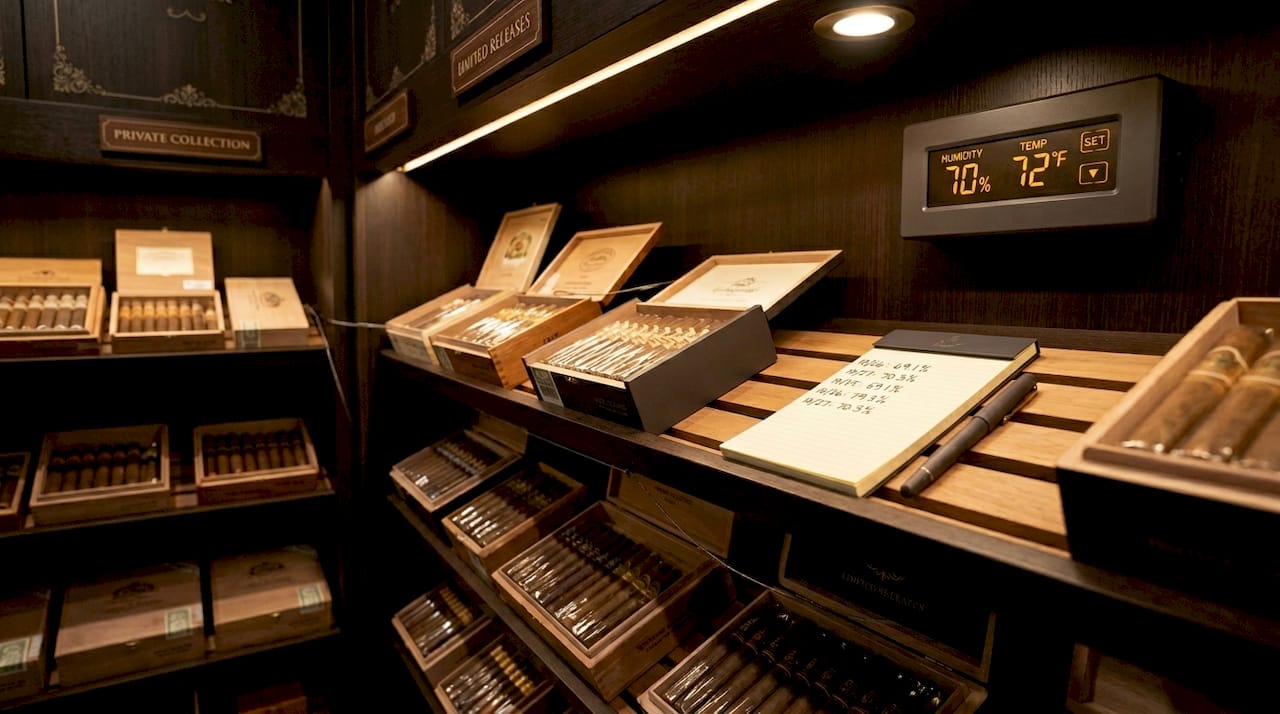
Electronic humidity regulation eliminates manual interventions and is favored for large collections and serious aging, where even minor fluctuations can alter the trajectory of a cigar’s development over months and years.
The precision advantage is significant. Electronic systems maintain RH within ±2%, a level of control that passive methods simply cannot match. For a collection of rare limited editions or vintage cigars that represent years of patient acquisition, this precision is not a luxury. It is a necessity.
Pros of electronic systems:
- Exceptional precision, typically ±2% RH
- Fully automated, minimal daily involvement
- Ideal for large cabinets, walk-in rooms, and aging collections
- Fan circulation prevents humidity stratification
- Programmable settings for different aging stages
Cons of electronic systems:
- Significantly higher upfront cost
- Requires a power source
- Periodic maintenance including refilling the humidification solution and cleaning sensors
- Overkill for small collections of 50 cigars or fewer
For collectors curating a high-value aging collection, explore electronic humidor options that integrate seamlessly with premium cabinetry and deliver the kind of climate consistency that serious aging demands.
Comparison of top humidity control methods
Let’s bring all these options together in a clear side-by-side comparison.
| Method | Precision | Maintenance | Ideal use case | Mold risk | Avg. cost |
|---|---|---|---|---|---|
| Distilled water/sponge | Low | High (weekly) | Beginners, small collections | Moderate to high | $5 to $15 |
| Two-way humidity packs | High | Low (monthly) | Travel, small to mid collections | Low | $10 to $30/set |
| Electronic system | Very high (±2%) | Moderate (quarterly) | Large collections, long-term aging | Very low | $100 to $500+ |
The trade-offs are clear. The distilled water method wins on initial cost but loses on precision and reliability. Two-way packs strike an excellent balance for most collectors. Electronic systems demand the highest investment but deliver unmatched control for serious aging environments.
For collectors managing a desktop humidor, two-way packs are almost always the superior choice over distilled water, offering better precision with far less effort.
Situational recommendations: Which method fits your collection?
Now, knowing the strengths and drawbacks, let’s help you match a method to your real-world needs. The right answer depends on your collection size, your habits, your climate, and your goals.
-
Small desktop collection (under 50 cigars): Two-way humidity packs are the clear choice. They are precise, low-maintenance, and perfectly scaled for a compact humidor. A pair of 69% packs placed inside a well-sealed box will maintain ideal conditions for weeks without any attention.
-
Large cabinet humidor (100 to 500 cigars): An electronic system earns its cost here. The volume of air inside a large cabinet requires active management, and passive methods will struggle to maintain consistent RH throughout the space. Fan circulation becomes especially important to prevent humidity stratification, where the bottom of the cabinet is wetter than the top.
-
Vacation or travel storage: Travel humidors or sealed containers with two-way packs are best for short-term and mobile storage needs. A small airtight case with a single properly rated pack will protect your travel selection without any fuss.
-
Long-term aging (2 or more years): This is where electronic control truly justifies its price. Aging cigars undergo complex biochemical changes that are highly sensitive to environmental consistency. Even modest RH swings over a multi-year period can alter flavor development in ways that cannot be reversed.
-
Walk-in or room-sized storage: For collectors fortunate enough to dedicate a room to their collection, explore walk-in humidor advice and consider a commercial-grade electronic system with zonal climate control capabilities.
Pro Tip: For aging, pair RH control with active temperature management. Ideal aging temperature sits between 65°F and 70°F. Higher temperatures accelerate aging but increase beetle risk. Lower temperatures slow development but offer greater stability for very long-term storage.
Experience counts: Why context matters more than tech
Here is the perspective we rarely see discussed openly: the most advanced system in the world will underperform a modest, well-managed setup if the collector does not understand their own environment. We have spoken with aficionados who invested in premium electronic systems only to find their collections suffering because the humidor was placed near a heating vent, in a room with extreme seasonal swings, or in a space that was opened and closed dozens of times a day.
Technology is only as effective as the context in which it operates. A collector in coastal Florida managing a 30-count desktop box with two-way packs and a calibrated hygrometer, who checks conditions weekly and understands how summer humidity affects their storage space, will consistently outperform someone who installed an expensive electronic system without accounting for the ambient conditions of their storage room.
“The best humidity control method is not the most expensive one. It is the one you understand, monitor, and adapt to your specific environment.”
This is not an argument against investing in quality. It is an argument for knowing your environment first. Before upgrading your system, spend a month tracking ambient temperature and humidity in your storage space. Note how conditions change with the seasons. Understand how often you open your humidor and how that affects RH recovery. Then choose your method. Our detailed care guides provide the frameworks experienced collectors use to make these assessments with precision.
The collectors who preserve their cigars most beautifully are not necessarily those with the most sophisticated equipment. They are the ones who approach storage as a craft, with the same patience and attentiveness they bring to the cigars themselves.
Premium humidors, perfect control: Find your next upgrade
If you’re ready to enhance your cigar storage and make your chosen method easier, consider these curated options.

At Dunn Luxury Selections, we understand that every collection is unique, and every collector deserves a storage solution built to match their precision and passion. Whether you’re curating a small but exceptional desktop collection or building a legacy aging room, our range of premium desktop humidors and advanced electronic humidors are crafted to complement every humidity control method discussed here. Pair your chosen system with our detailed humidor care guides to ensure your collection ages with the grace and complexity it deserves. Precision, prestige, and presence: that is the standard we hold, and the standard your collection deserves.
Frequently asked questions
What humidity level is ideal for cigars?
Cigars are best stored at 65 to 72% relative humidity, a range that preserves essential oils, maintains wrapper integrity, and supports optimal flavor development over time.
How often should I check my humidor’s humidity?
Check the humidity level at least once a week with a calibrated digital hygrometer, and more frequently during seasonal transitions when ambient conditions shift significantly.
Are two-way humidity packs safe for long-term storage?
Two-way humidity packs are best for travel and temporary storage, and while they can support longer-term collections, they require more frequent replacement than an electronic system would in a high-volume environment.
Can I use tap water in my humidor?
It’s not recommended. Using distilled water avoids the risks of mineral buildup, bacterial contamination, and mold that tap water introduces into the delicate microclimate of your humidor.
Do I need different methods for large and small collections?
Absolutely. Electronic humidity regulation is favored for large collections requiring consistent, automated control, while small or travel collections perform excellently with two-way packs or carefully managed distilled water systems.
Recommended
You May Also Enjoy

Cigar Locker Dimensions: Sizing Guide for Collectors and Lounges
Cigar locker dimensions explained: compartment sizes, cabinet footprints, capacity math and clearances, so you size a locker bank...
Read Article
Sealing a Walk-In Humidor: Envelope, Door and Penetrations
How to seal a walk-in humidor properly: vapor barrier placement, door gasket, penetrations and the controlled airflow a...
Read Article
Retail Humidor ROI: How to Measure What a Display Earns
What does a retail or lounge humidor really return? A practical framework for cigar shops, lounges and clubs:...
Read Article