

Discover what a walk-in humidor is and learn expert tips to design the perfect environment for your cigars. Optimize your collection today!
Most aficionados assume a walk-in humidor is simply a larger version of the cabinet humidor sitting in their study. Seal it tight, load in the cigars, and let the humidity do its work. That assumption, however, misses a critical truth: the finest walk-in humidors are precisely engineered environments, not just oversized sealed boxes. They require a carefully calibrated balance of humidity, temperature, and controlled air exchange that transforms a room into a living sanctuary for your collection. This guide covers everything you need to know to build, buy, or optimize a walk-in humidor worthy of your finest leaves.
Table of Contents
- What defines a walk-in humidor?
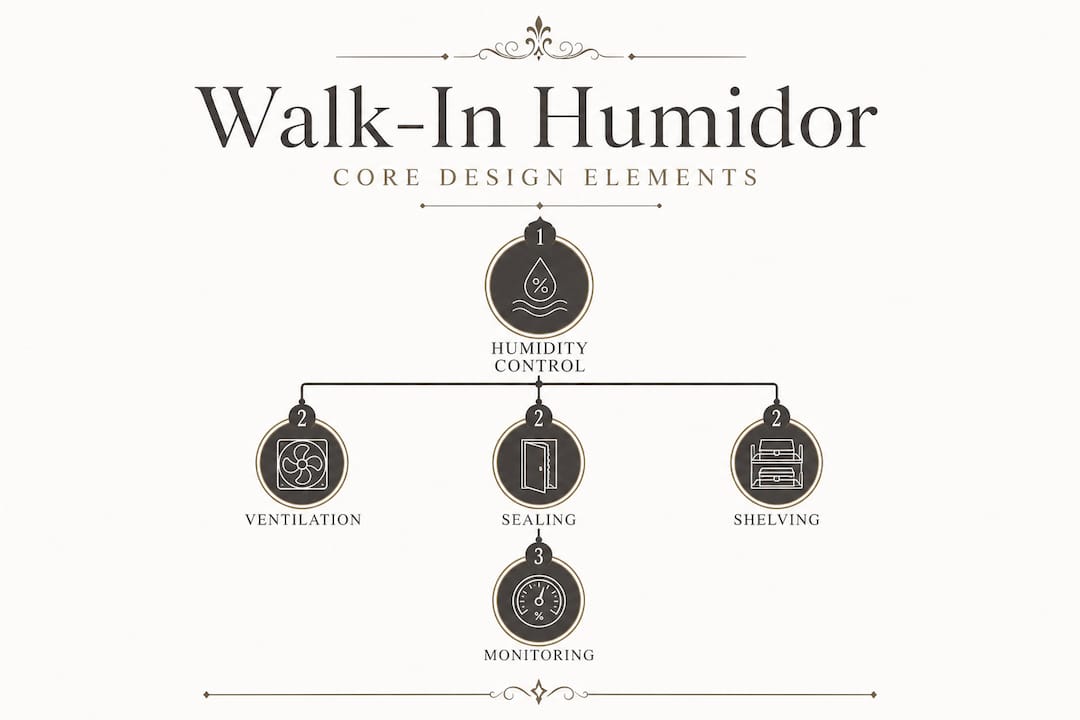
- Core functions and essential design elements
- Ventilation, air exchange, and common misconceptions
- Is a walk-in humidor right for you? Collector scenarios
- Why the pursuit of perfection in walk-in humidors is often misunderstood
- Explore the finest cigar storage solutions
- Frequently asked questions
Key Takeaways
| Point | Details |
|---|---|
| Walk-in humidors defined | A walk-in humidor is a room-sized storage space designed to maintain optimal conditions for large cigar collections. |
| Not fully airtight | Modern walk-ins benefit from controlled air exchange—not a hermetic seal—to stabilize humidity and air quality. |
| Essential design factors | Temperature, humidity, and air movement must all be balanced for proper long-term cigar aging. |
| Misconceptions dispelled | Over-sealing and neglecting air quality can hurt more than help; practical design adjustments make the biggest impact. |
| Quiz your needs first | Not every collector needs a walk-in; smaller solutions often work unless aging and volume demand more. |
What defines a walk-in humidor?
A walk-in humidor is a dedicated, room-scale storage environment designed to house large cigar collections under precisely controlled climatic conditions. Unlike a desktop tray or a cabinet model, a walk-in allows you to physically enter the space, curate your collection with intention, and access individual cigars without disturbing the broader environment. This is the gold standard for serious collectors, private lounges, and any aficionado whose passion has grown well beyond a single box.
You can explore the full walk-in humidor overview for a deeper look at what distinguishes these sanctuaries from conventional storage. But at the foundational level, several features define the category:
- Dedicated climate control: Walk-ins are equipped with independent humidification and cooling systems, not supplemental devices borrowed from adjacent rooms.
- Spanish Cedar lining: The walls, shelving, and often the ceiling are finished in Spanish Cedar, a wood prized for its natural moisture-regulating properties and its role in repelling tobacco beetles.
- Scale and layout: Walk-ins accommodate hundreds to thousands of cigars, with organized shelving, drawers, and zones for different aging stages or vitola families.
- Controlled entry: Solid, well-sealed doors minimize unwanted ambient air intrusion while still allowing deliberate, measured ventilation.
- Dedicated monitoring: Digital hygrometers, temperature sensors, and sometimes data loggers track conditions continuously rather than periodically.
Here is the nuance that separates informed collectors from the rest: as build guidance notes, walk-ins are not necessarily meant to be hermetically sealed. Ventilation and air exchange are sometimes treated as beneficial for air quality and moisture balance. That distinction matters enormously, and we will unpack it thoroughly in the sections ahead.
Scale also affects aging in ways that smaller humidors simply cannot replicate. When dozens of different blends share a common environment, their essential oils and aromatic compounds subtly interact over time. Many collectors describe this “cross-aging” effect as one of the quiet luxuries of a well-curated walk-in, a phenomenon impossible to achieve in a small desktop box.
Core functions and essential design elements
Now that you understand what a walk-in humidor is, let’s examine what’s required to make one function at its very best.
The walk-in is, at its core, an instrument of climate. Three functions must work in harmony for it to perform:
- Maintain steady relative humidity (RH): Target a consistent range between 65% and 72% RH. Fluctuations above or below this window can cause wrappers to crack, unravel, or develop mold. An electronic humidification system, rather than passive gel or bead-based solutions, is recommended for any space larger than a standard cabinet.
- Manage temperature with precision: Ideal storage temperatures fall between 65°F and 70°F. Temperatures above 75°F create conditions favorable to tobacco beetles, an infestation that can devastate an entire collection. A dedicated mini-split or in-wall cooling unit is far more reliable than repurposing a household HVAC system.
- Enable controlled air exchange: As build guidance confirms, in private walk-ins, air exchange can be achieved by keeping air circulating, and a daily air change is sufficient. Circulation fans positioned near the floor and ceiling prevent stratification, where cooler, drier air pools low while warmer, humid air sits high.
The following comparison illustrates how walk-ins stack up against cabinet and desktop models across the dimensions that matter most to serious collectors:
| Feature | Desktop humidor | Cabinet humidor | Walk-in humidor |
|---|---|---|---|
| Capacity | Up to ~50 cigars | 50 to 500+ cigars | 500 to 10,000+ cigars |
| Humidity system | Passive (gel/beads) | Passive or active | Active (electronic) |
| Temperature control | None | Limited | Dedicated cooling |
| Air circulation | None | Minimal | Fan-assisted |
| Spanish Cedar lining | Partial | Full interior | Full room lining |
| Monitoring | Manual hygrometer | Digital | Multi-sensor systems |
| Aging potential | Limited | Moderate | Exceptional |
When building or refitting a walk-in, the sequence of decisions matters. Follow these essential steps:
- Select the right space. An interior room with minimal exterior wall exposure is ideal, as exterior walls transmit ambient temperature swings that stress your climate system.
- Insulate thoroughly. Closed-cell spray foam insulation outperforms fiberglass batts in controlling both moisture and temperature infiltration.
- Line with Spanish Cedar. Apply it to all interior surfaces before any shelving is installed. Allow the wood to fully season before introducing cigars.
- Install dedicated climate equipment. Commission a purpose-built humidification unit and a separate cooling appliance rather than relying on combined HVAC solutions.
- Position sensors strategically. Place hygrometers and thermometers at multiple heights and zones to capture the full picture of your environment.
- Commission a circulation system. Even a pair of small, whisper-quiet fans positioned at opposing corners will distribute conditioned air and prevent stagnant pockets.
You can explore the full range of electronic humidification options to match the scale of your space, as well as cabinet humidor features if your collection sits at an intermediate scale.
Pro Tip: Never rely on a single hygrometer. Place calibrated sensors at low, mid, and high points within the walk-in, and check for more than a 3% RH variance between zones. If variance exceeds that threshold, your circulation needs adjustment before you consider the environment stable.
Ventilation, air exchange, and common misconceptions
Once core elements are in place, understanding air management separates the good walk-ins from the great.
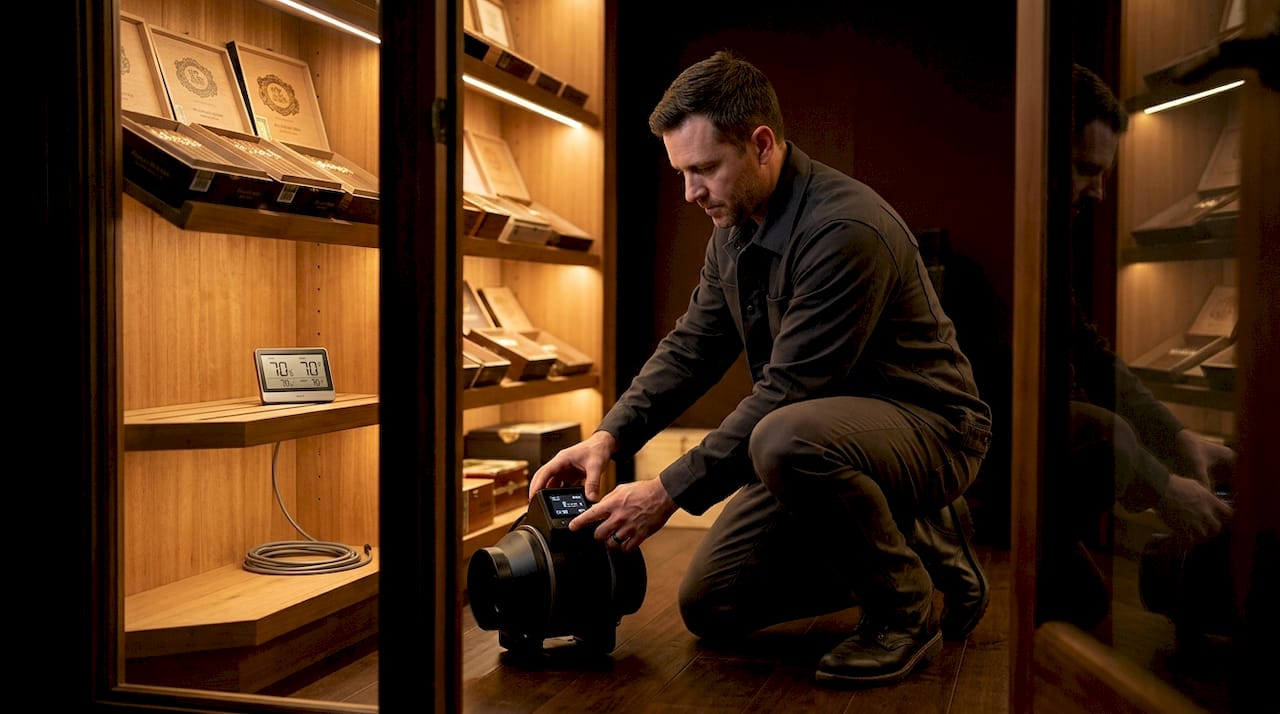
The single most persistent misconception in walk-in humidor design is this: tighter is always better. Many collectors obsess over sealing every gap, installing commercial-grade door sweeps, and treating air exchange as an enemy. In reality, a thoughtfully ventilated walk-in outperforms an over-sealed one in almost every meaningful way.
As expert guidance clarifies, some ventilation is useful, but uncontrolled leakage can undermine RH stability and increase the workload on your humidification system. The distinction is crucial: managed air exchange is a feature, while uncontrolled leakage is a flaw. One is purposeful, the other is entropy.
Consider the following comparison to clarify the two extremes:
| Approach | Benefits | Risks |
|---|---|---|
| Hermetically sealed | Minimal humidity loss when static | Stale air, ammonia buildup, increased mold risk |
| Managed air exchange | Fresh air, better aroma balance, stable RH | Requires proper equipment and monitoring |
| Uncontrolled leakage | None | RH instability, temperature swings, high equipment load |
Ammonia is a byproduct of the natural fermentation and aging process in tobacco. In a completely sealed room, ammonia concentrations can gradually build to levels that impart harsh, acrid notes to your cigars. A daily air change, as recommended for private walk-ins, flushes that buildup and keeps your collection’s aromatic profile clean and expressive.
Walk-ins should allow fresh air in and expel hot air when necessary. The goal is balance, not isolation. A sanctuary for your cigars breathes, just as fine tobacco itself does during the aging process.
Practical methods for achieving this balance include a small, programmable inline fan that draws fresh air through a filtered intake at a scheduled interval, and a simple passive exhaust vent positioned near the ceiling to expel warmer, stale air. This setup requires no exotic engineering and costs far less than you might expect.
Pro Tip: Set your inline ventilation fan to run for 10 to 15 minutes each morning before you open the door. This ensures the room has already completed its daily air change before you access your collection, minimizing the disruption each entry creates.
For further reading on maintaining your environment over time, our humidor care tips cover seasonal adjustments, sensor calibration, and long-term wood conditioning in detail.
Is a walk-in humidor right for you? Collector scenarios
Balancing performance and practicality brings us to a key question: should you invest in a walk-in, or is another solution best?
The honest answer is that a walk-in humidor is not for everyone, and that is not a limitation. It is a reflection of where you are in your collecting journey. The following scenarios illustrate when a walk-in is the natural next step, and when it is not yet necessary.
When a walk-in makes clear sense:
- Your collection consistently exceeds 500 cigars and continues to grow without signs of slowing.
- You host private tasting events or maintain a home lounge where presentation and environment matter as much as the cigars themselves.
- You are aging rare, limited-production, or vintage cigars for five or more years and require the stability that only a dedicated climate system can provide.
- You collect across multiple vitola families and want to organize by blend, origin, or vintage in a space that honors that curation.
When a cabinet or desktop model may suffice:
- Your collection sits comfortably between 100 and 400 cigars and you replenish regularly rather than age long-term.
- You prefer a more portable or compact solution, such as travel humidor solutions for cigars on the move.
- Budget constraints make a full room build impractical right now, and a premium desktop humidor alternative serves you beautifully in the interim.
As noted in expert build guidance, commercial environments face frequent door openings that require more aggressive air management strategies. In private walk-ins, however, a daily air change is sufficient, which means the engineering demands for a personal collection are genuinely manageable.
Ask yourself these questions before committing:
- Do I have a dedicated room or large closet with interior wall exposure on at least two sides?
- Am I prepared to invest in ongoing monitoring, maintenance, and the occasional equipment service?
- Does my collection include irreplaceable or highly valuable cigars that justify the investment in premium storage?
- Is the experience of physically moving through my collection part of how I connect with it?
If you answered yes to three or more of these, a walk-in is not an indulgence. It is the right tool for the collection you have built.
Why the pursuit of perfection in walk-in humidors is often misunderstood
We have witnessed a consistent pattern among collectors who build their first walk-in: they invest heavily in materials and sealing, then spend the following months fighting their own design. Over-engineered airtightness creates new problems: stale air, ammonia accumulation, and a humidification system running nearly continuously to compensate for moisture trapped with no circulation.
The collectors we admire most build for resilience, not for control. They design systems that respond gracefully to daily variation rather than systems that attempt to eliminate variation entirely. As the guidance cautions, treating “not airtight” and “air exchange” as the same concept is a nuanced but consequential error. One describes a flaw; the other describes a feature.
The most enduring walk-ins we have seen are monitored with the same attention a winemaker gives to a maturing vintage. Daily checks, seasonal recalibrations, and proactive equipment maintenance matter far more than the thickness of your door seal. Invest in quality hygrometers. Keep a simple log of temperature and RH readings across zones. Know your walk-in the way you know your finest Habanos: intimately, patiently, and with appreciation for what it takes to produce something exceptional.
For collectors ready to move beyond the basics, our resources on advanced humidor care offer the kind of seasoned, practical guidance that turns a good walk-in into a great one.
Pro Tip: The best walk-in humidor is not the most expensive one. It is the one whose owner understands it deeply enough to adjust it confidently as seasons change, as the collection grows, and as age transforms each cigar on the shelf.
Explore the finest cigar storage solutions
For the collector who has reached the point where a premium storage solution is not a luxury but a necessity, we are the partners you have been looking for. At Dunn Luxury Selections, we curate the finest walk-in, cabinet, desktop, and travel humidors available, each selected for precision, craftsmanship, and long-term performance.

Whether you are ready to commission a bespoke walk-in sanctuary or you are refining a collection that a premium cabinet humidor will serve beautifully right now, our collections offer every collector a worthy next step. Browse our expert guides, explore our curated humidor lines, and let our team help you match your storage solution to the collection and legacy you are building. Visit Dunn Luxury Selections to begin.
Frequently asked questions
Do walk-in humidors need to be airtight?
No. As build guidance confirms, walk-ins should not be hermetically sealed; some controlled air exchange is beneficial for air quality and humidity balance. The goal is managed ventilation, not complete isolation.
What humidity level is best for a walk-in humidor?
Aim for a relative humidity between 65% and 72% for ideal cigar aging and long-term preservation. Stability within that range matters more than hitting a single exact number.
How often should air be changed in a walk-in humidor?
As expert guidance notes, a daily air change is sufficient for private walk-ins, provided that air circulation and humidity levels remain steady throughout. A short daily cycle from a small inline fan accomplishes this efficiently.
Are walk-in humidors expensive to maintain?
They require ongoing monitoring and periodic equipment service, but a thoughtfully designed walk-in with quality components is far less costly to maintain than one that was under-engineered and constantly fighting itself. Smart design minimizes long-term expenses considerably.
Can I convert a small room into a walk-in humidor?
Yes. Many collectors successfully retrofit closets or small interior rooms with dedicated humidification equipment, proper insulation, and Spanish Cedar lining. The key is selecting a space with minimal exterior wall exposure and committing to proper climate equipment from the start.
Recommended
You May Also Enjoy
Cigar Locker Dimensions: Sizing Guide for Collectors and Lounges
Cigar locker dimensions explained: compartment sizes, cabinet footprints, capacity math and clearances, so you size a locker bank...
Read Article
Sealing a Walk-In Humidor: Envelope, Door and Penetrations
How to seal a walk-in humidor properly: vapor barrier placement, door gasket, penetrations and the controlled airflow a...
Read Article
Retail Humidor ROI: How to Measure What a Display Earns
What does a retail or lounge humidor really return? A practical framework for cigar shops, lounges and clubs:...
Read Article