

Discover what a hygrometer is, its types and uses. Learn how this essential tool measures humidity to enhance your indoor environment.
A hygrometer is defined as an instrument that measures the amount of water vapor in the air, expressed as relative humidity percentage. That single reading, displayed as %RH, tells you how close the surrounding air is to its maximum moisture-holding capacity at a given temperature. Whether you are conditioning a walk-in humidor, cultivating rare orchids, or simply trying to understand why your home feels oppressive in August, a hygrometer gives you the precise data to act. Instruments from manufacturers like Vaisala and measurement standards set by NIST have shaped how the modern world understands and controls humidity, from industrial clean rooms to the Spanish Cedar-lined sanctuary of a premium cigar collection.
How does a hygrometer work?
The science behind measuring humidity is more varied than most people realize. At its core, every hygrometer detects moisture by sensing a physical or electrical change in a material that responds to water vapor. The specific mechanism depends on the type of sensor used, and each approach carries distinct trade-offs in accuracy, cost, and application.
The main hygrometer types compared
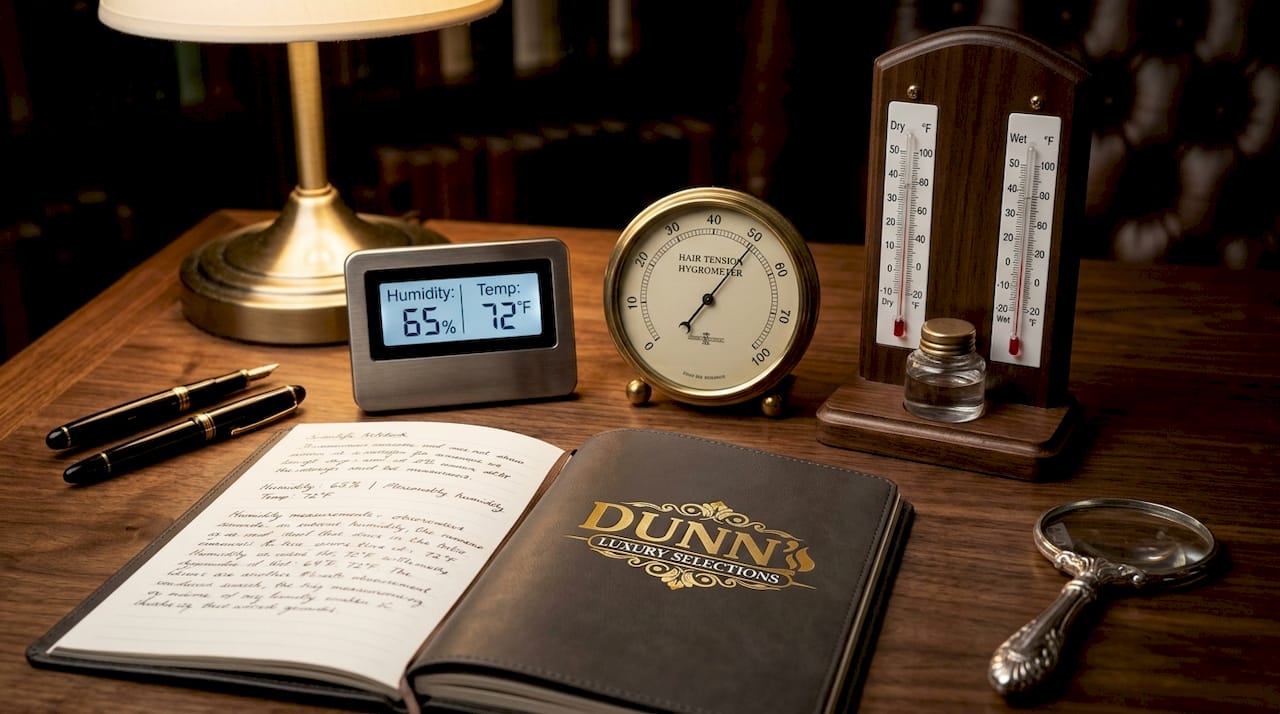
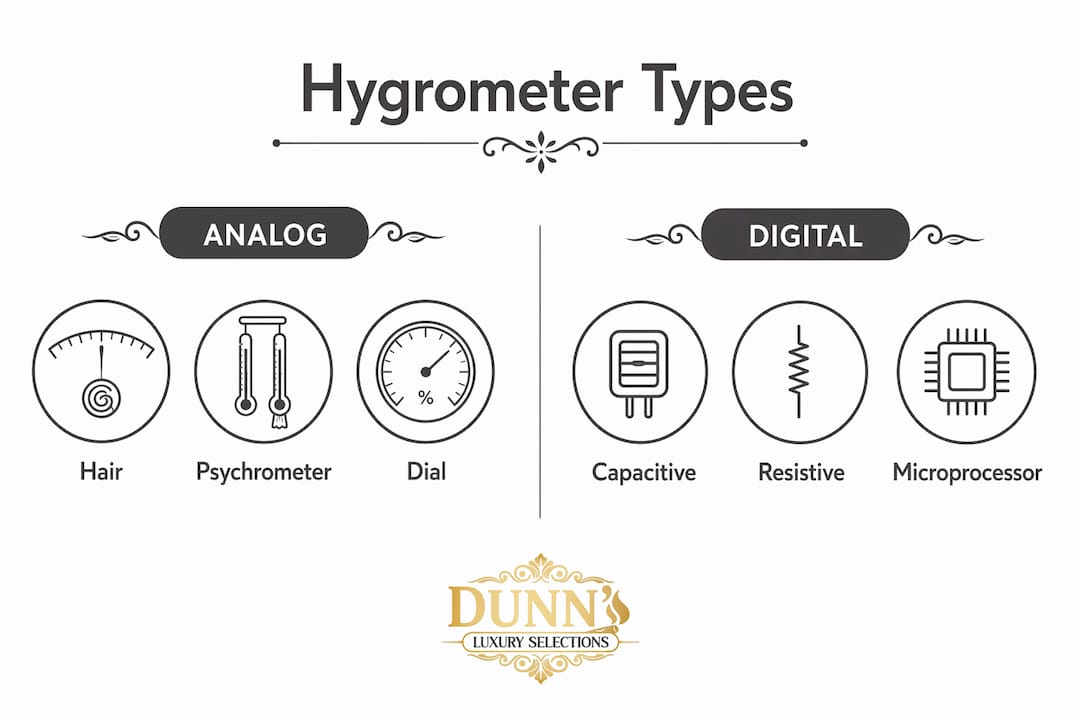
Electronic hygrometers detect humidity through shifts in electrical properties, specifically capacitance or resistance, caused by moisture absorption in a sensing film. These sensors convert that change into a real-time digital reading, which is why they dominate consumer and professional markets today. Psychrometric hygrometers, by contrast, use two thermometers: one with a wet wick and one dry. The rate of evaporative cooling between the two reveals the ambient humidity. Gravimetric hygrometers represent the gold standard of precision. NIST classifies gravimetric instruments as primary standards because they physically separate water vapor from a sampled air mass and compare masses directly, achieving relative uncertainty within 0.09%.
| Type | Measurement method | Best use | Accuracy |
|---|---|---|---|
| Capacitive (digital) | Electrical capacitance shift | Home, humidors, HVAC | ±2–3% RH |
| Resistive | Electrical resistance shift | Industrial monitoring | ±3–5% RH |
| Psychrometric | Wet-bulb/dry-bulb temperature | Field measurement | ±2% RH (skilled use) |
| Dew point | Chilled mirror condensation | Labs, very dry environments | ±0.1°C dew point |
| Gravimetric | Mass comparison of water vapor | Calibration standards | ±0.09% RH |
Pro Tip: If you are calibrating a hygrometer at home, use a saturated salt solution in a sealed container. Sodium chloride (table salt) produces a stable 75% RH environment at room temperature, giving you a reliable reference point without laboratory equipment.
What is a digital hygrometer, specifically? It is a capacitive or resistive sensor paired with a microprocessor and a digital display, offering real-time readings without the manual calculation required by psychrometric instruments. For most hobbyists and homeowners, a quality digital unit from brands like Govee, Inkbird, or SensorPush provides more than adequate precision.
What do humidity readings actually tell you?
Understanding the numbers on your hygrometer requires knowing which parameter you are reading and what it means in practice.
Relative humidity is a ratio: the actual water vapor present divided by the maximum vapor the air could hold at that temperature. This temperature dependence is the most misunderstood aspect of RH. When you heat a room, the RH drops even though the absolute amount of moisture has not changed. That is why a cold basement can feel damp at 70% RH while a heated living room at the same moisture content reads only 40% RH.
Key humidity parameters every hygrometer user should understand:
- Relative humidity (RH): The most common reading, expressed as a percentage. Comfortable indoor environments fall between 40% and 60% RH.
- Dew point temperature: The temperature at which air must be cooled before condensation forms. Vaisala notes that dew point measurement is a more absolute indicator of moisture content because it does not shift with ambient temperature changes.
- Absolute humidity: The mass of water vapor per unit volume of air, expressed in grams per cubic meter. Less common on consumer devices but useful in industrial contexts.
- Wet-bulb temperature: The lowest temperature achievable through evaporative cooling, used in psychrometric calculations.
For most cigar collectors and hobbyists, RH is the operative number. However, Vaisala recommends dew point for environments where RH drops below 10%, such as pharmaceutical drying chambers or aerospace testing, because calibration uncertainties in RH sensors compound at extremes. For a humidor maintained at 65% to 70% RH, a quality digital hygrometer reading RH directly is perfectly sufficient.
How to use hygrometer readings in everyday environments
Knowing your RH number is only half the discipline. Placing, reading, and responding to that number correctly determines whether your hygrometer actually protects what matters.
-
Place the sensor away from direct airflow. Vents, open windows, and air conditioning returns create localized humidity pockets that do not represent the ambient environment. Position your hygrometer at least 18 inches from any air source and at mid-height in the room or enclosure.
-
Allow the sensor to acclimate. A hygrometer moved from a cool storage area to a warm room needs 20 to 30 minutes to stabilize before its reading is reliable. Rushing this step is the most common source of false readings among hobbyists.
-
Calibrate at least once per year. Capacitive sensors drift over time. The saturated salt method described above costs nothing and takes under an hour. Professional instruments from Vaisala ship with calibration certificates, but consumer-grade units require periodic verification.
-
Respond to the full range, not just high readings. Ideal indoor humidity sits between 40% and 60% RH. Below 40%, wood furniture cracks, static electricity builds, and respiratory membranes dry out. Above 60%, mold spores activate and organic materials begin to degrade.
-
Use multiple sensors in large spaces. A single hygrometer in a 2,000-square-foot home tells you the humidity at one point. Zonal monitoring with two or three sensors reveals gradients that a single reading conceals entirely.
Pro Tip: For cigar humidors specifically, place your hygrometer at the center of the storage area, not near the humidification element. Readings taken adjacent to a humidifier will always read higher than the actual ambient RH experienced by your cigars.
The practical stakes are real. A humidor running at 80% RH risks mold growth on tobacco leaves, while one dropping below 60% causes wrappers to crack and essential oils to volatilize. The hygrometer is not a passive accessory. It is the instrument that makes preservation possible.
How is a hygrometer different from similar instruments?
One of the most persistent points of confusion involves the terms hygrometer and hydrometer. A hydrometer measures the density or specific gravity of a liquid, typically used in brewing, winemaking, and battery testing. It has no function in measuring air moisture. The two instruments share a similar name but serve entirely different purposes.
Here is how a hygrometer compares to related instruments:
| Instrument | Measures | Common uses |
|---|---|---|
| Hygrometer | Air moisture (% RH or dew point) | Homes, humidors, labs, HVAC |
| Hydrometer | Liquid density / specific gravity | Brewing, winemaking, batteries |
| Thermometer | Air or surface temperature | Universal |
| Barometer | Atmospheric pressure | Weather forecasting |
| Humidity monitor | RH plus logging, alerts, connectivity | Smart home, industrial |
The distinction between a hygrometer and a humidity monitor deserves particular attention. A humidity monitor is essentially an enhanced hygrometer that adds data logging, threshold alerts, and often wireless connectivity via Bluetooth or Wi-Fi. Devices like the SensorPush HT1 or Govee H5179 are technically humidity monitors, though the terms are used interchangeably in retail contexts.
When choosing between a dedicated hygrometer and a combined device, consider what you actually need:
- A dedicated hygrometer suits static environments like a humidor or wine cellar where you check readings manually and adjust manually.
- A humidity monitor with alerts suits environments where conditions can shift rapidly and unattended, such as a server room, a greenhouse, or a collection room housing irreplaceable items.
- A combined thermo-hygrometer covers most home and hobby needs in one unit, pairing temperature and RH in a single display.
Key takeaways
A hygrometer measures relative humidity as a percentage and is the foundational instrument for protecting any environment where moisture levels determine quality, comfort, or preservation.
| Point | Details |
|---|---|
| Core function | A hygrometer measures water vapor in air as %RH, dew point, or absolute humidity. |
| Best type for most uses | Capacitive digital hygrometers offer the best balance of accuracy and convenience for home and hobby use. |
| Ideal indoor RH range | Maintain 40–60% RH to protect health, materials, and organic collections like cigars. |
| Hygrometer vs. hydrometer | A hygrometer measures air moisture; a hydrometer measures liquid density. They are not interchangeable. |
| Calibration matters | Capacitive sensors drift over time; verify accuracy annually using a saturated salt solution reference. |
Why dew point deserves more attention than most hobbyists give it
Most people buy a hygrometer, read the RH number, and stop there. That is a reasonable starting point, but it leaves a meaningful gap in understanding. Tracking dew point alongside RH gives you a more complete picture of moisture conditions, particularly in environments where temperature fluctuates.
Here is what I have observed after years of working with precision humidity control in premium storage contexts. A humidor that reads 68% RH at 70°F is in excellent condition. That same humidor at 68% RH but 60°F is actually holding less moisture than it appears, because the dew point has shifted. If the temperature drops further overnight, condensation can form on the interior surfaces and on the cigars themselves, without the RH reading ever crossing an alarm threshold.
The technology has improved considerably. Modern digital sensors from Govee and SensorPush report both RH and dew point simultaneously, often for under $30. There is no longer a cost barrier to tracking both parameters. The barrier is simply awareness, and that is what separates a casual collector from someone who genuinely understands what their instruments are telling them.
I also see a persistent overconfidence in factory calibration. Consumer hygrometers are shipped with acceptable accuracy for general use, but “acceptable” and “precise” are not the same thing. A unit reading 3% high in a humidor set to 68% RH is actually running at 65% RH, which is the lower edge of the safe range for premium tobacco. Verify your instrument. The salt test takes 45 minutes and costs nothing. The cost of not doing it is a collection that ages poorly.
— Belle
Protect your collection with precision humidity control

At Dunnluxuryselections, precision is not a feature. It is the foundation of every humidor we offer. A hygrometer reading is only as valuable as the environment built to respond to it, and our cabinet humidor collections are engineered to hold humidity with the consistency that serious collectors demand. From Spanish Cedar-lined interiors that naturally buffer moisture to integrated hygrometer mounts designed for accurate center-placement readings, each piece reflects a commitment to preservation at the highest level. If you travel with your cigars, our travel humidor line brings that same discipline to portable form. Browse the full collection at Dunnluxuryselections and invest in an environment worthy of what you collect.
FAQ
What is a hygrometer used for?
A hygrometer measures relative humidity in a given environment to help maintain optimal moisture levels. Common uses include monitoring home comfort, protecting cigar humidors, managing greenhouse conditions, and controlling storage environments for wine, art, and instruments.
What is the difference between a hygrometer and a hydrometer?
A hygrometer measures water vapor in the air as a percentage of relative humidity. A hydrometer measures the density or specific gravity of a liquid and is used in brewing, winemaking, and battery maintenance.
How accurate are digital hygrometers?
Quality capacitive digital hygrometers typically achieve accuracy within ±2% to ±3% RH under normal conditions. Sensor drift over time means annual calibration using a saturated salt solution is recommended to maintain reliable readings.
What humidity level should a cigar humidor maintain?
Most cigar aficionados target 65% to 70% RH at 65°F to 70°F for long-term storage. Readings outside this range risk either mold growth at high humidity or wrapper cracking and oil loss at low humidity, both of which permanently damage the cigar.
What is the difference between relative humidity and dew point?
Relative humidity expresses moisture as a percentage of what the air can hold at its current temperature, so it changes as temperature changes. Dew point is the fixed temperature at which condensation forms and is a more stable, absolute indicator of actual moisture content in the air.
Recommended
You May Also Enjoy
Cigar Locker Dimensions: Sizing Guide for Collectors and Lounges
Cigar locker dimensions explained: compartment sizes, cabinet footprints, capacity math and clearances, so you size a locker bank...
Read Article
Sealing a Walk-In Humidor: Envelope, Door and Penetrations
How to seal a walk-in humidor properly: vapor barrier placement, door gasket, penetrations and the controlled airflow a...
Read Article
Retail Humidor ROI: How to Measure What a Display Earns
What does a retail or lounge humidor really return? A practical framework for cigar shops, lounges and clubs:...
Read Article