

Discover what is humidor dead zone and learn how to identify and fix it. Protect your cigars from uneven preservation for lasting quality.
A humidor dead zone is defined as a localized stagnant area inside a cigar humidor where humidity deviates more than 5% relative humidity from the target level, creating uneven preservation conditions. These zones form silently, often undetected by a single hygrometer, and they represent one of the most underestimated threats to a serious cigar collection. Understanding what is humidor dead zone means understanding that your humidor’s performance is not uniform across its entire interior. At Dunnluxuryselections, we see this as the defining line between a humidor that merely stores cigars and one that truly preserves them.
What is humidor dead zone and what causes it?
A humidor dead zone forms wherever air stops moving. Stagnant pockets develop in corners, beneath flush-fitting trays, and behind fixed dividers that block lateral and vertical airflow. The result is a microclimate that operates outside your intended humidity and temperature range, regardless of how well your humidification device performs.
Poor interior design is the most common root cause. Flush-fitting trays and fixed dividers obstruct air circulation so effectively that moisture never reaches the cigars stored in those pockets. Removing fixed dividers and ensuring tray clearance on all sides restores the circulation those areas need.
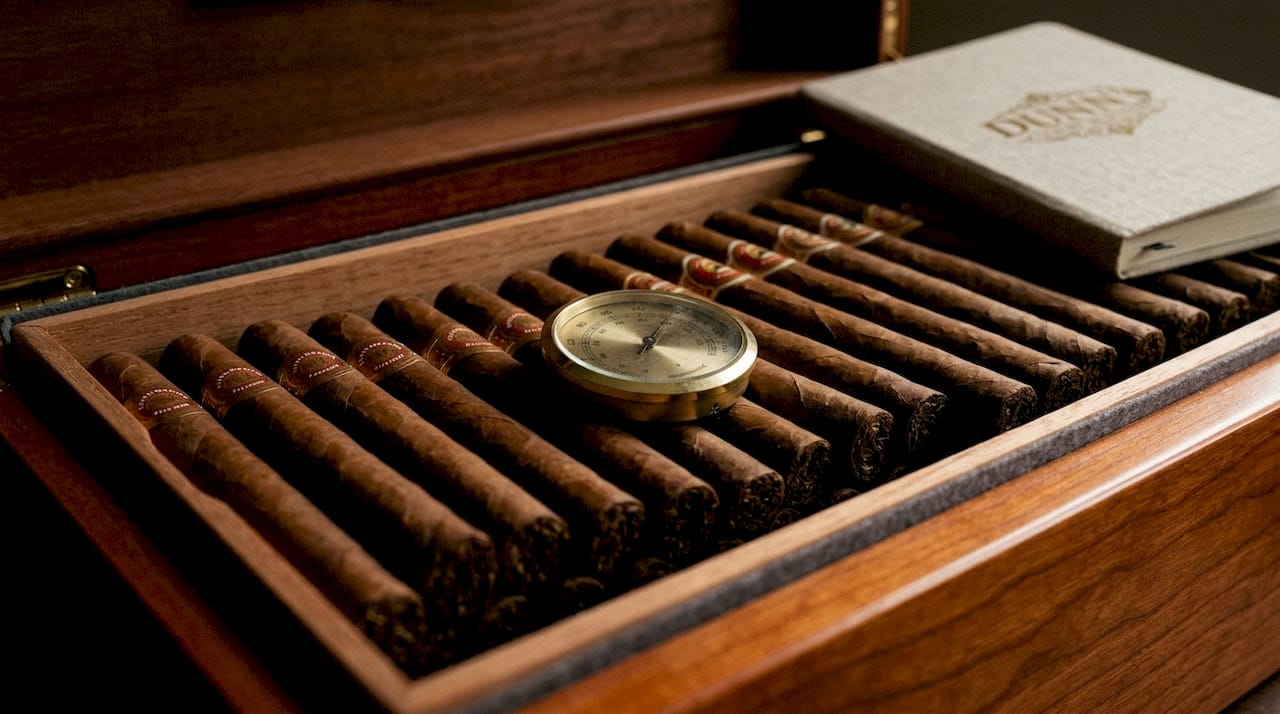
Overpacking compounds the problem significantly. When cigars are stacked wall to wall, air cannot move between them. Experts recommend sizing your humidor 25–30% larger than your current collection to maintain the airflow buffer that prevents dead zones from forming.
The humidor’s seal also plays a counterintuitive role. A perfectly airtight humidor with no air renewal will eventually develop saturated, stagnant pockets. Slight, controlled air renewal prevents that saturation from accumulating and keeps the internal environment balanced.
Key causes of humidor dead zones:
- Flush-fitting or fixed trays that block airflow beneath and around cigars
- Overpacking that eliminates the space air needs to circulate
- A single humidification unit placed in one corner of a large storage space
- No periodic air renewal, allowing saturated pockets to form
- Corners and back walls that receive no air movement from the humidifier
Pro Tip: Open your humidor briefly once a day, just as you would crack a window in a room. That small exchange of air prevents stagnant saturation from building in corners and along the back wall.
How do dead zones damage your cigars?
Dead zones produce two distinct and damaging effects: uneven aging and mold. Both are preventable, but only if you recognize that humidity deviations inside a humidor are not theoretical. They are physical realities with measurable consequences.
Uneven aging occurs when cigars in a high-humidity pocket absorb excess moisture while cigars in a dry pocket lose it. The flavor profiles of those two groups diverge over months. A cigar aged in a dead zone will burn differently, taste differently, and draw differently than one stored in a well-circulated area of the same humidor. For collectors curating aged inventory, this inconsistency is a serious loss.
Mold is the more urgent threat. Mold forms primarily from stagnant, saturated air rather than from high humidity alone. A humidor running at 70% relative humidity with good airflow carries far less mold risk than one running at 68% with stagnant pockets. The distinction matters because many collectors raise humidity levels when they see mold, which only worsens the underlying problem.
Dead zones also corrupt your hygrometer readings. A single sensor placed near the humidifier or in a stagnant pocket will not represent the full interior environment. You may believe your humidor is holding 70% RH when one corner sits at 62% and another at 76%. That false confidence leads to adjustments that make conditions worse, not better.
The consequences of undetected dead zones include:
- Flavor inconsistency across cigars stored in the same humidor
- Mold growth on cigars in saturated, stagnant corners
- Tobacco beetle risk in warm, poorly circulated areas
- Misleading humidity readings that prompt incorrect adjustments
- Accelerated degradation of wrapper leaves in dry dead zones
How to detect, prevent, and eliminate dead zones
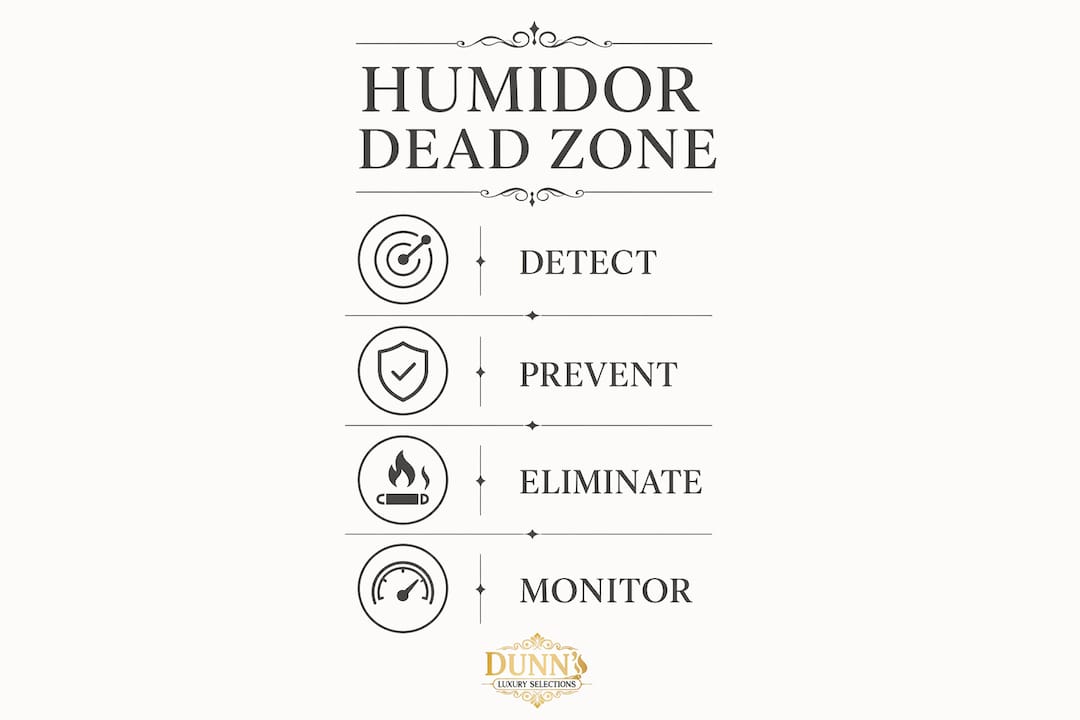
Detection requires more than one hygrometer. One sensor is insufficient to map the full humidity environment inside a humidor. Place digital hygrometers in at least three locations: near the humidifier, at the opposite corner, and in the center. Compare readings over 24 hours. A variance greater than 5% RH between any two sensors confirms a dead zone.
Prevention follows a clear sequence:
- Size your humidor correctly. Maintain 25–30% empty space inside at all times. That buffer is not wasted capacity. It is the airflow your cigars depend on.
- Audit your tray design. Replace flush-fitting trays with designs that allow air to pass beneath and around them. Spanish Cedar trays with raised feet or open-grid bases work well for this purpose.
- Rotate your cigars periodically. Move cigars from the back corners to the front and center every four to six weeks. Rotation compensates for minor airflow imbalances and ensures even aging across your collection.
- Introduce gentle air renewal. Open the humidor briefly each day. This simple practice, akin to allowing slight air exchange in a sealed room, prevents saturated stagnation from taking hold.
- Use an electronic humidifier with a fan. Devices like the Cigar Oasis Plus circulate moisture actively rather than relying on passive evaporation, which dramatically reduces dead zone formation in desktop and cabinet humidors.
Pro Tip: After placing multiple hygrometers, photograph the readings at the same time each day for one week. Patterns in the variance will reveal exactly where your dead zones are forming, so you can address the specific tray or corner causing the problem.
The goal is not high-velocity airflow. Consistent, gentle air movement is more effective than strong currents, which can dry out wrapper leaves and disrupt the slow, stable aging process that defines a great cigar collection. Calm is the method.
| Detection method | What it reveals |
|---|---|
| Multiple hygrometers | Variance greater than 5% RH between zones |
| Daily air renewal | Reduction in stagnant saturation over time |
| Cigar rotation every 4–6 weeks | Even aging across the full collection |
| Tray clearance audit | Blocked airflow beneath or around trays |
Dead zones in small humidors versus large walk-in humidors
The scale of the problem differs significantly between a desktop humidor and a walk-in storage room, but the underlying physics are identical. Both environments form dead zones wherever air stops moving.
In a small personal humidor, the solution centers on layout and tray design rather than multiple humidification units. A single well-placed electronic humidifier with a fan, combined with open-grid trays and 25–30% empty space, is sufficient to maintain even conditions. Desktop humidors with Spanish Cedar interiors benefit from the wood’s natural moisture-buffering properties, which soften the impact of minor airflow gaps.
Walk-in humidors present a fundamentally different challenge. The larger air volume, combined with frequent door openings that introduce warm, dry outside air, creates complex humidity gradients. Large walk-in humidors require multiple humidifiers distributed evenly throughout the space to eliminate dead zones and sustain consistent relative humidity. A single unit placed at one end of a walk-in room will never reach the far corners effectively.
| Humidor type | Primary dead zone risk | Recommended solution |
|---|---|---|
| Desktop (under 150 cigars) | Corner stagnation from tray design | Single electronic humidifier with fan, open-grid trays |
| Cabinet (150–500 cigars) | Vertical humidity stratification | Multiple humidification points, tray clearance |
| Walk-in (500+ cigars) | Complex gradients from door openings | Distributed humidifiers, redundant sensors, daily air renewal |
Cabinet humidors occupy the middle ground. Vertical stratification, where humidity pools at the bottom and dry air rises to the top, is their most common dead zone pattern. Placing one humidification unit at the top and one at the bottom corrects this stratification reliably.
Key Takeaways
A humidor dead zone is the single most preventable cause of uneven cigar aging, and eliminating it requires attention to airflow design, not just humidity levels.
| Point | Details |
|---|---|
| Dead zone definition | A localized area with RH deviation greater than 5% from the target level. |
| Root cause | Poor tray design, overpacking, and lack of air renewal create stagnant pockets. |
| Detection method | Place multiple hygrometers and compare readings; variance over 5% confirms a dead zone. |
| Prevention standard | Size your humidor 25–30% larger than your collection and use open-grid trays. |
| Scale matters | Walk-in humidors require multiple distributed humidifiers; desktop units need only layout corrections. |
What I’ve learned about dead zones that most guides miss
The most persistent misconception I encounter is that dead zones are a humidification device problem. Collectors upgrade to a more powerful humidifier, see no improvement, and conclude the humidor itself is defective. Humidity systems are limited by construction and airflow design. The device is rarely the issue. The interior architecture almost always is.
The second misconception is that an airtight seal is the ultimate goal. Airtight construction is valuable, but a perfectly sealed humidor with no air renewal becomes a stagnant environment over time. The analogy I use is a sealed room with no ventilation. You would not want to live in it, and neither do your cigars. A brief daily opening is not a flaw in your routine. It is part of the preservation method.
What I find most instructive is the craft humidor tradition. Makers who work with Spanish Cedar and hand-fitted joinery have understood for generations that the interior layout of a humidor determines its performance more than any electronic accessory. The care guides at Dunnluxuryselections reflect that same philosophy: build the environment correctly first, then support it with the right tools.
The collectors who age cigars most successfully are not the ones with the most expensive humidifiers. They are the ones who treat their humidor as a living environment that requires attention, rotation, and occasional renewal. That discipline, applied consistently, eliminates dead zones before they form.
— Brian
Dunnluxuryselections humidors are built to prevent dead zones
Every humidor in the Dunnluxuryselections collection is selected with airflow architecture in mind. From compact travel cases to full cabinet humidors designed for serious collectors, each piece is chosen because its interior design supports the even humidity distribution your cigars deserve.

The Florence Desktop Cigar Humidor and the Bermuda Large Cigar Cabinet Humidor represent two ends of the spectrum, each engineered for consistent airflow and Spanish Cedar humidity buffering. For collectors who want climate-controlled precision at scale, the Raching MON800A delivers zonal climate control across 600 cigars. Your collection is a legacy. It deserves a sanctuary built to protect it.
FAQ
What is a humidor dead zone?
A humidor dead zone is a localized area inside a humidor where relative humidity deviates more than 5% from the target level due to stagnant, poorly circulated air. It causes uneven cigar aging and increases mold risk.
How do I know if my humidor has a dead zone?
Place digital hygrometers in at least three locations inside your humidor and compare readings over 24 hours. A variance greater than 5% RH between any two sensors confirms a dead zone is present.
Does overpacking a humidor cause dead zones?
Yes. Overpacking eliminates the airspace cigars need for air to circulate freely. Experts recommend keeping 25–30% of your humidor’s capacity empty to maintain proper airflow and prevent stagnant pockets.
Can mold grow in a humidor with correct humidity levels?
Yes. Mold forms from stagnant, saturated air rather than from high humidity alone. A humidor with good airflow at 70% RH carries less mold risk than one with stagnant pockets at a lower humidity level.
Do large humidors need more than one humidifier?
Large walk-in humidors require multiple humidifiers distributed evenly throughout the space. A single unit cannot reach far corners effectively, leaving those areas vulnerable to dead zone formation.
Recommended
You May Also Enjoy
Cigar Collection Insurance: How to Protect Your Humidor
Home policies often cap or exclude cigars. Learn how floaters, agreed value, appraisals and inventories protect a serious...
Read Article
Cigar Locker Dimensions: Sizing Guide for Collectors and Lounges
Cigar locker dimensions explained: compartment sizes, cabinet footprints, capacity math and clearances, so you size a locker bank...
Read Article
Sealing a Walk-In Humidor: Envelope, Door and Penetrations
How to seal a walk-in humidor properly: vapor barrier placement, door gasket, penetrations and the controlled airflow a...
Read Article