

Discover what is humidor calibration and learn how precise adjustments can safeguard your fine cigars for perfect storage and taste.
Most cigar collectors maintain their humidors with genuine care, selecting the finest cigars, arranging them with intention, and trusting their hygrometer without question. That trust, however misplaced it may be, can quietly erode an entire collection over months or years. Even brand-new hygrometers labeled “pre-calibrated” often arrive with readings that are off by several percentage points of relative humidity (RH). This guide walks you through exactly what humidor calibration means, why it is the cornerstone of proper cigar preservation, and how to execute it with the precision that a serious collection demands.
Table of Contents
- What is humidor calibration and why does it matter?
- How hygrometer calibration works: Methods explained
- When and how often should you calibrate?
- Sensor placement and double-checks: Maximizing accuracy
- What most collectors miss about humidor calibration
- Enhance your humidor journey with Dunn’s Luxury Selections
- Frequently asked questions
Key Takeaways
| Point | Details |
|---|---|
| Why calibrate | Reliable calibration protects cigars from dryness and mold by ensuring your RH readings are accurate. |
| Calibration frequency | Digital hygrometers need calibration every 6-12 months, analog models every 4-6 months. |
| Method matters | Salt tests and calibration kits each offer unique pros and cons for accuracy, ease, and mess. |
| Check your sensors | Sensor placement and using more than one hygrometer in large humidors boosts reliability. |
What is humidor calibration and why does it matter?
At its most precise, humidor calibration is the process of adjusting your hygrometer so that its RH readings match a verified reference environment. It is not a one-time event. It is a discipline, a recurring commitment to accuracy that separates casual storage from true preservation.
Consider what is actually at stake. A hygrometer reading 68% when the true RH is 62% will give you false confidence while your cigars slowly lose moisture, developing cracked wrappers, brittle construction, and a harsh, unforgiving burn. Conversely, a device reading 72% when the actual RH climbs to 80% invites mold, tobacco beetle activity, and the kind of irreversible damage no aficionado ever wants to confront. Small numerical errors carry very large real-world consequences.
“Humidor calibration primarily means calibrating the humidor’s humidity measuring device, a hygrometer or humidity sensor, so its relative humidity readings match a known reference environment.” This definition clarifies something many collectors overlook: the humidor itself is not what you calibrate. The instrument measuring its interior is.
Even the finest hygrometers drift. Temperature fluctuations, physical vibration, age, and prolonged exposure to extreme humidity can all pull a sensor off its baseline. The key indicators that calibration matters include:
- Protecting your investment: A collection of premium cigars represents significant financial and emotional value. Calibration is insurance.
- Maintaining flavor integrity: The oils, sugars, and aromatic compounds in a well-aged cigar depend entirely on a stable, accurate microclimate.
- Enabling informed adjustments: Without a trustworthy reading, every humidity correction you make is a guess, not a decision.
- Extending the life of your humidification media: Accurate readings prevent over-compensating with distilled water or propylene glycol solutions.
Our humidor care guides reinforce that calibration is not a technical inconvenience. It is the foundation upon which everything else rests.
With clarity on why calibration is fundamental, let’s dive into the core methods for getting accurate RH readings.
How hygrometer calibration works: Methods explained
Two primary methods dominate the calibration conversation, each with distinct advantages depending on your preference for precision, convenience, and tolerance for process. Both aim for the same outcome: a hygrometer reading that accurately reflects real-world RH inside your humidor.
The salt test
The salt test is the traditional, time-honored approach. You combine table salt with a small amount of distilled water to create a saturated saline solution. This creates a chemically stable environment that holds at precisely 75% RH regardless of surrounding temperature. Your hygrometer sits inside a sealed bag or container alongside this solution for a minimum of 8 to 24 hours. Whatever your device reads at the end of that window is your offset. If it reads 72%, you know it reads 3 points low.
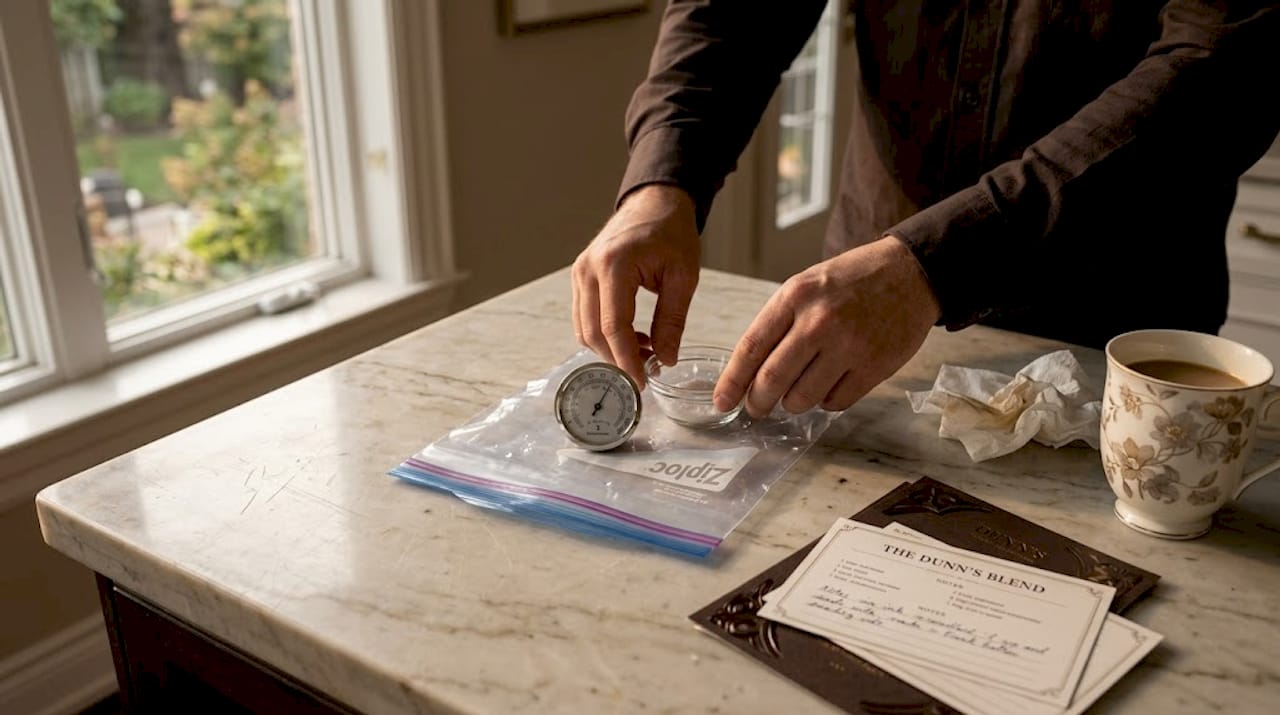
The elegance of the salt test lies in its simplicity. It requires materials available in any kitchen. However, it also introduces variables: the ratio of salt to water must be correct (you want a paste, not a pool), the seal must be airtight, and patience is non-negotiable. Rushing the process leads to unreliable results.
Calibration kits
Calibration kits, including those from Boveda, use pre-measured 75% RH pouches that eliminate the mixing step entirely. The reference environment is pre-established, consistent, and repeatable. You seal the hygrometer with the pouch, wait the appropriate time, and record your offset. The process is cleaner, more standardized, and removes the single largest source of human error in the salt test: improper solution preparation.
| Feature | Salt test | Calibration kit |
|---|---|---|
| Cost | Very low | Low to moderate |
| Setup complexity | Moderate | Minimal |
| Accuracy potential | High (if done correctly) | High (standardized) |
| Risk of error | Higher (ratio-dependent) | Lower |
| Time required | 8 to 24 hours | 8 to 24 hours |
| Repeatability | Variable | Consistent |
| Mess factor | Moderate | Very low |
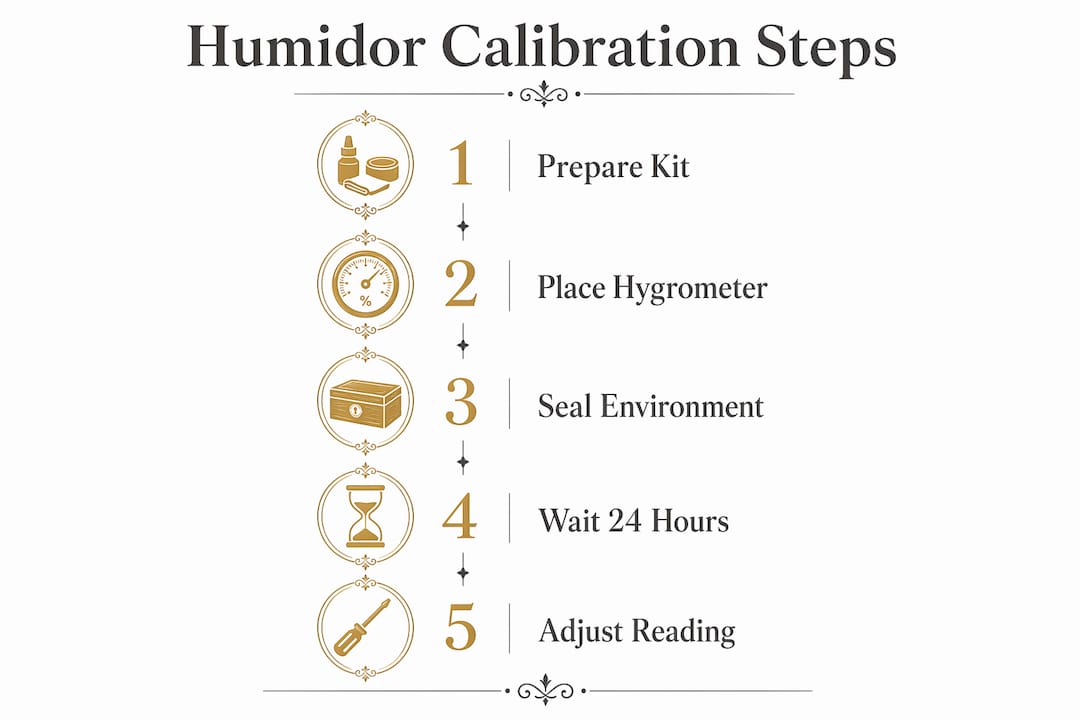
Here is a streamlined calibration workflow using either method:
- Gather your materials: Salt and distilled water for the traditional method, or a dedicated calibration pouch for the kit approach.
- Prepare the reference environment: Mix your saline paste or unseal the calibration pouch and place it inside a clean, resealable bag.
- Add your hygrometer: Ensure it is fully enclosed with no airflow pathways to the outside environment.
- Seal completely: Any air exchange will compromise your reference RH.
- Wait the full period: A minimum of 8 hours, ideally 24, for equilibrium to establish.
- Record your offset: Note the difference between the reading and 75% RH.
- Adjust or log: Adjust a calibratable device or document the offset to correct future readings mentally.
Pro Tip: When using a calibration kit, resist the urge to check results at the 4-hour or 6-hour mark. Sensors need the full stabilization window to produce reliable data. Document your offset in a maintenance log specific to each hygrometer in your collection.
Understanding humidor size and cigar preservation also informs how sensitive your RH environment will be, which makes accurate calibration even more critical in compact spaces where small fluctuations amplify quickly.
Now that the main calibration methods are clear, you need to know when and how often to apply them for the best results.
When and how often should you calibrate?
Calibration is not a once-and-done ritual. The sensor type in your hygrometer, combined with how actively your humidor is used, determines your calibration schedule. Knowing when to act is just as important as knowing how.
| Hygrometer type | Recommended frequency | Additional triggers |
|---|---|---|
| Digital | Every 6 to 12 months | After impact, relocation, or erratic readings |
| Analog | Every 4 to 6 months | After any significant temperature swing |
| Smart or electronic | Per manufacturer guidance | After firmware updates or power interruptions |
Digital hygrometers use electronic sensors that hold their calibration reasonably well but still drift, particularly in humidors that experience seasonal temperature changes. Digital hygrometers in frequently accessed humidors benefit from more regular checks since repeated opening exposes sensors to ambient air more often.
Analog hygrometers, which use a coil of treated hair or synthetic material to measure humidity, are inherently more prone to drift. The organic or semi-organic nature of their sensing element makes them sensitive to abrupt environmental changes. For collectors relying on analog instruments inside desktop humidors, a quarterly check is worth building into your routine.
Beyond the calendar, certain triggers should prompt an immediate recalibration regardless of schedule. Watch for these warning signs:
- Cigars feel noticeably dry or overly moist despite what the reading suggests
- Readings fluctuate erratically within a short timeframe without obvious environmental cause
- You have recently relocated the humidor to a different room, home, or climate zone
- The hygrometer sustained physical impact, even a minor bump can shift sensor alignment
- You introduced a new humidification source and readings jumped unexpectedly
- Mold appears despite readings appearing within normal range
- Cigars develop tunneling or uneven burn, which can signal improper RH conditions over time
Treating calibration as a quarterly or semi-annual ritual elevates your approach from reactive to proactive. The collectors who preserve the most value in their collections are those who never wait for visible damage before they investigate.
Calibration timing is only part of the equation. The placement of your hygrometer matters just as much for accurate results.
Sensor placement and double-checks: Maximizing accuracy
A perfectly calibrated hygrometer placed in the wrong location delivers perfectly wrong information. Sensor placement is the silent variable that undermines even the most diligent calibration practice. The goal is to position your hygrometer in the representative “average” humidity zone, not near any source that skews the microclimate.
Locations to avoid include:
- Directly adjacent to humidification devices: Sponges, Boveda packs placed too close, or built-in reservoirs create a localized high-humidity zone that inflates readings.
- Near hinges or door seams: These areas experience ambient air intrusion with each opening, creating a drier microclimate than the interior average.
- Pressed against the back or side walls: Walls absorb and release humidity differently than the air column in the center of the humidor.
- Under direct airflow from fans or vents in electronic humidors with active circulation systems.
For large cabinet humidors or especially walk-in humidors, single-point measurement is never sufficient. Zonal climate variation is real. The upper shelves in a tall cabinet may read 2 to 4 percentage points different from the lower shelves due to the natural stratification of humidity and temperature. Using multiple hygrometers and averaging their readings provides a far more accurate picture of your total environment.
Best-practice placement by humidor type:
- Desktop humidors: Center of the interior, elevated slightly from the bottom shelf, away from the humidification device by at least several inches.
- Cabinet humidors: At least two sensors, one in the upper third and one in the lower third of the interior.
- Walk-in humidors: A minimum of four sensors placed in each quadrant at mid-shelf height, with a fifth near the center as a reference.
Following a pro workflow for maintaining valuable items reinforces that serious collectors treat placement, calibration, and documentation as integrated disciplines rather than isolated tasks.
Pro Tip: If your cigars behave unexpectedly, for example, burning unevenly or drawing with unusual resistance, even while your hygrometer reads within a reasonable range, treat that as a cue to recalibrate before touching your humidification media. Adjusting humidity blindly based on an unchecked sensor can compound the problem significantly.
Our cigar maintenance tips speak directly to this integrated approach, combining technical discipline with sensory awareness for the most reliable results.
With these practical strategies, you are equipped for accuracy. Let’s share an expert perspective and next steps.
What most collectors miss about humidor calibration
We have observed a fascinating pattern among dedicated cigar collectors. The more technically inclined they become, the more they fixate on the number. The display reads 69%, they adjust. It reads 71%, they adjust again. The hygrometer becomes an oracle, and the cigars become secondary.
Here is the uncomfortable truth: your cigars are a more reliable indicator than any sensor. The feel of the wrapper, the way a stick responds to a gentle squeeze, the evenness of its draw, the quality of its ash, these are data points that no digital display can fully replicate. The most accomplished collectors we work with do something that surprises newcomers: they put the cigar first. If a reading seems plausible but the cigars behave “wrong”, they recalibrate the instrument rather than adjusting the environment.
The second thing most collectors miss is temporal drift. A hygrometer that was perfectly accurate eighteen months ago may have drifted 4 or 5 points without any visible indication. The readings still change with the seasons. The numbers still feel responsive. Nothing looks wrong. But the baseline has quietly shifted, and every adjustment you have made since then has been built on a flawed foundation.
The impact of humidor size amplifies this problem. In a small desktop humidor, a 5-point calibration error can push your actual RH outside acceptable range within days of a temperature change. In a large cabinet, that same error may take weeks to manifest visibly, but the damage accumulates just the same.
Our recommendation: combine regular calibration with deliberate sensory engagement with your collection. Trust the instruments, but verify them with your hands, your eyes, and ultimately your palate. That combination of technical rigor and connoisseur instinct is what separates a well-maintained collection from a truly exceptional one.
Enhance your humidor journey with Dunn’s Luxury Selections
Precision calibration is the foundation of exceptional cigar storage, but it reaches its full potential when paired with a humidor engineered to hold a stable microclimate with unwavering consistency.

At Dunn’s Luxury Selections, we have curated an unmatched collection of humidors designed for collectors who refuse to compromise. Whether you seek the understated elegance of our desktop humidors, the commanding presence of our premium cabinet humidors, or a bespoke solution from our complete humidor collection, every option is built to honor your collection. Your cigars represent a legacy worth protecting. Let the sanctuary that holds them reflect that same standard. Explore our full range and take the next step toward preservation without compromise.
Frequently asked questions
Do all new hygrometers need calibration?
Yes, even new hygrometers labeled as pre-calibrated should be checked and calibrated for best accuracy, as factory settings can drift during shipping or storage.
How long does the salt test for calibration take?
The salt test requires a minimum of 8 to 24 hours in a sealed environment for humidity to fully stabilize. Rushing the process produces unreliable offset readings that can mislead your adjustments. Calibration kits follow the same timeline but with less room for error.
What RH percentage should my humidor’s hygrometer read after calibration?
Most calibration methods, including the salt test and 75% RH calibration kits, use 75% RH as the standardized reference point. Your target storage RH is a separate preference, typically between 65% and 72% for most collectors.
Can I trust one hygrometer for a large humidor?
For larger humidors, one sensor is insufficient. Even a calibrated hygrometer can misrepresent the overall environment if placed near walls, humidity sources, or in a non-representative zone. Multiple sensors placed strategically and averaged together provide the most reliable picture.
Recommended
You May Also Enjoy
Cigar Locker Dimensions: Sizing Guide for Collectors and Lounges
Cigar locker dimensions explained: compartment sizes, cabinet footprints, capacity math and clearances, so you size a locker bank...
Read Article
Sealing a Walk-In Humidor: Envelope, Door and Penetrations
How to seal a walk-in humidor properly: vapor barrier placement, door gasket, penetrations and the controlled airflow a...
Read Article
Retail Humidor ROI: How to Measure What a Display Earns
What does a retail or lounge humidor really return? A practical framework for cigar shops, lounges and clubs:...
Read Article