

Unlock the secrets of what is humidor capacity. Learn how to choose the right size for your cigars and avoid costly mistakes.
Understanding what is humidor capacity is one of the most misunderstood aspects of cigar collecting. Most enthusiasts buy a humidor labeled “100 cigars” and assume that number is precise. It is not. Capacity ratings are estimates, calculated against a baseline cigar size that rarely matches your actual collection. Whether you are curating a modest desktop sanctuary or building a serious cabinet collection, knowing how capacity is measured, where those numbers fall short, and how to assess your real needs will save you from the frustration of overpacking or wasting shelf space.
Table of Contents
- Key takeaways
- What is humidor capacity and how is it determined?
- Humidor size categories and what they suit
- How to assess your own capacity needs
- Nuances that affect real humidor capacity
- Practical capacity calculations with real examples
- My honest take on choosing the right capacity
- Find your ideal humidor at Dunnluxuryselections
- FAQ
Key takeaways
| Point | Details |
|---|---|
| Capacity is an estimate | Manufacturer ratings are based on small baseline cigars and rarely reflect real storage numbers. |
| Plan for 30 to 50% extra | Build in extra space beyond your current inventory to support airflow and future growth. |
| Shelving shapes your capacity | Shelf depth, angle, and tray configuration change effective capacity even within the same cubic footage. |
| Overpacking damages cigars | Filling a humidor to its rated maximum restricts airflow and raises humidity inconsistencies. |
| Size categories guide selection | Small, medium, and large humidors serve distinct collection stages and lifestyle needs. |
What is humidor capacity and how is it determined?
Humidor capacity refers to the number of cigars a humidor can hold under its intended storage conditions. The concept sounds simple. The reality is layered.
Most manufacturers base their capacity ratings on the Corona, a cigar measuring roughly 5.5 inches in length with a 42 ring gauge. This is one of the smaller, more compact vitolas in the standard cigar catalog. When a manufacturer says a humidor holds 100 cigars, they mean 100 Coronas arranged as efficiently as possible. Your actual collection, built on Toros, Churchills, Robustos, and Torpedoes, will store at a lower number every time. A humidor rated for 100 cigars will often hold fewer due to the size discrepancy between the rating basis and real cigars stored.
Beyond cigar size, several variables directly influence what a humidor can actually hold:
- Interior shelving configuration. The number of shelves, their depth, and whether they are fixed or removable all determine how efficiently you can arrange stock.
- Humidification device placement. A passive humidifier mounted on the lid or a side panel takes up physical space and creates a zone you should keep clear for accurate humidity dispersal.
- Cigar packaging state. Sealed boxes stack tighter than opened ones. Singles arranged individually consume more surface area than a neatly stacked box.
- Cubic footage as a baseline estimate. As a general planning rule, 1 cubic foot holds roughly 75 to 100 cigars, depending on shelving design and cigar dimensions.
The market reflects this reality. Most humidors come in 25, 50, 75, and 100 cigar capacities, with larger options scaling into the hundreds for serious collectors. Treat these numbers as a starting framework, not a guarantee.
Humidor size categories and what they suit
Selecting the right humidor begins with understanding where the major size categories sit and what they realistically accommodate.
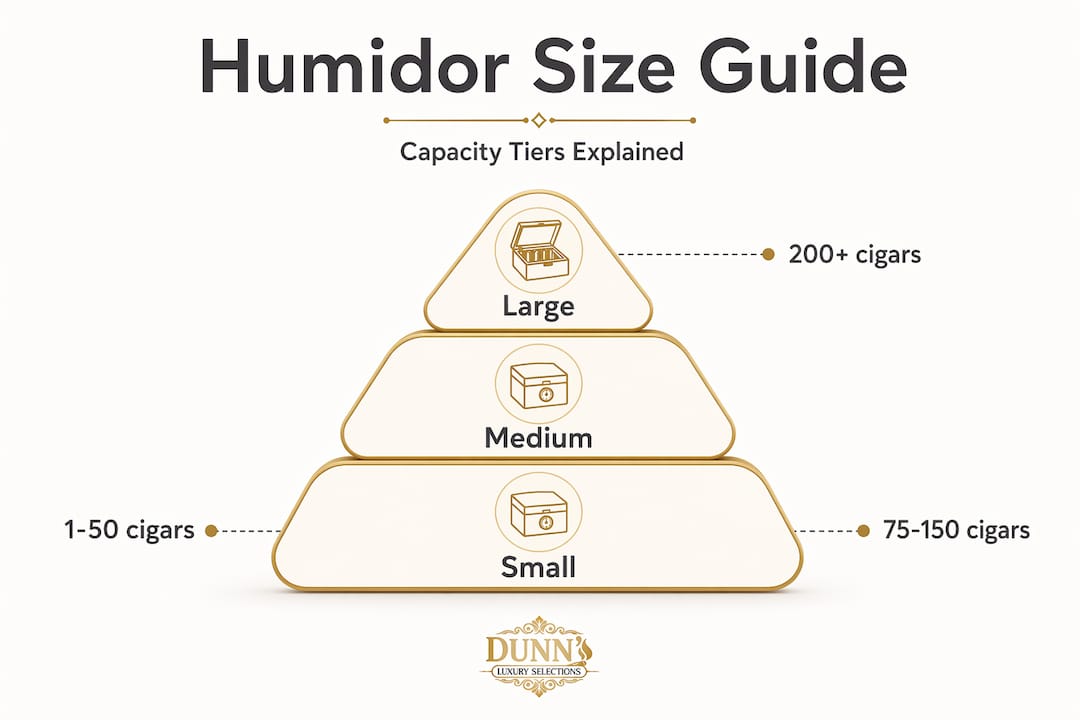
| Size Category | Capacity Range | Best Suited For |
|---|---|---|
| Small | 1 to 50 cigars | Beginners, gifting, travel use, casual smokers |
| Medium | 50 to 150 cigars | Growing collections, regular aficionados |
| Large | 150 to 500+ cigars | Serious collectors, lounge displays, aging reserves |
| Walk-in / Cabinet | 500+ cigars | Professional settings, dedicated collector rooms |
Small humidors occupy the desktop tier. They are approachable, portable, and excellent for anyone beginning to build their palate. A 25-cigar desktop unit in Spanish Cedar is a genuine sanctuary for a focused selection. The constraint is real, though. Once your collection starts rotating through 10 to 15 cigars per week, a small humidor will feel limiting within months.
Medium humidors represent the sweet spot for most dedicated enthusiasts. A cabinet in the 75 to 150 range gives you the flexibility to store multiple box sizes, maintain a singles rotation, and age a few premium selections simultaneously. This is where the craft of curating truly begins.
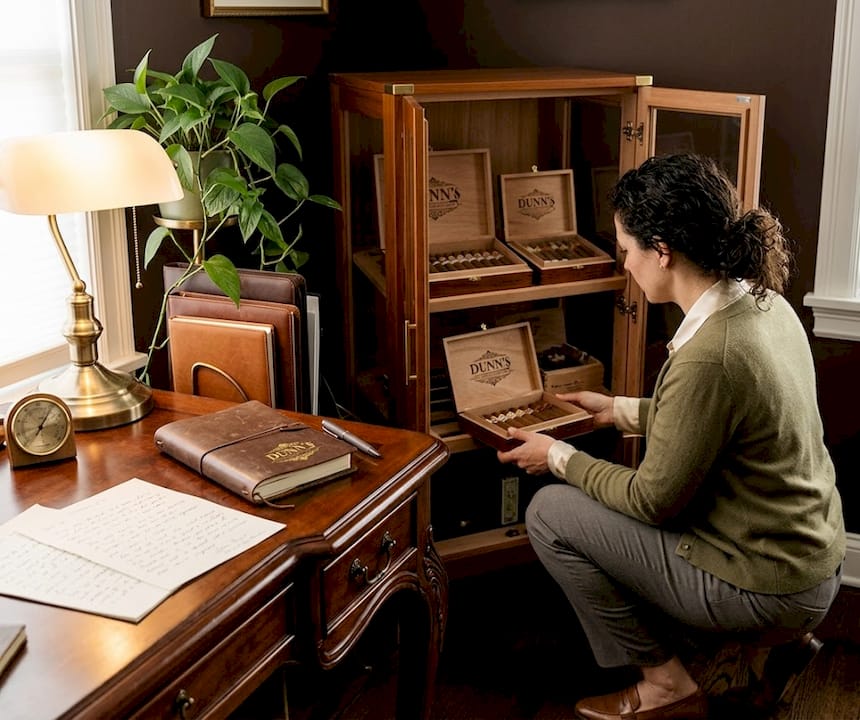
Large and cabinet humidors are instruments of serious collecting. They accommodate multiple open boxes, aging stock, and the kind of organized display that reflects real depth of passion. Walk-in humidors should allow 3 to 4 customers or collectors to browse comfortably, which means capacity planning must account for human access beyond pure volume.
Pro Tip: If you are debating between two size categories, always select the larger one. The cost difference between a 75-count and a 100-count humidor is minor. The regret of running out of space is not.
How to assess your own capacity needs
Selecting your ideal humidor capacity is not about guessing. It is about methodically analyzing your habits, your collection, and where both are headed. Work through these steps before making any purchase decision.
-
Audit your current inventory. Count every cigar you own right now, noting whether they are in sealed boxes, open boxes, or stored as singles. This is your baseline number.
-
Calculate your weekly consumption rate. How many cigars do you smoke per week on average? A collector who smokes five cigars per week will cycle through stock at a fundamentally different rate than someone who smokes one per day.
-
Identify your typical cigar sizes. If your rotation leans heavily toward 60-ring gauge Toros and 7-inch Churchills, your effective storage per unit of space is lower than a collection built on Petites. Adjust your expectations accordingly.
-
Account for packaging format. Opened boxes take more room than sealed boxes. If you prefer to display singles for easy access, your required space increases substantially over what raw cigar counts suggest.
-
Build in 30 to 50% additional capacity. This is not a casual suggestion. Experts recommend designing for 30 to 50% extra space beyond your opening inventory to support airflow, prevent overcrowding, and accommodate future growth without forcing a premature upgrade.
-
Factor in aging reserves. If you intend to age any stock, those cigars sit untouched for months or years. They occupy permanent shelf space that cannot be counted in your rotation math.
-
Consider humidor placement and physical dimensions. Your selected space at home determines which humidor dimensions are viable. Measure your intended location before falling in love with a cabinet that will not fit.
Pro Tip: Use the linear feet of your shelving, not just cubic footage, to get a precise storage estimate. Shelf linear footage and depth provide more accurate planning results than simple volume calculations.
Nuances that affect real humidor capacity
Raw numbers only tell part of the story. These are the factors that shift your humidor’s effective capacity in practice, often without any warning from the manufacturer.
- Shelf depth and angle. Shelving style dramatically impacts usable capacity. Deeper shelves hold more cigars per row but can make retrieval awkward. Angled display shelves sacrifice total count in favor of visibility, which matters when you are browsing a large collection.
- Humidification system footprint. Larger passive humidifiers, Boveda packs stacked in clusters, or electronic humidification units all consume space. Plan storage around the device, not alongside it as an afterthought.
- Singles display trays. Dedicated singles trays add elegance and accessibility but reduce total box storage. Understanding how to maximize trays lets you balance display with density.
- Breathing room for humidity stability. A humidor packed to its rated maximum will develop uneven humidity pockets. Cigars on the outer edges receive a different environment than those at the center. That inconsistency ages your collection unevenly.
“A humidor that’s too full is not a well-stocked collection. It’s a risk. Overcrowding restricts the airflow that humidity depends on, and it turns every retrieval into a game of chance where the wrong cigar gets bent, nicked, or rolled.”
Hygrometer placement deserves particular attention. Placing a hygrometer too close to humidification sources causes false high humidity readings, which can lead to under-humidification of your cigars while your display tells you everything is fine. Position your hygrometer at the opposite end of the humidor from the humidification device for a true ambient reading. Calibrate it every 6 to 12 months with a salt test or 75% RH kit to maintain reliability.
Practical capacity calculations with real examples
Understanding humidor storage capacity becomes far more useful when you attach concrete numbers to it.
The cubic footage rule in practice. A desktop humidor with interior dimensions of 12 inches wide, 8 inches deep, and 6 inches tall has a volume of 576 cubic inches, which equals 0.33 cubic feet. At the standard estimate of 75 to 100 cigars per cubic foot, this unit holds roughly 25 to 33 Coronas. Add larger ring gauge cigars to the mix, and you are working with 18 to 22 cigars at realistic capacity.
Planning a 100-cigar humidor. The table below illustrates how actual storage breaks down when a mixed collection replaces uniform Coronas.
| Cigar Type | Dimensions | Boxes or Count | Space Required |
|---|---|---|---|
| Robusto (5x50) | Compact | 2 boxes (20 ct each) | 40 cigars |
| Toro (6x52) | Medium | 1 box (20 ct) | 20 cigars |
| Churchill (7x48) | Long | 1 box (25 ct) | 25 cigars |
| Singles rotation | Various | 15 individual slots | 15 cigars |
| Total | 100 cigars |
The result is a humidor filled to its theoretical maximum with no breathing room remaining. A better approach reserves 20 to 30 of those 100 slots as buffer, leaving space for airflow, future additions, and comfortable retrieval. Humidor bags follow the same principle: bags sized for 60 to 80 cigars should carry no more than 50 to 60 for optimal conditions.
The practical lesson is this: buy capacity for what you intend to store at comfortable density, not for what you can physically force inside.
My honest take on choosing the right capacity
I have watched more collectors than I can count make the same mistake. They size their humidor for today’s collection and discover within a year that they have outgrown it entirely. The humidor sits overpacked, the relative humidity swings unpredictably, and retrieving a specific cigar becomes an excavation project.
In my experience, most enthusiasts underestimate their needed capacity by at least 30%. That number is not intuition. It reflects how naturally a collection grows once the habit deepens. One box becomes two, aging stock accumulates, and a gifted sampler takes permanent residence on the shelf.
What I have also learned is that overfilling does real damage. Cigars pressed against each other pick up wrapper impressions, and airflow around humid zones becomes inconsistent. I have seen collections aged beautifully on the outside row and dried out in the center, all because the humidor was treated as a warehouse rather than a sanctuary.
My recommended approach: calculate your current inventory, add 50% capacity for growth, and then move up one size category from that result. For collectors starting fresh, a desktop humidor in the 75 to 100 range serves beautifully if discipline is maintained. For anyone with an established rotation of 50 or more cigars, the move to a cabinet humidor is not a luxury. It is a necessity.
— Belle
Find your ideal humidor at Dunnluxuryselections
At Dunnluxuryselections, we have built our collection around one belief: that every serious aficionado deserves a humidor sized precisely for their life and their legacy.

Whether you are stepping into cigar collecting for the first time or expanding a decades-long passion, Dunnluxuryselections offers humidors across every capacity tier. Explore compact desktop models engineered for 25 to 100 cigars, and grand cabinet humidors built to house serious collections with precision climate management. For collectors on the move, our travel humidors protect your finest selections without sacrificing integrity. Each piece is crafted with Spanish Cedar interiors, precision sealing, and the kind of presence that tells a story the moment it enters a room.
FAQ
What does humidor capacity mean?
Humidor capacity refers to the estimated number of cigars a humidor can hold, typically calculated using Corona-sized cigars as the baseline. Real capacity varies based on the size and ring gauge of cigars you actually store.
Why does my humidor hold fewer cigars than rated?
Most capacity ratings are based on smaller baseline cigars like the Corona. Larger ring gauge cigars such as Robustos or Churchills occupy more space per unit, which reduces total count below the manufacturer’s stated number.
How much extra capacity should I plan for?
Experts recommend 30 to 50% additional capacity beyond your current inventory to support airflow, accommodate future growth, and prevent overcrowding that can damage cigars.
Can overpacking a humidor damage my cigars?
Yes. Filling a humidor to its rated maximum restricts airflow and creates uneven humidity distribution, which ages cigars inconsistently and risks physical damage from pressure between cigars.
How do I measure humidor capacity for my collection?
Calculate the interior cubic footage of the humidor, then apply the standard estimate of 75 to 100 cigars per cubic foot as a baseline. Adjust downward based on your typical cigar sizes and whether you store sealed boxes, open boxes, or singles.
Recommended
You May Also Enjoy
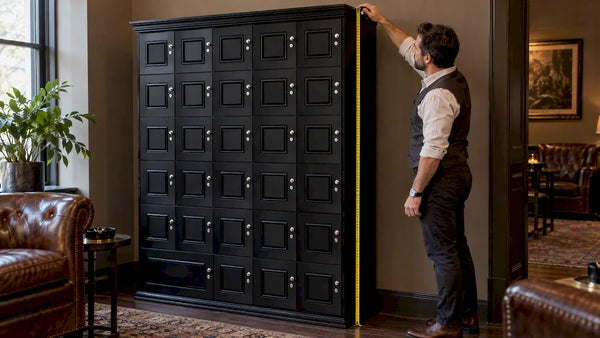
Cigar Locker Dimensions: Sizing Guide for Collectors and Lounges
Cigar locker dimensions explained: compartment sizes, cabinet footprints, capacity math and clearances, so you size a locker bank...
Read Article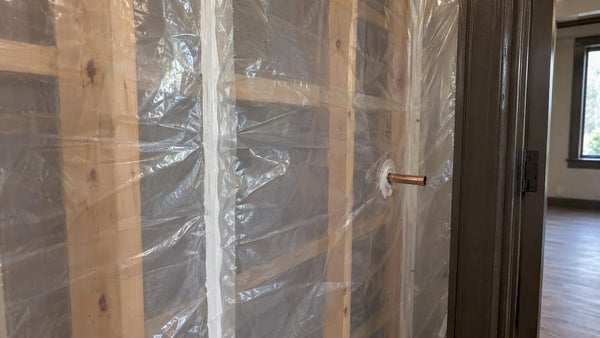
Sealing a Walk-In Humidor: Envelope, Door and Penetrations
How to seal a walk-in humidor properly: vapor barrier placement, door gasket, penetrations and the controlled airflow a...
Read Article
Retail Humidor ROI: How to Measure What a Display Earns
What does a retail or lounge humidor really return? A practical framework for cigar shops, lounges and clubs:...
Read Article