

Unlock the secrets to perfect cigar storage with our ideal humidor temperature guide. Preserve flavor and ensure longevity for your collection!
Every cigar you own is a preserved moment, a carefully crafted expression of tobacco terroir and the artisan’s hand. Yet that investment unravels the moment your humidor temperature drifts out of range. This ideal humidor temperature guide exists to prevent exactly that. The consequences of improper storage are not subtle: beetles hatch, essential oils evaporate, and flavors built over years of cultivation degrade in days. Whether you’re managing a modest desktop collection or a full cabinet sanctuary, mastering your humidor temperature settings is the single most decisive act of stewardship you can perform for your cigars.
Table of Contents
- Key takeaways
- Ideal temperature and humidity ranges for your humidor
- Setting up your humidor for stable temperature control
- Monitoring and maintaining your humidor over time
- Troubleshooting common humidor problems
- My honest take on humidor temperature management
- Preserve your collection with the right humidor
- FAQ
Key takeaways
| Point | Details |
|---|---|
| Follow the 70/70 rule as baseline | Target 70°F and 70% RH to replicate the conditions of premium cigar-producing climates. |
| Stability beats precision | Consistent temperature matters more than hitting an exact number; swings cause more damage than slight offsets. |
| Temperatures above 72°F carry serious risk | Beetle infestations and essential oil evaporation become genuine threats above this threshold. |
| Calibrate your hygrometer regularly | An uncalibrated device gives false confidence; use the salt test or a calibration kit every few months. |
| Age cooler for long-term preservation | Collectors aging cigars for years often prefer 65°F and 65% RH to slow development and reduce pest risk. |
Ideal temperature and humidity ranges for your humidor
The 70/70 rule is the industry standard most collectors learn first: maintain 70°F (21°C) and 70% relative humidity. That pairing is no accident. It mirrors the climate of Cuba, Nicaragua, the Dominican Republic, and other premier tobacco-growing regions, effectively allowing your cigars to continue resting in the environment they were born into.
That said, the rule is a starting point, not a ceiling. The accepted range for optimal cigar storage temperature is 65°F to 70°F, with humidity levels for cigars sitting between 65% and 72% RH. Within that range, your cigars will remain supple, aromatic, and ready to smoke.
Here is where things get critical:
- Above 72°F: The risk of tobacco beetle infestation rises sharply. Beetle larvae already present in cured tobacco can hatch and tunnel through your entire collection, destroying cigars from the inside out.
- Above 80°F: Temperatures at this level cause rapid deterioration and intensify pest activity to a near-catastrophic level for any collection.
- Above 72°F and high humidity combined: Essential oils begin to evaporate, and flavor loss becomes irreversible. There is no correcting a cigar that has been cooked in its own box.
- Below 65°F: Cigars dry out gradually. The wrapper becomes brittle, the filler loses its moisture balance, and the burn becomes uneven and harsh.
- Below 60°F: At this point, the aging process effectively stalls, which can be useful for very long-term storage but counterproductive for cigars you intend to smoke within months.
What experienced collectors understand, and what separates a well-tended collection from a neglected one, is that consistency matters more than precision. A humidor that holds steadily at 68°F is far preferable to one that swings between 65°F and 73°F throughout the day. Large temperature swings stress the tobacco, cause the wrapper to expand and contract, and accelerate the very degradation you are working to prevent.
Pro Tip: If you run your humidor on the cooler side at 65°F to 67°F, you can afford to be slightly more relaxed about exact humidity percentages. Cooler air holds moisture more predictably, giving you a wider stable window.
Setting up your humidor for stable temperature control
Getting the right equipment and placing your humidor correctly from the start will save you months of troubleshooting. Here is how to do it properly.
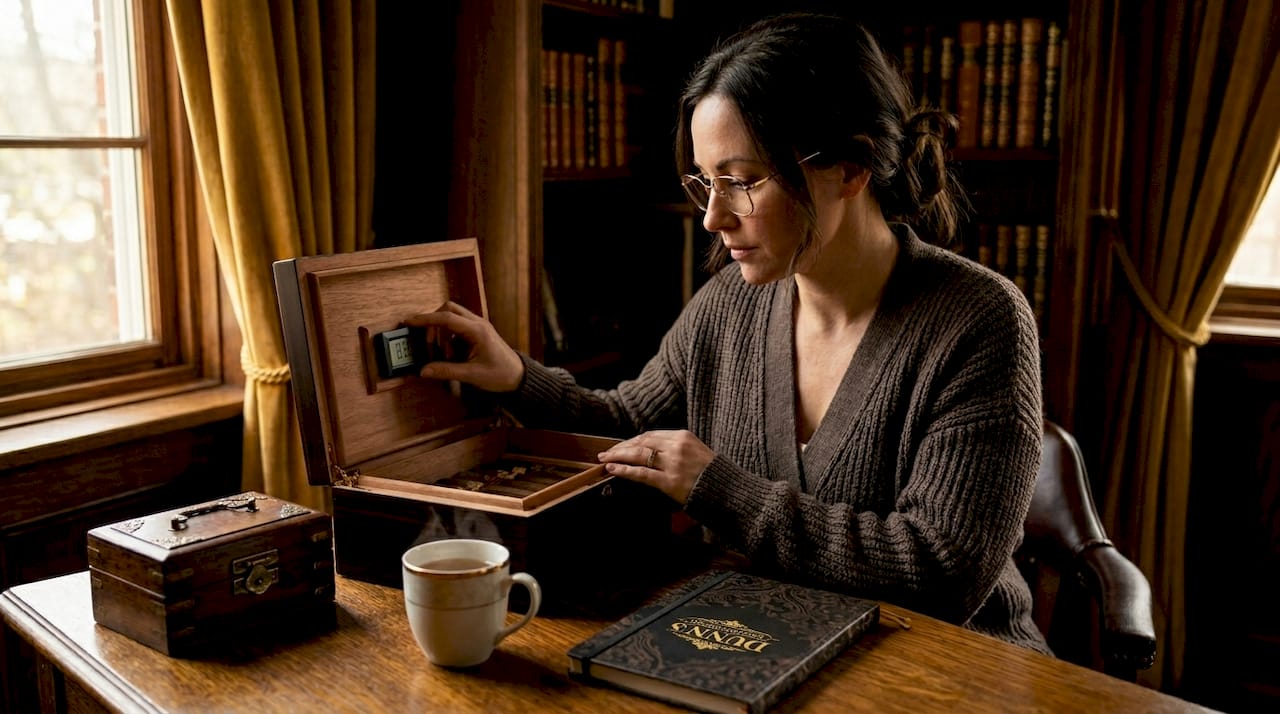
1. Invest in a calibrated digital hygrometer. Analog hygrometers, while visually elegant, are notoriously inaccurate. A quality digital hygrometer gives you real-time temperature and humidity readings you can trust. However, even digital devices drift over time. Calibrate periodically using the salt test: place the device in a sealed bag with a small dish of damp table salt for 24 hours. At equilibrium, it should read 75% RH. If it does not, adjust accordingly or replace the device.
2. Choose your humidification device thoughtfully. Passive floral foam devices are affordable but require more attention. Beads and crystals offer superior stability. For a larger cabinet, an electronic humidifier for cigar storage with automatic top-off capability is worth every dollar. The best humidification levels are achieved when the device matches the volume of your humidor, not just the number of cigars inside.
3. Season your humidor correctly before loading it. Never wipe Spanish Cedar interiors with water directly. That swells and warps the wood. Use seasoning packs rated at 84% RH and allow the cedar to absorb moisture gradually over 7 to 14 days. A properly seasoned humidor stabilizes far more efficiently once cigars are introduced.
4. Choose your placement with care. Avoid HVAC vents, direct sunlight, and exterior walls, all of which introduce temperature fluctuations that no humidification system can fully compensate for. Interior closets and basements offer the most consistent ambient conditions year-round.
5. Adjust for your local climate and season. A collector in Phoenix faces entirely different challenges than one in Boston in January. During summer heat waves, consider placing a small cool pack near (not inside) the humidor to moderate ambient temperature. In arid winter climates, your humidification device will work significantly harder, and you may need to increase refill frequency.
Pro Tip: If you travel with cigars, a quality travel humidor engineered for temperature stability is not optional. Leaving cigars in a car glove compartment on a warm day can bring interior temperatures past 90°F within minutes.
Monitoring and maintaining your humidor over time
A stable humidor environment does not maintain itself. It rewards consistent attention. The following routine keeps your collection in peak condition.
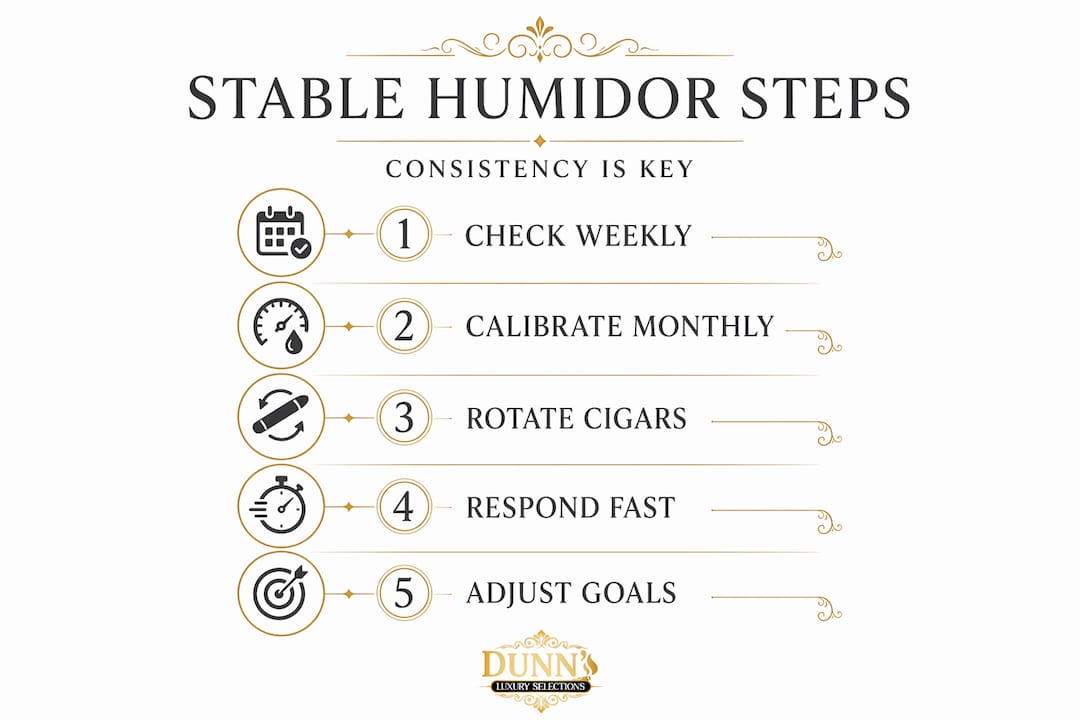
Weekly checks: Read your hygrometer at least once per week. Log the temperature and humidity together, not just one or the other. A reading of 70% RH means something very different at 68°F versus 74°F.
Monthly calibration reminders: Set a monthly calendar reminder to verify your hygrometer’s accuracy. Active monitoring and calibration are what separate collectors who lose cigars from those who don’t.
Rotate your cigars. Every few months, move cigars from the top tray to the bottom and back. This ensures even humidity distribution and prevents any single area of the humidor from becoming a micro-climate. It also gives you the opportunity to visually inspect each cigar for early signs of mold or drying.
Respond quickly to imbalances. If humidity drops below 65% RH, add distilled water to your humidification device and give it 24 to 48 hours to stabilize before making additional changes. If humidity climbs above 72%, leave the lid slightly ajar for an hour, then recheck. Knee-jerk overcorrections cause the swings that damage cigars most.
Adjust for aging goals. If you are aging for long-term flavor development, consider running your humidor at 65°F and 65% RH. Cooler and drier conditions slow the aging process, preserve essential oils, and reduce beetle risk substantially. This is the preferred approach among collectors holding cigars for five years or more.
You can also track cigar freshness and condition systematically. Dunnluxuryselections offers a detailed guide on monitoring cigar condition over time, which pairs well with the temperature routines outlined here.
Troubleshooting common humidor problems
Even a well-managed collection encounters problems. Knowing how to read the signs is half the battle.
- Mold on the wrapper: This signals humidity consistently above 72% RH, often combined with insufficient airflow. Remove affected cigars immediately, reduce humidity, and air out the humidor before reintroducing your collection.
- Cracked or brittle wrappers: Humidity has dropped too low and likely stayed there for an extended period. Rehydrate slowly. Sudden reintroduction of high moisture can crack dry wrappers further.
- Uneven burn or harsh draw: Often traced to inconsistent moisture distribution rather than the cigar itself. Rotate your stock and recheck hygrometer placement within the humidor.
- Tiny pinholes in the wrapper: The most alarming sign. Tobacco beetles have hatched. Isolate every cigar, freeze unaffected ones at 0°F for 72 hours to kill any larvae, and deep-clean the humidor before restoring conditions.
| Problem | Likely cause | Immediate fix |
|---|---|---|
| Mold on cigars | Humidity above 72% RH | Reduce humidity; improve airflow |
| Brittle, cracking wrappers | Humidity below 65% RH | Slow rehydration over 48 hours |
| Beetle pinhole damage | Temps above 72°F | Freeze unaffected cigars; clean humidor |
| Uneven burn quality | Inconsistent moisture distribution | Rotate cigars; recalibrate hygrometer |
The most common mistake collectors make is ignoring calibration until something goes wrong. An uncalibrated hygrometer reading 68% RH might actually be measuring 74%, and you would never know until you open the box to find mold. Beginners especially benefit from starting with the 70/70 rule and observing how their cigars smoke and age over the first few months before adjusting settings.
Pro Tip: When troubleshooting humidity problems, always rule out hygrometer error before adding or removing moisture. Make no adjustments for 48 hours after recalibrating. Let the real data speak first.
My honest take on humidor temperature management
I’ve watched collectors obsess over hitting exactly 70°F as if a single degree of variance ruins everything. In my experience, that fixation is misplaced. The cigars I’ve seen suffer most were never victims of a 68°F versus 70°F debate. They were victims of swings, of humidors left near radiators in winter, of summer storage in non-climate-controlled rooms where afternoon heat pushed temps past 74°F day after day.
What I’ve learned is that a stable humidor environment at 66°F will outperform a technically “correct” humidor that rides temperature waves throughout the day. I adjusted my own setup after a particularly brutal summer in a Southern state forced me to invest in an electronic cabinet system. That decision transformed my collection’s consistency in ways no passive humidification device ever could.
I’m also direct with beginners: don’t start with the most complex setup. Start with a quality desktop humidor, a calibrated digital hygrometer, and the 70/70 baseline. Smoke from it for six months. Pay attention to burn quality and draw. That feedback from the cigar itself tells you more than any chart.
For long-term aging, I lean cooler. The preference among experienced collectors toward 65°F and 65% RH for extended aging is well-grounded. Cooler storage slows development beautifully and all but eliminates beetle anxiety. Give your most prized cigars that protection.
— Belle
Preserve your collection with the right humidor
Your cigars deserve a sanctuary built for precision. Dunnluxuryselections curates America’s finest selection of luxury humidors, each engineered to deliver the stable humidor environment your collection demands.

From compact desktop humidors built for the discerning collector to expansive cabinet humidors with advanced climate regulation, every piece in the Dunnluxuryselections collection reflects a commitment to precision and legacy. For collectors who want total control over temperature and humidity levels for cigars, our electronic humidors deliver automated climate management with zero compromise. The right humidor does not just store cigars. It protects the craftsmanship, patience, and investment behind every single one. Explore the full collection at Dunnluxuryselections and find the instrument worthy of what you’re preserving.
FAQ
What is the ideal temperature for a cigar humidor?
The ideal temperature range is 65°F to 70°F, with the classic 70/70 rule (70°F and 70% RH) serving as the most widely accepted baseline. Stability within that range matters more than hitting a precise number.
What happens if a humidor gets too warm?
Temperatures above 72°F increase the risk of tobacco beetle infestation and cause essential oils to evaporate, permanently degrading cigar flavor. At 80°F or above, deterioration becomes rapid and largely irreversible.
How often should I check my humidor’s temperature and humidity?
Check your hygrometer at minimum once per week and calibrate it monthly using the salt test or a dedicated calibration kit to confirm its accuracy.
What humidity level is best for aging cigars long-term?
For cigars held five or more years, experienced collectors prefer approximately 65°F and 65% RH. Cooler, slightly drier conditions slow aging, preserve essential oils, and reduce the risk of tobacco beetles hatching.
Where is the best place to keep a humidor in my home?
Place your humidor away from HVAC vents, direct sunlight, and exterior walls. Interior closets and basements offer the most consistent ambient temperature year-round, minimizing the environmental stress that causes humidity and temperature swings.
Recommended
You May Also Enjoy
Cigar Locker Dimensions: Sizing Guide for Collectors and Lounges
Cigar locker dimensions explained: compartment sizes, cabinet footprints, capacity math and clearances, so you size a locker bank...
Read Article
Sealing a Walk-In Humidor: Envelope, Door and Penetrations
How to seal a walk-in humidor properly: vapor barrier placement, door gasket, penetrations and the controlled airflow a...
Read Article
Retail Humidor ROI: How to Measure What a Display Earns
What does a retail or lounge humidor really return? A practical framework for cigar shops, lounges and clubs:...
Read Article