

Discover effective methods for stress testing humidor setups. Ensure your cigars are perfectly preserved with accurate hygrometers and tested environments.
Stress testing humidor setups is the practice of systematically verifying hygrometer accuracy, sensor placement, and environmental stability to confirm your humidor delivers a reliable sanctuary for cigar preservation. Most collectors season their humidor once and assume the job is done. That assumption costs them aged cigars, cracked wrappers, and years of careful curation. The tools you need, including calibrated hygrometers, the saturated salt method, and a disciplined placement strategy, are straightforward. The discipline to use them correctly is what separates a collector from a custodian of a perfectly balanced ecosystem.
How to stress test your humidor with the salt method
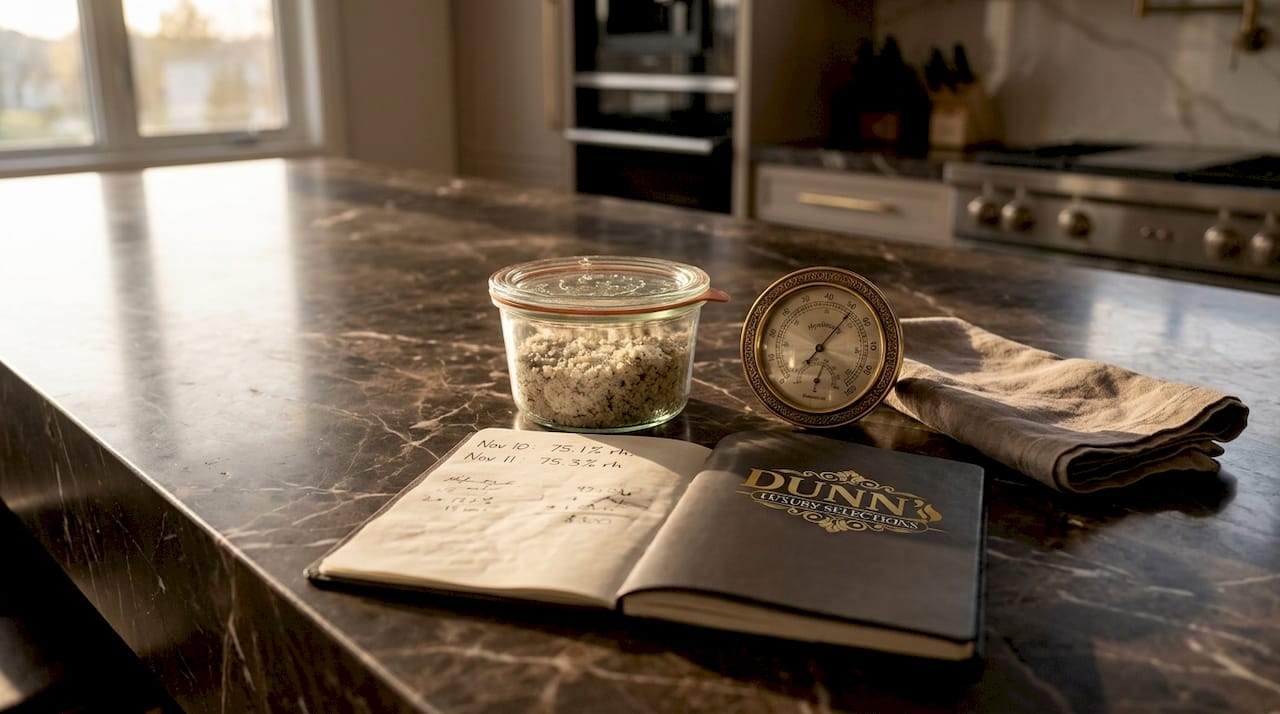
The saturated salt test is the gold standard for verifying hygrometer accuracy before any humidor performance analysis begins. It works by creating a controlled microenvironment that produces exactly 75% relative humidity (RH), giving you a fixed reference point against which to measure your sensor’s reading.
Follow these steps precisely:
- Gather your materials. You need a small, airtight container (a zip-lock bag or sealed plastic tub works well), a bottle cap or shallow dish, non-iodized table salt, and distilled water.
- Create the salt slurry. Fill the bottle cap with salt, then add just enough distilled water to moisten it. The mixture should hold its shape without pooling free liquid. Too much water dilutes the effect; too little produces an inconsistent vapor.
- Seal the hygrometer inside. Place your hygrometer in the container alongside the salt slurry without letting them touch. Seal the container completely.
- Wait 8 to 12 hours. The salt test method produces a stable 75% RH environment at equilibrium. Do not open the container during this period.
- Read and record. At the 8-hour mark, note the reading without opening the container. A perfectly calibrated hygrometer reads exactly 75% RH. If yours reads 72%, your offset is minus 3 points. Apply that correction to every future reading.
- Reset or adjust. Many digital hygrometers, including models from Caliber and Xikar, have a calibration button that lets you set the display to 75% while the sensor is still inside the sealed container. Analog models typically require you to track the offset manually.
The most common mistake collectors make is not sealing the container tightly enough. Even a small gap allows ambient air to dilute the controlled environment, producing a false reading that sends your entire calibration process in the wrong direction. Recalibrate every 6 to 12 months to account for sensor drift, particularly after seasonal temperature swings.
Pro Tip: Run two hygrometers through the salt test simultaneously. If both read within 2 percentage points of each other after calibration, you have a reliable cross-check system for your humidor going forward.
Where to place sensors for accurate readings
Sensor placement is the most underestimated variable in testing cigar storage conditions. A hygrometer positioned incorrectly will report stable, convincing numbers while your cigars experience a completely different microclimate.
The rules for placement are specific:
- Avoid proximity to humidification sources. Placing a sensor directly beside a Boveda pack, a Cigar Oasis unit, or any active humidifier creates microclimate bias that inflates your RH reading. The sensor reports the humidity directly adjacent to the moisture source, not the ambient condition your cigars actually experience.
- Stay away from walls and hinges. The corners and edges of a humidor are the first areas to lose humidity when the seal is compromised. Readings taken there skew low and create a false impression of a dry environment.
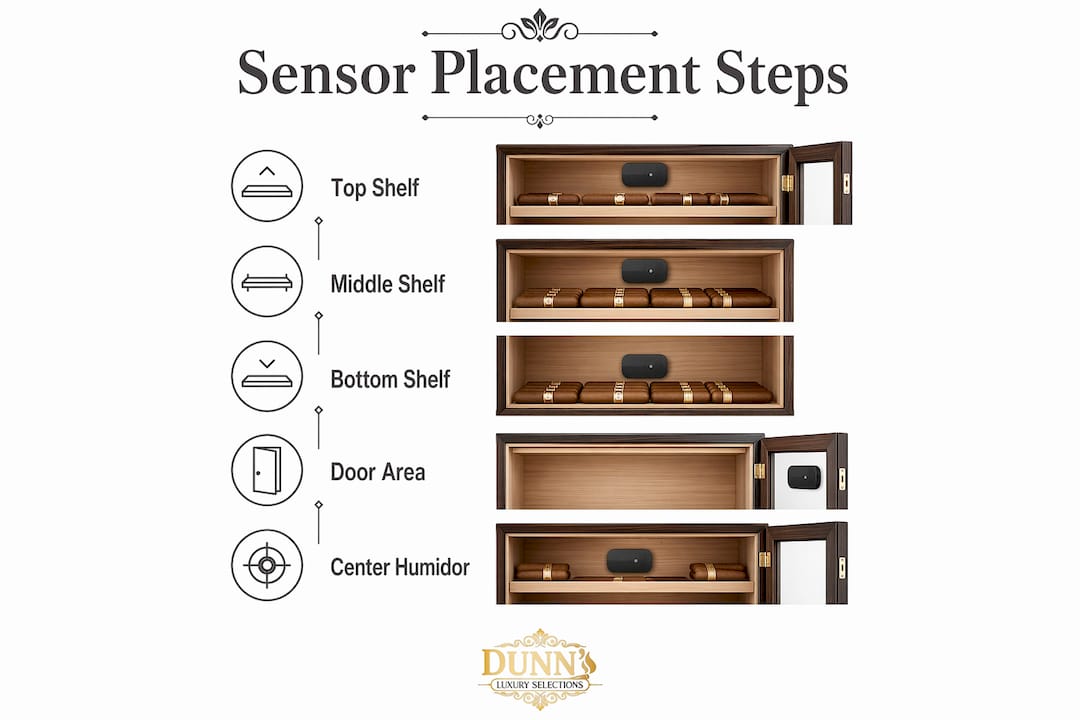
- Position sensors at mid-height. Humidity stratifies inside a humidor. The lower shelves tend to run slightly drier than the upper shelves, particularly in cabinet-style units. A mid-height placement captures the most representative average.
- Use multiple sensors. Agreement within 2 percentage points between two independently calibrated sensors confirms reliable data. Wide disagreement signals that at least one sensor needs recalibration or repositioning.
- Account for airflow. In larger cabinet humidors with fans, place one sensor upstream and one downstream of the airflow path to detect any humidity gradient the fan creates.
Pro Tip: In a cabinet humidor holding more than 500 cigars, use three sensors: one on the top shelf, one in the middle, and one near the bottom. This reveals vertical humidity gradients that a single sensor will never detect.
How to run a full operational stress test
A full humidor stress test moves beyond calibration and into real-world performance analysis. The goal is to observe how your humidor responds to the conditions it will face every day and every season.
Allow the humidor to equilibrate for 24 to 48 hours after any seasoning or environmental change before you begin recording data. Premature readings during the equilibration phase produce transient fluctuations that look like failures but are simply the humidor finding its balance.
Once equilibrated, run these stress scenarios in sequence:
- Door open simulation. Open the humidor for 30 seconds, close it, and record how long it takes for RH to return to baseline. A well-sealed humidor with adequate humidification media recovers within 15 to 30 minutes.
- Seasonal temperature shift. Move the humidor to a room that is 10 degrees Fahrenheit warmer or cooler for 24 hours. Log RH and temperature every 4 hours. Temperature and humidity are inversely related: as temperature rises, RH drops, and vice versa.
- Power interruption (electronic units). For units using a Cigar Oasis Excel or similar electronic humidifier, cut power for 12 hours and log the RH decline rate. This tells you how long your humidor can maintain acceptable conditions during a power outage.
- Load variation. Test with the humidor at 25% capacity and again at 90% capacity. Cigars themselves contribute moisture to the environment, and a near-empty humidor will behave very differently from a full one.
Log your findings in a structured format:
| Stress scenario | RH before | RH after | Recovery time |
|---|---|---|---|
| Door open (30 sec) | 68% | 63% | 22 minutes |
| Temperature shift (+10°F) | 68% | 61% | 6 hours |
| Power off (12 hours) | 68% | 59% | N/A |
| Load at 25% capacity | 68% | 65% | Stable |
Common stress scenarios like these reveal whether your humidification system is sized correctly for your humidor’s volume and usage patterns.
Troubleshooting what stress testing reveals
Stress testing identifies not only device inaccuracies but also environmental inconsistencies that directly threaten cigar preservation. When your data points to a problem, the diagnosis is usually one of four things.
- Persistent high humidity. If RH consistently reads above 72% despite reducing humidification output, check for a compromised Spanish Cedar lining that has absorbed excess moisture during over-seasoning. Re-season with a dry cloth pass before reintroducing humidification. Over-humidification invites mold and tobacco beetles, two threats that can destroy an entire collection.
- Persistent low humidity. If RH drops below 62% despite active humidification, inspect the seal. Run a dollar bill test: close the lid on a bill and pull. Resistance should be firm. If the bill slides freely, the gasket needs replacing. Also check whether your humidification media (Boveda packs, beads, or a foam insert) has exhausted its capacity and needs replacement or recharging.
- Mold presence. Visible mold on cigars or Spanish Cedar indicates a combination of excess humidity and poor airflow. Remove affected cigars immediately, wipe the interior with a lightly dampened cloth, and allow the humidor to air out for 24 hours before re-humidifying.
- Dry, cracking wrappers. This is the signature of chronic under-humidification. Target ranges sit between 62% and 72% RH depending on your aging goals. Collectors aging long-filler Nicaraguan or Dominican blends often prefer the lower end of that range for slower, more controlled development.
Which hygrometer type performs best under testing?
Choosing the right sensor is a prerequisite for any credible humidor performance analysis. Each hygrometer type carries distinct trade-offs.
| Hygrometer type | Accuracy | Calibration ease | Drift tendency | Battery required |
|---|---|---|---|---|
| Analog | Moderate | Difficult | High | No |
| Digital | High | Easy (offset button) | Low to moderate | Yes |
| Smart (Wi-Fi/Bluetooth) | High | App-based | Low | Yes |
Analog hygrometers drift over time and require manual offset tracking, which introduces human error into every reading. Digital models from brands like Xikar and Caliber IV offer a calibration button that makes the salt test adjustment a 10-second task. Smart hygrometers, such as those from SensorPush or Govee, add continuous data logging and smartphone alerts, which transforms passive monitoring into active humidor performance analysis.
For serious collectors, a dual-sensor setup pairing a calibrated digital unit with a smart hygrometer provides both immediate readout and historical trend data. The two readings cross-validate each other, and the smart sensor’s app history reveals slow humidity drift that a single glance at a dial would never catch.
Key takeaways
Stress testing a humidor setup requires calibrated sensors, correct placement, and structured scenario testing to guarantee a stable environment for long-term cigar preservation.
| Point | Details |
|---|---|
| Salt test calibration | Seal your hygrometer with moistened salt for 8 to 12 hours; the correct reading at equilibrium is 75% RH. |
| Sensor placement matters | Position sensors at mid-height, away from humidifiers and walls, to avoid microclimate bias. |
| Equilibrate before testing | Allow 24 to 48 hours after seasoning before recording stress test data to avoid false readings. |
| Run real-world scenarios | Test door openings, temperature shifts, and power interruptions to measure true humidor resilience. |
| Match hygrometer to purpose | Use digital or smart hygrometers for easier calibration; pair two sensors for cross-validation. |
What I’ve learned from years of watching collectors get this wrong
The most consistent mistake I see among passionate collectors is treating the initial setup as the finish line. They season the humidor, drop in a Boveda pack, place a single analog hygrometer near the front, and declare the environment stable. Months later, they wonder why their Padron 1964 Anniversary Series feels brittle or why a prized Cohiba Behike developed a faint musty note.
The truth is that a humidor is a living instrument. Its performance shifts with the seasons, with how often you open it, with how full or empty it runs. The salt test is not a one-time ritual. I recommend scheduling calibration checks every six months, ideally at the transition between summer and winter, when ambient temperature and humidity swings are most pronounced.
I am also a firm believer in the redundancy principle. Two sensors, from different manufacturers, calibrated independently, and placed at different heights inside the humidor. If they agree, you have confidence. If they diverge by more than 3 percentage points, you have a problem worth investigating before it becomes an irreversible one.
One more thing: resist the temptation to push RH toward the high end of the acceptable range because you believe more moisture means better preservation. It does not. The optimal humidor setup for most aged cigars sits between 65% and 68% RH. That range allows slow, even development without the mold risk that lurks above 72%.
— Belle
Protect your collection with Dunnluxuryselections
Your cigars deserve a sanctuary built to hold its environment through every season and every stress scenario you put it through. Dunnluxuryselections offers a curated selection of premium cabinet humidors engineered for zonal climate control, Spanish Cedar interiors, and the kind of seal integrity that passes every dollar-bill test with authority.

Beyond the humidor itself, Dunnluxuryselections provides expert care guides covering seasoning protocols, calibration schedules, and humidity management for collections of every size. Whether you are building your first serious setup or refining a cabinet that holds hundreds of prized cigars, the expertise and craftsmanship behind every Dunnluxuryselections piece gives you the precision your collection demands.
FAQ
What does stress testing a humidor actually mean?
Stress testing a humidor means deliberately exposing it to real-world conditions, such as door openings, temperature changes, and power interruptions, while monitoring RH and temperature to verify the unit maintains a stable environment for cigar preservation.
How accurate is the salt test for calibrating a hygrometer?
The salt test produces exactly 75% RH in a sealed container at equilibrium, making it a reliable and widely accepted method for verifying and adjusting hygrometer accuracy before placing sensors in a humidor.
How often should I recalibrate my humidor hygrometer?
Recalibrate every 6 to 12 months, with additional checks after any major environmental change such as moving the humidor, a seasonal temperature shift, or replacing humidification media.
What RH range is best for aging cigars?
Most collectors target between 62% and 72% RH, with the 65% to 68% range favored for long-term aging. Humidity above 72% risks mold and tobacco beetles, while levels below 62% cause wrappers to crack and flavor compounds to deteriorate.
Can I use a smart hygrometer instead of an analog one?
Smart hygrometers from brands like SensorPush offer continuous data logging and app-based alerts, making them superior to analog models for ongoing humidor performance analysis. Pair one with a calibrated digital unit for the most reliable dual-sensor setup.
Recommended
You May Also Enjoy
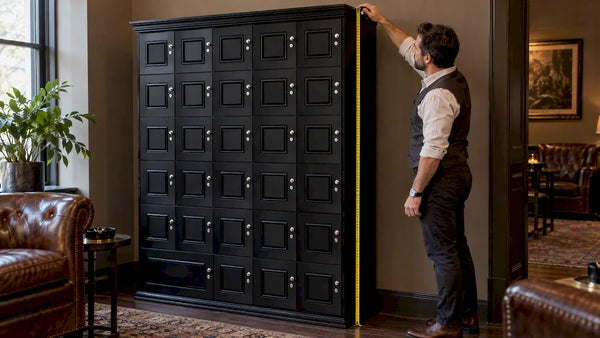
Cigar Locker Dimensions: Sizing Guide for Collectors and Lounges
Cigar locker dimensions explained: compartment sizes, cabinet footprints, capacity math and clearances, so you size a locker bank...
Read Article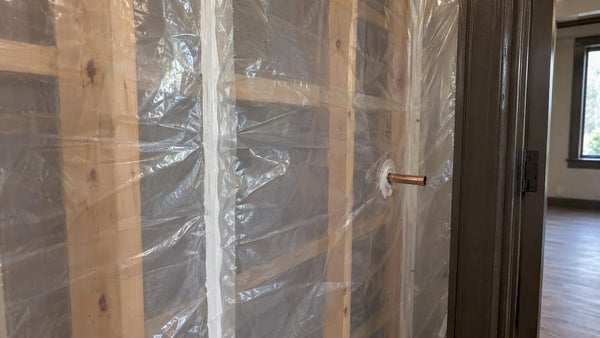
Sealing a Walk-In Humidor: Envelope, Door and Penetrations
How to seal a walk-in humidor properly: vapor barrier placement, door gasket, penetrations and the controlled airflow a...
Read Article
Retail Humidor ROI: How to Measure What a Display Earns
What does a retail or lounge humidor really return? A practical framework for cigar shops, lounges and clubs:...
Read Article