

Discover what is a humidor seal and why it’s essential for preserving your cigars. Learn how proper sealing maintains optimal humidity!
Many cigar enthusiasts invest heavily in premium cigars yet give almost no thought to what is a humidor seal, the quiet guardian standing between their collection and ruin. A humidor seal is the physical barrier that runs along the junction of a humidor’s lid and body, controlling air exchange to maintain the precise relative humidity your cigars demand. Without an effective seal, no amount of quality humidification equipment can compensate for the steady bleed of moisture escaping through a compromised edge. Understanding this component, from how it works to how it fails, is the foundation of genuine cigar preservation.
Table of Contents
- Key Takeaways
- What is a humidor seal and how it works
- Types of humidor seals and their tradeoffs
- How to test your humidor seal
- Fixing and maintaining your humidor seal
- My perspective on what collectors consistently get wrong
- Elevate your collection with Dunnluxuryselections
- FAQ
Key Takeaways
| Point | Details |
|---|---|
| Seal function is critical | The humidor seal controls humidity retention, protecting cigars from drying out or over-humidification. |
| Multiple seal types exist | Wooden lip, magnetic gasket, and silicone seals each carry distinct advantages depending on humidor design. |
| Test your seal regularly | Use the dollar bill or flashlight method to detect leaks before your cigars pay the price. |
| Seals degrade with use | Everyday opening and closing degrades seal integrity within one to two years, requiring proactive maintenance. |
| Fixes range from simple to total replacement | Minor leaks can be addressed with food-grade sealant; severe failure may warrant a new humidor. |
What is a humidor seal and how it works
At its most fundamental level, a humidor seal is the material or structural element that lines the perimeter where a humidor’s lid meets its base, forming a controlled barrier between the interior climate and the external environment. Think of it as the gasket on a fine Swiss watch: invisible in day-to-day use, yet absolutely decisive in maintaining the instrument’s precision.
A properly functioning seal does not create a perfectly airtight chamber. That distinction matters more than most collectors realize. Cigars are living organic materials that continue to breathe, releasing and absorbing moisture. The seal’s role is to slow the rate of air exchange enough that your humidification system can maintain relative humidity consistently between 65 and 72 percent, without humidity flooding out faster than it can be replenished.
How the seal achieves this depends on its construction. The most traditional approach uses a wooden lip seal, where a raised ridge of Spanish Cedar or similar wood traces the interior edge of the box. When you season a new humidor, that wooden lip absorbs moisture and swells, pressing more firmly against the opposing surface and tightening the barrier naturally. This is precisely why seasoning a new humidor is not optional. It is what activates the seal.
The hallmark of a well-calibrated seal is a tactile one. A snug lid requiring effort to open, with a faint vacuum suction sensation, tells you the seal is doing its job. If the lid swings open with no resistance whatsoever, air is moving in and out far too freely.
Key elements that define seal construction include:
- The lip material: Spanish Cedar swells predictably and resists mold, making it the preferred choice in traditional humidors
- Surface contact area: Wider lid lips create a larger sealing surface, which generally provides better humidity retention
- Lid alignment: Even a perfectly constructed seal fails if the lid warps, so the quality of the hinge and the wood’s seasoning both affect seal performance
- Interior finish: Unfinished wood interiors are intentional. Lacquered or sealed interiors would prevent the wood from breathing and absorbing humidity as designed
Types of humidor seals and their tradeoffs
Not all humidor seals are created equal, and understanding the differences helps you assess what you currently own and what to look for when upgrading.
| Seal Type | Best For | Key Advantage | Key Drawback |
|---|---|---|---|
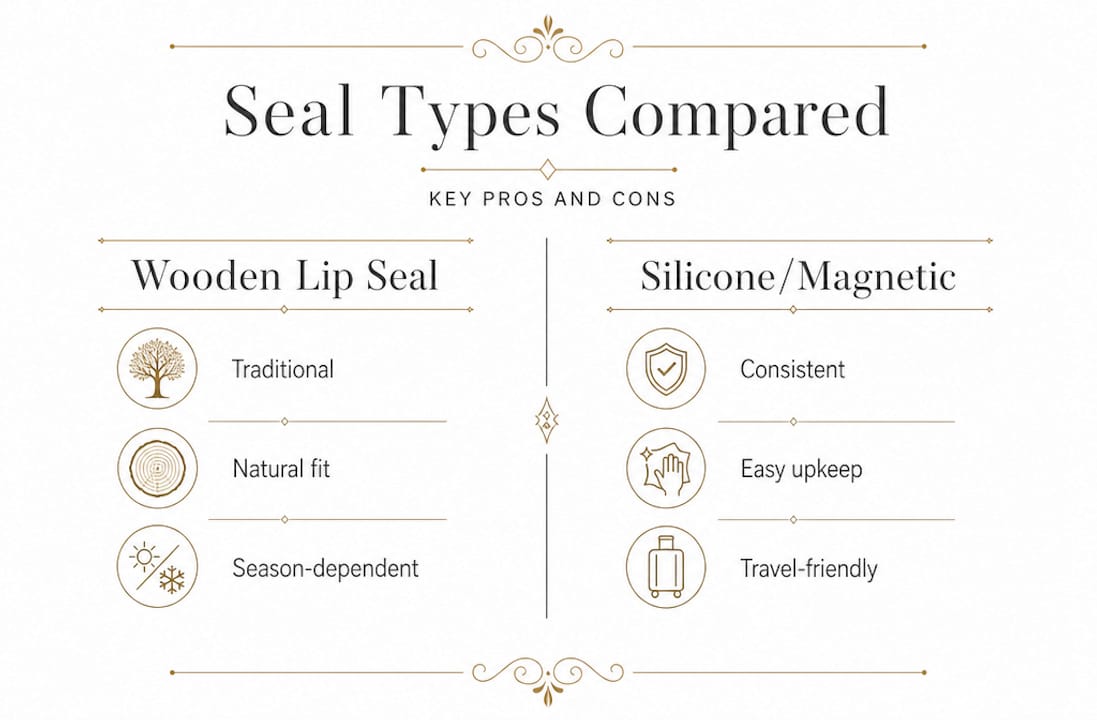
| Wooden lip seal | Traditional desktop and cabinet humidors | Natural humidity interaction, improves with seasoning | Requires proper seasoning; susceptible to warping if humidity swings dramatically |
| Magnetic gasket seal | Acrylic, modern, and travel humidors | Consistent contact pressure, no seasoning required | Less forgiving of manufacturing defects; can degrade faster under heat |
| Silicone or rubber seal | Travel and entry-level humidors | Durable, flexible, weather-resistant | Can absorb odors over time; may not provide the same tactile “suction” feel |
| Compression foam seal | Budget or portable cases | Inexpensive to replace | Breaks down relatively quickly, often within one year of regular use |
Magnetic or silicone seals have become increasingly common in acrylic and travel formats because they maintain consistent contact pressure without requiring the wood to swell. For collectors who travel frequently, the silicone seal inside a quality travel humidor offers a reliable alternative to the traditional wooden lip model.

Pro Tip: After purchasing a new humidor with a wooden lip seal, resist the urge to load it with cigars immediately. Season the humidor for 24 to 72 hours using distilled water, allowing the wooden lip to swell fully before your collection takes up residence.
The wooden lip seal remains the gold standard for premium desktop and cabinet humidors because of its symbiotic relationship with Spanish Cedar interiors. The same wood that seasons to form the seal also absorbs and releases humidity from within, creating a more stable microclimate overall. The two functions reinforce each other.
How to test your humidor seal
Knowing your seal is functioning correctly should not be left to guesswork. Two field-tested methods allow any collector to assess seal integrity without specialized equipment.
-
The dollar bill test. Close your humidor on a dollar bill so that half the bill is inside and half hangs outside. Try to pull the bill free with a smooth, steady motion. If the bill slips out easily, the seal at that point is too loose. Work your way around all four edges of the lid, testing each section individually, because seals rarely fail uniformly. A weak corner is enough to compromise the entire interior climate.
-
The flashlight test. Place an illuminated flashlight inside the humidor, close the lid, and take the humidor into a dark room. Examine every edge where the lid meets the base. Any visible light escaping through the seam indicates a gap in your seal. This method is particularly useful for identifying whether one specific corner or edge is the problem, rather than a general looseness across the entire perimeter.
-
The suction test. Open your humidor briskly and pay attention to the tactile and auditory experience. A properly sealed humidor produces a faint resistance or soft pop when the lid is lifted, evidence of the negative pressure differential built up inside. If the lid opens as freely as an unlocked box, your seal warrants closer inspection.
-
The hygrometer consistency test. Place a calibrated digital hygrometer inside the humidor and monitor readings over 48 hours without opening. Unexplained humidity drops of more than three or four percentage points suggest air is escaping through seal failures. Pairing this with a fresh-battery hygrometer and a reliable humidification device eliminates other variables.
-
Visual inspection under strong light. Examine the lid lip closely. Look for warping, uneven gaps, compressed or flattened material, or areas where the seal material has separated from the wood. These are physical indicators that the seal has mechanically degraded.
Pro Tip: Perform the dollar bill test every six months as a standard part of your humidor care routine. Seal integrity degrades with regular use, typically within one to two years, so proactive testing protects rare or expensive cigars before any noticeable humidity drop occurs.
Fixing and maintaining your humidor seal
Poor seal performance does not automatically mean you need a new humidor. Several repair and maintenance approaches can extend the life of a compromised seal, depending on the nature and severity of the problem.
-
Reseasoning the humidor. If you have a wooden lip seal and notice mild looseness, the solution may be as simple as reseasoning. Humidity loss causes the wood to contract. A thorough seasoning cycle with distilled water can restore the swelling that makes the seal effective again.
-
Food-grade silicone sealant. For small gaps or minor seam separations, odorless caulking or silicone sealant applied carefully to the affected area provides a reliable temporary fix. The critical word is “odorless.” Any scented or chemical-heavy sealant will transfer its character directly into your cigars over time, which is not the legacy you want for a prized collection.
-
Replacing gasket strips. On humidors with magnetic or foam gasket seals, the gasket material itself can often be sourced and replaced without replacing the entire humidor. Measure the existing strip carefully before ordering a replacement, and use a slow, deliberate hand when applying the adhesive-backed replacement to avoid bubbles or misalignment.
-
Hinge and lid adjustment. Sometimes the seal material is fine, but the lid has shifted out of alignment due to humidity-induced warping. Gently adjusting or tightening the hinge hardware can restore proper contact between lid and body, effectively improving seal performance without touching the seal itself.
-
Lid handling discipline. This one is underappreciated. Dropping the lid or letting it fall open violently compresses and distorts the seal material over time. Treat the lid with the same deliberate care you afford the cigars inside. Open and close slowly, and never leave the lid propped open at an extreme angle.
-
Knowing when to replace the humidor. If the wooden body itself has warped significantly, the lid no longer sits flush regardless of the seal condition, or if multiple repair attempts have failed to stabilize humidity, the humidor has reached the end of its functional life. At that point, the most effective preservation decision is a new sanctuary for your collection.
My perspective on what collectors consistently get wrong
I’ve seen collectors spend hundreds of dollars on rare Nicaraguan or Cuban cigars, then store them in a humidor they have never once tested for seal integrity. There is a belief, surprisingly common, that a new humidor is inherently airtight and trustworthy. It is not. Even premium humidors ship dry and need proper seasoning before the wooden lip seal becomes effective.
What changed my approach to cigar care was losing a small lot of aged Cohiba Behikes to what I eventually traced back to a single failing corner on a wooden lip seal. The hygrometer readings had been drifting for weeks, and I had assumed it was the humidification device losing charge. It was not. A five-second dollar bill test would have caught the problem months earlier.
I’ve also tried fixes that did not hold up. Painter’s tape around the lid edge, for instance, is a trick that circulates online and does almost nothing for real humidity retention. The silicone sealant approach, applied correctly with a food-grade product, actually works for minor gaps. However, it is worth being honest that once a wooden humidor warps beyond a certain point, no sealant in the world restores true integrity. The wood itself has lost its geometry.
My most consistent advice: treat your humidor seal as a component that requires the same periodic attention as your humidification device. It is not set-and-forget. The vacuum suction feel when opening your humidor is one of the most reliable and immediate indicators of collection health you have. If that sensation disappears, investigate before your cigars pay the price.
— Belle
Elevate your collection with Dunnluxuryselections
At Dunnluxuryselections, every humidor in our collection is engineered with seal integrity as a foundational design priority, not an afterthought. Whether you are curating a growing collection in a desktop humidor or housing a legacy collection in a premium cabinet humidor, our craftsmanship ensures that every lid closes with the precision and resistance that serious collectors demand.

From Spanish Cedar-lined interiors that season to form natural wooden lip seals, to precision-engineered electronic humidors with advanced humidity control, our range addresses every level of collecting ambition. Explore our humidor collections and find a sanctuary worthy of your cigars at Dunnluxuryselections.
FAQ
What is a humidor seal made of?
A humidor seal is typically made from the wooden lip of the humidor box itself, which swells after seasoning to create a barrier. Some humidors use magnetic gaskets, silicone strips, or compressed foam as alternative sealing materials.
How do I know if my humidor seal is working?
A properly functioning seal creates a faint vacuum suction sensation when you open the lid. You can also confirm seal integrity using the dollar bill test, where the bill should resist being pulled free from a closed lid.
How often should I test my humidor seal?
Test your humidor seal every six months. Regular use degrades seal quality within one to two years, and periodic testing protects your collection before any noticeable humidity loss occurs.
Can a broken humidor seal be repaired?
Minor seal gaps can be repaired using food-grade, odorless silicone sealant applied carefully to the affected seam. If the humidor lid has warped significantly, replacement is often the more reliable solution.
Why does a humidor seal matter for cigar quality?
A compromised seal allows humidity to escape, making it impossible for your humidification system to maintain the consistent relative humidity cigars require. This leads to drying, cracking of wrappers, loss of flavor, and irreversible damage to your collection.
Recommended
You May Also Enjoy
Cigar Locker Dimensions: Sizing Guide for Collectors and Lounges
Cigar locker dimensions explained: compartment sizes, cabinet footprints, capacity math and clearances, so you size a locker bank...
Read Article
Sealing a Walk-In Humidor: Envelope, Door and Penetrations
How to seal a walk-in humidor properly: vapor barrier placement, door gasket, penetrations and the controlled airflow a...
Read Article
Retail Humidor ROI: How to Measure What a Display Earns
What does a retail or lounge humidor really return? A practical framework for cigar shops, lounges and clubs:...
Read Article