

Discover what is humidor insulation and learn how it protects your cigars from heat and humidity fluctuations. Preserve your collection today!
Humidor insulation is the thermal and vapor barrier system that stabilizes the internal climate of a cigar storage environment against external temperature and humidity fluctuations. Without it, even the finest Spanish Cedar lining and the most precise humidification device cannot maintain the narrow conditions your cigars demand. The concept draws on two distinct principles: thermal resistance, measured by R-value, and vapor control, managed by a dedicated moisture barrier. Understanding both is the difference between a humidor that preserves a legacy and one that quietly destroys it.
What is humidor insulation and why it matters for cigars
Humidor insulation is defined as the structural thermal barrier designed to minimize heat exchange between the humidor interior and the external environment. Think of it as the skeleton of your storage system. Spanish Cedar lining, while prized for its aromatic properties and modest moisture-buffering capacity, functions as the skin. The skeleton must come first.
Temperature and humidity are inseparable partners in cigar preservation. When external heat penetrates a poorly insulated humidor, the interior temperature rises, and warmer air holds more moisture. That shift forces your humidification system to work harder, creates uneven humidity zones, and raises the risk of mold. Proper insulation breaks that cycle by holding the interior temperature steady regardless of what the room around it is doing.
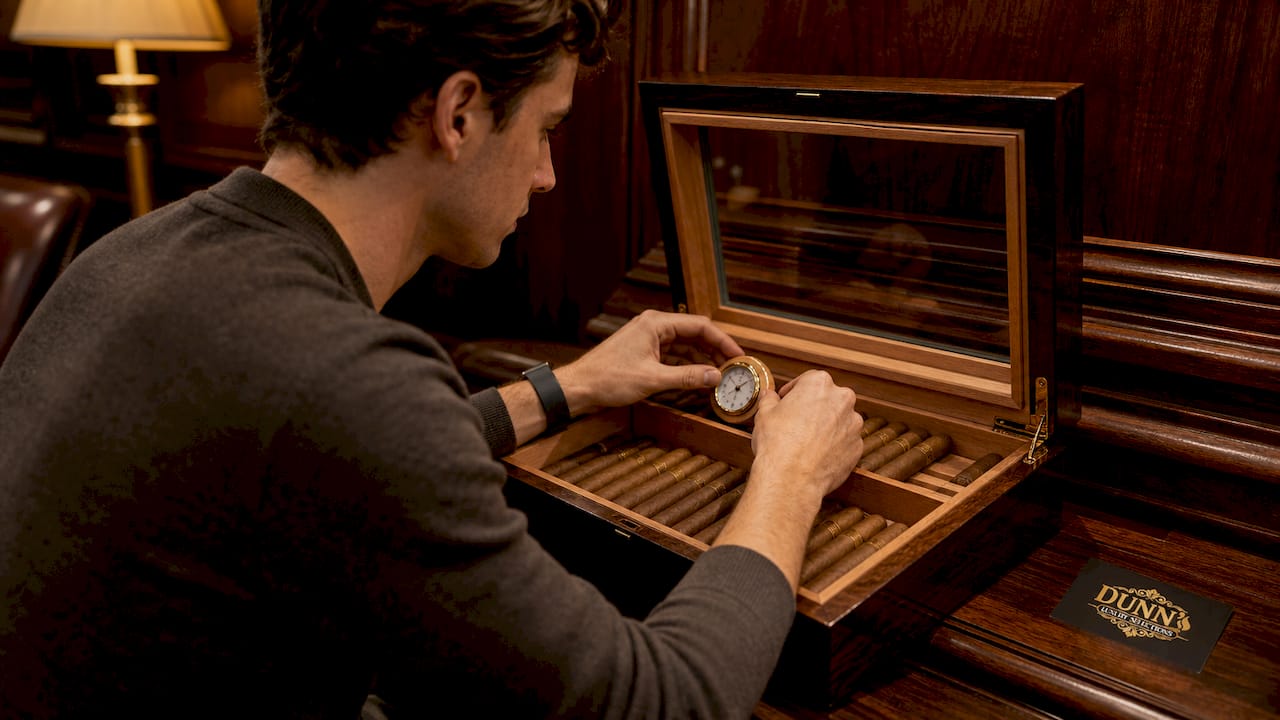
A common misconception among collectors is that a thick-walled wooden humidor provides adequate insulation on its own. Many collectors mistakenly equate thick Spanish Cedar walls with good insulation, but proper insulation and vapor barriers independent of wood thickness are the key to humidity retention. Wood alone is a poor thermal insulator. The R-value of solid wood is roughly R-1 per inch, far below what professional standards require.
How does humidor insulation work to control temperature and humidity
Thermal resistance, expressed as R-value, measures how effectively a material slows heat transfer. The higher the R-value, the slower heat moves through a wall or ceiling. In a humidor, slowing that heat transfer keeps the interior temperature stable, which in turn keeps relative humidity predictable and controllable.
Temperature stability directly influences humidity control in humidors. At 78°F, a 72% relative humidity reading carries a meaningfully higher mold risk than the same reading at 68°F, because warm air holds more moisture vapor and creates conditions where tobacco beetles and mold thrive. Holding the interior at a consistent 68°F is the professional standard for a reason. It is the sweet spot where your cigars age gracefully without biological threat.
Insulation achieves this by doing three things simultaneously:
- Blocking conductive heat transfer through walls and ceilings, preventing external temperature swings from penetrating the interior
- Reducing convective air movement by sealing gaps where warm or cold outside air could infiltrate
- Supporting vapor control by working alongside a dedicated vapor barrier to prevent moisture migration into wall cavities
Insulation is truly the backbone of a humidor’s climate stability. Without it, humidification systems face a constant uphill battle against external temperature swings, cycling on and off repeatedly and creating the very fluctuations they are meant to prevent.
Pro Tip: Place a calibrated digital hygrometer, such as a Boveda Butler or Xikar PuroTemp, at the center of your humidor to detect temperature-driven humidity drift before it affects your cigars.
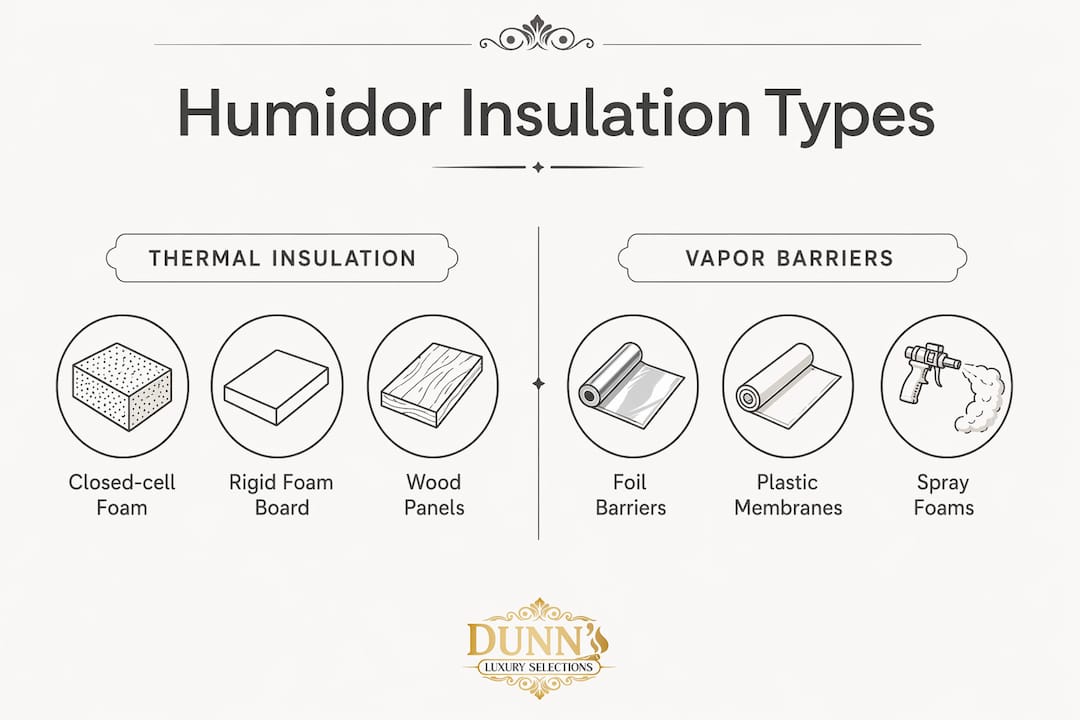
What are the common types of humidor insulation?
Choosing the right insulation material depends on your humidor type, whether a desktop cabinet, a converted cooler, or a dedicated walk-in room. Each material carries distinct advantages in R-value, vapor resistance, and ease of installation.
| Insulation type | Approximate R-value per inch | Vapor barrier needed? | Best use case | Relative cost |
|---|---|---|---|---|
| Closed-cell spray foam | R-6 to R-7 | No (self-sealing) | Walk-in humidors, custom builds | High |
| Rigid foam board (XPS/polyiso) | R-4 to R-6.5 | Yes (tape seams) | DIY builds, coolidors | Moderate |
| Fiberglass batts | R-3 to R-4 | Yes (6-mil poly sheet) | Framed wall cavities | Low |
| Cooler walls (high-density foam) | R-4 to R-5 (varies) | Integral to design | Coolidor builds | Low to moderate |
| Solid wood walls only | R-1 per inch | Not applicable | Desktop humidors (limited) | Varies |
Closed-cell spray foam acts simultaneously as a high-R-value insulator, air barrier, and moisture sealant, reducing vapor intrusion distinctly better than fiberglass. Industry practitioners widely prefer it for walk-in humidor applications precisely because it eliminates the need for a separate vapor barrier installation. Rigid foam board, particularly extruded polystyrene (XPS) or polyisocyanurate, is a strong second choice for collectors building a coolidor or a custom cabinet, provided all seams are taped and sealed.
High-density coolers used as coolidors often maintain more stable humidity levels compared to traditional wooden humidors due to superior insulation and gasket sealing. Passive wooden humidors can drift ±5 to 10% relative humidity, while a well-insulated coolidor with a quality humidification device holds within ±1 to 2% RH. That is a meaningful difference for a collector aging premium cigars over years.
Pro Tip: When selecting rigid foam board for a DIY build, choose XPS (the pink or blue board) over EPS (white beadboard). XPS has a lower vapor permeability rating, reducing moisture migration without a secondary barrier.
Why vapor barriers are non-negotiable in humidor insulation
A vapor barrier is a distinct component from thermal insulation, though the two work as a system. Thermal insulation slows heat transfer. A vapor barrier prevents moisture-laden air from migrating into wall cavities where it condenses, feeds mold, and causes structural damage invisible to the eye until the problem is severe.
A vapor barrier prevents moisture migration into wall cavities, avoiding mold over years. The standard material is 6-mil polyethylene sheeting, installed on the warm side of the insulation with fully sealed seams and sealed penetrations around any pipes, conduits, or fasteners. Every unsealed gap is a pathway for moisture.
The consequences of omitting or improperly installing a vapor barrier are severe:
- Mold growth inside wall cavities, often undetected for months or years, eventually contaminating the interior air and your cigars
- Structural deterioration of framing and drywall as trapped moisture cycles through freeze-thaw or wet-dry patterns
- Persistent humidity loss, because moisture escaping through walls forces your humidification system to compensate constantly
- Inconsistent readings on your hygrometer, making it impossible to trust your monitoring data
Poorly installed vapor barriers or insufficient insulation cause daily humidity fluctuations of 10 to 15 percentage points, directly jeopardizing cigar quality. A cigar aged at fluctuating humidity expands and contracts repeatedly, cracking its wrapper and losing the oils that define its character. No humidification device, regardless of its sophistication, can fully compensate for a compromised vapor barrier.
Professional insulation standards for walk-in humidors
Walk-in humidors represent the pinnacle of cigar storage, and they demand professional-grade insulation standards. Cutting corners at the construction phase creates problems that no amount of maintenance can fully correct.
Professionals recommend a minimum R-value of 19 for walls and R-30 for ceilings in walk-in humidors to ensure climate stability. Ceilings receive a higher standard because heat rises and ceiling surfaces are more exposed to temperature differentials, particularly in rooms below an attic or uninsulated space. These are minimums, not targets. In climates with extreme seasonal temperature swings, exceeding these values is prudent.
| Location | Minimum R-value | Preferred material | Key installation note |
|---|---|---|---|
| Walls | R-19 | Closed-cell spray foam | Seal all penetrations before lining |
| Ceiling | R-30 | Closed-cell spray foam or rigid board | Address thermal bridging at joists |
| Floor | R-11 to R-19 | Rigid foam board | Install vapor barrier beneath slab if applicable |
| Door | R-5 to R-10 | Insulated core with gasket seal | Magnetic or compression gasket preferred |
The target interior temperature of 68°F is not arbitrary. Maintaining a stable internal temperature of about 68°F is the professional standard for reducing mold risk while preserving the essential oils and moisture content of premium tobacco. Deviating above 72°F invites tobacco beetles. Dropping below 60°F slows the aging process and can dry out wrappers.
Pro Tip: Before lining your walk-in humidor with Spanish Cedar, conduct a blower door test or use a smoke pencil to identify air leaks around electrical boxes, pipe penetrations, and door frames. Sealing these before the cedar goes up saves significant remediation cost later.
Practical tips for collectors to optimize humidor insulation
You do not need to build a walk-in room to benefit from sound insulation principles. Desktop and cabinet humidors can be optimized with attention to a few critical factors.
- Assess your gasket condition first. A worn or compressed gasket on a desktop humidor or cabinet door undermines every other insulation measure. Press a dollar bill in the closed door and pull. If it slides out without resistance, the seal needs replacement.
- Consider a coolidor for large collections. A high-density foam cooler converted into a cigar storage unit provides superior insulation and gasket sealing compared to most wooden humidors at a fraction of the cost of a custom cabinet.
- Stabilize the room, not just the humidor. Placing your humidor near a heating vent, a window with direct sun exposure, or an exterior wall subjects it to temperature swings that no internal insulation can fully absorb. A climate-controlled interior room is the correct environment.
- Calibrate your hygrometer regularly. A Boveda calibration kit or a simple salt test confirms your readings are accurate. Insulation reduces humidity drift, but you need reliable data to know it is working.
- Let insulation reduce humidification device workload. A well-insulated humidor requires less frequent refilling of Boveda packs, Xikar crystal jars, or electronic humidifiers. If you are refilling more than once a month, your insulation or sealing likely has a gap.
Pairing strong insulation with well-organized internal storage, including the use of humidor trays for airflow, creates a complete preservation system where every element supports the others.
Key takeaways
Proper humidor insulation, combining adequate R-value thermal barriers with sealed vapor barriers, is the single most determinative factor in maintaining stable humidity and temperature for long-term cigar preservation.
| Point | Details |
|---|---|
| Insulation is the skeleton | Spanish Cedar and humidification devices cannot compensate for inadequate thermal and vapor barriers. |
| R-values matter | Walk-in humidors require minimum R-19 for walls and R-30 for ceilings to prevent condensation and mold. |
| Vapor barriers are non-negotiable | 6-mil polyethylene sheeting with sealed seams prevents moisture migration that causes hidden mold and humidity loss. |
| Coolidors outperform wood alone | High-density foam coolers hold humidity within ±1 to 2% RH versus ±5 to 10% for passive wooden humidors. |
| Stability beats correction | A properly insulated humidor reduces humidification device workload and prevents the fluctuations that crack wrappers and degrade tobacco oils. |
Why I believe insulation is the most undervalued decision in cigar storage
Most collectors I speak with obsess over Spanish Cedar species, hygrometer brands, and humidification systems. Very few ask about R-values or vapor barriers. That gap in attention is where collections quietly deteriorate.
I have seen walk-in humidors built with beautiful cedar millwork and premium electronic humidifiers that still swung 12 percentage points in relative humidity across a single day. The culprit was always the same: fiberglass batts installed without a vapor barrier, or spray foam applied too thin to meet R-19. The wood looked magnificent. The cigars suffered.
The uncomfortable truth is that insulation is invisible once the cedar goes up. That invisibility makes it easy to cut corners during construction and easy to overlook during troubleshooting. But temperature and humidity form a tag-team, and controlling both requires insulation that stabilizes temperature to maintain safe humidity without mold risk. No amount of Boveda packs corrects a structurally compromised wall.
My advice is direct: before you spend on a premium humidification system or a second hygrometer, confirm your insulation meets professional standards. For walk-in builds, invest in closed-cell spray foam. For desktop and cabinet humidors, inspect gaskets and room placement before anything else. The cigars you are aging deserve a sanctuary built on a solid foundation, not one dressed up in beautiful wood over a flawed structure.
— Brian
Preserve your collection with Dunnluxuryselections
At Dunnluxuryselections, we understand that a humidor is not merely a box. It is the sanctuary where your collection matures, where legacy is preserved, and where craftsmanship meets precision climate science.

Our cabinet humidor collections are built with sealed construction and superior materials that honor the insulation principles outlined in this guide. For collectors ready to invest in a dedicated space, our walk-in humidor designs are engineered to professional R-value standards, with vapor barrier integration and precision climate control. For those who travel with their prized cigars, our travel humidor line applies the same insulation philosophy in a portable form. Every piece in our collection reflects the belief that your cigars deserve nothing less than a perfectly balanced ecosystem.
FAQ
What is humidor insulation in simple terms?
Humidor insulation is the thermal and vapor barrier system built into a humidor’s walls, ceiling, and floor to prevent external temperature changes from destabilizing the interior climate. It works alongside humidification devices to maintain the stable conditions cigars require for long-term preservation.
What R-value do I need for a walk-in humidor?
Professionals recommend a minimum of R-19 for walls and R-30 for ceilings in walk-in humidors. These values prevent condensation inside wall cavities and maintain the stable interior temperature of approximately 68°F that protects cigars from mold and tobacco beetles.
Does Spanish Cedar provide enough insulation on its own?
Spanish Cedar does not provide adequate thermal insulation on its own. Its R-value is approximately R-1 per inch, far below professional standards. Cedar regulates moisture at the surface level, but dedicated insulation and a vapor barrier are required to control the broader thermal environment.
What is the best insulation material for a humidor?
Closed-cell spray foam is the preferred material for walk-in humidors because it functions simultaneously as a high-R-value insulator, air barrier, and vapor barrier. For smaller builds or coolidors, extruded polystyrene rigid foam board with taped seams is a strong and cost-effective alternative.
How does poor insulation affect my cigars?
Insufficient insulation causes daily humidity fluctuations of 10 to 15 percentage points, which force cigars to expand and contract repeatedly. This cracks wrappers, degrades the essential oils that define flavor, and creates conditions where mold and tobacco beetles thrive.
Recommended
You May Also Enjoy
Cigar Collection Insurance: How to Protect Your Humidor
Home policies often cap or exclude cigars. Learn how floaters, agreed value, appraisals and inventories protect a serious...
Read Article
Cigar Locker Dimensions: Sizing Guide for Collectors and Lounges
Cigar locker dimensions explained: compartment sizes, cabinet footprints, capacity math and clearances, so you size a locker bank...
Read Article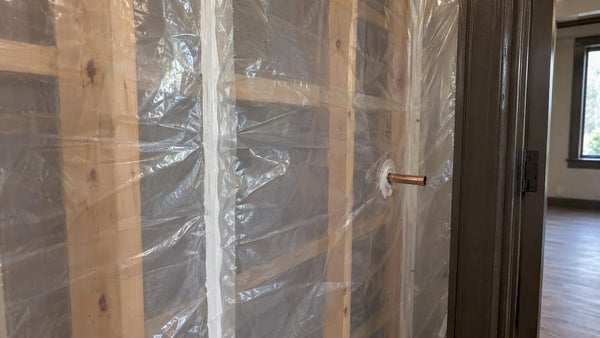
Sealing a Walk-In Humidor: Envelope, Door and Penetrations
How to seal a walk-in humidor properly: vapor barrier placement, door gasket, penetrations and the controlled airflow a...
Read Article