

Discover how to control humidity for your cigars with expert steps, ensuring they age perfectly and retain their rich flavor and character.
Opening your humidor to find cracked wrappers or, worse, the pale bloom of mold is a collector’s quiet heartbreak. It happens more often than it should, and almost always for the same reason: humidity was either ignored or misunderstood. Your cigars are not passive objects waiting on a shelf. They are living, breathing compositions of fermented tobacco leaf that respond directly to the moisture in their environment. Get that environment right and your collection ages with elegance, each stick preserving its character and complexity. Get it wrong and even the finest Habano or premium Dominican blend degrades beyond saving. This guide gives you a precise, proven path to lasting humidity control.
Table of Contents
- Why humidity matters for cigars
- Core tools and materials you’ll need
- Step-by-step: How to set, control, and monitor humidor humidity
- Verification and calibration: Getting accurate readings
- Common mistakes and troubleshooting tips
- Expert perspective: Why stability matters more than the number
- Enhance your collection with premium humidors
- Frequently asked questions
Key Takeaways
| Point | Details |
|---|---|
| Stabilize humidity first | Consistency matters more than chasing an exact number to keep cigars at their best. |
| Use the right tools | Pair a sealed humidor, a calibrated hygrometer, and the right humidification method for simple success. |
| Calibrate and check | Test hygrometers regularly with a salt test to ensure true readings and avoid hidden risks. |
| Avoid common pitfalls | Skipping seasoning and calibration or relying on unchecked sensors leads to ruined cigars. |
| Premium storage helps | Quality humidors make stable, long-term humidity control much easier for all collectors. |
Why humidity matters for cigars
Relative humidity, or RH, refers to the percentage of moisture in the air relative to the maximum it can hold at a given temperature. For cigars, this number is everything. The tobacco in your collection is hygroscopic, meaning it continuously exchanges moisture with its surrounding air. When the environment is too dry, tobacco fibers contract, wrappers crack, and the delicate oils responsible for flavor and aroma begin to dissipate. When the environment is too wet, cigars swell, draw resistance increases, and the moist conditions invite the very mold and tobacco beetle activity that can devastate an entire collection.
For humidity control methods to work effectively, you first need to understand what the target looks like. As a general rule, aim for 65–70% RH for day-to-day care, focusing on stability rather than chasing an exact number. Many collectors and product manufacturers design their systems around a 65–72% RH window, and that range reflects years of practical refinement.
What many collectors underestimate is the danger of fluctuation rather than simply sitting at the wrong number. A humidor that swings between 60% and 78% RH over the course of a week does far more harm than one holding steady at 68%. Those swings cause the tobacco to repeatedly expand and contract, stressing the wrapper leaf and loosening the bond between filler, binder, and wrapper. The result is uneven combustion, a compromised draw, and a smoke that bears little resemblance to the cigar the blender intended.
| RH Level | Effect on Cigars |
|---|---|
| Below 60% | Drying, cracking wrappers, lost aroma and oils |
| 60–64% | Acceptable short-term, slightly dry burn |
| 65–72% | Ideal zone, stable flavor and aging |
| 73–80% | Over-humidified, swelling, draw issues |
| Above 80% | Mold risk, tobacco beetle activation |
Think of your humidor as a perfectly balanced ecosystem. Every element, from the Spanish Cedar lining to the seal quality, works in concert to create a microclimate that keeps RH stable. When that microclimate is established and maintained, most storage problems simply stop occurring.
“For cigar storage, aim for roughly 65–70% RH for day-to-day care, while keeping humidity stable rather than chasing exact numbers.” — How to Store Cigars: Humidor Essentials
Key takeaways on what happens outside the ideal zone:
- Below 60% RH: Oils evaporate, wrappers crack, flavors flatten, and the cigar becomes harsh on the palate.
- Above 75% RH: Risk of mold spores activating, beetles hatching from larvae if present, and wrappers separating from binders.
- Rapid swings: Structural damage to the tobacco leaf, uneven aging, compromised burn and draw.
Core tools and materials you’ll need
Knowing the critical range and why it matters, let’s assemble the right tools for hands-on humidity control. The tools you select form the foundation of everything that follows. Choosing the wrong ones, or using the right ones incorrectly, undermines every other effort you make.
Humidor types:
Your first decision involves the humidor itself. Desktop humidors are ideal for collections ranging from 25 to 150 cigars, offering elegance and accessibility in a compact form. Cabinet humidors suit serious collectors with larger inventories, providing zonal climate control and architectural presence in a room. Travel humidors protect your finest sticks in transit. Electronic humidors represent the pinnacle of precision, integrating built-in sensors and automated humidification systems for collectors who demand exacting control without manual intervention.
Humidification devices compared:
| Device Type | Best For | Precision | Maintenance |
|---|---|---|---|
| 2-way humidity packs | Most collectors | High | Low (replace every 2–3 months) |
| Propylene glycol gel | Mid-size humidors | Medium | Moderate (refill as needed) |
| Florist foam/sponge | Budget setups | Low | High (monitor constantly) |
| Electronic humidifiers | Large cabinets | Very High | Low (periodic refill) |
For active electronic humidification, units like those from Cigar Oasis provide automated moisture delivery and, in premium models, WiFi monitoring. These are particularly well-suited for cabinet humidors housing hundreds of cigars. For most desktop collectors, however, a sealed humidor with a calibrated hygrometer and a quality 2-way humidification system delivers exceptional results with minimal daily effort.
Hygrometers: digital vs. analog:
Your hygrometer measures RH inside the humidor, and accuracy here is non-negotiable. Digital hygrometers offer greater precision, typically within 1–2% accuracy, while analog models are prone to drift over time but remain popular for their aesthetic appeal in high-end wooden humidors. Either way, calibration before use is mandatory. Never trust a hygrometer straight out of the box.
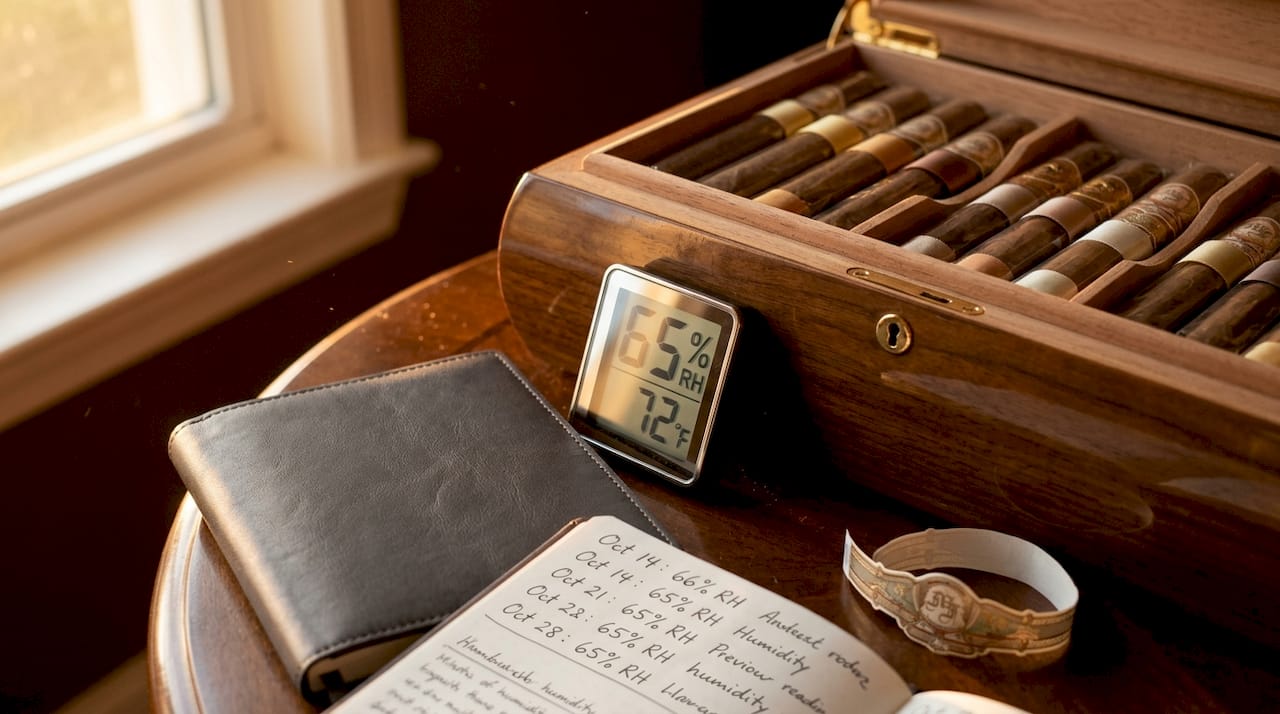
Pro Tip: Before placing any hygrometer inside your humidor, perform a salt calibration test to verify its accuracy. A properly calibrated sensor is the difference between confidence and guesswork.
Other essentials include:
- Seasoning packets or distilled water: For conditioning the humidor interior before first use.
- A tight-fitting seal: Arguably the single most critical feature of any humidor. No humidification device compensates for a poorly sealed lid or cabinet door.
- Distilled water only: Tap water introduces minerals that degrade humidification elements and can introduce contaminants to your tobacco.
You may also find value in exploring smoke shop accessories that support your overall storage and enjoyment experience.
Step-by-step: How to set, control, and monitor humidor humidity
You’ve got the essentials. Now follow these steps to bring every element together for dependable, lasting humidity control.
-
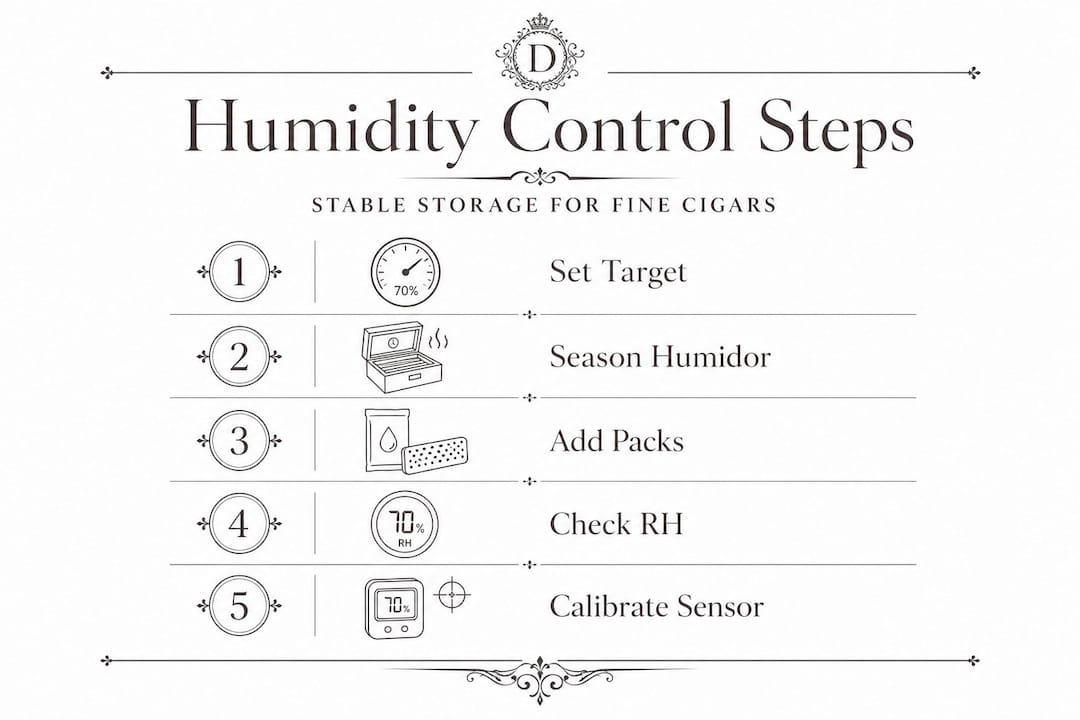
Season your humidor. Before placing a single cigar inside, introduce moisture to the Spanish Cedar interior gradually. Use a seasoning kit or a small container of distilled water placed inside the closed, empty humidor for 24 to 48 hours. Repeat this process until the wood stabilizes near your target RH. Skipping this step means the dry cedar will pull moisture away from your cigars for weeks.
-
Calibrate your hygrometer. Perform the salt test: seal your hygrometer in a ziplock bag alongside a small cup containing a saturated salt solution (table salt moistened with distilled water, not soaking). After 6 to 8 hours, the hygrometer should read precisely 75% RH. Note any deviation and adjust your readings accordingly, or use a digital unit with a manual offset function.
-
Select and install your humidification device. Match the device to your humidor’s internal volume. A single 60-gram 2-way pack suits a humidor holding up to roughly 50 cigars. Larger humidors require multiple packs or an electronic unit. Place the device away from direct contact with cigars to prevent moisture spots.
-
Monitor daily for the first week. After loading your cigars and closing the humidor, check readings every 24 hours for the first seven days. New humidors often fluctuate as the wood acclimates. Document your readings to spot trends rather than reacting to single data points.
-
Transition to weekly monitoring. Once your humidor has stabilized, weekly checks are sufficient for most collections. A 2-way humidification system both adds moisture when the environment drops below target and absorbs excess humidity when it rises above, dramatically reducing the risk of overshoots that invite mold.
-
Adjust for electronic humidors. If you’re running an electronic unit, set your target to 68% RH and allow the system to regulate automatically. Review logs or alerts weekly, and inspect the water reservoir monthly.
For advanced humidity strategies tailored to larger collections, and to understand how humidor size affects preservation as your collection grows, we encourage you to explore these resources before making significant storage decisions.
Statistic to know: Tobacco beetle eggs can hatch at temperatures above 72°F combined with humidity above 72% RH. Controlling both variables together is essential for collections that include aged or vintage sticks.
Pro Tip: Never open your humidor more than once daily during the seasoning and stabilization phase. Every opening introduces outside air, forcing the system to compensate and creating unnecessary fluctuations.
Verification and calibration: Getting accurate readings
Once your system is running, keep it dependable with regular calibration and verification routines.
Even the finest hygrometer drifts over time. Sensors age, components shift, and readings that once matched reality become unreliable without anyone noticing. The consequences are serious: you believe your collection sits comfortably at 68% when it is actually hovering at 74%, quietly approaching mold territory.
Follow these steps to maintain reliable readings:
- Recalibrate analog hygrometers every two months. Analog hygrometers drift and require recalibration on a bimonthly schedule to remain trustworthy.
- Check digital hygrometers annually. Digital units are more stable but still benefit from an annual salt test comparison.
- Use the salt test as your baseline. The saturated sodium chloride solution consistently produces 75% RH at room temperature, making it the gold standard for verification.
- Position your hygrometer correctly. Place it in the center of your humidor, not near the humidification device or the walls, to capture a true ambient reading.
- Re-verify after any disruption. Power outages, humidor moves, or changes in humidification devices can shift readings. Always recalibrate after these events.
“Calibrate your hygrometer using a salt test, then place it correctly inside the closed humidor for reliable readings.” — How to Calibrate Your Hygrometer, CigarWorld
Sensor placement deserves particular attention. A hygrometer sitting directly above a humidity pack will read higher than the true ambient level of the humidor. Position matters as much as calibration. Visit our humidor care resources for detailed placement diagrams and product-specific guidance.
Common mistakes and troubleshooting tips
Even with good systems in place, avoid these preventable errors for true peace of mind.
The most expensive mistakes in cigar storage are rarely the dramatic ones. They are the quiet, overlooked habits that slowly degrade a collection over months, often undetected until significant damage is done.
Most common errors collectors make:
- Skipping humidor seasoning. This single step is bypassed by a surprising number of collectors, particularly those new to premium humidors. Unseasoned cedar acts like a sponge, pulling moisture from your cigars rather than maintaining a stable environment around them.
- Ignoring hygrometer recalibration. Using an uncalibrated sensor gives you the false comfort of precise numbers with the actual reliability of a guess.
- Using the wrong amount of humidification. Overfilling with too many humidity packs drives RH above 75%. Too few packs in a large humidor leave sections dry and unprotected. Match the device to the volume.
- Trusting a poorly placed sensor. A hygrometer pressed against the humidor wall or resting on top of a humidity source will misrepresent actual conditions inside.
- Obsessively airing out the humidor. Opening the lid repeatedly to “air out” slightly elevated humidity introduces fresh dry air, causing oscillating RH that is far more harmful than a brief, stable reading at 74%.
As the principle stabilizing the microclimate correctly captures, cigar storage is less about adding moisture and more about controlling swings. The collector who masters patience and restraint protects their cigars more effectively than one who intervenes constantly.
Pro Tip: If you notice RH climbing above 74% consistently, remove one humidity pack rather than opening the humidor repeatedly. Let the system recalibrate over 48 hours before evaluating again.
Explore our dedicated content on humidity control mistakes for a full breakdown of advanced troubleshooting scenarios.
Expert perspective: Why stability matters more than the number
Here is the insight that separates experienced collectors from those perpetually chasing a “perfect” reading: the specific number matters far less than the consistency with which you hold it.
We have seen collectors with impeccable 68% readings lose cigars to mold because that number swung by 12 points every few days. We have also seen collections maintained beautifully at a steady 66%, well below what some consider ideal, because the environment never wavered. The tobacco had time to acclimate, the wrapper stayed supple, and the cigars smoked exactly as intended.
The truth is that your humidor is a living system, not a static box. Temperature changes outside, seasonal shifts in ambient air, the frequency with which you open the humidor, even the number of cigars inside all influence what happens to RH. The seasoned collector learns to read these dynamics and respond with measured adjustments rather than reactive interventions.
As the core principle affirms, controlling humidity for a cigar collection is about controlling swings, not simply adding moisture. This perspective reframes the entire practice. Your goal is not to hit 70.0% and hold it there mechanically. Your goal is to build an environment so stable and well-maintained that the cigars inside are never stressed by their surroundings.
The tools matter, certainly. But the discipline of the collector, the consistency of weekly checks, the patience during seasoning, the restraint to avoid unnecessary interventions, that discipline is what produces a collection that ages with grace and distinction. The finest humidor in the world underperforms in careless hands. A modest, well-maintained sanctuary outperforms expectations every time.
Explore real-world humidity lessons from collectors who have navigated these challenges across diverse climates and collection sizes.
Enhance your collection with premium humidors
The steps outlined in this guide are only as effective as the humidor housing your collection. A precision storage environment begins with a vessel worthy of what it protects.

At Dunn Luxury Selections, we offer an expertly curated range of storage solutions designed for collectors who refuse to compromise. Our cabinet humidors deliver zonal climate control and the architectural elegance that transforms a storage piece into a statement. For everyday access and refined display, our desktop humidors combine Spanish Cedar craftsmanship with airtight seals that make humidity management straightforward and reliable. When precision and automation define your standard, our electronic humidors integrate intelligent humidification systems that maintain your ideal environment without constant manual oversight. Every piece we offer is built around the collector’s most fundamental need: a sanctuary that truly preserves.
Frequently asked questions
What is the ideal humidity range for storing cigars long-term?
Store cigars at 65–70% RH for best long-term quality and flavor preservation, prioritizing stability over hitting a precise number.
How often should I recalibrate my humidor’s hygrometer?
Analog hygrometers drift and should be recalibrated every two months; digital units benefit from an annual verification using the salt test method.
What’s the easiest way to stabilize humidity in my humidor?
Use a sealed humidor paired with a calibrated hygrometer and a 2-way humidification pack, which automatically adds or absorbs moisture to hold your target RH.
Are electronic humidifiers better than traditional packs?
Electronic humidifiers offer precise automated control ideal for large cabinets, while 2-way packs are simpler, more affordable, and highly reliable for most desktop collections.
Why do my cigars crack or grow mold even when humidity seems right?
Rapid humidity swings or a poorly calibrated, misplaced hygrometer can cause cracking and mold even when your readings appear to be within the ideal range.
Recommended
You May Also Enjoy
Cigar Locker Dimensions: Sizing Guide for Collectors and Lounges
Cigar locker dimensions explained: compartment sizes, cabinet footprints, capacity math and clearances, so you size a locker bank...
Read Article
Sealing a Walk-In Humidor: Envelope, Door and Penetrations
How to seal a walk-in humidor properly: vapor barrier placement, door gasket, penetrations and the controlled airflow a...
Read Article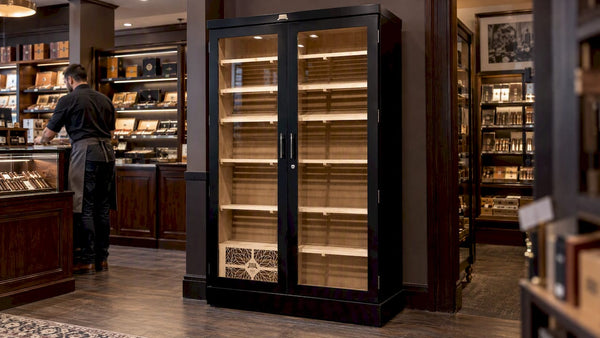
Retail Humidor ROI: How to Measure What a Display Earns
What does a retail or lounge humidor really return? A practical framework for cigar shops, lounges and clubs:...
Read Article