

Discover the crucial role of shelving in cigar humidors. Learn how the right materials and arrangement preserve your cigars' quality and flavor.
Shelving in cigar humidors is defined as the structural and functional system that governs airflow, humidity distribution, and cigar organization within a controlled storage environment. The role of shelving in cigar humidors extends far beyond simple storage. The right shelving material, arrangement, and maintenance protocol determines whether your cigars age with grace or deteriorate from uneven moisture exposure. Spanish cedar, the industry’s preferred shelf material, actively regulates relative humidity while simultaneously repelling tobacco beetles and imparting the subtle aromatic character that aficionados prize. Whether you collect a dozen sticks or several hundred, your shelving architecture is the very heart of your humidor’s performance.
How shelving materials affect humidity control and cigar preservation
The material your shelves are made from is not a cosmetic decision. It is a climate decision. Spanish cedar shelves carry humidity-regulating properties that actively help maintain optimal cigar preservation conditions, functioning as a secondary buffer alongside your humidification device. This hygroscopic quality means the wood absorbs excess moisture when humidity spikes and releases it when levels drop, creating a self-correcting microclimate inside your humidor.
Beyond moisture regulation, Spanish cedar resists tobacco beetle infestation, regulates humidity, and enhances the flavor profile of aging cigars. No other commercially available shelf material delivers that combination of functional and sensory benefits. Mahogany and walnut are sometimes used for exterior cabinetry, but neither matches Spanish cedar’s hygroscopic performance for interior shelving.
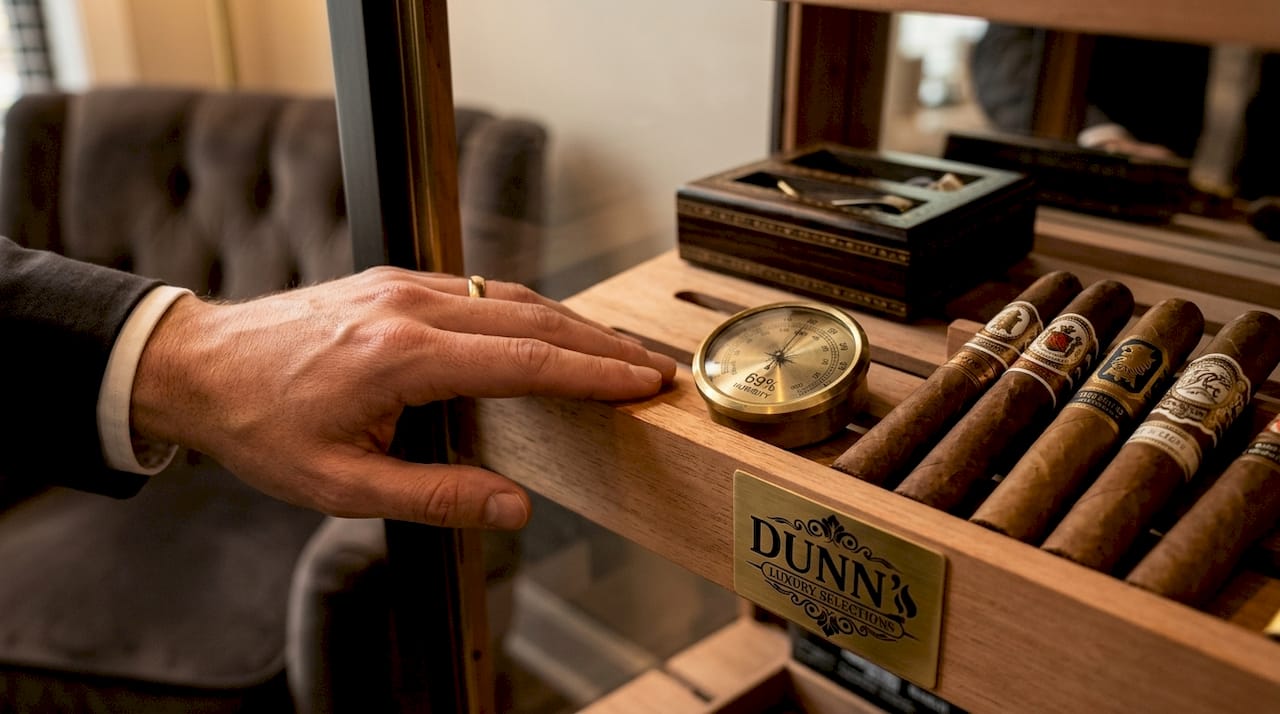
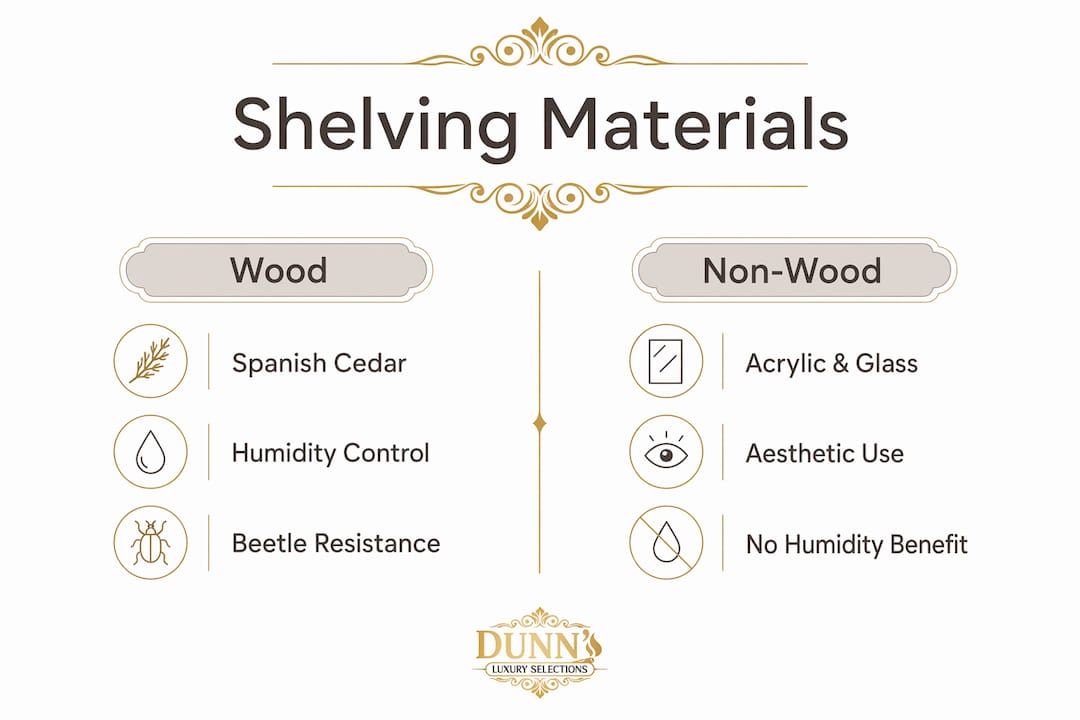
The table below compares the most common shelving materials used in premium humidors:
| Material | Humidity regulation | Beetle resistance | Aroma contribution | Best use |
|---|---|---|---|---|
| Spanish cedar | Excellent | Yes | Positive, classic | Interior shelves and linings |
| Mahogany | Moderate | No | Neutral | Exterior cabinetry |
| Walnut | Low | No | Neutral to slight | Decorative trays |
| Acrylic/glass | None | N/A | None | Display-only compartments |
Acrylic and glass shelves appear in some modern humidor designs for aesthetic reasons, but they contribute nothing to humidity balance. If you use non-wood shelving in any compartment, you must compensate with a more active humidification system to maintain stable conditions.
Pro Tip: Season your Spanish cedar shelves before first use by wiping them with a lightly dampened cloth and allowing them to acclimate for 24 to 48 hours inside the closed humidor. This primes the wood’s hygroscopic properties and prevents it from aggressively pulling moisture from your cigars during the initial loading period.
What causes shelf warping in humidors and how to prevent it
Shelf warping is the most common structural failure inside a humidor, and it is almost always caused by uneven moisture exposure. Repeated humidity cycles cause swelling, shrinking, and permanent dimensional changes in wooden shelves, including warping and cupping. The mechanism is straightforward: when one face of a shelf absorbs moisture faster than the other, the wetter side expands while the drier side remains stable, bowing the board into a concave or convex shape.
The most common causes of uneven moisture exposure in a humidor include:
- Placing cigars directly above the humidification device, which concentrates moisture on the underside of the shelf above it
- Leaving one shelf surface unfinished, allowing that face to absorb and release moisture at a different rate than the finished face
- Rapid humidity swings caused by frequently opening the humidor or using an undersized humidifier
- Poor ventilation that creates moisture pockets in specific zones of the cabinet
“Despite stable hygrometer readings, shelf microclimates can cause wood stress leading to warping over time.” This insight from conservation research confirms that a single hygrometer reading does not capture the full picture of what is happening at the shelf level inside a large cabinet humidor.
Maintaining indoor relative humidity between 35% and 55% reduces dimensional changes in wooden shelves and prolongs their functional life. For cigar storage, the optimal target is typically 65% to 72% relative humidity, which sits above that general woodworking range. This makes proper shelf finishing even more critical in a humidor context than in a standard storage environment.
Applying film-forming finishes on all shelf surfaces helps maintain stability by balancing moisture absorption rates across both faces of the board. Many collectors finish only the visible top surface of a shelf and leave the underside raw, which is precisely the condition that invites cupping. Finish every surface, including edges, to create a balanced moisture barrier.
Pro Tip: Rotate your cigars and shelves every three to four months. This practice redistributes any minor moisture gradients that develop over time and gives you a natural opportunity to inspect shelf condition before warping becomes permanent.
How to organize cigar humidors using shelves effectively
Organization inside a humidor is not simply about aesthetics. Strategic shelf arrangement directly affects humidity consistency and cigar quality. Avoid placing cigars directly above humidifiers and maintain balanced airflow to prevent shelf cupping and uneven humidity distribution across your collection.
A well-organized humidor follows a logical hierarchy that serves both preservation and accessibility. Use the following sequence when arranging your shelves:
- Designate zones by strength. Place mild and Connecticut-wrapped cigars on upper shelves where humidity tends to be slightly lower, and reserve lower shelves for fuller-bodied Nicaraguan or Honduran blends that benefit from marginally higher moisture levels.
- Separate by aging status. Cigars you are actively aging should occupy dedicated shelves or trays, clearly labeled with the date of acquisition. Mixing aged and fresh cigars on the same shelf creates cross-contamination of aromas and makes inventory tracking unreliable.
- Use dividers for brand or origin grouping. Cedar dividers allow you to create distinct columns within a single shelf tier, separating Cuban vitolas from Dominican or Honduran production without requiring additional shelf space.
- Reserve the lowest shelf for your humidification device or a buffer tray. This keeps direct moisture output away from your primary cigar storage and allows humidity to rise and distribute naturally before reaching the cigars above.
- Label every section. A simple cedar tag or archival label on each shelf zone transforms your humidor from a storage box into a curated collection. You will find specific sticks faster, and you will never accidentally age a cigar you intended to smoke fresh.
Using stackable trays and multi-level shelves enables efficient space use and organized cigar categorization, particularly in cabinet humidors holding several hundred cigars. For collectors who use humidor trays as a primary organizational tool, the principle is the same: each tray should represent a single category, and trays should never be stacked so tightly that airflow between layers is restricted.
How to select the best shelves for your cigar humidor
Choosing shelves for your humidor requires evaluating four criteria: wood species, thickness, finish type, and adjustability. Each factor influences both the functional performance and the long-term durability of your storage system.
The characteristics that define a superior humidor shelf are:
- Wood species stability. Spanish cedar remains the gold standard, but quarter-sawn cuts of any hygroscopic wood species warp less than flat-sawn cuts because the grain orientation resists moisture-driven movement more effectively.
- Shelf thickness. Shelves thinner than 12mm flex under the weight of a full cigar load, creating contact pressure that can damage wrappers. A minimum of 15mm to 18mm thickness provides the structural integrity needed for a fully loaded shelf in a cabinet humidor.
- Surface finish. A thin lacquer or shellac coat on all surfaces slows moisture exchange without eliminating the hygroscopic benefit of the wood entirely. Avoid polyurethane, which seals the wood so completely that it loses its humidity-regulating function.
- Adjustability. Customizable shelving solutions help collectors adapt storage to cigar sizes and quantities as their collection evolves. Fixed shelves are a liability when you acquire a box of 60-ring-gauge cigars that will not fit the existing configuration.
The table below summarizes shelf selection criteria by humidor type:
| Humidor type | Recommended shelf material | Minimum thickness | Finish type | Adjustability priority |
|---|---|---|---|---|
| Desktop humidor | Spanish cedar | 12mm | Light shellac | Low |
| Cabinet humidor | Spanish cedar (quarter-sawn) | 18mm | Thin lacquer | High |
| Electronic humidor | Spanish cedar or cedar-lined composite | 15mm | Light shellac | Medium |
| Travel humidor | Cedar-lined tray | N/A | Unfinished or light oil | Low |
For collectors building or upgrading a cabinet humidor, modular shelf systems that allow you to reconfigure the interior without tools are worth the premium. Your collection will change. Your shelving should be able to change with it.
Key takeaways
Shelving material, finish, and arrangement collectively determine whether a humidor functions as a precision preservation instrument or simply a decorative box.
| Point | Details |
|---|---|
| Spanish cedar is the standard | It regulates humidity, resists beetles, and enhances cigar flavor. No substitute matches its combined benefits. |
| Finish every shelf surface | Unfinished undersides absorb moisture unevenly and cause cupping. Apply a thin lacquer or shellac to all faces and edges. |
| Organize by zone, not by chance | Separate cigars by strength, origin, and aging status to protect quality and simplify inventory management. |
| Avoid direct humidifier exposure | Never place cigars directly above the humidification device. Allow humidity to distribute naturally before it reaches your collection. |
| Adjustable shelves protect your investment | Modular configurations accommodate changing cigar sizes and quantities without compromising airflow or organization. |
What I have learned after years of watching collectors get shelving wrong
Most collectors spend considerable time selecting their humidor’s exterior and almost no time thinking about what goes inside it. I have seen beautiful cabinet humidors with warped shelves, cracked wrappers, and cigars that smell faintly of mildew because the owner never considered how moisture moves through the interior architecture.
The single most overlooked detail is shelf microclimate management. A hygrometer mounted on the door of a large cabinet humidor tells you the average humidity of the space. It does not tell you that the bottom shelf near the humidifier is running at 74% while the top shelf is sitting at 67%. Those seven percentage points represent the difference between a perfectly conditioned Cohiba Behike and a cigar with a cracked foot.
My practical advice: place a secondary digital hygrometer on your lowest shelf and another on your highest shelf. If the readings diverge by more than three to four percentage points, your airflow is unbalanced. Adjust your humidifier placement, add a small USB-powered fan to circulate air, or reconfigure your shelf layout to open up the interior. The humidity control methods that actually work long-term are the ones that address the full three-dimensional environment of the humidor, not just the average reading on a single device.
I also counsel collectors to resist the temptation of overfilling their shelves. A humidor packed to capacity restricts airflow between cigars and between shelf levels. Leave at least 20% of your shelf space open at all times. Your cigars will age more evenly, and your shelves will last longer.
— Belle
Discover precision shelving at Dunnluxuryselections
At Dunnluxuryselections, every humidor in our collection is built around the principle that shelving is not an afterthought. It is the foundation of preservation.

Our cabinet humidors feature Spanish cedar-lined interiors with adjustable, quarter-sawn shelves designed to maintain zonal climate control across every tier of your collection. Our desktop humidors deliver the same material precision in a form suited for the desk, the study, or the lounge. Each piece is crafted for collectors who understand that the sanctuary you build for your cigars reflects the standard you hold for the cigars themselves. Browse the Dunnluxuryselections collection and find the shelving architecture your collection deserves.
FAQ
What is the best wood for cigar humidor shelves?
Spanish cedar is the best wood for cigar humidor shelves. It regulates humidity, resists tobacco beetles, and contributes a subtle aromatic quality that complements the aging process of premium cigars.
Why do humidor shelves warp?
Humidor shelves warp because one surface absorbs moisture faster than the other, causing uneven expansion. Finishing all shelf surfaces with a thin lacquer or shellac and maintaining stable humidity levels between 65% and 72% prevents most warping.
How should I organize cigars on humidor shelves?
Organize cigars by strength, origin, and aging status on separate shelf zones or trays. Keep cigars away from direct humidifier exposure and use cedar dividers and labels to maintain clear categories within each shelf tier.
How many shelves does a cigar humidor need?
The number of shelves depends on collection size and cigar format. A cabinet humidor holding 500 or more cigars benefits from at least four to six adjustable shelf tiers to allow proper airflow and organized categorization by blend or vitola.
Can I use non-wood shelves in a cigar humidor?
Non-wood shelves like acrylic or glass contribute nothing to humidity regulation and should be avoided as primary storage surfaces. If used for display purposes, compensate with a more active humidification system to maintain stable conditions throughout the cabinet.
Recommended
You May Also Enjoy
Cigar Locker Dimensions: Sizing Guide for Collectors and Lounges
Cigar locker dimensions explained: compartment sizes, cabinet footprints, capacity math and clearances, so you size a locker bank...
Read Article
Sealing a Walk-In Humidor: Envelope, Door and Penetrations
How to seal a walk-in humidor properly: vapor barrier placement, door gasket, penetrations and the controlled airflow a...
Read Article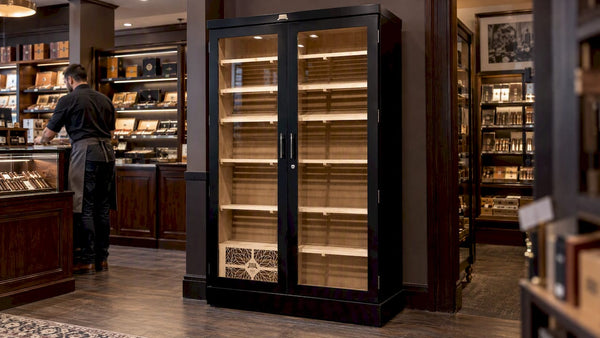
Retail Humidor ROI: How to Measure What a Display Earns
What does a retail or lounge humidor really return? A practical framework for cigar shops, lounges and clubs:...
Read Article