

Learn how to upgrade your humidor and protect your cigar collection. This comprehensive guide ensures optimal humidity and preservation!
Your humidor is the sanctuary your cigars call home, and when that sanctuary falters, every stick inside pays the price. Knowing how to upgrade your humidor is one of the most valuable skills a serious collector can develop, because inconsistent humidity, failing seals, and outdated humidification are quiet destroyers of great tobacco. This guide walks you through every stage of the process: assessing what you have, gathering what you need, executing the upgrade with precision, and verifying that your collection remains in peak condition for years to come.
Table of Contents
- Understanding your current humidor setup and identifying upgrade needs
- Preparing your humidor upgrade: tools, materials, and prerequisites
- Step-by-step guide to upgrading your humidor’s humidity control and seal
- Verifying and maintaining your upgraded humidor for optimal cigar preservation
- Why upgrading your humidor is more than just adding humidifiers
- Explore premium humidor collections for your upgraded cigar storage
- Frequently asked questions
Key Takeaways
| Point | Details |
|---|---|
| Check seal integrity | A tight seal is essential to maintain humidity and prevent cigar drying or mold growth. |
| Use proper humidification | Doubling Boveda packs or upgrading to electronic systems stabilizes humidity especially in larger humidors. |
| Maintain 50-75% fill | Keeping your humidor partially filled ensures optimal airflow and consistent humidity distribution. |
| Regular maintenance | Monitoring hygrometer readings weekly and rotating cigars monthly prevents uneven aging and quality loss. |
| Holistic approach | Upgrading your humidor also means addressing placement, seal, airflow, and maintenance—not just adding humidifiers. |
Understanding your current humidor setup and identifying upgrade needs
Before you can improve any instrument, you need to understand where it is failing you. The most telling signs of a humidor in distress are easy to spot once you know what to look for.
Signs your humidor needs an upgrade:
- Cigars feel dry or brittle to the touch, even when your hygrometer reads within range
- A musty odor lingers inside the box, suggesting mold or residue buildup
- Relative humidity (RH) readings swing more than five points in either direction during a single week
- The lid does not close with a satisfying, airtight resistance
- Your hygrometer has never been calibrated and may be reading several points off actual RH
The paper test is the fastest way to evaluate seal integrity. Slip a clean, thin piece of paper between the lid and the body of the humidor, then close the lid. If the paper slides out with minimal resistance, your seal is compromised. A healthy seal should grip the paper firmly.
Evaluating your humidification system is equally important. Foam-based humidifiers are notoriously imprecise, prone to mold, and require frequent maintenance. If your humidor still relies on a foam unit, that is almost certainly the first component worth replacing. Boveda packs and electronic humidifiers each serve different needs, and understanding your humidor’s size matters enormously here. Research on humidor size impact consistently shows that undersized humidification for a given volume creates chronic low-humidity conditions that no amount of tweaking will fully resolve.
Also assess how full your humidor is. The ideal fill sits between 50% and 75% of total capacity. An overfilled humidor restricts airflow; an underfilled one forces your humidification system to work overtime to condition excess airspace.
Pro Tip: If you suspect a leaky seal, more Boveda packs can serve as a compensating measure while you plan a more permanent seal repair. It buys your cigars time without exposing them to fluctuation.
Preparing your humidor upgrade: tools, materials, and prerequisites
Preparation is where most collectors cut corners, and it shows in the results. A proper upgrade demands the right materials assembled before a single cigar leaves the box.
Essential tools and materials:
- Calibrated digital hygrometer with a calibration kit (salt test or Boveda calibration pack)
- Distilled water only, never tap, which carries minerals that disrupt the cedar’s natural properties
- Clean, lint-free cloths for interior wiping
- Fine-grit sanding materials for addressing rough cedar patches
- Food-grade mineral oil for conditioning lid seals
- Replacement humidification devices: electronic units, gel jars, or two-way humidity packs
- Propylene glycol solution, if your existing foam humidifier requires it
| Material | Purpose | Estimated cost |
|---|---|---|
| Digital hygrometer | Accurate RH monitoring | $20–$60 |
| Boveda calibration pack | Hygrometer accuracy check | $5–$10 |
| Distilled water | Safe seasoning and refilling | $1–$3/gallon |
| Mineral oil | Seal conditioning | $5–$10 |
| Boveda 65% or 69% packs | Two-way humidity control | $10–$30 |
| Electronic humidifier | Active moisture distribution | $50–$200+ |
Prerequisites before any physical upgrade begins:
- Remove all cigars and store them temporarily in a Ziploc bag with a Boveda pack
- Extract all trays, dividers, and accessories
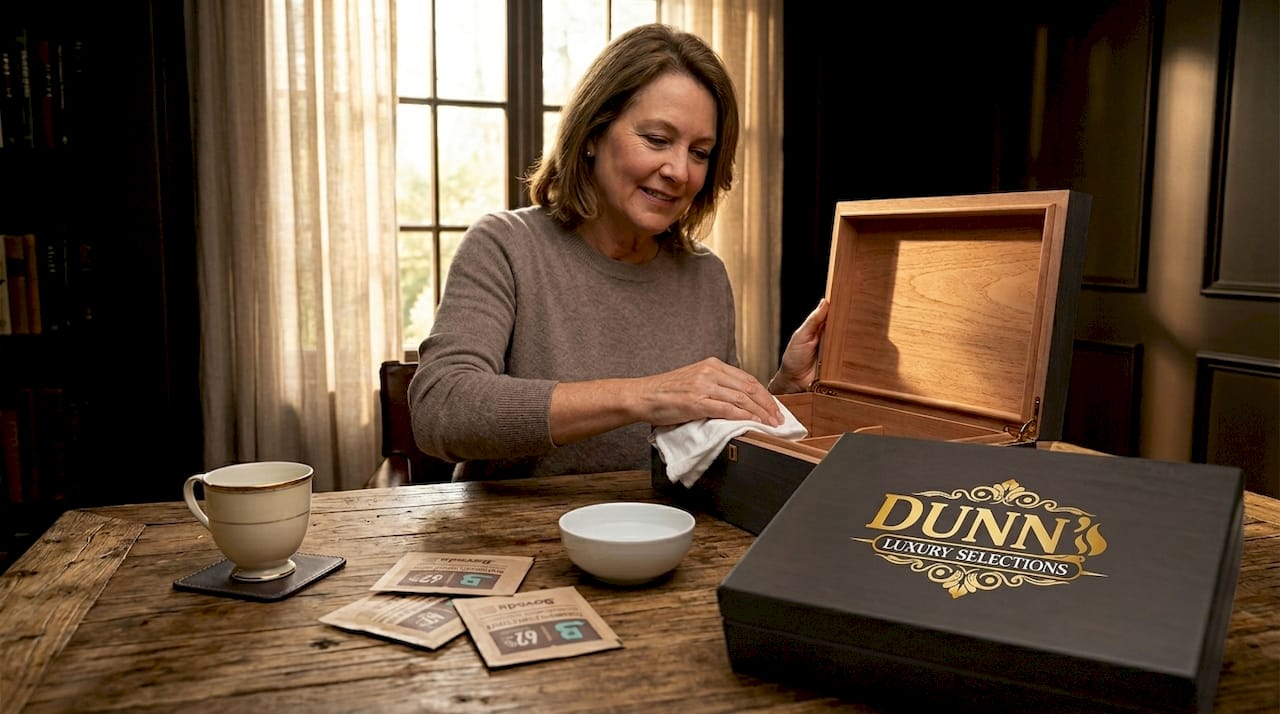
- Wipe the interior thoroughly with a clean cloth lightly dampened with distilled water
Seasoning your humidor’s Spanish Cedar lining is not optional if the wood has dried out. Seasoning the interior by slowly introducing moisture to the cedar prevents the wood from drawing humidity away from your cigars once they return. The cedar should be wiped down and left closed for 24 to 48 hours before you reintroduce any tobacco.
For detailed humidor care guides covering seasoning schedules and material recommendations, we have compiled resources specifically for collectors who want the full picture before starting.
Step-by-step guide to upgrading your humidor’s humidity control and seal
This is the core of the process. Work through each step deliberately, and resist the temptation to rush past the verification stages.
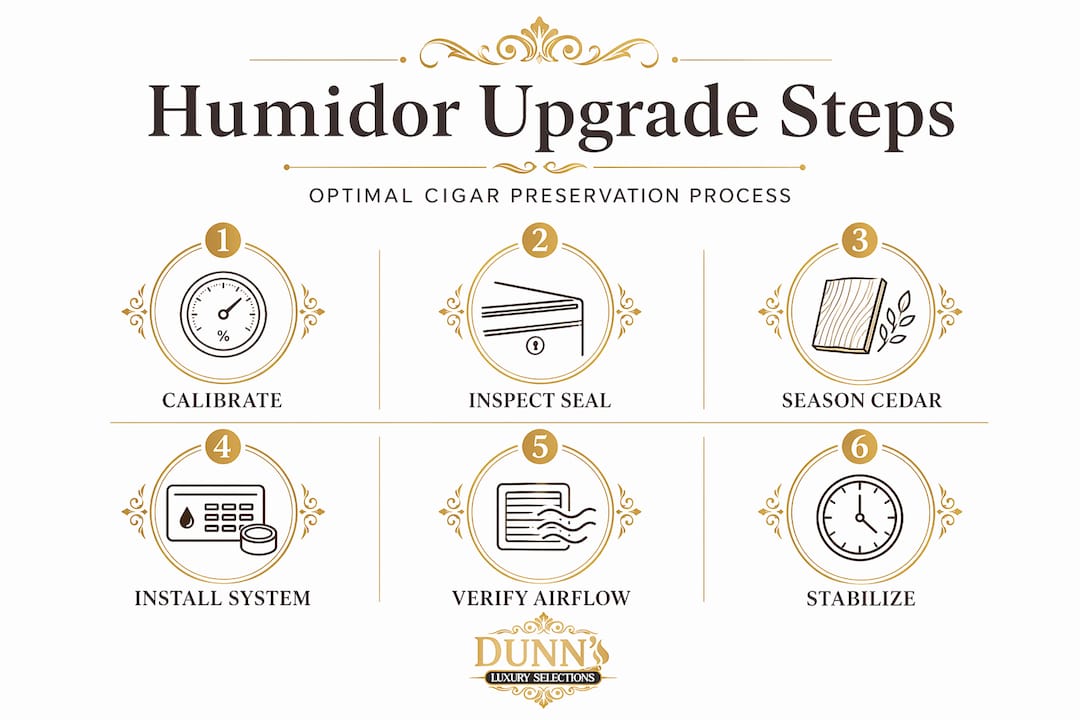
1. Calibrate your hygrometer first. Before anything else, run a salt test or use a Boveda calibration pack. A hygrometer reading five points high means you could be running your humidor at 63% RH while believing it sits at 68%. That margin matters enormously over months of aging.
2. Inspect and condition the seal. Close the lid and examine the gasket or felt lining along the perimeter. If the felt has compressed unevenly or the gasket has cracked, replace it. For minor compression, apply a light coat of food-grade mineral oil to restore pliability and improve the airtight connection.
3. Season the cedar if needed. Wipe the interior surfaces with a cloth dampened in distilled water. Leave a small dish of distilled water inside and close the humidor for 24 hours. Repeat once more before reinstalling your humidification devices.
4. Install your upgraded humidification system. Placement matters as much as equipment choice. Mount or position your humidifier near the back and slightly elevated so moisture disperses downward and outward across the full interior space.
5. Verify airflow and spacing. Ensure that no cigars or trays will block the humidifier’s output once the box is filled. In cabinet or large lounge humidors, fans that circulate interior air prevent humidity pockets from forming in corners.
6. Allow stabilization before reintroducing cigars. Close the humidor with only the humidification device inside and monitor readings for 12 to 24 hours. You want to see the RH settle consistently in the 65% to 72% range before any tobacco returns.
| Humidification type | Best for | Maintenance frequency | Cost range |
|---|---|---|---|
| Foam humidifier | Very small humidors | Weekly to biweekly | $5–$20 |
| Boveda two-way packs | Desktop and travel humidors | Every 2–3 months | $10–$30 |
| Gel-based jar humidifier | Small to mid-size humidors | Monthly | $15–$40 |
| Electronic humidifier | Cabinet and lounge humidors | Quarterly with daily auto-sensing | $50–$300 |
For those curating a serious collection in a large cabinet, electronic humidification systems with internal fans represent the most reliable upgrade available. Experts recommend doubling humidification packs or moving to active electronic systems for larger humidors to maintain ideal humidity across the full interior. You can also review a range of humidity control methods to find the right solution for your specific setup.
Pro Tip: In dry winter months, add one additional Boveda pack per 25 cigars your humidor can hold. Seasonal dry air demands more from your humidification system, and this simple adjustment prevents the need for emergency re-seasoning.
Verifying and maintaining your upgraded humidor for optimal cigar preservation
An upgrade executed well is only as valuable as the maintenance that follows it. This is where long-term cigar quality is truly decided.
Weekly and monthly maintenance habits:
- Log hygrometer and thermometer readings every week. Target 65% to 72% RH and 65°F to 70°F. Deviations beyond five points in either metric warrant investigation.
- Rotate your cigars monthly to prevent micro-climates from forming. Cigars at the top and front of a humidor experience slightly different conditions than those at the back and bottom.
- Replenish Boveda packs or refill electronic reservoirs the moment you notice any hardening or drying. Do not wait until readings drop.
- Practice lid discipline: open your humidor only when necessary and close it promptly. Each extended opening releases conditioned air and forces your humidification system to recover.
Quarterly maintenance:
- Wipe interior surfaces with a clean, distilled-water-dampened cloth to remove tobacco residue and dust.
- Inspect the seal. Reapply mineral oil if the gasket shows any stiffening.
- Check your Spanish Cedar lining for any whitish bloom, which signals early mold. A light wipe with a 50% isopropyl alcohol solution resolves surface mold before it penetrates the wood.
For monitoring cigar freshness over the long term, maintaining a simple log of your readings is one of the highest-value habits a collector can build.
“Stable humidity is not a convenience—it is the difference between a cigar that honors the blender’s craft and one that disappoints on the first draw. Every degree of fluctuation is a tax on the quality you paid for.”
Pro Tip: Place a baking soda sachet in a corner of the humidor if musty odors develop. It absorbs off-aromas without affecting relative humidity or cedar character.
Why upgrading your humidor is more than just adding humidifiers
Here is the perspective we rarely see shared openly, even among experienced collectors: most humidor problems are not equipment problems. They are habit problems.
We have spoken with collectors who installed the finest electronic humidification systems available, only to continue struggling with inconsistent readings. The culprit was never the device. It was a humidor placed on top of a refrigerator (heat and vibration), a collection filled to 90% capacity (no airflow), and a lid opened multiple times a day (constant humidity loss).
The equipment upgrade is a multiplier. It multiplies the quality of the environment you give it to work in. Addressing humidor size relative to your collection, maintaining the 50% to 75% fill threshold, and placing your humidor away from windows, vents, and temperature extremes will deliver more measurable improvement than any single hardware change.
We also believe strongly in the case for separating your collection into two distinct environments: one humidor for active, everyday smoking and one dedicated to long-term aging. The aging humidor can be set slightly lower, around 65% RH, to encourage slow, controlled development, while your everyday box runs at 68% to 70% for cigars ready to smoke. This is a practice common among master collectors but rarely discussed in introductory guides.
Modern electronic humidifiers are genuinely excellent instruments. But they do not replace the human factor: logging, rotating, and developing the discipline of minimal lid openings. The collectors whose cigars consistently outperform expectations are not those with the most expensive equipment. They are the ones who treat maintenance as a ritual rather than a task.
Explore premium humidor collections for your upgraded cigar storage
If this guide has revealed that your current humidor has reached the limit of what upgrades can accomplish, it may be time to consider a purpose-built sanctuary for your collection.

At Dunn Luxury Selections, we have curated a portfolio of luxury humidors designed specifically for collectors who refuse to compromise on preservation. Our cabinet humidors are engineered for large collections, featuring premium Spanish Cedar interiors and full compatibility with advanced electronic humidification. For the aficionado who travels without leaving quality behind, our travel humidors deliver reliable humidity control in an elegant, portable form. And for those ready to invest in a fully autonomous environment, our electronic humidors combine precision moisture sensors with internal fan circulation for effortless, consistent climate control. Every piece reflects the craftsmanship and prestige your collection deserves.
Frequently asked questions
How often should I re-season my humidor after upgrading?
Re-season your humidor annually as standard practice, or sooner if you notice consistent humidity drops. As a pointed reminder: re-season when needed, especially in dry climates or after periods of heavy use, to keep the Spanish Cedar healthy and effective.
What is the ideal humidity level to maintain in an upgraded humidor?
Target a stable relative humidity between 65% and 72% RH. Consistency within that range matters more than hitting any single number, and readings should consistently read 65-72% RH before you reintroduce cigars after a seasoning or upgrade.
Can electronic humidifiers completely replace traditional Boveda packs?
Electronic humidifiers are ideal for large collections and cabinet-scale storage, where fans ensure even moisture distribution. However, many collectors retain Boveda packs as a backup layer, and electronic systems are recommended specifically for cabinets holding hundreds of cigars where consistent airflow is essential.
How do I know if my humidor seal needs attention?
Perform the paper test: slide a thin piece of paper between the lid and the body, then close. If it pulls free with little resistance, your seal needs conditioning or replacement. The standard practice is to check seal integrity by inserting a thin piece of paper between the lid and body, then closing the lid, and noting how firmly it holds.
Recommended
You May Also Enjoy
Cigar Locker Dimensions: Sizing Guide for Collectors and Lounges
Cigar locker dimensions explained: compartment sizes, cabinet footprints, capacity math and clearances, so you size a locker bank...
Read Article
Sealing a Walk-In Humidor: Envelope, Door and Penetrations
How to seal a walk-in humidor properly: vapor barrier placement, door gasket, penetrations and the controlled airflow a...
Read Article
Retail Humidor ROI: How to Measure What a Display Earns
What does a retail or lounge humidor really return? A practical framework for cigar shops, lounges and clubs:...
Read Article